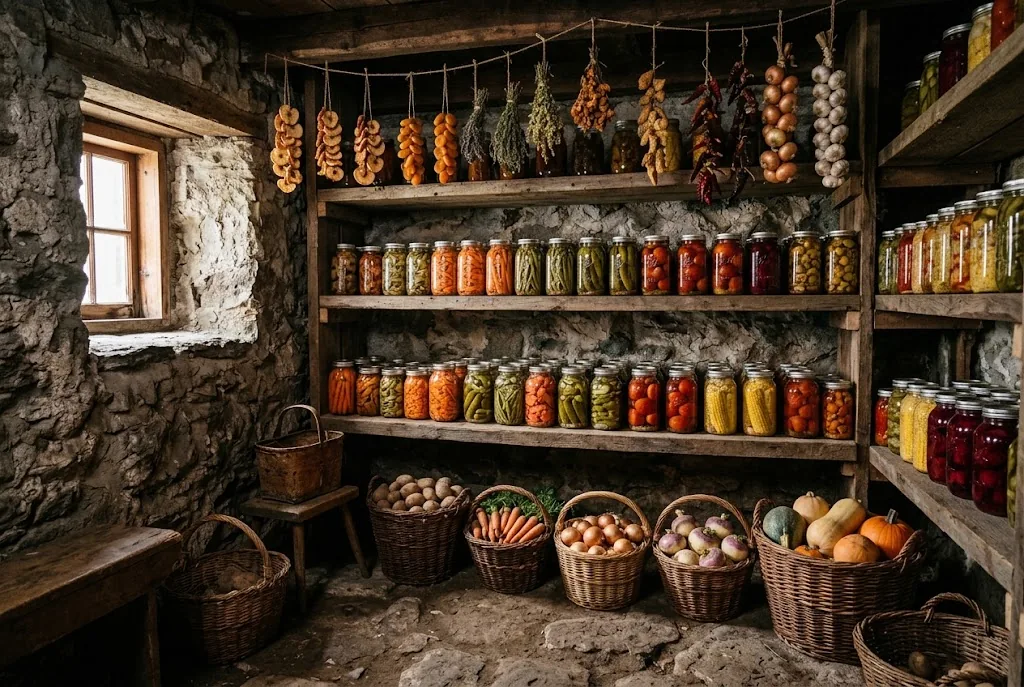
A generator is a bridge, not a plan. It runs while the fuel lasts, and then you are exactly where you would have been without it — with a fridge full of food and no way to keep it cold. Real off-grid food security does not come from a louder generator. It comes from changing the question: instead of “how do I keep this cold?” you ask “how do I store this so it does not need to be cold?”
Short answer: preserve the bulk of your food into shelf-stable form — dehydrate produce, pressure can meat and low-acid vegetables, and vacuum seal dried goods — and use passive cold storage only for what genuinely needs it. Done in that order, a household can store most of its food safely with no electricity at all.
Disclosure: the product links here are affiliate links, and the food-safety numbers below follow USDA and NCHFP guidance rather than sales-page claims. This is the workflow, step by step.
Step 1: Triage Before You Touch Anything
When the power is out for good, the clock is already running on some of your food and stopped entirely on the rest. Sort fast into three piles:
- Eat now: anything already thawing or highly perishable — eat it or cook it today.
- Preserve this week: ripe produce, meat, and vegetables that are still good but won’t last.
- Already stable: rice, beans, flour, canned goods — these can wait.
This five-minute sort tells you what to process first and stops you wasting effort on food that was never at risk.
Step 2: Dehydrate to Make Food Shelf-Stable
Drying is the oldest preservation method there is, and it is still one of the best. Remove the water and spoilage organisms have nothing to work with; properly dried foods stored cool, dry, and dark keep for roughly 4 months to a year, with vegetables lasting about half as long as fruit (NCHFP).
Slice thin and even, dry until brittle (for most vegetables) or leathery (for most fruit), and let pieces cool before storing. If you have no power at all, fruit can be dried with a screen, airflow, and sun — see our DIY solar food dehydrator build. Vegetables (except vine-dried beans) and meats are not recommended for outdoor drying because they spoil more easily (NCHFP). The method, not the machine, is what makes the food off-grid-safe.
Step 3: Pressure Can the Low-Acid Foods
Dehydrating handles produce beautifully, but it cannot preserve meat or low-acid vegetables safely. Those require canning — and specifically pressure canning.
This is the single most important safety rule in home food storage: meat and low-acid vegetables must be pressure canned, never water-bath canned. A boiling-water bath tops out at 212°F, which is not hot enough to kill the botulism spores that thrive in low-acid, oxygen-free environments. Low-acid foods should be processed at 240°F to 250°F, which only a pressure canner can reach (NCHFP), and the CDC calls pressure canning the only recommended method for low-acid foods (CDC). Follow tested processing times for your altitude and never improvise them, and on an outdoor gas burner keep the heat to 12,000 BTUs or less (Clemson Cooperative Extension). High-acid foods — jams, pickles, tomatoes with added acid — can go in a simpler water-bath pot, which also needs no electricity.
Step 4: Vacuum Seal Dried Goods for the Long Haul
Once food is dried, oxygen is its enemy. Oxygen drives the rancidity and staleness that ruin dried goods and feeds the pantry pests that get into them.
Vacuum seal your dehydrated fruit and vegetables and your dry staples — rice, beans, oats — and store them cool and dark. For very long storage, pairing vacuum sealing with mylar and oxygen absorbers extends shelf life further; see the mistakes to avoid in our long-term food storage guide.
Step 5: Passive Cold Storage for the Rest
Some food you simply want cool — root vegetables and the jars you canned. You do not need power for that; you need thermal mass and shade.
- A root cellar or the coolest corner of a basement holds roots and canned goods at a stable, cool temperature. See how to build a root cellar.
- An evaporative cooler or a container buried in shaded ground gives you short-term chilling for a few items using nothing but airflow and ground temperature.
These passive methods keep cool the foods that do not need refrigerator temperatures, without a watt of power.
Step 6: Rotate, Label, and Check
A store you cannot trust is not a store. Date every jar and sealed bag, use oldest first, and keep everything cool, dark, and dry. Check periodically for broken seals, condensation, or pests, and pull anything questionable. A jar that is bulging, leaking, or off-smelling goes in the trash without a taste test; the CDC warns that botulinum toxin cannot be seen, smelled, or tasted (CDC).
The Takeaway
Keeping food cold with a generator is a countdown; preserving it is a plan. Dehydrate the produce, pressure can the meat, vacuum seal the dried goods, and let a root cellar handle the rest — and a dead fridge stops being an emergency. The same no-power philosophy extends to the rest of an off-grid cabin, from water to sanitation — our roundup of the best composting toilets for off-grid cabins covers that side of the build. For the blackout version of this problem, when you are only trying to bridge a short outage, see our guide to keeping food cold without power.
Frequently Asked Questions
- How do you keep food off-grid without any refrigeration?
- You stop relying on cold and start relying on preservation. Dehydrating removes the water that spoilage organisms need, pressure canning seals cooked food in a sterile vacuum, and vacuum sealing keeps dried goods oxygen-free. What you still want cool goes into passive cold storage like a root cellar. Together these methods store most of a household's food safely with no power at all.
- Can I pressure can over a propane burner or wood stove?
- A propane burner can work within limits: Clemson Cooperative Extension recommends a maximum of 12,000 BTUs on an outdoor gas burner, with 10,000 BTUs optimal, because excessive heat can warp the canner. For a wood stove, check your canner's manual for approved heat sources. What matters is maintaining the required pressure for the full processing time, so use a canner with an accurate gauge and follow tested times for your altitude and food.
- Isn't a dehydrator an electric appliance? How is that off-grid?
- An electric dehydrator is the fastest option when you have any power source, including a small solar setup, but drying does not require electricity. Fruit can be dried in the sun with a screen and airflow, or in a solar food dehydrator. The National Center for Home Food Preservation does not recommend outdoor drying for vegetables (other than vine-dried beans) or meats, so dry those in a dehydrator or oven. The method is what makes food off-grid-safe, not the specific machine.
- What food should I preserve first when the power is out for good?
- Work outward from most perishable to least. Preserve meat and dairy-adjacent items and ripe produce first, since those spoil fastest, then vegetables and fruit, and leave dry staples for last because they are already stable. Triaging this way means you save the food that would otherwise be lost within hours.
Sources & references
- National Center for Home Food Preservation, Ensuring Safe Canned Foods (opens in new tab)
- CDC, Home-Canned Foods and Botulism (opens in new tab)
- National Center for Home Food Preservation, Sun Drying (opens in new tab)
- National Center for Home Food Preservation, Packaging and Storing Dried Foods (opens in new tab)
- Clemson Cooperative Extension HGIC, Pressure Canning Outdoors (opens in new tab)
Before you go
The Renter's Homestead Pack
Self-reliance projects for the yard you don't own — container yields, a raised bed built to move with you, balcony preservation basics, and the landlord questions to ask first.
Free guide
The Renter's Homestead Pack
Self-reliance projects for the yard you don't own — container yields, a raised bed built to move with you, balcony preservation basics, and the landlord questions to ask first.