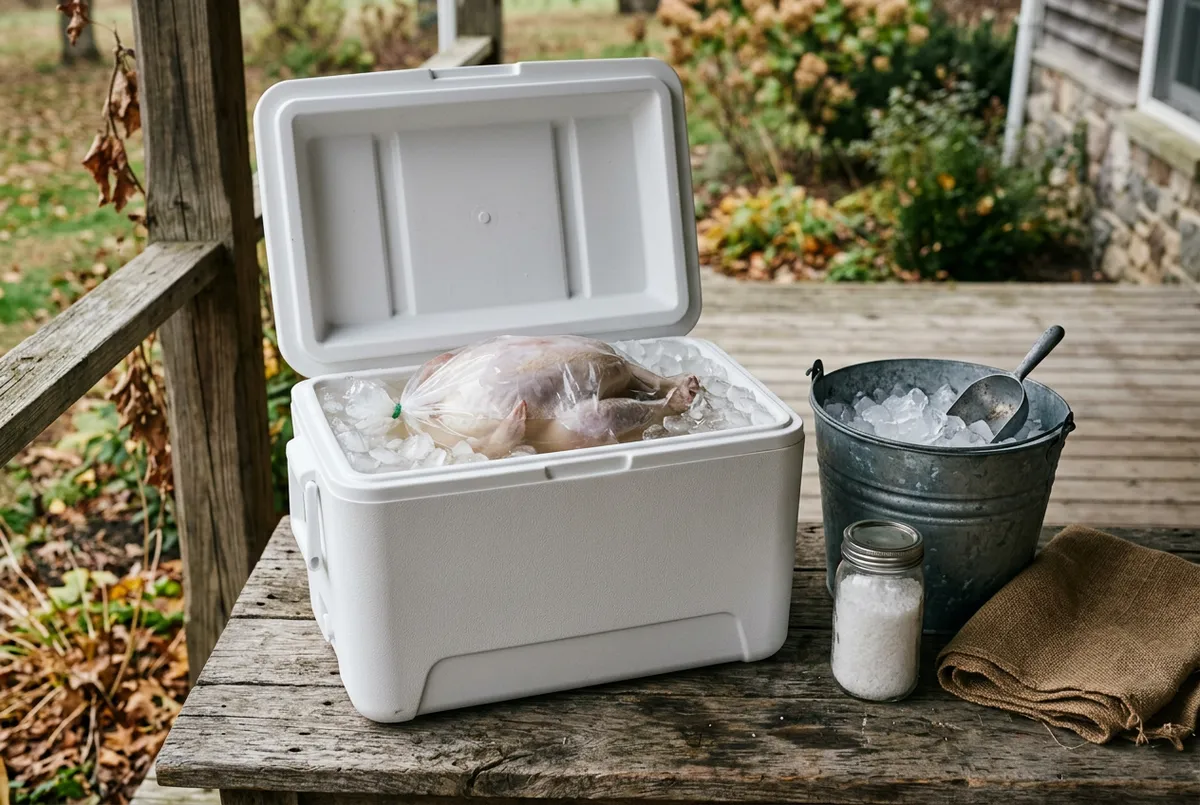
The refrigerator is full, the turkey has not gone in yet, and the brine needs hours of cold. A cooler packed with ice looks like the easy fix, and USDA’s Thanksgiving guide does name it. It attaches a condition, though: the turkey and the brine must stay cold for the whole brine, and a cooler is the harder place to prove that.
The short answer: Yes, but only if the turkey and the brine stay at 40°F or below the entire time. USDA FSIS lists a cooler with ice as a place to store a fully submerged brine (USDA FSIS, updated Nov 25, 2025), and an FSIS technician advises brining no longer than two days at 40°F or less (USDA FSIS via UW-Madison Extension, 2020 upload). No USDA source gives a tested ice amount, so measure the temperature, and use the refrigerator if you cannot hold 40°F.
Why USDA allows a cooler, and why some cooks say no
The FSIS Safe Thanksgiving guide says to totally submerge the turkey in the brine and store it covered in the refrigerator or in a cooler with ice (USDA FSIS, updated Nov 25, 2025). University of Illinois Extension adds numbers: brine in the refrigerator or in a cooler with 5 to 6 ice packs, holding the turkey and brine at 40°F or below for the entire brining process (University of Illinois Extension, undated page).
The 40°F line comes from how fast bacteria multiply. FSIS says they grow fastest between 40°F and 140°F and can double in number in as little as 20 minutes. Cold food should stay at or below 40°F, and one method FSIS lists is placing food in containers on ice (USDA FSIS, Danger Zone, last updated Jun 28, 2023). A cooler full of ice is that advice applied to a whole turkey.
Not everyone signs off. The Kitchn says it does not recommend brining a turkey in a cooler because it is hard to be sure the bird stays out of the danger zone, and it suggests a crisper drawer, a brining bag in a roasting pan, or a dry brine when fridge space is short (The Kitchn, updated Nov 21, 2025). The positions fit together: USDA allows the cooler under conditions, and The Kitchn doubts the conditions can be checked.
Start with a thawed, unwashed turkey
Illinois Extension starts the brine with a fresh or completely thawed turkey, so a frozen bird has to thaw first (University of Illinois Extension, undated page). FSIS lists three safe ways to thaw: the refrigerator, cold water and the microwave. Counter thawing and hot-water thawing are not safe (USDA FSIS, updated Nov 25, 2025).
The refrigerator takes the longest. FSIS puts it at about 24 hours per 4 to 5 pounds, so a 20-pound bird needs roughly four to five days, and the thawed bird then keeps for 1 to 2 days. Cold-water thawing runs 30 minutes per pound with the water changed every 30 minutes, and FSIS says to cook the bird immediately afterward. A multi-hour brine does not fit that instruction, so the refrigerator thaw is the conservative choice for a brined bird. That is an inference from the FSIS wording, not a USDA statement about brining.
Time limits stack. The FSIS brining page says poultry can stay in the refrigerator up to 2 days after it is thawed or bought fresh (USDA FSIS, last updated May 20, 2024), and an FSIS technician says fresh turkeys keep only 1 to 2 days in the refrigerator (USDA FSIS via UW-Madison Extension, 2020 upload). Read that as one window: the brine time sits inside it, not on top of it. For Thursday, November 26, 2026, FSIS says to buy a fresh bird only 1 to 2 days ahead, which points to the Tuesday or Wednesday before (USDA FSIS, updated Nov 25, 2025).
Check the package, too. FSIS notes that poultry can already carry added solution, up to 3% by weight for bone-in poultry (USDA FSIS, last updated May 20, 2024). Advice to skip the brine on kosher, enhanced or self-basting birds comes from recipe and food publications, and the published research found no USDA rule saying so, so treat it as unconfirmed.
Mix the brine at the USDA ratio
FSIS gives one ratio: 3/4 cup of salt per gallon of water, or 3 tablespoons per quart, using sodium chloride table salt. The turkey has to be totally submerged, and the brine is discarded after use (USDA FSIS, last updated May 20, 2024). For a 2-gallon batch, that works out to 1.5 cups of table salt.
University of Illinois Extension publishes a stronger recipe: 4 cups of kosher salt (crystal) or 2 cups of table salt in 2 gallons of cold water, plus 1 cup of sugar (University of Illinois Extension, undated page). That is 1 cup of table salt per gallon against the FSIS 3/4 cup. The sources disagree, so pick one and do not blend them. This guide uses the FSIS figure because it is the USDA number and the weaker of the two. Salt type matters too: the Illinois recipe needs twice the volume of crystal kosher salt as table salt, so the two are not interchangeable cup for cup.
If you heat the brine to dissolve the salt, an FSIS technician says it must cool to room temperature before the turkey goes in, and the turkey should not sit at room temperature while it brines (USDA FSIS via UW-Madison Extension, 2020 upload). In a cooler setup, finish and cool the brine before the bird goes near the ice.
Set up the cooler
Step 1: Pick a food-grade bag or container
FSIS allows food-grade plastic, stainless steel or glass containers and food-grade plastic bags, and it says not to use a household trash bag (USDA FSIS, updated Nov 25, 2025). Traeger’s turkey brine page advises double-bagging in unscented garbage bags for a cooler brine (Traeger, undated). This guide follows FSIS, so use a bag made for food or brining, with the bird breast down and covered (USDA FSIS via UW-Madison Extension, 2020 upload).
Step 2: Clean the cooler
Cubix Outdoors, a cooler maker, says to sanitize the cooler before the turkey goes in (Cubix Outdoors, Nov 24, 2025). The published research found no USDA procedure written for coolers. FSIS does give a sanitizing mix of 1 tablespoon of unscented liquid chlorine bleach per gallon of water for cutting boards and surfaces (USDA FSIS, updated Nov 25, 2025). Whether that mix suits a cooler is unconfirmed, so check the cooler maker’s care instructions before using it.
Step 3: Pack the ice
No USDA, FSIS or extension source gives a validated amount of ice or a validated maximum hold time for a cooler brine. The published examples are:
- University of Illinois Extension: 5 to 6 ice packs, to hold 40°F or below throughout (University of Illinois Extension, undated page).
- America’s Test Kitchen: a sealed bag of turkey and brine plus 15 pounds of ice in a cooler or Styrofoam box, left unopened. The ice kept a 20-pound turkey cool for more than 12 hours (America’s Test Kitchen, published Oct 3, 2018). That is a test-kitchen result with a 12-hour horizon, not USDA guidance.
- Cooler makers: Cubix packs bags of ice around the outside of the brining bag (Cubix Outdoors, Nov 24, 2025), and Grizzly Coolers puts a 15-pound bag of ice or frozen 2-liter bottles on top (Grizzly Coolers, Sep 25, 2021). Both are commercial sources, not safety authorities.
How fast ice melts depends on the cooler, the bird and the weather, so a recipe’s ice amount is only a starting point.
Step 4: Measure, do not guess
Illinois’s 40°F or below applies for the entire brining process, so one reading at the start proves little, and only measuring confirms it. No USDA or extension source in the published research says where to place the probe or how often to check, and blog advice to monitor with a probe is unconfirmed as a safety rule. Treat any check schedule as your own safety margin, not an official one. A digital food thermometer is one way to measure it; check that its listed range covers both 40°F now and the 165°F you will confirm at cooking time.
If the reading climbs above 40°F, FSIS gives no cooler-specific allowance. The closest USDA time limits are general: do not leave food out of refrigeration more than 2 hours, or more than 1 hour above 90°F (USDA FSIS, Danger Zone, last updated Jun 28, 2023). Those are not cooler rules, so the conservative move is to avoid needing them: add ice early, or move the bird to the refrigerator.
How long can a cooler brine run?
Two days is a ceiling, not a target. FSIS says that for best results poultry should stay in the refrigerated brine at least overnight (USDA FSIS, last updated May 20, 2024) and to brine no longer than two days at 40°F or less (USDA FSIS via UW-Madison Extension, 2020 upload).
The cooler-specific sources run shorter. Illinois Extension chills the turkey 6 to 8 hours, or uses an overnight method with the salt and sugar halved (University of Illinois Extension, undated page). The America’s Test Kitchen ice test reports more than 12 hours and goes no further. Cubix plans 12 to 24 hours (Cubix Outdoors, Nov 24, 2025), and Grizzly Coolers lists 12, 24 or 48 hours with its own ratio of 1 cup of salt per gallon, which differs from the FSIS figure (Grizzly Coolers, Sep 25, 2021).
Because no source validates a cooler hold beyond that 12-hour test, the conservative plan is the short end: the Illinois 6 to 8 hours, or overnight. A longer brine is not a better brine: FSIS caps refrigerated brining at two days.
When the refrigerator is the better choice
If you cannot hold 40°F in the cooler, or cannot check it, the refrigerator is the plain alternative, and FSIS lists it alongside the cooler. The Kitchn’s crisper drawer and roasting-pan options, covered above, fit here too.
A dry brine skips the liquid entirely. FSIS describes dry brining as a two-day refrigerator method using 1 tablespoon of kosher salt per 5 pounds of turkey (USDA FSIS, last updated May 20, 2024). The Kitchn prefers it over a cooler brine when space is short.
Should you rinse the turkey?
FSIS says it is safest not to wash raw turkey, and if you do, to clean and sanitize the sink and the surrounding area (USDA FSIS, updated Nov 25, 2025). The FSIS brining article is more direct: do not wash the bird before brining (USDA FSIS via UW-Madison Extension, 2020 upload).
Other sources disagree. Illinois Extension’s first step is to wash the bird (University of Illinois Extension, undated page), and Grizzly Coolers says to wash it off after the brine (Grizzly Coolers, Sep 25, 2021). This guide follows FSIS: skip the rinse, and if you rinse anyway, sanitize the sink and the area around it afterward.
After the brine: discard, cook, store
Discard the brine after use (USDA FSIS, last updated May 20, 2024). Cook the turkey to a minimum internal temperature of 165°F, checked in the thickest part of the breast, the innermost part of the wing and the innermost part of the thigh (USDA FSIS, updated Nov 25, 2025). When roasting, use an oven temperature no lower than 325°F (USDA FSIS, Danger Zone, last updated Jun 28, 2023). Put leftovers into covered shallow containers within 2 hours and eat them within four days or by the Monday after Thanksgiving (USDA FSIS, updated Nov 25, 2025).
What is current as of late October 2026
The FSIS Safe Thanksgiving guide still carries its Nov 25, 2025 date, and no 2026 revision turned up as of Oct 21, 2026 (USDA FSIS, updated Nov 25, 2025). Archived copies from October 2025 show the same FSIS brining text (USDA FSIS archive, Oct 15, 2025) and the same Illinois cooler line (University of Illinois Extension archive, Oct 11, 2025).
In the last 30 days, an FSIS constituent update on Oct 2, 2026 updated Salmonella performance category data for raw poultry and did not mention brining or Thanksgiving guidance (USDA FSIS, Oct 2, 2026). On Oct 17, 2026, FSIS posted a recall by Kayem Foods of about 1,584,361 pounds of ready-to-eat meat and poultry products tied to temperature deviations in a warehouse cooler, with no confirmed illnesses (USDA FSIS, Oct 17, 2026). It is not turkey news, only a reminder that cold storage is something to measure.
Next step
Pick the method before the bird arrives: decide whether a refrigerator shelf, crisper drawer or roasting-pan setup can hold the brine, and if it cannot, line up the cooler and a thermometer now and the ice later. Then work backward from Thursday, November 26 to set the thaw start and the brine window. For the rest of the holiday fridge, the guide to storing fresh cranberries and Thanksgiving produce covers the produce side, and the min/max root cellar thermometer review covers a different setting with the same habit: measuring a temperature instead of guessing it.
Frequently Asked Questions
- Is it safe to brine a turkey in a cooler?
- USDA FSIS lists a cooler with ice as a place to store a fully submerged turkey brine, and University of Illinois Extension says to keep the turkey and brine at 40°F or below for the entire brining process. The Kitchn does not recommend a cooler brine because it is hard to be sure the bird stays out of the danger zone. If you cannot hold and check 40°F, use the refrigerator.
- How long can a turkey brine in a cooler?
- An FSIS technician advises brining no longer than two days, keeping the turkey and brine at 40°F or less. No USDA, FSIS or extension source gives a validated maximum hold time for a cooler. Illinois Extension chills a turkey 6 to 8 hours, and America's Test Kitchen reported its ice setup held a 20-pound turkey cool for more than 12 hours.
- Can I brine a frozen turkey?
- No. University of Illinois Extension starts with a fresh or completely thawed turkey. FSIS lists three safe thawing methods: refrigerator, cold water and microwave. The refrigerator takes about 24 hours per 4 to 5 pounds, and counter or hot-water thawing is not safe.
- Can I use a trash bag to brine a turkey in a cooler?
- No. FSIS allows food-grade plastic bags and food-grade plastic, stainless steel or glass containers, and says not to use a household trash bag.
- Should I rinse the turkey after brining?
- FSIS says it is safest not to wash raw turkey, and its brining article says not to wash the bird before brining. If you do wash it, FSIS says to clean and sanitize the sink and the surrounding area.
Sources & references
- USDA FSIS, Your Safe Thanksgiving Guide (opens in new tab)
- USDA FSIS, Poultry: Basting, Brining, and Marinating (opens in new tab)
- USDA FSIS via UW-Madison Extension, Brining Safely (opens in new tab)
- USDA FSIS, Danger Zone (40°F to 140°F) (opens in new tab)
- University of Illinois Extension, Brine Method (opens in new tab)
- America's Test Kitchen, How to Brine Turkey in a Cooler (opens in new tab)
- The Kitchn, How to Brine a Turkey (opens in new tab)
- Traeger, Turkey Brine (opens in new tab)
- Cubix Outdoors, How to Brine Turkey in a Cooler (opens in new tab)
- Grizzly Coolers, How to Brine a Turkey in a Cooler (opens in new tab)
- USDA FSIS, Constituent Update, October 2, 2026 (opens in new tab)
- USDA FSIS, Kayem Foods recall (opens in new tab)
Before you go
The Renter's Homestead Pack
Self-reliance projects for the yard you don't own — container yields, a raised bed built to move with you, balcony preservation basics, and the landlord questions to ask first.
Free guide
The Renter's Homestead Pack
Self-reliance projects for the yard you don't own — container yields, a raised bed built to move with you, balcony preservation basics, and the landlord questions to ask first.