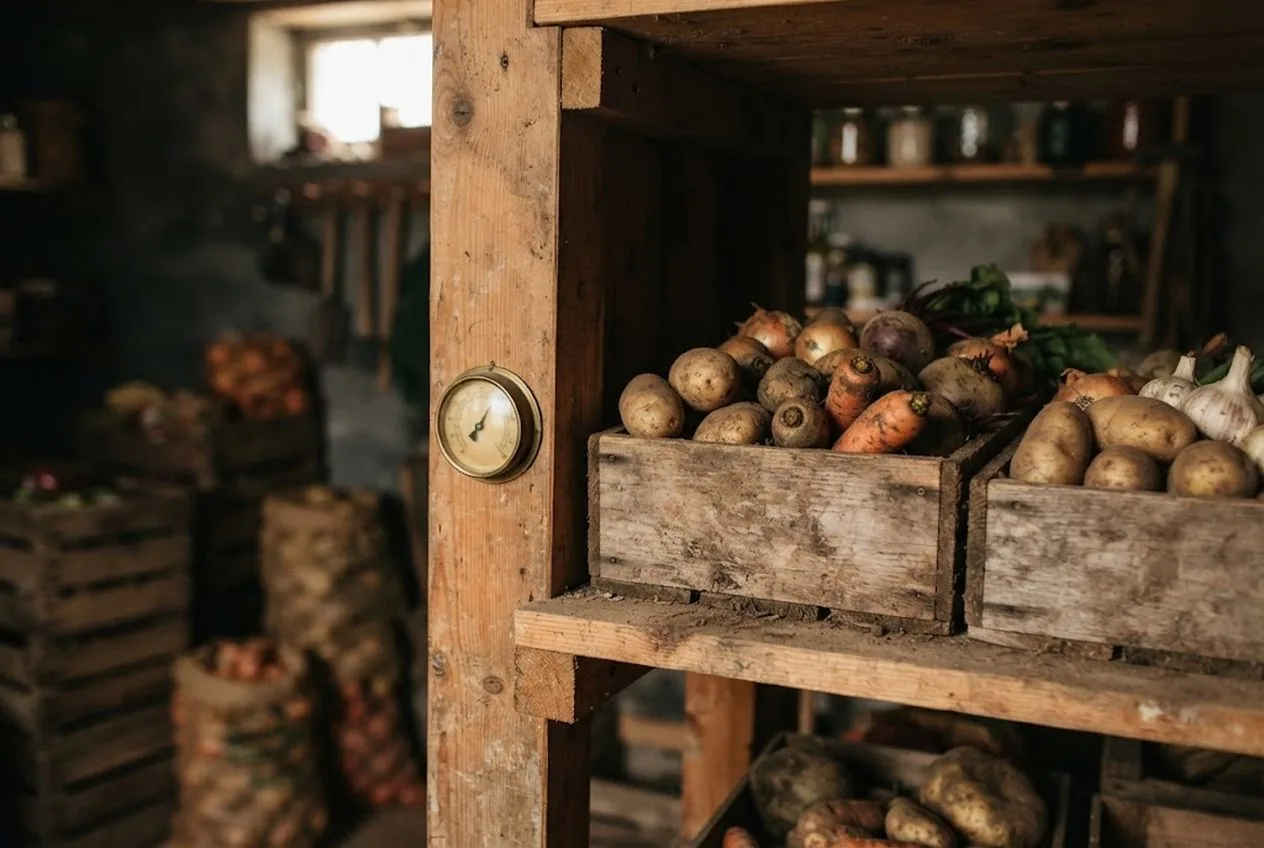
Of all the gear that goes into a season of food storage — the crates, the buckets, the canner, the shelving — the single most cost-effective piece is also the smallest and the one most people skip: a min/max thermometer. It costs about what you’d spend on a few pounds of the vegetables it protects, and it’s the only tool in the cellar that answers the one question that actually determines whether your harvest survives: what did the temperature do while I wasn’t here?
This is a single-product review to close out the storage season. We’ll cover what a min/max thermometer does, why the “memory” is the whole point, how to place it, the digital-versus-analog choice, and whether it’s worth adding to a cellar you’ve already stocked. If you’re still arranging that cellar, a good storage layout is the companion to this tool — the thermometer is what makes that layout measurable.
Short answer: a min/max thermometer is a cheap, essential monitoring tool that records the overnight low and daytime high in your cellar so a single weekly glance catches the freeze or warm spell that would otherwise ruin food between visits. It’s not glamorous and it won’t win on features, but for the money there is no better insurance on a winter’s worth of stored food.
Disclosure: the product links here are affiliate links, so we may earn a commission if you buy through them at no extra cost to you. This assessment is built from how min/max thermometers work and long-standing root-cellaring guidance on temperature and humidity — not a multi-year lab test of a single brand.
What a Min/Max Thermometer Does — and Why It Matters Here
A plain thermometer tells you one thing: the temperature at the instant you look at it. That’s nearly useless for a room you visit once a week, because the readings that decide your harvest’s fate happen when you’re not there — the 3 a.m. low on a clear, cold night, the warm afternoon during a January thaw.
A min/max thermometer records both extremes since its last reset and holds them until you clear it. Walk in a week after resetting it and it tells you the coldest the cellar got and the warmest it reached across all seven days and nights. That memory is the entire value. It converts a weekly walk-through into effectively continuous monitoring, and it’s the only practical way to know whether your storage climate actually held where you need it. University of Maine Extension names a maximum/minimum thermometer as a substitute for a recording thermometer for exactly this job (UMaine Extension).
For root cellaring specifically, the two numbers map straight onto the two ways a cellar fails:
- The low reading catches a freeze. Freezing occurs in all stored produce below 32°F, and some crops are ruined by a single freeze (UMaine Extension) — a low near or below 32°F is your alarm to close the intake vent and insulate.
- The high reading catches a warm spell. Creeping warmth shortens storage life and starts sprouting; a rising max tells you to open the vents or flush the room on the next cold night.
Accuracy and the Humidity Question
For cellar work, a min/max thermometer doesn’t need laboratory precision — you’re managing a room to within a few degrees, not calibrating an instrument. What matters is that it’s consistent and readable, so a shift of a few degrees week to week means something you can act on. Mainstream units clear that bar easily.
The upgrade worth paying for is humidity. Root cellaring is a two-variable game: roots want cold and very humid (80–95%) (UAF Extension), while onions and garlic want cool and dry and squash a dry, warmer spot (roughly 50–70%) (UMaine Extension). A combined thermometer-hygrometer lets you watch both zones from one device — is the root zone humid enough, is the allium shelf dry enough — which is genuinely more useful in a cellar than temperature alone. If your unit reads temperature only, a separate hygrometer fills the gap, but the combo is the tool we’d buy.
Placement: Where You Put It Decides What It Tells You
A thermometer only reports the air around it, so placement is half the value:
- Mount it at produce height, on an inside wall or a shelf edge, in the zone where your most temperature-sensitive crops sit. Up near the ceiling it reads the warmest air in the room (UAF Extension); down on a cold slab it reads colder than your crops feel.
- Keep it out of the intake draft. A sensor sitting in the cold current from an intake vent will log a low that’s colder than what the vegetables actually experienced, sending you chasing a freeze that never reached the shelves.
- Reset it on a schedule — every visit — so each reading covers a known window. A min/max you never reset just shows the extremes since installation, which tells you nothing about this week.
Get those three right and the numbers become trustworthy enough to make real decisions on.
Digital vs Analog
There are two flavors, and the choice comes down to readability against battery dependence.
- Digital models show current, min, and max as crisp numbers, usually add humidity, and often include a remote probe you can place inside a crate or in a second zone. The catch: they run on a battery, and cold, damp cellars are hard on batteries (Battery University) — keep a spare on the shelf.
- Analog dial min/max thermometers need no power at all and never die on you, which is a real virtue in a room you’d rather not fuss with. They’re a little fiddlier to read and reset, and most don’t do humidity.
For most people the digital combo thermometer-hygrometer is the easier daily tool, with an analog as an optional no-battery backup if you want redundancy through a long winter.
A quick first-week sanity check earns its keep either way. When the unit is new, set it beside a second thermometer you trust — even the one in your kitchen fridge — for a few hours and confirm the two agree within a couple of degrees. It’s a two-minute test that tells you the min/max is reading true before you start making freeze-or-thaw decisions on its word, and it flags the rare dud before it costs you a crate of potatoes. Do the same the following autumn when you pull it back out of storage, since a winter in a damp cellar is hard on any instrument.
Pros and Cons
Pros
- Records overnight lows and daytime highs, turning a weekly visit into round-the-clock monitoring
- Catches both cellar failures — a killing freeze and a spoiling warm spell — before they cost a crop
- Extremely cheap relative to the harvest it protects
- Combo thermometer-hygrometer models manage both cellar zones (cold-moist and cool-dry) from one device
- Digital versions often include a remote probe for a second zone or inside a crate
Cons
- Only as accurate as its placement — a bad spot gives misleading readings
- Digital models depend on a battery that cold, damp air can drain
- Analog dial versions are fiddlier to read and reset and usually skip humidity
- Passive tool — it warns you, but you still have to act on what it shows
Who Should Buy One — and Who Shouldn’t
Buy it if you’re storing any real quantity of food in a root cellar, unheated basement, or garage this winter. At its price it’s the cheapest insurance you can put on the harvest, and it matters just as much in a small cellar, where a single freeze can take a bigger share of the stores. The crops on our fall vegetables for root cellar storage list are exactly what it’s standing guard over. Choose a digital thermometer-hygrometer for the easiest daily read.
Skip it only if you already run a monitored setup — a smart sensor that logs and alerts to your phone covers the same ground with more data, and a second thermometer would be redundant. Even then, a battery-free analog min/max makes a cheap fail-safe for when the smart sensor’s battery dies mid-cold-snap.
The Bottom Line
The min/max thermometer is the least exciting purchase of the storage season and, dollar for dollar, the smartest. Everything else in the cellar stores the food; this is the one tool that tells you whether the food is safe, by remembering the cold nights and warm afternoons you slept through. It won’t act for you — you still have to open a vent or add insulation when it flags trouble — but it gives you the one thing a passive cellar otherwise denies you: a number, instead of a guess.
Pair it with the layout in our how to organize a root cellar for winter guide, and if you’re still building or upgrading the room itself, our how to build a root cellar guide covers the vents and insulation that give this thermometer something worth measuring. If part of your winter storage is dry staples in buckets rather than produce, our Gamma seal vs standard bucket lids comparison keeps that side of the pantry squared away too. For a season-end buy that protects everything else you put up — the natural last item on our list of fall homestead projects to finish before the freeze — it’s an easy recommendation.
Frequently Asked Questions
- What does a min/max thermometer actually do?
- It records the highest and lowest temperature reached since you last reset it, and holds both readings until you clear them. That means a single glance shows you the coldest point overnight and the warmest point during the day — even though you weren't there to see either. For a root cellar you visit once a week, that memory is the whole point: it catches a 3 a.m. freeze or a mild-afternoon warm spell that a plain thermometer would never reveal, because the plain one only ever shows the temperature at the moment you happen to look.
- Where should you place a root cellar thermometer?
- Mount it at produce height on an inside wall or a shelf edge, in the zone where your most temperature-sensitive crops sit — not up near the ceiling where the warmest air collects, and not pressed against a cold outer wall that reads colder than the room. You want it reading the air your vegetables actually experience. Keep the sensor out of direct airflow from an intake vent, too, so a cold draft doesn't skew the low reading below what the crops really felt.
- Is a digital or analog min/max thermometer better for a root cellar?
- Both work; the trade-off is readability versus battery dependence. A digital model shows current, min, and max as clear numbers and often adds humidity, which is genuinely useful in a cellar — but it needs a working battery in a cold, damp room. An analog dial min/max needs no power and never dies on you, but is a little fiddlier to read and reset. For most cellars a digital combo thermometer-hygrometer is the easier daily tool; keep a simple analog as backup if you want redundancy.
- Does a root cellar thermometer need to measure humidity too?
- It helps a lot. Root cellaring is a two-variable game — roots want cold and very humid, while onions want cool and dry and squash a dry, warmer spot — so a combined thermometer-hygrometer lets you manage both zones from one device. If your unit only reads temperature, you can add a separate hygrometer, but a combo model that shows temperature, humidity, and the min/max memory in one glance is the most useful single tool for the job.
- Is a min/max thermometer worth it for a small root cellar?
- Yes, because a single freeze can take a big share of a small cellar's stores. At roughly the price of a few pounds of the vegetables it protects, a min/max thermometer is the cheapest insurance in the cellar. It turns 'I think it stayed cold enough' into a number you can act on, which is exactly what stops a quiet overnight freeze from becoming a lost harvest.
Sources & references
Before you go
The Renter's Homestead Pack
Self-reliance projects for the yard you don't own — container yields, a raised bed built to move with you, balcony preservation basics, and the landlord questions to ask first.
Free guide
The Renter's Homestead Pack
Self-reliance projects for the yard you don't own — container yields, a raised bed built to move with you, balcony preservation basics, and the landlord questions to ask first.