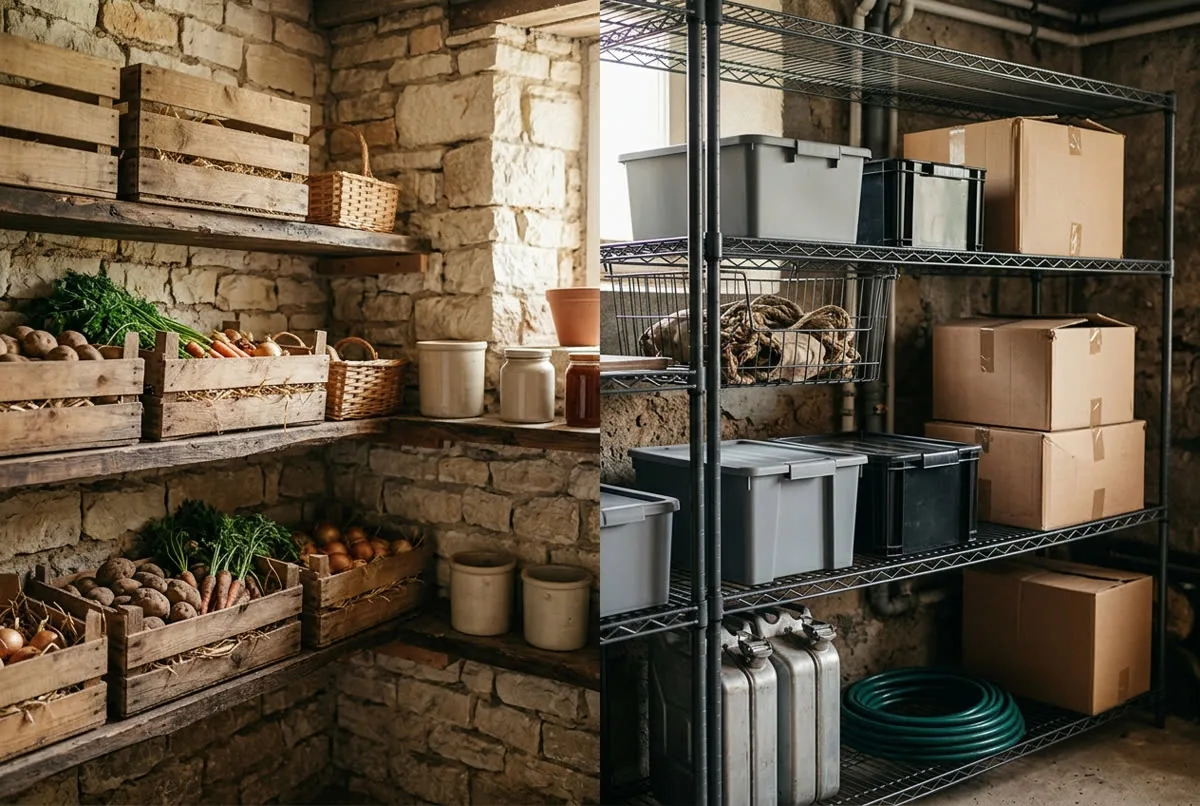
Late October is when the question stops being theoretical. Nights are dropping into the 30s and 40s in much of the country, and the potatoes, carrots, and squash piled by the back door need somewhere colder than the kitchen but not cold enough to freeze solid. For anyone without a dedicated root cellar, the choice usually comes down to two spaces already on the property: an unheated basement corner, or the garage. Both look like they should work. Both are cold, dim, and out of the way. But “cold” isn’t the same as “cold in the right range, with the right humidity, on the coldest night of the year,” and that’s where one of these two spaces usually falls short. Trust a thermometer over a hunch when deciding where winter vegetables spend the next four months.
The short answer: A true root cellar, an insulated space in contact with the earth, is built to hold a narrow 32-40°F range with high humidity. An unheated garage can work for some crops, such as squash and pumpkins, but only if it stays at or above 50°F and has been measured; left unchecked, a hard freeze can ruin stored produce and dry air can shrivel it.
What Temperature Does a Root Cellar Actually Need to Hit
University of Alaska Cooperative Extension puts the optimum storage temperature for most vegetables at 32 to 40°F, with 80 to 95 percent relative humidity to keep them from drying out (University of Alaska Cooperative Extension, revised 2020). That’s the range a traditional root cellar is built to hold. The same publication notes that uninsulated masonry walls conduct the cool ground temperature into a root cellar, that above-ground walls should be insulated against winter cold and summer heat, and that ventilation helps control temperature and humidity.
Not every crop wants the same corner of that range, though. Iowa State Extension lists carrots at 32 to 35°F with 98 to 100 percent relative humidity and rutabagas at 32 to 35°F, while potatoes want about 40°F with 90 to 95 percent humidity and develop a sugary, sweet taste when stored below 40°F (Iowa State University Extension). Cured winter squash and pumpkins prefer it noticeably warmer, 50 to 55°F, and Oregon State Extension says they can be damaged when temperatures drop below 50°F (Oregon State University Extension). That split matters more than most people expect: a space cold enough for carrots is too cold for squash, and a space warm enough for squash is too warm for carrots. It’s also why a single storage space, whatever it’s called, rarely handles a whole harvest equally well. University of Alaska Extension adds that warm air rises, so even within one cellar the warmer temperatures will be found at the top.
Why an Unheated Garage Usually Misses That Target
A garage without insulation behaves less like a cellar and more like an extension of the outdoors. Iowa State Extension’s storage guide, for example, advises that onions kept in an unheated garage be moved to another site before temperatures drop below 32°F (Iowa State University Extension). That’s the core problem with treating “cool” and “cold enough” as the same thing: a garage can read cool on a mild afternoon and still fall below freezing overnight once a cold front moves through, while a real cellar’s walls carry the cool ground temperature into the space.
This is also the root of the most common assumption people bring into the garage-versus-cellar decision: that any unheated space that feels cold is doing the same job as a root cellar. UConn Extension cautions that “ideal” storage conditions for many vegetables are not attainable around the average home, and that the temperature of any improvised space should not fluctuate too much (UConn Extension, 2017). A root cellar’s advantage isn’t just that it’s cold. It’s that it is built, with insulation, earth contact, and ventilation, to hold a steadier range than a space that was never designed for it.
Which Vegetables Can Handle Garage Storage, and Which Can’t
Given that split, some crops are better candidates for garage storage than others. Squash and pumpkins, which want that warmer 50 to 55°F range, are often a better fit for a garage than for a true cold cellar; Oregon State Extension says a garage often works well for them, especially on shelves that keep them off the floor, as long as temperatures stay at or above 50°F (Oregon State University Extension). Carrots and other crops stored at 32 to 35°F are the ones most at risk in a garage, because they have almost no margin between properly stored and frozen.
The deciding factor isn’t the label on the space, it’s whether that specific garage, in that specific climate, holds inside the range a given crop needs. A detached garage in a mild coastal climate might sit at a steadier temperature all winter than a poorly insulated basement corner in a colder region. That’s why measuring, covered further down, matters more than which structure a household starts with. For the fuller list of what should go into cold storage in the first place, see Fall Vegetables for Root Cellar Storage: The Full List.
Humidity: The Variable Garages Get Wrong Twice
Temperature gets most of the attention, but humidity failures ruin storage crops just as often, in two opposite directions. Correct ventilation and moisture management matter as much as temperature: high humidity keeps vegetables from drying out, while excess moisture encourages mold (University of Alaska Cooperative Extension, revised 2020). Iowa State Extension says carrots will wilt or shrivel if relative humidity is less than 95 percent.
University of Alaska Extension notes that the easiest way to keep moisture high is a dirt floor, and that if the floor is concrete or wood it may be necessary to place several pans of water on it. A garage slab has no such moisture source, so a garage that’s cold enough for carrots can still be too dry and leave you with soft, wrinkled roots by midwinter, even though the temperature reading looked fine the whole time. That’s a hard problem to catch by feel. It shows up on a hygrometer well before it shows up in the produce.
Making a Marginal Space Work
A garage or basement corner that misses the target isn’t automatically ruled out. It usually just needs adjusting before it’s trusted with a full winter’s produce. University of Alaska Extension notes that temperature and humidity are easier to control in a small cellar, and that a walled-off part of a garage with a window for ventilation can serve as one, so insulating garage walls or sectioning off a smaller, more enclosed corner is a reasonable way to move a swingy room toward the stability a true root cellar gets from earth contact. On the humidity side, the same publication suggests layering vegetables in moist sawdust, sand, or peat moss to hold moisture around produce when the surrounding air runs dry.
None of that replaces measurement, though. A fix that “should” help still needs to be checked against a thermometer and hygrometer before it’s trusted, because a garage’s insulation, airflow, and exposure to wind are different enough from house to house that no single adjustment works the same way twice.
How to Measure Before You Trust Either Space
The only way to know whether a garage, a basement corner, or a dug-in container is actually doing the job is to measure it, not guess at it. UConn Extension advises monitoring temperature, humidity, and air flow in any storage area and checking it at least weekly, and University of Alaska Extension suggests placing thermometers throughout a cellar to monitor temperatures. A thermometer and a hygrometer, checked over time rather than once, cover both.
Where to place the sensor
Put the thermometer and hygrometer at the height where the produce actually sits, not at eye level or near a door. A reading taken near the garage entrance will run colder and draftier than the back corner where boxes are stacked, and because warm air rises, readings near the ceiling will run warmer than those at shelf level. If the storage spot is a buried container, an insulated basement corner, or a converted section of garage, measure inside that specific microclimate rather than the room as a whole.
What a week of readings should tell you
A single reading tells you almost nothing, because both temperature and humidity in an unheated space move with the weather outside. Track the space for at least a week, ideally through one cold snap, before trusting it with a full winter’s worth of vegetables. If the low readings dip below freezing on a hard night, or the humidity sits consistently low, that space needs insulation, added moisture, or a different crop assignment before it’s ready.
A Garage Floor Can Run Colder Than Its Shelves
Before filling any storage space, the University of Saskatchewan’s College of Agriculture and Bioresources says to measure the temperature of the storage area with a thermometer (University of Saskatchewan, April 6, 2021). Cold air is heavier than warm air, so the floor may be colder than a shelf higher up. The same publication says that difference helps decide which vegetables go where.
Its storage chart gives the numbers to read the thermometer against. Carrots and beets are listed at 32°F, cold but not frozen. Potatoes are listed at 38 to 40°F. Winter squash, including pumpkin, is listed at 50 to 55°F and goes on a shelf. A floor corner and a higher shelf in the same room can read differently, so it helps to note both.
Whatever spot is chosen, the source says it must not freeze, and the ideal temperature is even, without large swings. Freezing can damage vegetables, while too much warmth can make them sprout or over-ripen. A space that is not quite ideal can still work: the source notes that vegetables can keep a long time in cool conditions even when temperatures are not perfect.
No Basement, No Problem: Middle-Ground Options
Not every home has a basement corner or a naturally cold garage, and the choice isn’t strictly binary. UConn Extension describes options from outdoor mounds and pits to a buried 20-gallon trash can with drainage holes, plus a breezeway, a shed, or a garage that is not used for storing vehicles, lawn equipment, or chemicals that may affect the flavor of produce (UConn Extension). University of Alaska Extension names a walled-off part of a basement or garage as a convenient root cellar location. A root cellar doesn’t have to be an elaborate underground room to function like one; it has to hold the right temperature and humidity, however that’s achieved.
That reframes the original question. It’s less “root cellar or garage” and more “which specific space, measured over time, actually holds the range this crop needs.” A well-insulated garage corner with soil contact can outperform a leaky, uninsulated basement. An uninsulated garage in a cold-winter region will struggle to hold anything close to 32 to 40°F once temperatures drop hard, no matter how organized the shelving is. Root cellaring is one piece of a larger no-power approach to keeping food through winter; see 7 Food Preservation Methods That Don’t Need Electricity for the rest of that picture.
Start by measuring whatever space is closest to root-cellar conditions on the property, log it through a cold snap, and sort produce by what each space can actually deliver rather than by which structure sounds more traditional. The vegetables won’t know the difference between a dug container, a basement corner, and a garage. They’ll only respond to the temperature and humidity they actually sit in, so let a week of readings settle the argument before the first hard frost puts it out of reach.
Frequently Asked Questions
- Is my unheated garage cold and humid enough to act as a root cellar?
- Only if you've measured it. An unheated garage can drop below freezing on a cold night, and Iowa State Extension advises moving onions stored in an unheated garage to another site before temperatures fall below 32F. Humidity matters too: University of Alaska Cooperative Extension says 80 to 95 percent relative humidity keeps most vegetables from drying out, and that a concrete floor may need pans of water to hold moisture up.
- What temperature should a root cellar stay at over winter?
- Most vegetables store best between 32 and 40F with high humidity, per University of Alaska Cooperative Extension. Winter squash and pumpkins prefer it warmer, 50 to 55F, per Oregon State and Iowa State Extension, so the right target depends on what you're storing.
- How do I measure and control humidity in a DIY root cellar or garage?
- Place a thermometer and hygrometer at the height where the produce sits, not near a door, and track readings for at least a week through a cold snap before trusting the space with a full season of vegetables.
Sources & references
- University of Alaska Cooperative Extension, Vegetable Storage in Root Cellars (opens in new tab)
- Iowa State University Extension, Storing Winter Storage Vegetables (opens in new tab)
- Oregon State University Extension, Plan now to harvest and store pumpkins and winter squash (opens in new tab)
- UConn Extension, Cold Storage: A Sustainable Way to Preserve the Harvest (opens in new tab)
- University of Saskatchewan, Cold Storage of Root Crops, Winter Squash, Onions and Garlic (opens in new tab)
Before you go
The Renter's Homestead Pack
Self-reliance projects for the yard you don't own — container yields, a raised bed built to move with you, balcony preservation basics, and the landlord questions to ask first.
Free guide
The Renter's Homestead Pack
Self-reliance projects for the yard you don't own — container yields, a raised bed built to move with you, balcony preservation basics, and the landlord questions to ask first.