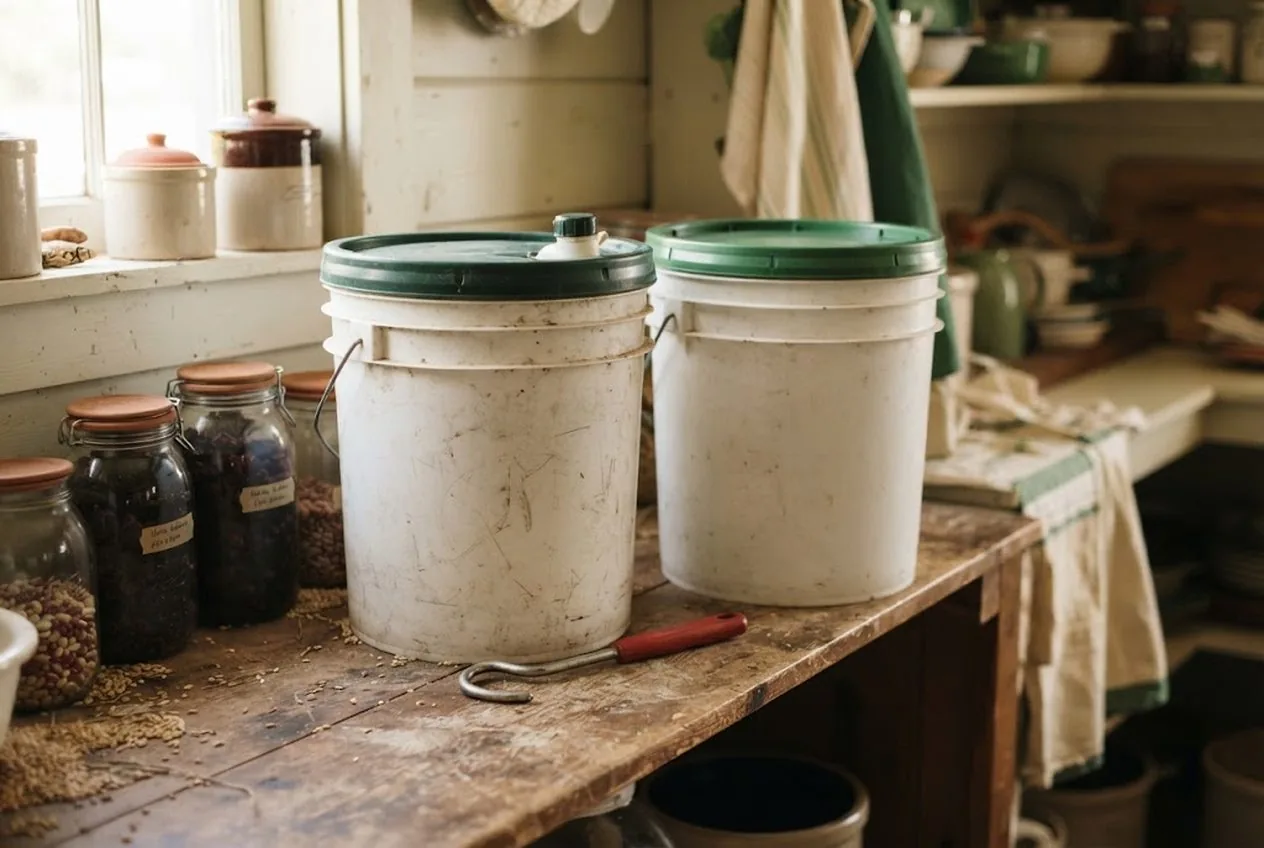
Once you commit to storing food in buckets, you hit a small decision with a surprisingly big impact on daily life: the lid. On one side is the standard snap-on lid that comes with every bucket — cheap, secure, and a genuine wrestling match to open. On the other is the Gamma Seal, a two-piece screw-top that costs more but spins off and back on in seconds. Which one belongs on your buckets depends entirely on how often you plan to open them.
Here’s the honest version up front: neither lid is the airtight barrier that gives food its long shelf life — that’s the Mylar and oxygen absorbers inside the bucket. The lid’s job is physical protection and access. So the real question isn’t “which seals better for 25 years,” it’s “which makes your pantry easier to actually live with.” And there the answer splits cleanly by use.
Short answer: put Gamma Seal lids on the buckets you open often — flour, rice, oats, sugar, anything in active rotation — and keep standard lids on the buckets you seal once and store for years. Use both, matched to how each bucket earns its keep.
What a Lid Actually Does (and Doesn’t)
It’s worth being precise, because this is where people over- or under-spend.
A bucket lid — either kind — provides physical protection: it keeps rodents, dust, and light off, and holds the contents secure. A good lid also seals against air and moisture while it’s closed, with a gasket doing the sealing work. What a lid does not do is make ordinary bucket plastic a true long-term barrier. Over years, oxygen and moisture slowly seep through the walls of the bucket itself; Utah State University Extension notes plastics can let significant oxygen in within 1 to 2 years (USU Extension), which is why deep-storage staples always go in Mylar bags with oxygen absorbers inside the bucket. The bag is the real barrier; the bucket and lid are the armor around it.
So judge lids on the jobs they actually own: how securely they seal day to day, and how easy they are to open and close. That framing makes the Gamma-versus-standard choice simple.
Side-by-Side: Gamma Seal vs Standard Lid
| Gamma Seal Lid | Standard Snap Lid | |
|---|---|---|
| Airtight when closed | Yes — gasketed screw seal | Yes — gasketed snap seal |
| Ease of opening | Spins off in seconds | Pry with a lid tool; a workout |
| Repeated access | Excellent — made for it | Poor — wears and cracks the lid |
| One-time deep-storage seal | Overkill, but works | Ideal and cheap |
| Cost per bucket | $$ (higher) | $ (often included) |
| Two-piece design | Ring stays on, lid screws in/out | Single piece, on or off |
| Best for | Buckets you open weekly | Buckets sealed for years |
| Durability of seal | Reseals reliably every time | Weakens with each pry-off |
Read the table as a story about access frequency. Both seal airtight when shut; they part ways entirely on how pleasant they are to open again and again.
When the Gamma Seal Wins
Reach for a Gamma Seal lid on any bucket you’ll open regularly. The two-piece design is the whole point: an outer ring snaps permanently onto the bucket rim, and the inner lid screws in and out of that ring in seconds, sealing with a gasket (University of Arkansas Extension). No prying, no lid tool, no stressing the plastic — just spin it off, scoop what you need, and spin it back to an airtight seal.
That convenience matters more than it sounds. The buckets you dip into weekly — flour, rice, oats, sugar, even pet food — are exactly the ones where a standard lid becomes a daily aggravation and where repeated prying invites moisture and pests during each fumbling open. A Gamma lid keeps a working bucket sealed between uses and makes using it effortless, which is the difference between a rotation staple you actually cook from and one you avoid because getting into it is a chore.
Disclosure: the product links here are affiliate links, so we may earn a commission if you buy through them at no extra cost to you. Our recommendations follow long-standing food-storage practice, not brand marketing.
When the Standard Lid Wins
For buckets you seal once and won’t touch for years, the standard snap-on lid is the smarter, cheaper choice. Deep-storage staples — bulk rice, wheat, and beans sealed in Mylar and set on the shelf until a hard year arrives — don’t need easy access, because the whole point is that you’re not opening them. A standard gasketed lid seals those buckets airtight for the long haul at a fraction of the cost, and its one weakness, being a pain to pry off, simply doesn’t matter on a bucket you’re not opening. (Deciding what actually goes in those buckets? Our list of foods to stockpile for a one-year pantry covers the staples worth bulk-sealing.)
There’s a cost argument too. Outfitting an entire wall of deep-storage buckets with Gamma lids adds up fast, and it buys you convenience you’ll never use on buckets designed to sit sealed for decades. Spend that money on more food instead.
The Smart Pantry Uses Both
The best setup isn’t all-Gamma or all-standard — it’s a mix that matches each bucket’s job.
- Gamma Seal lids go on your handful of working buckets: the flour, rice, oats, and sugar you open every week. Their easy resealing keeps active staples sealed and accessible.
- Standard lids go on your deep-storage buckets: the bulk staples in Mylar you’re storing for years and won’t open until you need them. Cheaper, and the awkward opening is irrelevant.
A common pattern is one or two Gamma-lidded buckets in the kitchen for daily cooking, refilled periodically from the standard-lidded deep-storage buckets in the basement. The deep buckets get pried open rarely — once every few months to refill — so their harder-to-open lids barely register, while the kitchen buckets stay effortless.
So Which Should You Buy?
Let access frequency and budget decide, not marketing:
- Buy Gamma Seal lids if the bucket is in active rotation and you’ll open it often — the convenience is real and the airtight reseal protects the contents between uses.
- Buy standard lids if the bucket is sealed deep-storage you won’t touch for years — they seal airtight, cost far less, and their one drawback doesn’t apply.
- The natural setup is both: Gamma lids on a few working buckets, standard lids on the deep-storage wall behind them.
Whichever lid tops the bucket, remember the seal that actually earns the decades is inside it (BYU Magazine). Our how to pack a 5-gallon bucket for 25-year food storage guide covers the Mylar-and-absorber method the lid protects, and if you’re weighing storage methods more broadly, our Mylar bags vs vacuum sealing comparison shows where each belongs — with our vacuum sealer pick covering the machine side when vacuum wins. Get the lid right for how you’ll use each bucket, and your pantry stays both sealed and genuinely easy to live with.
Frequently Asked Questions
- Are Gamma Seal lids airtight enough for long-term food storage?
- Yes — a Gamma Seal lid seals airtight when the inner ring is screwed down, with a rubber gasket that keeps out air, moisture, and pests. For a bucket you'll open regularly, it's an excellent airtight closure. That said, for true 25-year deep storage the airtight barrier that matters most is the Mylar bag and oxygen absorbers inside the bucket, not the lid. The Gamma lid shines on the working buckets you dip into often, where its resealable convenience prevents the moisture and pest exposure that repeated opening otherwise invites.
- Do you still need Mylar bags if you use a Gamma Seal lid?
- For decades-long storage of dry staples, yes. Neither a Gamma lid nor a standard lid makes bucket plastic a true oxygen and light barrier — over years, air slowly migrates through. Mylar bags with oxygen absorbers inside the bucket are what deliver the 25-to-30-year shelf life. The lid's job is physical protection and, with a Gamma, easy resealable access. Use Mylar for anything you're storing long-term; the lid choice is about how easily you get into the bucket, not the deep seal.
- Are Gamma Seal lids worth the extra cost?
- They're worth it for buckets you open often — flour, rice, oats, sugar, pet food, anything in active rotation. Prying off a standard snap lid several times a week is a genuine hassle and stresses the lid, while a Gamma lid spins off and back on in seconds and reseals airtight every time. For buckets you seal once and won't touch for years, a standard lid is cheaper and perfectly adequate. Match the spend to how often you'll actually open each bucket.
- Can you put a Gamma Seal lid on any bucket?
- Gamma Seal lids fit standard round buckets, generally in the 3.5-to-7-gallon range, but you should confirm the lid matches your bucket's diameter before buying. The lid's outer ring snaps onto the bucket rim like a normal lid and stays there; the inner lid then screws in and out of that ring. Make sure both bucket and lid are the same nominal size and, for food, that the bucket is food-grade — the lid doesn't change what the bucket itself is rated for.
- What's the downside of standard bucket lids?
- Standard snap-on lids are cheap and seal well, but they're a fight to open and close. Prying one off with a lid opener takes effort, doing it repeatedly wears out the lid and can crack it in the cold, and it's hard on your hands. That's fine for a bucket you seal once for deep storage, but frustrating for anything you access weekly. Their strength is cost and a secure one-time seal; their weakness is everyday convenience.
Sources & references
Before you go
The Renter's Homestead Pack
Self-reliance projects for the yard you don't own — container yields, a raised bed built to move with you, balcony preservation basics, and the landlord questions to ask first.
Free guide
The Renter's Homestead Pack
Self-reliance projects for the yard you don't own — container yields, a raised bed built to move with you, balcony preservation basics, and the landlord questions to ask first.