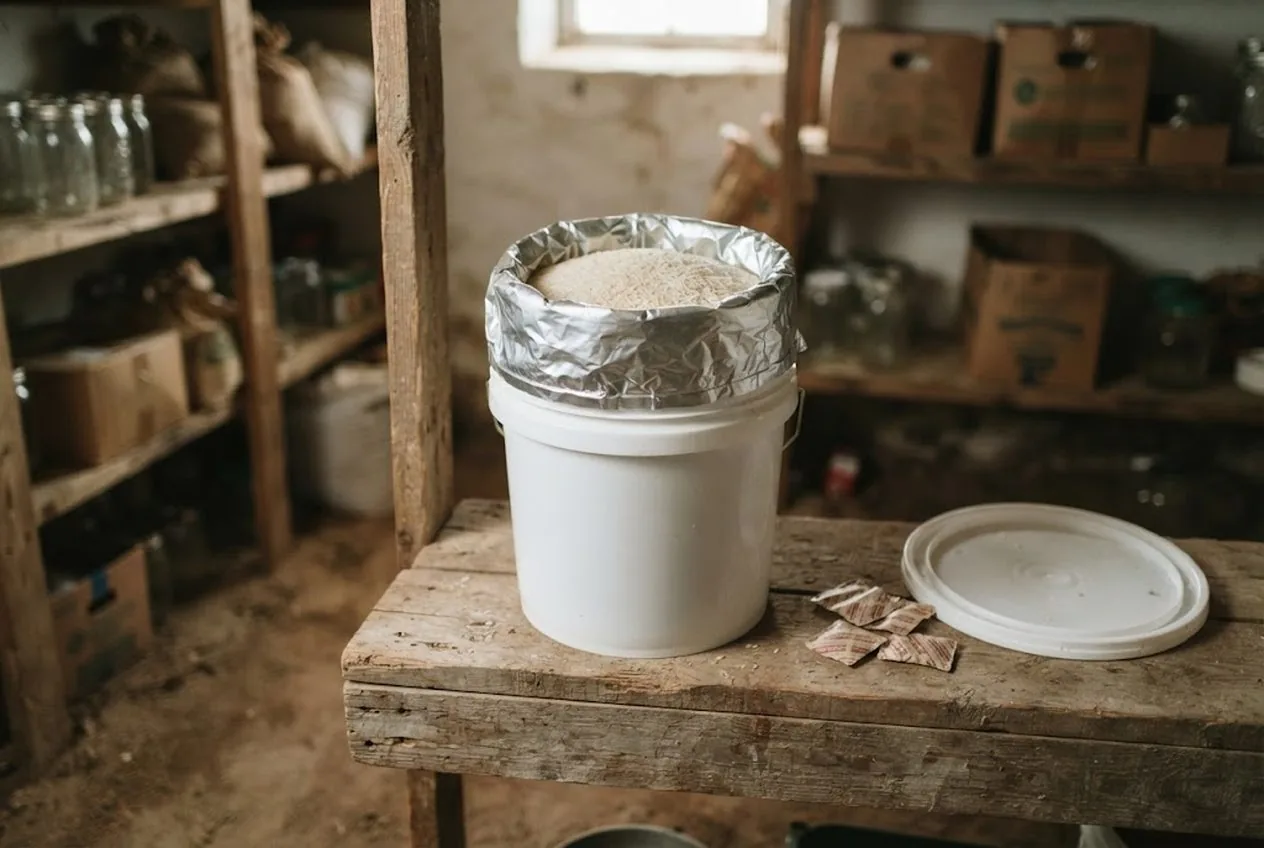
Walk into any serious prepper’s basement and you’ll see the same thing: a wall of white five-gallon buckets, stacked and labeled, holding rice and beans and wheat that will still be food in 2050. It’s the backbone of a real pantry — cheap calories, sealed against time, waiting quietly for a year you hope never comes. And the whole system comes down to one repeatable skill: packing a single bucket correctly.
Done right, a five-gallon bucket of white rice or dried beans keeps for 25 to 30 years (BYU Magazine). Done wrong — the wrong food, too few absorbers, a lazy seal — and the same bucket can spoil, go rancid, or fill with weevils inside a year. This guide walks the whole process, start to finish, so every bucket you pack is one you can count on decades from now.
Short answer: line a clean food-grade bucket with a 5-mil Mylar bag, fill it with a low-moisture, low-oil dry staple, add enough oxygen absorber for the bag size, press out the air and heat-seal the Mylar, then snap on the gasket lid, label it, and store it cool and dark. That package lasts decades.
The Three-Layer System (and Why You Need All Three)
A packed bucket is really three things working together, and skipping any one of them quietly shortens its life.
- The bucket is physical protection and structure. Food-grade plastic keeps chemicals out of your food, the gasket lid keeps rodents and light off, and the shape makes the whole thing stackable. But ordinary bucket plastic is not a true gas barrier — over years, oxygen and moisture slowly migrate through it and past the lid seal. Utah State University Extension notes plastics can let significant oxygen into a container within 1 to 2 years (USU Extension).
- The Mylar bag is the airtight, light-proof barrier that the bucket can’t be on its own. Metallized film stops oxygen, moisture, and light cold. This is the layer that actually earns you the 25-year number.
- The oxygen absorbers remove the air already trapped inside the sealed bag. Even a perfect Mylar seal traps air that is about 21% oxygen (Utah State University Extension), which is enough to feed rancidity and hatch insect eggs. The absorbers pull that down to nearly zero, and the food goes dormant.
Think of it as bag-in-bucket: the Mylar seals, the absorbers scrub the air, and the bucket armors the whole package. Miss the Mylar and you have a few years, not decades. Miss the absorbers and trapped oxygen spoils the food from the inside.
Which Foods Belong in a 25-Year Bucket
Be strict here — this is the step people get wrong. The method works for low-moisture, low-oil dry staples, and only those.
Great for long-term buckets (25–30 years):
- White rice, wheat berries, and other whole grains
- Rolled oats and dry cereals
- Dried beans, lentils, and legumes
- Pasta (flour and cornmeal store this way too, for a shorter span)
Do not bucket this way:
- Oily foods — brown rice, nuts, seeds, and high-oil flours go rancid no matter how well you seal them. They last months, not decades. Freeze and rotate these instead.
- Sugar and salt — they keep a long time sealed dry in Mylar, but don’t add an oxygen absorber. Seal them without absorbers.
- Anything with moisture — a sealed, oxygen-free environment is exactly what botulism likes. Utah State University Extension warns products stored with oxygen absorbers must be dry, about 10 percent moisture or less (USU Extension). Dry goods only, always.
That last point is a safety rule, not a preference. Keep buckets to genuinely dry staples and you have nothing to worry about.
What You’ll Need
- Food-grade buckets with gasket lids (Amazon) — the physical container and stacking base; confirm the bucket is rated food-grade and the lid has a sealing gasket
- Mylar bags (Amazon) — buy bags at least 5 mil thick (7 mil resists punctures better), sized to line a five-gallon bucket
- 300cc oxygen absorbers (Amazon) — enough to match the maker’s sizing chart for a five-gallon bag; buy in bulk and store spares in an airtight jar
- A heat source to seal: a household iron or a flat hair straightener; an impulse sealer is faster for many buckets
- A board or the bucket rim to press the seal against, plus a permanent marker for labeling
Disclosure: the product links here are affiliate links, so we may earn a commission if you buy through them at no extra cost to you. The shelf-life figures below reflect university-extension and long-term-storage research for properly sealed, cool-stored staples (BYU Magazine), not brand marketing.
Step-by-Step: Packing the Bucket
Step 1: Start Clean and Dry
Wash the bucket and dry it completely — any leftover moisture is trapped forever once you seal it. Inspect the lid gasket for cracks and make sure it snaps down tight. A new food-grade bucket is ideal; a reused one is fine if it only ever held food and is clean, dry, and sound.
Step 2: Line the Bucket With the Mylar Bag
Open a five-gallon Mylar bag and drop it into the bucket so it lines the walls, folding the open top down over the rim. Lining the bag inside the bucket is the whole trick — the bucket holds the bag upright and open, so filling is clean and the finished package is ready to stack. Trying to fill a floppy bag on its own is a spill waiting to happen.
Step 3: Fill With Your Dry Staple
Pour your staple into the lined bag, settling it as you go, and stop a few inches below the top so you have clean Mylar to seal. A five-gallon bag of rice or beans is heavy once full, so pack it where it’s going to live if you can.
Step 4: Size and Add the Oxygen Absorbers
Absorbers are rated in cc — the cubic centimeters of oxygen they neutralize — and you size them to the volume of food. Use the absorber maker’s sizing chart for a five-gallon bag (one maker’s approximate chart lists 1,000 cc for fine grains up to 2,000 cc for pasta in a 20” x 30” bag (IMPAK/Sorbent Systems)); the correct number for the package size is what makes them effective (University of Arkansas Extension). Drop them right on top of the food.
Work fast once the absorber package is open: the sachets begin reacting with room air the moment they’re exposed, so don’t leave them sitting out while you do something else. Reseal any you don’t use in an airtight glass jar so they stay active for the next bucket. When in doubt, use more — over-absorbing does no harm, under-absorbing leaves oxygen behind.
Step 5: Press Out the Air and Heat-Seal
Gather the top of the Mylar and press out as much air as you can — the absorbers handle the rest, but starting with less air gives a tighter, faster result. Lay the top across the bucket rim or a board and run a hot iron or hair straightener slowly along it to fuse a smooth, continuous seal. Leave a small gap at one end, squeeze out the last of the air, then close it. Tug the finished seal gently; it should hold without separating.
Step 6: Lid, Label, and Store Cool
Fold the sealed bag down into the bucket and snap on the gasket lid. Write the contents and the date on the bucket in permanent marker — future you will not remember which white powder is flour and which is rice. Then store everything cool, dark, and dry.
Heat is the one enemy no seal can beat: Utah State University Extension, citing USDA, says shelf life drops by about half for every 10.8°F rise in storage temperature (USU Extension), so a bucket at 50°F outlasts the same bucket in a 90°F garage many times over. A basement, an interior closet, or an under-bed space all beat an attic or garage.
Verifying the Seal
Come back a day later and look at the Mylar. As the absorbers pull the oxygen out, the bag should draw tight and firm around the food, almost like a vacuum pack. That snugness is your proof the seal held and the absorbers are alive. If the bag is still loose and puffy after 24 hours, you have a leak or dead absorbers — open it, add fresh absorbers, and reseal before closing the lid for good.
Real Shelf Life, Bucket by Bucket
Sealed correctly and stored cool, here’s what the effort returns:
| Food | Shelf life in a sealed bucket |
|---|---|
| White rice | 25–30 years |
| Wheat berries | 25–30 years |
| Dried beans | 25–30 years |
| Rolled oats | 25–30 years |
| Pasta | 25–30 years |
| Flour, cornmeal | Shorter than whole grains; rotate sooner |
| Sugar/salt (Mylar, no absorber) | Long-lasting if kept dry |
| Brown rice, nuts (oily) | Months — freezer instead |
Those aren’t marketing numbers; they’re what properly packed, cool-stored staples actually deliver. The variables that shrink them are always the same three — heat, oxygen, and moisture — which is exactly what this system controls.
Where Buckets Fit in the Pantry
Bucket staples are the foundation of a pantry, not the whole thing. They’re calorie insurance — rice, beans, and wheat that will still feed you in decades — but they need rounding out with the variety and rotation of the food you actually eat week to week. If you’re weighing bags versus buckets or wondering about the sealing details, our long-term food storage with Mylar bags and oxygen absorbers guide goes deeper on the barrier science, and avoiding the errors in our long-term food storage mistakes guide keeps this whole layer intact.
An afternoon of packing buys you decades of security. Start with a bucket of white rice and a bucket of dried beans — the cheapest, longest-lasting calories there are — and build the wall one bucket at a time.
Frequently Asked Questions
- Do you need a Mylar bag inside the bucket, or is the bucket enough?
- You need both, and they do different jobs. A food-grade bucket with a gasket lid is a good physical container, but ordinary bucket plastic slowly lets oxygen and moisture seep through over years, and the lid seal isn't a true gas barrier. The Mylar liner is what actually makes the package airtight and light-proof; the oxygen absorbers pull out the trapped air inside it. The bucket then protects that sealed bag from punctures, rodents, and light, and makes the whole thing stackable. Bucket alone gets you a few years at best — Mylar plus absorbers inside the bucket gets you decades.
- How many oxygen absorbers go in a 5-gallon bucket?
- Size absorbers to the bag and the food in it, not the bucket, using the absorber maker's sizing chart for a five-gallon bag; extension guidance stresses that the correct number for the package size is what makes them effective. When in doubt, use more: over-absorbing does no harm, while too little leaves oxygen behind that shortens shelf life. Work quickly once the absorber package is open, since the sachets start reacting with room air right away, and reseal any leftovers in an airtight jar.
- Which foods can you store in a bucket for 25 years?
- Only low-moisture, low-oil dry staples: white rice, wheat and other whole grains, rolled oats, dried beans and legumes, and pasta. In BYU storage research, these kept acceptable quality for up to 30 years when packaged to remove oxygen and stored at room temperature or below; flour and cornmeal can be stored this way too, but rotate them sooner. Avoid oily foods like brown rice, nuts, and seeds — their oils go rancid regardless of oxygen. Seal sugar and salt in Mylar without oxygen absorbers instead.
- Can you reuse a food-grade bucket for the next batch?
- Yes, as long as it stays clean, dry, and undamaged, and it was food-grade to begin with. Wash and fully dry the bucket between uses, inspect the lid gasket for cracks, and replace lids that no longer snap down tight. The Mylar bag inside is what contacts the food, so a clean, sound bucket can be resealed batch after batch for years. Only retire a bucket if it's cracked, warped, or was ever used for non-food chemicals.
- How do you know the bucket sealed correctly?
- Check the Mylar bag a day after sealing. As the oxygen absorbers pull the air out, the bag should draw tight and firm around the food, almost vacuum-like. That snugness is your confirmation the seal held and the absorbers are working. If the bag stays loose and puffy after 24 hours, you likely have a leak in the seal or dead absorbers — reseal or add fresh absorbers before closing the lid for good.
Sources & references
- BYU Magazine, Ask an Expert: New Tips for Old Food (opens in new tab)
- Utah State University Extension, Food Storage: Will I Use It? (opens in new tab)
- Utah State University Extension, Packaging Foods (opens in new tab)
- University of Arkansas Extension, Getting Started with Long Term Food Storage (opens in new tab)
- IMPAK/Sorbent Systems, Oxygen Absorber Facts (opens in new tab)
Before you go
The Renter's Homestead Pack
Self-reliance projects for the yard you don't own — container yields, a raised bed built to move with you, balcony preservation basics, and the landlord questions to ask first.
Free guide
The Renter's Homestead Pack
Self-reliance projects for the yard you don't own — container yields, a raised bed built to move with you, balcony preservation basics, and the landlord questions to ask first.