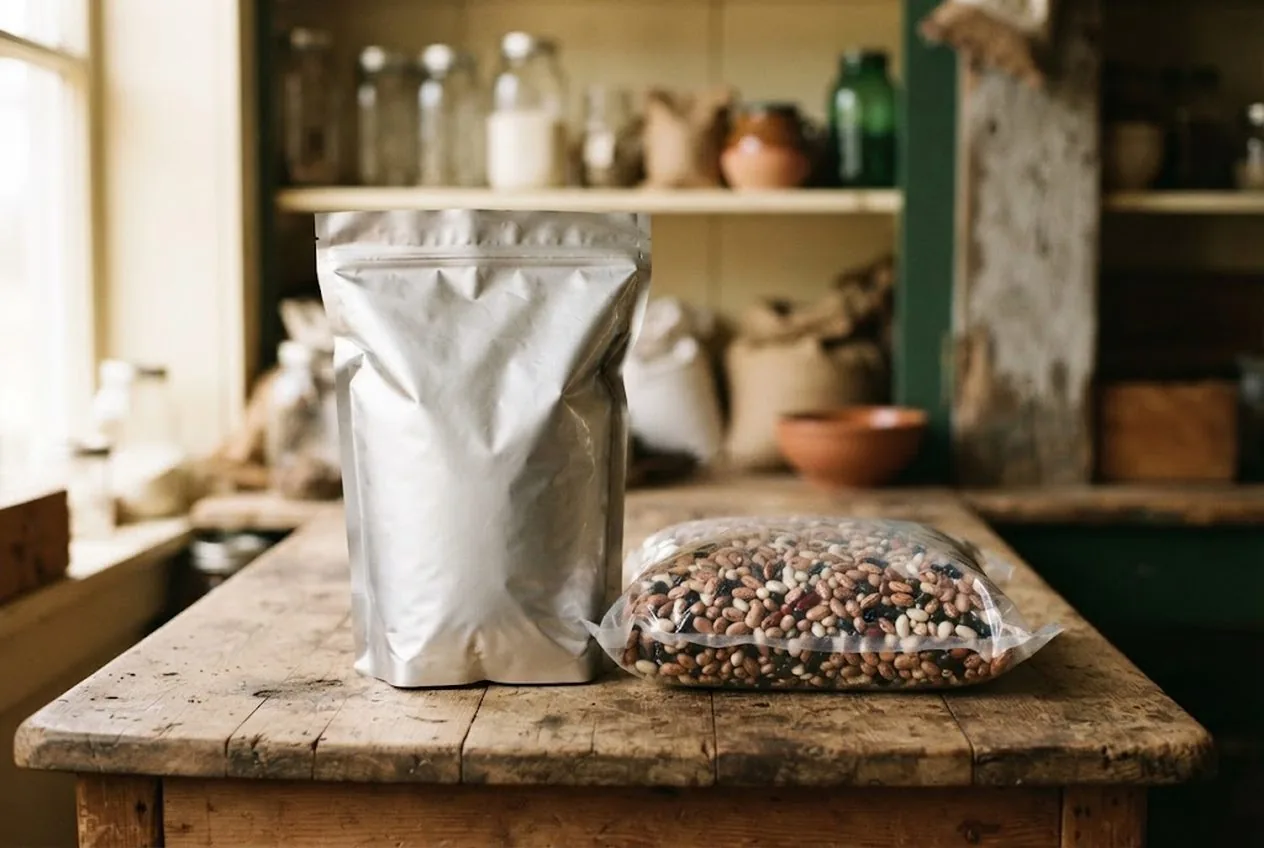
Two silver-and-clear methods dominate home food storage, and they get confused constantly. Mylar bags with oxygen absorbers and vacuum-sealed bags both look like they do the same job — squeeze out the air, lock in freshness — so people reach for whichever they already own and assume the food will keep for years. Then they’re surprised when the vacuum-sealed rice tastes stale years sooner while the neighbor’s Mylar bucket is still perfect a decade on.
The truth is they’re not competitors so much as tools for two different jobs. One is built for deep storage measured in decades; the other for everyday rotation measured in months. Understanding which is which is the difference between a pantry that actually carries you through a hard year and one that quietly fails when you need it.
Short answer: for long-term dry staples, Mylar bags with oxygen absorbers win decisively — up to 30 years versus a far shorter span. For fridge, freezer, and everyday rotation, vacuum sealing wins. Use both, matched to the food.
What Each Method Actually Does
They attack air in fundamentally different ways, and that mechanism decides everything downstream.
Vacuum sealing mechanically sucks the air out of a plastic bag and heat-seals it. It removes most of the oxygen and collapses the bag tight against the food, which slows oxidation, freezer burn, and staling. But two things limit it: it leaves a small amount of residual oxygen behind, and standard vacuum-seal plastic is not a true barrier — oxygen and moisture slowly migrate back through the film over months and years. Utah State University Extension also stresses that vacuum packaging is not a food preservation method by itself (USU Extension).
Mylar plus oxygen absorbers works chemically, not mechanically. The metallized Mylar film is a genuine barrier: its foil layer dramatically reduces the transmission of oxygen and moisture (USU Extension) and blocks light. Sealing still traps air that’s about 21% oxygen (Utah State University Extension), so you add oxygen absorbers — iron-powder sachets (University of Arkansas Extension) that react with that oxygen and lock it away, pulling the interior to nearly zero. The food goes dormant and stays that way for decades because nothing can get back in and there’s nothing left inside to spoil it.
That’s the crux: vacuum sealing reduces oxygen behind a permeable wall; Mylar and absorbers eliminate oxygen behind an impermeable one.
Side-by-Side: Mylar vs Vacuum Sealing
| Mylar + Oxygen Absorbers | Vacuum Sealing | |
|---|---|---|
| Shelf life (dry staples) | Up to 30 years | Far shorter |
| Oxygen removal | Near-total (absorbers) | Most, but residual remains |
| Barrier to re-entry | True barrier — airtight | Permeable — air seeps back |
| Light protection | Complete (opaque) | None (clear plastic) |
| Pest resistance | High (in a bucket) | Low — rodents chew through |
| Best for | Bulk dry staples, decades | Fridge/freezer, rotation |
| Reusable equipment | Iron/straightener, cheap | Sealer machine + bag rolls |
| See the contents | No | Yes |
| Ongoing cost | Bags + absorbers per batch | Bags/rolls per batch |
Read the table as a picture of timeframe and food type, not overall quality. Neither is “better” in the abstract — they’re pointed at different shelves in your kitchen.
Where Mylar Wins: The Deep-Storage Layer
When the goal is calorie insurance that sits untouched for years, Mylar with oxygen absorbers is the answer and vacuum sealing isn’t close. Bulk white rice, wheat, dried beans, oats, and pasta sealed in Mylar and tucked into food-grade buckets keep for 25 to 30 years stored cool and dark (BYU Magazine). That’s the layer that lets you buy staples once and forget them, confident they’ll still be food in decades.
Vacuum sealing simply can’t reach that timeframe for dry goods, because its plastic breathes and its vacuum leaves oxygen behind. Bag some rice in a vacuum sealer and it’ll be noticeably stale long before a Mylar bucket of the same rice has aged at all.
Disclosure: the product links here are affiliate links, so we may earn a commission if you buy through them at no extra cost to you. The shelf-life figures reflect university-extension and long-term-storage research (BYU Magazine), not brand marketing.
For the full walk-through of sizing absorbers and sealing bags, our long-term food storage with Mylar bags and oxygen absorbers guide covers the method step by step, and how to pack a 5-gallon bucket for 25-year storage takes it from sealed bag to finished bucket. Home-dehydrated vegetables qualify for this layer too — our guide to dehydrating the fall harvest shows how to get them dry enough to seal.
Where Vacuum Sealing Wins: Everyday Rotation
Now flip the timeframe. For food you’ll actually eat in the coming weeks and months, vacuum sealing is the clear winner — and Mylar is the wrong tool entirely.
A vacuum sealer shines at exactly what Mylar can’t do:
- Freezer meat and fish — vacuum bags conform to the food and fight freezer burn far better than wrap or zip bags, stretching freezer life dramatically.
- Blanched vegetables and leftovers — portioned, sealed, and dated for quick weeknight meals.
- Bulk-buy portioning — split a warehouse-club purchase into meal-sized packs so nothing spoils before you get to it.
- Cheese, nuts, and coffee — foods that go stale or rancid fast keep noticeably longer sealed.
Because vacuum bags are clear, you can see what’s inside, and because the machine reseals easily, it’s a genuine week-to-week waste-cutting tool. This is the layer that saves money on the food you’re already buying.
Do You Need Both? Almost Certainly Yes
This is the part people miss. Mylar and vacuum sealing aren’t an either/or — they’re two layers of the same pantry.
- Mylar with absorbers is your base layer: bulk dry staples sealed once and stored for decades. It’s the food you hope never to touch.
- A vacuum sealer is your rotation layer: the fridge and freezer food you eat and replace constantly, plus bulk buys you portion to prevent waste.
A resilient kitchen runs both. The Mylar buckets sit in the cool and dark, silent insurance. The vacuum sealer earns its keep every week, trimming the grocery bill and stretching what’s in the freezer. Buying one doesn’t replace the other any more than a spare tire replaces your everyday tires.
So Which Should You Buy First?
Let your immediate goal decide:
- Building a survival food store from scratch? Start with Mylar and oxygen absorbers. Getting bulk rice, beans, and wheat into decades-long storage is the highest-value first move, and the equipment is cheap — an iron and a box of bags and absorbers.
- Trying to cut weekly food waste and stock the freezer? Start with a vacuum sealer. It pays for itself fast in salvaged bulk buys and freezer meat that doesn’t burn.
- Serious about food security overall? Get both, in that order — Mylar first for the foundation, then a sealer for rotation.
Whichever you reach for, match the method to the food: decades-long dry staples go in Mylar; everything you’ll eat soon goes in vacuum bags. If you’re picking a machine, our best vacuum sealer for long-term food storage review breaks down what to look for. Get the pairing right and no single failure — a freezer that dies, a bad year, a bare grocery shelf — leaves you without food.
Frequently Asked Questions
- Do vacuum-sealed bags last as long as Mylar with oxygen absorbers?
- No — not for dry staples. Vacuum sealing removes most of the air but leaves a small amount of residual oxygen, and standard vacuum-seal plastic is not a true oxygen or light barrier, so air slowly migrates back in over time. That's why vacuum-sealed dry goods keep for a far shorter span, while BYU research found dry staples packaged to remove oxygen held acceptable quality for up to 30 years. For decades-long storage, Mylar plus absorbers wins clearly.
- Can you vacuum seal inside a Mylar bag for the best of both?
- You can, but it's usually unnecessary. A Mylar bag with correctly sized oxygen absorbers already pulls the interior to near-zero oxygen and draws tight on its own as the absorbers work, so a vacuum step adds little. Some people use a vacuum sealer with a nozzle to pull air from a Mylar bag before heat-sealing, which is fine, but the oxygen absorbers are what actually deliver the long shelf life — the vacuum is just a head start. Never rely on vacuum alone for a Mylar bag; always add absorbers.
- Which is better for freezer storage, Mylar or vacuum sealing?
- Vacuum sealing, by a wide margin. Vacuum bags are made to conform to food and resist freezer burn, and they're clear so you can see what's inside — ideal for meat, blanched vegetables, and leftovers you'll eat within months. Mylar with oxygen absorbers is the wrong tool for the freezer: it's built for shelf-stable dry staples, not moist or frozen food. Match the method to the food — vacuum for the freezer, Mylar for the dry pantry.
- Is vacuum sealing a waste of money if I already use Mylar?
- Not at all — they solve different problems. Mylar and absorbers are your deep-storage layer for bulk dry staples that sit for decades. A vacuum sealer is your everyday-rotation tool: it extends the fridge and freezer life of meat, cheese, and produce, portions bulk buys, and cuts waste week to week. A well-stocked kitchen uses both, because one preserves the food you'll open in 20 years and the other preserves the food you'll open next month.
- Does vacuum sealing protect against light and pests like Mylar does?
- No. Standard vacuum-seal bags are clear plastic, so they let light through and offer little defense against rodents, which can chew straight through them. Mylar is opaque and metallized, blocking light entirely, and when protected inside a food-grade bucket it also resists pests and punctures. If light exposure or rodents are a concern in your storage space, that's another reason Mylar plus a bucket beats bare vacuum bags for long-term staples.
Sources & references
- BYU Magazine, Ask an Expert: New Tips for Old Food (opens in new tab)
- Utah State University Extension, Packaging Foods (opens in new tab)
- Utah State University Extension, Food Storage: Will I Use It? (opens in new tab)
- University of Arkansas Extension, Getting Started with Long Term Food Storage (opens in new tab)
Before you go
The Renter's Homestead Pack
Self-reliance projects for the yard you don't own — container yields, a raised bed built to move with you, balcony preservation basics, and the landlord questions to ask first.
Free guide
The Renter's Homestead Pack
Self-reliance projects for the yard you don't own — container yields, a raised bed built to move with you, balcony preservation basics, and the landlord questions to ask first.