What’s the short answer?
- A jar seal has failed if the lid flexes when pressed, sounds dull when tapped, or isn't concave at eye level.
- Spurting liquid when opening a jar is a spoilage warning sign, not proof of a good seal.
- Bulging lids, dried food streaks, off odors, unnatural color, and cotton-like mold all mean the food has spoiled.
- Suspect low-acid foods, including home-canned tomatoes, can show little or no spoilage sign even when contaminated, so a good seal is not proof of safety.
- Never taste food from an unsealed jar or one showing spoilage signs; put still-sealed suspect jars in a heavy garbage bag, and detoxify unsealed or leaking ones by boiling 30 minutes before disposal.
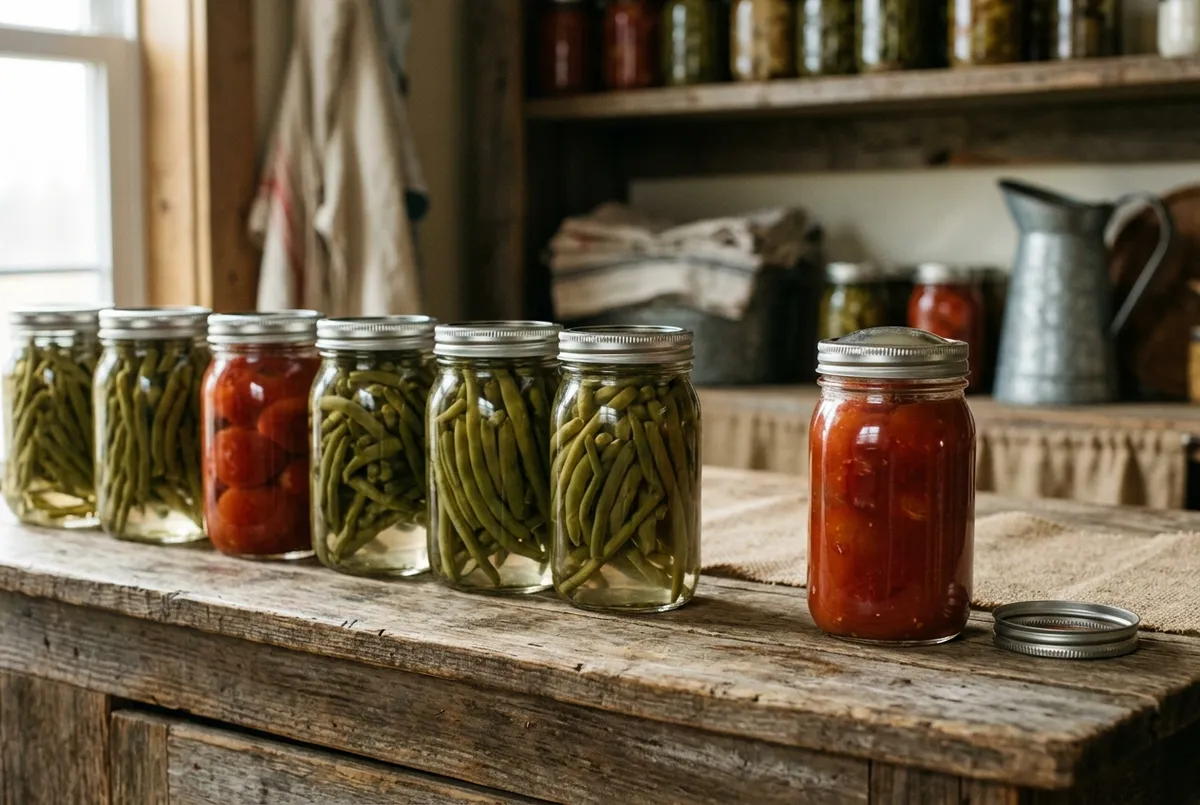
You’re going through the jars you put up this fall, and one lid doesn’t look quite right; it flexes when you press it, or that whole batch of green beans just doesn’t sit the way the ones next to it do. Before you decide whether to eat it, toss it, or worry over nothing, it helps to know exactly what a failed seal looks and sounds like, and what a failed seal does and doesn’t tell you about the food inside. A seal is something you check, not something you assume.
The short answer: A canning jar seal has failed if the center of the lid flexes or pops back up when you press it, makes a dull sound when you tap it with a spoon, or isn’t visibly curved down (concave) at the center when you look at it from the side. But a seal that passes all three tests still isn’t proof the food is safe to eat, so you need to check for spoilage signs too before anything from that jar goes near your mouth.
The Three Official Tests for a Failed Seal
The National Center for Home Food Preservation, drawing on the USDA’s “Complete Guide to Home Canning,” lays out three ways to check whether a jar actually sealed, and all three work on any standard two-piece canning lid (National Center for Home Food Preservation, 2015). None of the three require special equipment. You’re using your own hands, a spoon from the kitchen drawer, and your own eyes, which is part of why it’s worth doing on every jar rather than skipping the ones that “look fine” from across the counter.
The Press Test
Once a jar has cooled fully, remove the screw band and press the center of the flat metal lid with a finger. If the center flexes down and pops back up when you let go, the jar did not seal. A properly sealed lid stays put when you press it; there’s no give left in it because the vacuum inside is holding it down.
The Tap Test
Tap the center of the lid with the bottom of a teaspoon. A high, ringing sound means the lid is pulled down tight by vacuum, which is what you want. A dull, flat-sounding thud means the lid is not sealed and is sitting loose on the jar rim.
The Eye-Level Test
Set the jar on a counter and get down so your eyes are level with the lid, or pick the jar up and look at it from the side. A sealed lid curves down slightly toward the center, like a very shallow bowl turned upside down. If the center looks flat or is bulging upward instead of concave, the seal has not held.
Any one of these three tests failing means the jar is unsealed. Move it to the refrigerator and use it within a few days, or reprocess it with a new lid within 24 hours, rather than storing it on the pantry shelf. It’s worth running all three tests rather than stopping at the first one that seems to pass, since a lid can feel firm under a quick press and still fail the eye-level check, or vice versa. The three together are more reliable than any one alone.
Signs the Food Inside Has Already Spoiled
A failed seal and spoiled food are related but not the same problem, and it helps to know what spoilage looks like separately from the seal itself. The National Center for Home Food Preservation lists several signs that food inside a jar has gone bad, whether or not the seal is currently holding (National Center for Home Food Preservation):
- A lid that’s swollen or bulging upward instead of flat or concave
- Streaks of dried food running down from under the lid to the outside of the jar
- Rising air bubbles inside the jar, or a color that looks off for that food
- Liquid that spurts out when you open the jar
- Cotton-like mold on the surface of the food, in white, blue, black, or green
- Any unnatural or off smell when you open the jar
If you see any of these, the food is spoiled. That holds true even if the lid tested as sealed on all three checks above, because spoilage and seal failure don’t always show up together or in the order you’d expect.
Checking Jars Through the Storage Season, Not Just Once
Most home canners run the seal tests once, right when the jars come out of the canner, and then treat that as settled for the whole storage season. That first check matters, but it isn’t the only one that counts, because gas from spoilage bacteria growing inside a jar is specifically what swells a lid and breaks a seal, and that process can happen well after canning day, not only in the first hours off the canner (National Center for Home Food Preservation). Working back through the shelf periodically, especially as you pull jars for winter meals, gives you a chance to catch a seal that has since failed before you’re standing at the counter deciding whether to trust a jar you haven’t looked at closely in months.
Why Spurting Liquid on Opening Isn’t a Good Sign
It’s tempting to treat any pressure release when you open a jar as proof of a strong seal. That instinct can run backward. Spurting liquid on opening is listed specifically as a spoilage warning sign, not a sign of a healthy vacuum (National Center for Home Food Preservation).
The reason comes down to what’s actually pressurizing the jar. Spoilage bacteria produce gas as they grow, and that gas is what swells lids and eventually breaks a jar’s seal in the first place (National Center for Home Food Preservation). So a seal you find broken weeks or months after canning isn’t always a sign the original processing failed; sometimes it’s a downstream symptom of spoilage that already happened inside the jar. Either way, a jar that spurts liquid on opening should be set aside, not tasted.
When a Good-Looking Seal Doesn’t Mean Safe Food
Here’s the part that surprises a lot of home canners: a seal that looks and sounds perfect is not, by itself, proof the food inside is safe. Spoiled low-acid foods, including home-canned tomatoes, may show very little spoilage evidence, which is why suspect jars are treated as having produced the toxin that causes botulism (National Center for Home Food Preservation).
That’s a hard rule, not a maybe. You cannot smell, see, or taste your way to confirming a suspect jar of low-acid food is safe, and you should not try (CDC). The official guidance is explicit: do not taste food from a jar with an unsealed lid, or food that shows any of the spoilage signs above (National Center for Home Food Preservation).
This is also why judging a jar by how it smells on opening is not a reliable safety test on its own for low-acid canned goods. Smell is a reasonable check for a lot of things in a kitchen. It is not reliable here, and treating it as one is how people get hurt.
What To Do With a Suspect Jar
If a jar of low-acid food, like tomatoes, green beans, or a meat-based recipe, fails a seal check in storage or shows any spoilage sign, the guidance is to treat it as hazardous rather than inspect it further. There are two ways to handle disposal (National Center for Home Food Preservation):
- If the jar is still sealed, place it in a heavy garbage bag and discard it without opening it, so nothing inside contacts your hands, counters, or drain.
- If the jar is unsealed, open, or leaking, detoxify it before disposal: wearing gloves, boil the jar, lid, and contents for 30 minutes.
Either path keeps you from being exposed to what might be inside. Neither one involves tasting the food to decide, and that’s the point: the decision gets made by the seal test and the visible spoilage signs, not by a taste test that low-acid foods specifically can’t be trusted to catch.
If you’re working through a stack of jars from this year’s harvest and want a system so uncertain jars like this don’t pile up, a FIFO pantry rotation makes it easier to track what was canned when, so nothing sits unchecked at the back of a shelf for an extra season. And if canning meat or produce at home is new to you this year, how to can beef and meat at home covers the low-acid processing basics that make seal failures less common in the first place.
Keeping the Rest of Your Preserved Food Safer
Seal testing is a habit worth building into how you handle every batch, not just the jars that already look questionable. Checking lids as jars finish cooling, before they ever go on the shelf, catches failed seals early, while there’s still time to refrigerate that jar or reprocess it with a new lid instead of finding out months later. For food you’ve already moved past canning, like vacuum-sealed items sitting in the same pantry, the same instinct applies: check seals and packaging on a schedule rather than assuming everything is fine because nothing looks wrong from across the room. Our review of whether a vacuum sealer is worth it for long-term storage walks through how that equipment handles its own kind of seal check.
None of this is about being anxious over every jar in the pantry. It’s about knowing which three physical checks actually tell you a seal held, which visible signs mean the food inside has spoiled regardless of the seal, and which foods, low-acid ones especially, don’t give you a reliable warning at all. Run the press, tap, and eye-level checks on the jars you’re unsure about this week, set aside anything that fails or shows a spoilage sign, and handle a suspect low-acid jar as hazardous rather than trying to inspect your way to an answer a seal test can’t give you.
Frequently Asked Questions
- What does a bad canning jar seal actually look or sound like?
- The lid flexes or pops back up when you press the center, it makes a dull thud instead of a ringing sound when tapped with a spoon, and it looks flat or bulged instead of concave when viewed at eye level.
- Is it safe to eat home-canned food if the lid pops when opened?
- Not on the strength of the pop alone. Spurting liquid when you open a jar is listed as a spoilage warning sign, not confirmation of a good seal, so treat it as a reason to set the jar aside rather than eat from it, and check for the other listed spoilage signs before eating anything.
- Can a jar seal look fine on the outside but still be spoiled inside?
- Yes. Spoiled low-acid foods, including home-canned tomatoes, may show very little spoilage evidence, which is why suspect jars are treated as if they contain the toxin that causes botulism, so a good-looking seal alone is not proof the food is safe.
- What should I do with a jar of home-canned tomatoes I'm not sure about?
- Treat it as hazardous: if the jar is still sealed, place it in a heavy garbage bag and discard it without opening it; if it is unsealed, open, or leaking, detoxify the jar, lid, and contents by boiling them for 30 minutes before disposal.
- Is it true you can't always tell if canned food has botulism just by looking?
- Yes. Spoiled low-acid foods may show very little spoilage evidence, so suspect jars are treated as if the botulism-causing toxin is present, which is why the rule is to never taste food from an unsealed jar or one showing any spoilage sign.
Sources & references
Before you go
The Renter's Homestead Pack
Self-reliance projects for the yard you don't own — container yields, a raised bed built to move with you, balcony preservation basics, and the landlord questions to ask first.
Free guide
The Renter's Homestead Pack
Self-reliance projects for the yard you don't own — container yields, a raised bed built to move with you, balcony preservation basics, and the landlord questions to ask first.