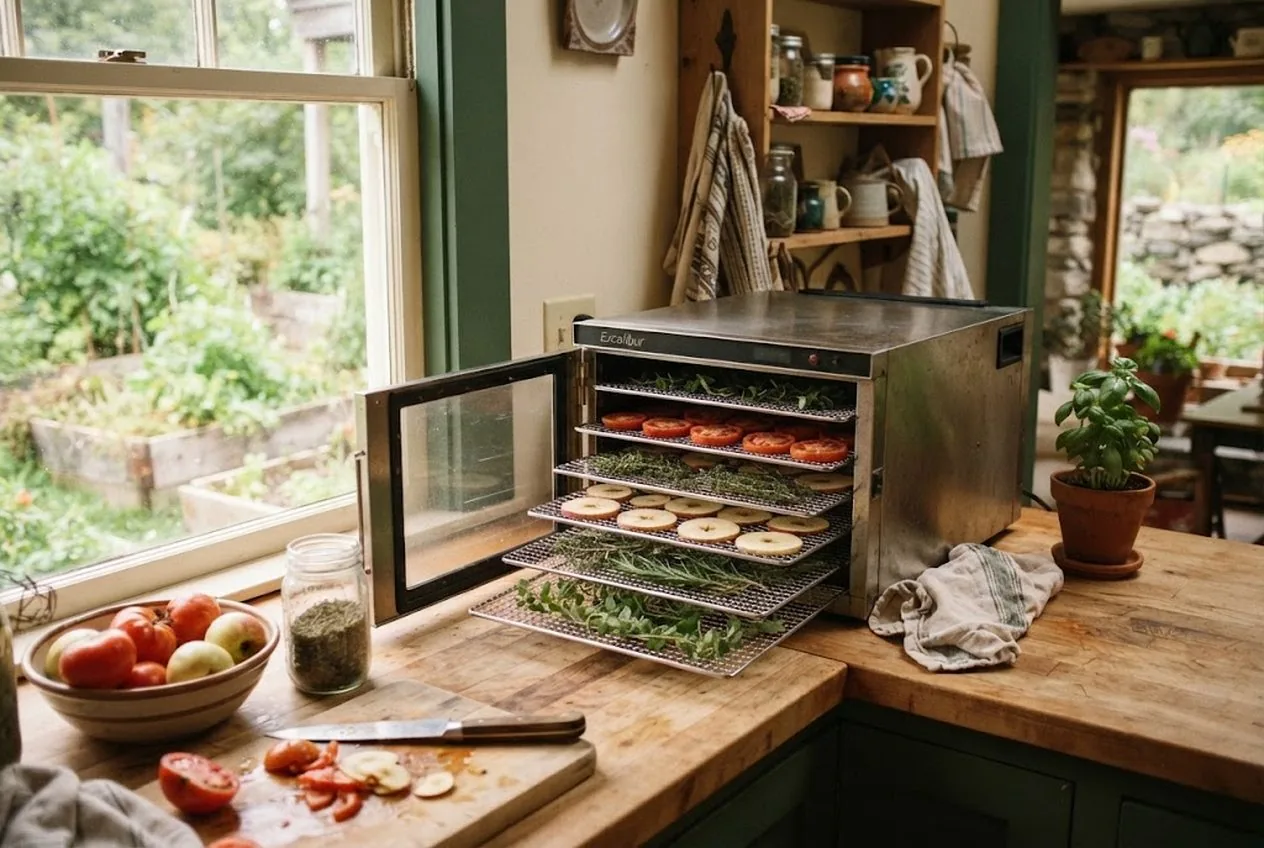
A dehydrator is the quiet workhorse of harvest season. It turns a glut of tomatoes into intense, pantry-stable flavor bombs, surplus apples into weeks of snacks, and a bolting herb bed into jars of seasoning that outlast the growing year — all at a fraction of the effort of canning, and with no botulism math to worry about. But the market runs from bargain-bin disappointments to commercial cabinets, and the differences that matter aren’t the ones on the box.
Short answer: for most backyard growers, a stainless-steel shelf-tray dehydrator with horizontal airflow and a real thermostat is the pick, and the COSORI Premium is the model that nails that combination at a home-friendly price. Below is why that design wins, where a stackable Nesco makes more sense, and what to avoid in the bargain bin.
Disclosure: the product links here are affiliate links, so we may earn a commission if you buy through them at no extra cost to you. This assessment is built from manufacturer specifications and the cited sources, not a multi-year test of every unit in our own kitchen.
What Actually Matters in a Dehydrator
Before naming picks, it’s worth knowing which specs earn their keep and which are noise. Four things separate a dehydrator that saves your harvest from one that frustrates you:
- Airflow direction. Horizontal airflow (a fan on the back wall pushing across every shelf) dries all trays evenly with no rotating. Vertical airflow with the fan at the base can let flavors blend and liquids drip into the heating element (NCHFP); some stackables use a top-mounted fan instead. This is the single biggest quality-of-life difference.
- Temperature range and control. A real adjustable thermostat spanning roughly 95–165°F lets you dry herbs low and fruit and vegetables at the 140°F dehydrators are designed for, and finish jerky properly (NCHFP says the meat must also reach an internal 160°F). Fixed-temperature units can’t do this, and it’s a common reason budget models disappoint.
- Tray material and capacity. Stainless-steel trays shrug off sticky fruit and clean easily; plastic stains and can warp. More square footage means fewer batches during a heavy week.
- Noise and a timer. A dehydrator runs for hours, sometimes overnight. A quiet unit with a shut-off timer is far easier to live with than a loud one you have to babysit.
Hold every unit up to those four, and the field sorts itself out quickly.
The Top Pick: COSORI Premium Food Dehydrator
The Cosori Premium hits all four marks. Its rear-mounted fan drives horizontal airflow across the trays, so a full load of tomatoes dries evenly without the tray-shuffling ritual. The thermostat covers the full 95–165°F range, meaning one machine takes you from delicate basil to fruit leather to jerky. The six stainless-steel trays wipe clean after the stickiest peaches, and a built-in 48-hour timer lets you load it at bedtime and walk away. COSORI rates it at less than 48 dB in operation (COSORI).
Its only real “cost” is exactly that — price. It sits above the stackable crowd. But for a grower who dries food every week through the season, the even drying and stainless durability make it the unit you stop thinking about, which is the highest compliment a tool earns.
Pros
- Horizontal airflow dries every tray evenly — no rotating
- Full 95–165°F thermostat covers herbs, veg, fruit, and jerky
- Stainless-steel trays clean easily and won't stain or warp
- Timer with auto shut-off for hands-off overnight batches
- Rated by COSORI at under 48 dB in operation
Cons
- Costs more than stackable units
- Takes up real counter and storage space
- Six trays may be too much for very occasional use
The Stackable Alternative: Nesco FD-75A Snackmaster
Not everyone needs a cabinet. If you dry food in occasional bursts rather than an all-season pipeline, a stackable unit is lighter, cheaper, and packs away in a cupboard. The Nesco FD-75A Snackmaster is the long-running favorite here: a top-mounted fan and adjustable thermostat (95–160°F), expandable from 5 to 12 trays when a big batch lands, and a genuinely low price of entry. Nesco says its Converga-Flow fan pushes heated air down the outside and then across each tray, so no tray rotation is needed, and the top-mounted fan keeps liquids from dripping into the heater (NESCO).
The trade-offs are plastic trays instead of stainless and a temperature ceiling of 160°F rather than 165°F. For herbs, apple slices, and modest batches, none of that is a dealbreaker, and the Nesco has a long-running following for good reason.
The Budget Route: What You Give Up
The bargain bin is where most first-time buyers get burned. A generic sub-$50 dehydrator can absolutely dry food — but the corners it cuts are exactly the four that matter. Some have a fixed temperature (so herbs scorch and jerky under-dries), thin plastic trays that stain and warp, and no timer. If your budget is genuinely tight, a basic food dehydrator (Amazon) will get you started and teach you the craft — just go in knowing you’ll likely want to upgrade once your harvest outgrows it.
How to Actually Dry Your Harvest
Whichever unit you pick, the technique is the same. Slice food evenly — uniform thickness dries uniformly — and match the temperature to the food: herbs low, and most fruit and vegetables at 140°F, the temperature dehydrators are designed for (NCHFP). For jerky, heat the meat to an internal 160°F (in marinade before drying, or in the oven afterward) and dry at 140°F (NCHFP). Dry vegetables until brittle, fruit until leathery with no beads of moisture when you squeeze a piece.
For fruit, add one extra step: conditioning. Pack the cooled, dried fruit loosely in sealed jars for 7 to 10 days, shaking daily; if any condensation appears, the fruit goes back in the dehydrator (NCHFP). That step catches hidden moisture that would otherwise spoil a whole jar in storage. Store finished food airtight in a cool, dark place — and for the long haul, sealing it with the oxygen removed extends shelf life further, which we cover in our long-term food storage with Mylar bags and oxygen absorbers guide.
The Bottom Line
For preserving a real garden harvest, the COSORI Premium is the confident recommendation: horizontal airflow, a full temperature range, stainless trays, and a timer add up to a machine that dries evenly and disappears into your routine. Choose the Nesco Snackmaster if you dry only occasionally and want to save money and space, and treat a bare budget unit as a learning tool rather than a keeper.
Dehydrating is one of the most flexible skills in a self-reliant kitchen — no pressure gauges, no acid math, just low heat and airflow. If you’d rather run it off-grid, our DIY solar food dehydrator build does the same job on sunshine alone, and our guide to food preservation without electricity shows where drying fits alongside canning and cold storage in a pantry that doesn’t depend on the grid.
Frequently Asked Questions
- What's the best food dehydrator for preserving a garden harvest?
- For most backyard growers, a stainless-steel, shelf-tray dehydrator with a rear-mounted fan and a real thermostat — like the Cosori Premium — is the sweet spot. Horizontal airflow dries every tray evenly so you don't have to rotate them, the temperature range handles everything from herbs to jerky, and stainless trays clean easily after sticky fruit. It costs more than a stackable unit but earns it in even drying and durability.
- What temperature do you dehydrate vegetables and fruit at?
- The National Center for Home Food Preservation notes dehydrators are designed to dry foods at 140°F, which covers most fruit and vegetables; delicate herbs go lower. For jerky, NCHFP says the meat must reach an internal 160°F (heated in marinade before drying, or in the oven afterward) and then dry at 140°F. A dehydrator with an adjustable thermostat across roughly 95–165°F covers every food a garden and kitchen produce. Cheap units with a single fixed temperature can't adjust, which is a common reason a budget dehydrator disappoints.
- Are stackable dehydrators worse than shelf-tray ones?
- Not worse, just different. Stackable units like the Nesco Snackmaster are lighter, cheaper, and store compactly; Nesco says its top-mounted Converga-Flow fan pushes air across each tray so no rotation is needed, while units with a fan at the base can let liquids drip into the heating element. Shelf-tray units with horizontal airflow dry evenly without rotation and handle bigger, wetter loads. For occasional batches, stackable is fine; for heavy harvest-season use, a shelf-tray unit saves fuss.
- How long does dehydrated food last?
- Properly dried and stored in a cool, dry, dark place, dried foods keep roughly 4 months to a year, per the National Center for Home Food Preservation: most dried fruit about 1 year at 60°F or 6 months at 80°F, and vegetables about half as long. The key is drying thoroughly — until vegetables are brittle and fruit is leathery with no moisture beads — and conditioning fruit before storage so no hidden moisture causes spoilage.
- Is a food dehydrator worth it versus an oven or the sun?
- For anything more than an occasional tray, yes. An oven may not hold a low enough temperature and ties up your kitchen for hours; sun drying is free but slow and weather-dependent. A dedicated dehydrator holds a precise low temperature with steady airflow, which dries food faster, more evenly, and more safely, and it uses modest power doing it.
Sources & references
- National Center for Home Food Preservation, Food Dehydrators (opens in new tab)
- National Center for Home Food Preservation, Packaging and Storing Dried Foods (opens in new tab)
- National Center for Home Food Preservation, Jerky (opens in new tab)
- COSORI, Premium 6-Tray Stainless Steel Food Dehydrator (opens in new tab)
- NESCO, FD-75PR Snackmaster Pro Food Dehydrator (opens in new tab)
Before you go
The Renter's Homestead Pack
Self-reliance projects for the yard you don't own — container yields, a raised bed built to move with you, balcony preservation basics, and the landlord questions to ask first.
Free guide
The Renter's Homestead Pack
Self-reliance projects for the yard you don't own — container yields, a raised bed built to move with you, balcony preservation basics, and the landlord questions to ask first.