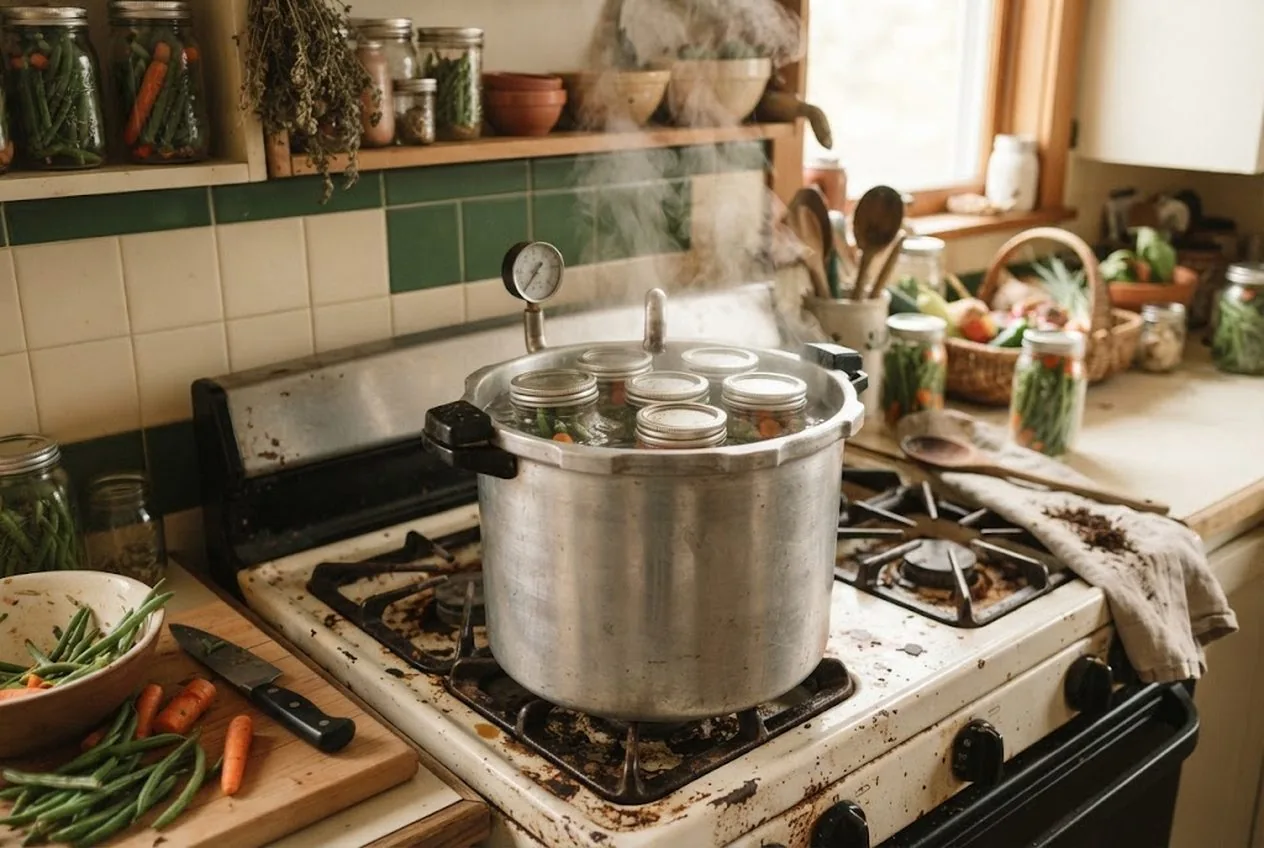
When the fall garden comes in all at once — bushels of green beans, a wall of tomatoes, carrots and potatoes by the crate — a pressure canner is what turns that glut into a pantry that feeds you through winter. And in kitchen after kitchen, the canner doing that work is a Presto. It’s the aluminum workhorse that’s been putting up harvests for generations.
This is a single-product review: what the Presto pressure canner does well, where its limits are, and whether it’s the right canner to buy for a real fall harvest. If you’re still deciding between water-bath and pressure canning at all, start with our water-bath vs. pressure canning guide — this review assumes you already know you need the pressure canner for low-acid foods.
Short answer: the Presto is a proven, affordable, genuinely capable pressure canner that safely puts up low-acid vegetables, beans, and meat, doubles as a water-bath canner, and is backed by easy-to-find parts. Its one recurring chore — the annual dial-gauge check on that model — is minor. For most fall-harvest kitchens, it’s the default first canner.
Disclosure: the product links here are affiliate links, so we may earn a commission if you buy through them at no extra cost to you. This assessment is built from manufacturer specifications, long-standing USDA and university-extension canning guidance, and the cited sources — not a multi-year test of every model in our own kitchen.
Why a Pressure Canner at All
It’s worth restating the safety logic, because it’s the entire reason this tool exists. A boiling-water bath tops out at 212°F, which is safe only for high-acid foods like fruit, jam, and pickles. Low-acid foods — green beans, corn, carrots, beans, meat — can harbor the heat-resistant spores of Clostridium botulinum, and destroying those spores requires about 240°F, a temperature only a pressure canner reaches by trapping steam under pressure (National Center for Home Food Preservation).
There is no practical substitute and no workaround: the same source estimates a boiling-water canner would need 7 to 11 hours to safely process low-acid foods. If your fall harvest includes plain vegetables or you want to can meat and soups, a pressure canner isn’t optional. The Presto’s whole job is to hit and hold that 240°F reliably, batch after batch.
Capacity: Sizing It to Your Harvest
The Presto canners come in two common sizes, and choosing between them is really a question of how much you grow.
- The larger 23-quart is the harvest workhorse. It holds a double stack of pint jars (20 pints, or 7 quarts), so you process far more jars per cycle (Presto) — a huge time saver when you’re staring down a mountain of green beans. It’s heavier and wants a sturdy burner, but for a productive garden it’s the size that saves you hours.
- The smaller 16-quart is lighter, stores more easily, and fits compact stovetops. It’s the sensible pick for smaller harvests, tighter kitchens, or anyone who cans in modest batches.
For most people putting up a genuine fall harvest, the 23-quart is the better long-term buy — the capacity turns an all-day marathon into a manageable afternoon.
Living With It: Ease of Use
Pressure canning has a reputation for being intimidating, and the Presto does a lot to defuse that. The routine becomes second nature within a batch or two:
- Vent the canner — let steam flow steadily for the required time (10 minutes) to purge air (National Center for Home Food Preservation).
- Bring it to pressure and hold the correct pressure for your food and altitude.
- Watch the gauge and adjust the heat to keep pressure steady.
- Let it cool naturally until the pressure drops on its own before opening.
On the dial-gauge models, the one recurring bit of upkeep is having the gauge tested for accuracy once a year — many county Cooperative Extension offices can check it (National Center for Home Food Preservation). A weighted-gauge version skips that entirely by regulating pressure mechanically, which some canners prefer for exactly that reason. The gasket and overpressure plug are wear parts, but they’re cheap and easy to find, which is a real advantage over off-brand canners whose spares can vanish.
One Pot, Both Jobs
A point that’s easy to miss: because it’s a tall pot, the Presto also works as a boiling-water-bath canner for high-acid foods. Used unsealed — lid vented, jars covered by boiling water — it processes jam, pickles, and acidified tomatoes just like a dedicated water-bath canner (Presto). That means a single purchase covers both methods, which is why we call the pressure canner the smarter one-canner choice for anyone serious about a full pantry. Our beginner walkthroughs of water-bath canning the summer harvest and water-bath canning tomatoes both run exactly the same in this pot.
You will need the small hand tools, though, and they matter more than beginners expect. A jar lifter, a canning funnel, a bubble remover, and a magnetic lid wand make the work fast and burn-free — fishing hot jars out with tongs is how people get hurt and drop batches.
Pros and Cons
Pros
- Reaches and holds the ~240°F needed to safely can low-acid foods
- Large capacity — the 23-quart handles a serious harvest per batch
- Doubles as a boiling-water-bath canner for high-acid foods
- Widely available, affordable replacement parts (gaskets, gauges)
- Proven, generations-old design that's easy to learn
Cons
- Dial-gauge models need an annual accuracy check
- Heavy when loaded, and wants a sturdy burner
- Standard aluminum models aren't induction compatible; you need the stainless steel-clad-base version
- The process asks you to learn a routine — more steps than a water bath
Who Should Buy One — and Who Shouldn’t
Buy it if you grow a real fall harvest of low-acid vegetables, or you want to can beans, meat, and soups. In that world the Presto is close to the default answer: capable, affordable, serviceable, and forgiving to learn. Size up to the 23-quart if your harvest is substantial and you’ll can often.
Think twice if you only ever make jam, pickles, and acidified tomatoes — high-acid foods need only a cheaper water-bath setup, so a pressure canner is more than you need. And if you cook exclusively on induction, confirm you’re getting the model with the stainless steel-clad base (Presto) before buying.
The Bottom Line
The Presto pressure canner does the hard part of fall preservation genuinely well: it hits the safe 240°F for low-acid foods, swallows a big batch of jars, moonlights as a water-bath canner, and keeps running for decades because parts are always at hand. The lone recurring chore — the annual dial-gauge check — is trivial against what it lets you store. For a kitchen facing down a real garden harvest, it’s a confident recommendation.
Canning is only one layer of putting up the season, of course. Pair it with cold storage from our fall vegetables for root cellar storage list, and lean on our off-grid food storage without a fridge or generator guide to see how a canner earns its keep even when the power’s out — you can run one over propane or a wood stove and keep preserving through a grid-down stretch.
Frequently Asked Questions
- Which Presto pressure canner size is best for a fall harvest?
- For putting up a garden harvest, the larger 23-quart canner is usually the better buy — it holds a double stack of pint jars, so you process far more jars per batch and spend less time overall. The smaller 16-quart is lighter, easier to store, and fits smaller stovetops, which suits apartment kitchens or occasional canners. If your fall harvest is substantial and you'll can regularly, the extra capacity of the 23-quart pays for itself in saved hours at the stove.
- Does a Presto pressure canner need its gauge tested?
- If it's a dial-gauge model, yes — have the dial gauge checked for accuracy once a year, since a dial that reads wrong can leave food unsafe or overcooked. Many county Cooperative Extension offices can check them, or you can contact the canner manufacturer. Weighted-gauge canners don't need testing because the weight itself regulates pressure mechanically. This annual check is the one recurring bit of upkeep a dial-gauge canner asks of you, and it takes only a few minutes.
- Can a Presto pressure canner also do water-bath canning?
- Yes. Used without sealing it to pressure — lid vented and jars covered by boiling water — a tall pressure canner works as a boiling-water-bath canner for high-acid foods like jam, pickles, and acidified tomatoes. That versatility is a big part of the value: one pot covers both low-acid pressure canning and high-acid water-bath canning, so it can be the only canner you buy.
- Is the Presto pressure canner induction compatible?
- The standard aluminum Presto canners are not induction compatible on their own, because aluminum isn't magnetic — they're designed for regular and smooth-top ranges. Presto offers a 23-quart model with a stainless steel-clad base built to work on induction ranges. If you cook on induction, confirm the specific model or plan on the stainless option before you buy.
- Is a Presto pressure canner worth it compared to a cheaper canner?
- For most home canners, yes. Presto's canners are widely used, reasonably priced for what they do, and backed by easy-to-find replacement parts like gaskets and gauges — which matters for a tool you'll own for years. A bargain canner can save money upfront but often costs more later in scarce parts and less reliable sealing. For safely putting up low-acid vegetables and meat, a proven canner with available spares is money well spent.
Sources & references
- National Center for Home Food Preservation, Ensuring Safe Canned Foods (opens in new tab)
- National Center for Home Food Preservation, Recommended Canners (opens in new tab)
- Presto, 23-Quart Pressure Canner and Cooker (opens in new tab)
- Presto, 23-Quart Induction Compatible Pressure Canner (opens in new tab)
Before you go
The Renter's Homestead Pack
Self-reliance projects for the yard you don't own — container yields, a raised bed built to move with you, balcony preservation basics, and the landlord questions to ask first.
Free guide
The Renter's Homestead Pack
Self-reliance projects for the yard you don't own — container yields, a raised bed built to move with you, balcony preservation basics, and the landlord questions to ask first.