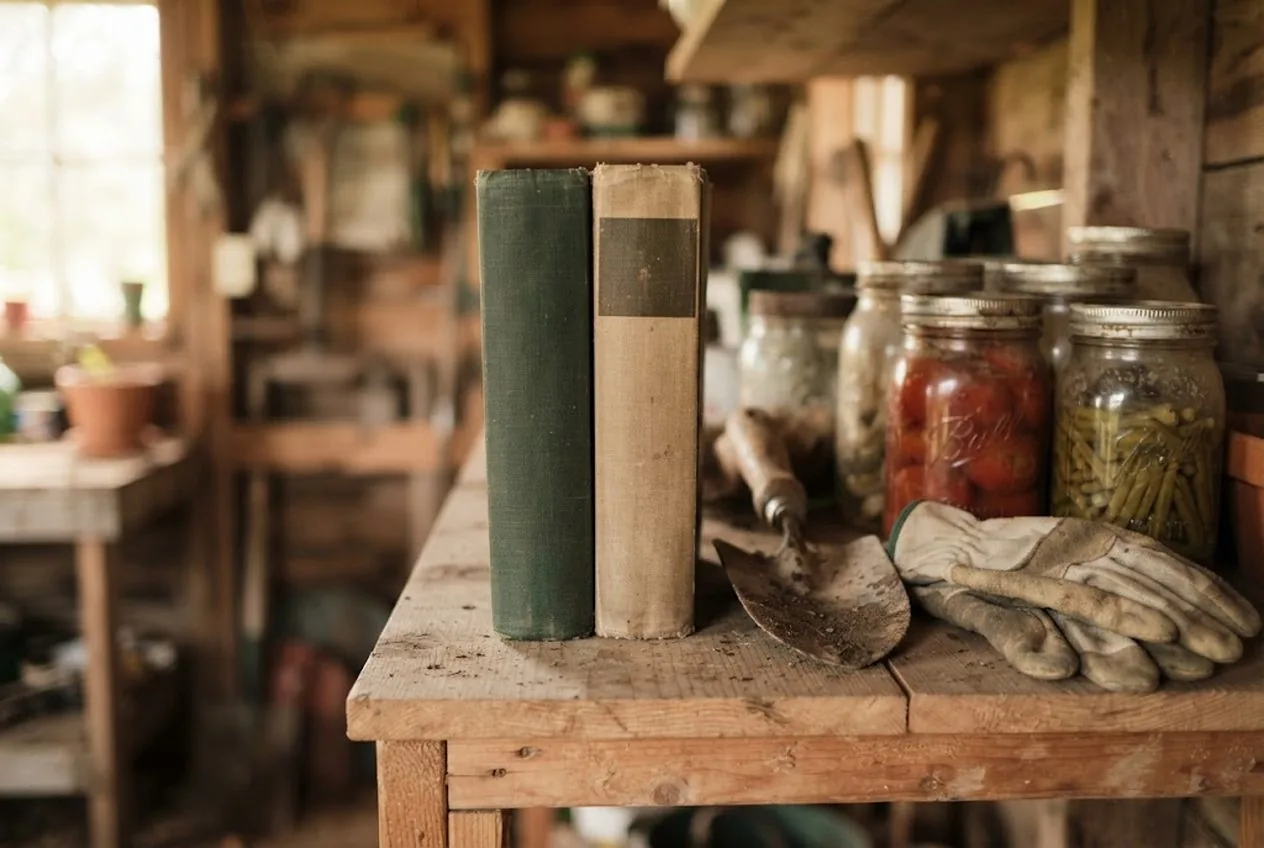
Every homesteader eventually wants one thing on the shelf: a reference they can pull down when a question comes up and the internet isn’t an option. Two books dominate that role, and they come up in the same breath so often that people assume they’re interchangeable. They’re not. Storey’s Basic Country Skills and The Backyard Homestead are built on different premises, and picking the right one — or knowing why you’d own both — comes down to what you’re actually trying to do.
Short answer: Storey’s Basic Country Skills is the broad, all-in-one self-reliance encyclopedia — a little of everything from gardening to building to animals to water systems — while The Backyard Homestead is the focused, deeper guide to producing a lot of food on a small suburban lot. Want one book that covers country living top to bottom? Storey’s. Want to feed your family from a quarter-acre yard? The Backyard Homestead. Here’s how they really compare.
Disclosure: this comparison reflects the content and reputation of both books rather than a page-by-page audit of every edition, and the product links here are affiliate links. With that said, here’s the head-to-head.
Storey’s vs The Backyard Homestead: Side-by-Side
| Storey’s Basic Country Skills | The Backyard Homestead | |
|---|---|---|
| Core focus | Broad country self-reliance | Food production on a small lot |
| Scope | Very wide — gardening, animals, food, building, tools, water systems | Narrower — growing and raising food, preserving it |
| Depth per topic | Overview-plus; a reference to grow into | Deeper and more actionable on food |
| Best for | An all-purpose homestead reference shelf | Suburban beginners maximizing a backyard |
| Format | Thick, encyclopedic reference | Organized around a realistic food goal |
| Prepping overlap | High — water, animals, preserving | Moderate — food production and storage |
| Ideal reader | Rural or aspiring, wants breadth | Small-lot owner, wants a food plan |
The two decisive rows are core focus and depth per topic — and they pull in opposite directions, which is exactly why this is a real choice rather than a tie.
The Case for Storey’s Basic Country Skills
Storey’s pitch is breadth. It’s the closest thing homesteading has to a single-volume encyclopedia of self-reliance, sweeping across gardening, raising animals, food preservation, rural building and repair, tools, water systems, and the general craft of country living (Hachette Book Group). When a question comes up that you didn’t expect — how to approach a fence, what to know before keeping a particular animal, how food preservation methods differ — Storey’s almost certainly has a section on it. That coverage is what makes it a reference you grow into: it stays useful as your interests widen, because it already anticipated most of them.
That breadth is also its overlap with prepping and off-grid living. The same chapters that serve a homesteader — water, animals, food storage, building — are exactly the competencies preparedness leans on. A printed volume this comprehensive is a resilience asset in its own right: it answers questions when the grid, and your phone, are down.
The honest caveat is the flip side of breadth: on any one topic, Storey’s gives you a strong overview rather than the last word. It’ll get you competent and pointed in the right direction on dozens of subjects, but a keeper who goes deep on, say, beekeeping or canning will eventually want a dedicated title for that craft. Think of Storey’s as the hub of a reference shelf, not the only spoke.
The Case for The Backyard Homestead
The Backyard Homestead wins on focus. It’s built around one concrete, motivating promise — that you can produce a surprising amount of your own food on a small suburban lot — and it organizes everything toward that goal. Rather than a little of everything, you get a deeper, more actionable treatment of the thing most new homesteaders actually start with: growing vegetables and fruit, and often keeping a few small animals, in the space of an ordinary backyard. It shows you what to plant where, how much a small plot can yield, and how to preserve the surplus with canning, drying, and pickling (Hachette Book Group). (For a hands-on first taste of that preserving side, our step-by-step guide to dehydrating the fall harvest is an easy weekend project.)
That focus makes it the gentler on-ramp for a suburban beginner. Instead of the slightly daunting sprawl of an encyclopedia, you get a clear plan tied to a realistic outcome, which is exactly what a first-year grower needs for direction and momentum.
Its limit is the mirror image of Storey’s: because it’s focused on food, it doesn’t try to cover the wider world of rural building, tools, water systems, and general country skills. That’s a feature if food is your goal and a gap if you want one book for everything. The Backyard Homestead makes you productive fast in a defined lane; it doesn’t pretend to be the whole shelf.
Do You Need Both?
You can thrive with just one — the right one for your goal — but these two complement each other unusually well, which is why a lot of serious homesteaders end up owning both. The Backyard Homestead drives the food-production plan: it’s the book you work from in the garden and the coop, season by season. Storey’s fills in everything around the food: the building, the tools, the animals beyond the basics, the water and preservation questions a maturing homestead runs into. Together they answer nearly every question a new homesteader hits in the first few years, and both keep working when the internet doesn’t.
If you’re going to buy one first, let your goal decide. A small-lot owner who wants to grow and raise food should start with The Backyard Homestead for its focus and momentum, then add Storey’s as the deeper reference they grow into. Someone drawn to broad country self-reliance — or building toward rural or off-grid living — should start with Storey’s and add The Backyard Homestead when food production becomes the priority.
Why a Printed Reference Belongs in a Prep Kit
It’s worth stating plainly, because it’s easy to dismiss a book in an age of instant answers: a printed homesteading reference is itself a piece of preparedness. It works when the power’s out, the network’s down, and your phone is dead — the exact conditions in which reliable how-to information is most valuable and hardest to get, since outages can disrupt communications (Ready.gov). Skills matter more than gear, and a good reference is how skills survive a bad day. Keep one on the shelf beside the first-aid skills every prepper should practice, and you’ve got knowledge that doesn’t depend on the grid staying up. If your interest tilts toward frontier-era techniques and old-time remedies, our Lost Frontier Handbook review weighs another popular candidate for that same shelf.
The Verdict
- Best all-purpose self-reliance reference: Storey’s Basic Country Skills — the broad encyclopedia to grow into, and the stronger pick for prepping and off-grid overlap.
- Best focused guide for feeding your family from a small lot: The Backyard Homestead — deeper and more actionable on food, and the gentler start for a suburban beginner.
Neither is a wrong buy; they’re aimed at different goals. Choose Storey’s for breadth and long-term reference value, The Backyard Homestead for a focused, food-first start — and if you’re building a real reference shelf, the two together are hard to beat. For the deep-preparedness end of that shelf, our Ultimate Guide to Rebuilding Civilization review covers the most ambitious of the survival manuals. Whichever you pick, pair the reading with the doing: our room-by-room blackout kit guide turns homestead know-how into a household that’s actually ready.
Frequently Asked Questions
- What's the real difference between these two homesteading books?
- Scope. Storey's Basic Country Skills is a broad self-reliance encyclopedia — it spans gardening, animals, food preservation, building, tools, water systems, and country living in one thick reference, giving you a little of everything. The Backyard Homestead is narrower and deeper on one thing: producing a lot of food on a small suburban lot. If you want a single all-purpose country-living reference, Storey's is the pick; if your goal is maximizing food from a quarter-acre backyard, The Backyard Homestead is more focused and practical.
- Which book is better for a total beginner?
- The Backyard Homestead is the gentler on-ramp for most suburban beginners because it's organized around a realistic goal — feeding your family from a small yard — and shows exactly what to plant and raise where. Storey's Basic Country Skills is more of a comprehensive reference you grow into; it's fantastic to own, but its breadth can feel like a lot at once. Many people start with The Backyard Homestead for direction, then keep Storey's on the shelf as the deeper reference they reach for as their skills expand.
- Do I need both books or just one?
- You can absolutely thrive with one, and which one depends on your goal — food-from-a-small-lot points to The Backyard Homestead, broad country self-reliance points to Storey's. That said, they complement each other unusually well: The Backyard Homestead drives the food-production plan, and Storey's fills in the wider skills — building, animals, tools, preserving, water — that a homestead eventually needs. If you're building a genuine reference shelf, owning both covers nearly every question a new homesteader hits.
- Are these books useful for prepping and off-grid living, not just homesteading?
- Yes, especially Storey's Basic Country Skills, which covers self-reliance topics — water, food preservation, animals, and rural building — that overlap heavily with prepping and off-grid living. The Backyard Homestead is more strictly about food production, but that's a core prepping skill too, since growing and preserving your own food is one of the most durable forms of resilience. Neither is a survival-specific manual, but both build the practical, hands-on competence that underpins real preparedness.
- Are printed reference books worth it when everything is online?
- For preparedness, very much so. A printed reference works when the power's out, the internet's down, and your phone is dead — precisely the conditions in which you most need reliable how-to information. Online sources are convenient day to day, but they vanish the moment the grid does. A well-chosen homesteading reference on the shelf is a piece of resilience in itself: durable, searchable by hand, and never dependent on a network staying up to answer your question.
Sources & references
Before you go
The Renter's Homestead Pack
Self-reliance projects for the yard you don't own — container yields, a raised bed built to move with you, balcony preservation basics, and the landlord questions to ask first.
Free guide
The Renter's Homestead Pack
Self-reliance projects for the yard you don't own — container yields, a raised bed built to move with you, balcony preservation basics, and the landlord questions to ask first.