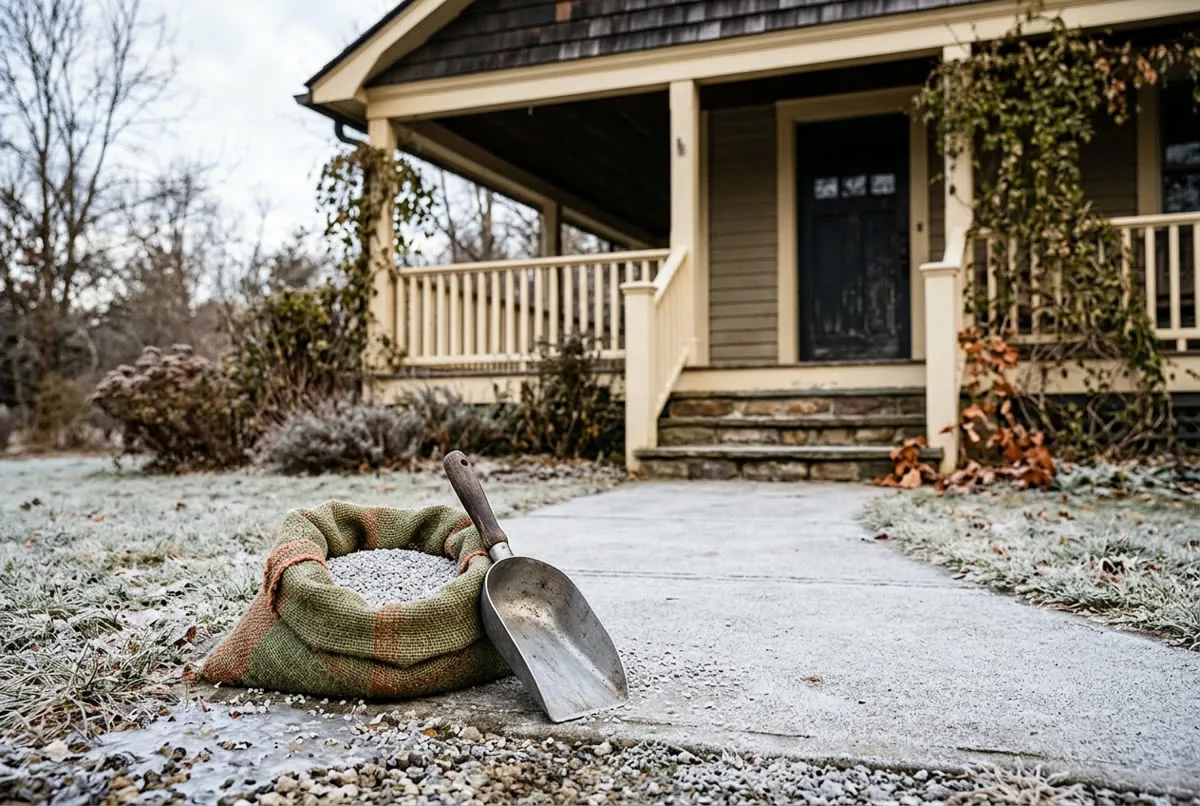
What’s the short answer?
- Sodium chloride stops working around 15°F; calcium chloride keeps melting down to about -20°F, so match the product to your coldest nights.
- More de-icer is not more effective once a surface is saturated, and it damages concrete, plants, and waterways more than a properly measured dose.
- Sand or grit gives traction without adding salt, making it the better choice near gardens, coops, and pet-heavy paths.
- Clearing snow early, before it bonds to concrete, does more good than any chemical treatment applied after ice has formed.
Homestead walkways turn into a hazard fast once temperatures swing below freezing after a wet week, and by the time ice has bonded to the concrete, choices narrow down to whatever bag is on the shelf. Grabbing the cheapest rock salt and dumping it heavy is the default move when a path is already slick, but it is rarely the right one. A single missed window, days before the freeze rather than after, is usually what separates a walkway that stays clear all season from one that turns into a skating rink by January. The walkways that stay usable all winter are the ones prepped before the first freeze, not treated after ice has already formed.
The short answer: For most homestead walkways, calcium chloride keeps melting ice down to about -20°F where rock salt quits around 15°F, though it is corrosive to concrete and metal; calcium magnesium acetate is the gentler pick for concrete. The biggest factor in a safe winter walkway is still timing: clearing snow early and using the least de-icer that does the job, not the most (ISU Extension, 2025; ISU AnswerLine, 2019).
Which Ice Melt Is Safest for Your Concrete Driveway and Walkways?
The de-icer that works best on a given walkway depends on two things: how cold it typically gets, and what the surface is made of. Iowa State University Extension explains that sodium chloride, the common rock salt sold at most hardware stores, is most effective above about 15°F (-9°C), while calcium chloride keeps working down to roughly -20°F (-29°C) (ISU Extension, 2025). If your region regularly sees single-digit or below-zero nights, a plain sodium chloride product may sit on the ice doing almost nothing.
Surface matters as much as temperature. Iowa State University’s AnswerLine notes that de-icers can damage concrete along with plants and the surrounding environment, and points homeowners toward using the least amount of product needed and choosing lower-impact options like calcium-magnesium-acetate, which it describes as having little effect on plant growth or concrete (ISU AnswerLine, 2019). Calcium chloride is not the concrete-friendly choice its cold-weather performance might suggest: ISU Extension calls it highly corrosive to concrete and metals, and University of Maryland Extension warns that sodium and calcium chloride are particularly damaging to newly poured concrete (ISU Extension, 2025; UMD Extension, 2024). On a standard poured driveway or walkway, calcium-magnesium-acetate is the gentler default, with calcium chloride saved for the nights that are too cold for anything else.
Match the Product to Your Coldest Nights
Before buying a pallet of any single de-icer, check what your typical overnight lows actually run during the coldest stretch of your winter, not the seasonal average. A homestead that dips into single digits for a week most Januaries needs a calcium chloride product on hand even if most storms only call for something milder.
Metal railings, gate hardware, and any vehicle parked near the walkway are also worth factoring in before choosing a bag off the shelf. A product formulated to be gentler on concrete is not automatically safe for the metal fixtures near a homestead entry, so checking the label for corrosion warnings is worth the extra minute before spreading anything near a wrought-iron rail or a parked truck.
What De-Icer Is Least Harmful to Pets and Plants?
This is where a lot of homesteaders get burned, because the products marketed hardest are not always the ones that spare the yard. ISU AnswerLine recommends using the smallest effective amount of de-icer, using sand, kitty litter, or chicken grit as alternatives, and reaching for lower-impact products like calcium-magnesium-acetate, which it notes is said to be pet and wildlife friendly, since de-icing salts can damage nearby plants along with concrete and the wider environment (ISU AnswerLine, 2019).
Iowa State’s Yard and Garden program adds a landscape-specific warning: de-icing salts damage plants both through salt spray that lands on foliage and through salt that builds up in the soil, where it keeps roots from taking up enough water. Its guidance is to avoid piling salt-laden snow and ice around trees and shrubs, and to use only enough salt to loosen ice so it can be shoveled off (ISU Extension, 2025).
For pets, the practical takeaway from the same body of extension guidance is consistent: less product on the ground means less exposure. A dog walking across a heavily salted path picks up de-icer on its paws and can ingest it while cleaning them later. Sweeping up visible excess once the ice has melted, rather than letting it sit until it washes away on its own, cuts down on both plant damage and what pets track back inside.
How Much Ice Melt Should You Spread on a Walkway?
More is not safer, and it is not more effective past a certain point. University of Maryland Extension advises following the manufacturer’s directions, and using even less than recommended where possible, rather than eyeballing a heavier coat, and it warns that overuse of some de-icers can accelerate the freeze-and-thaw cycles that damage concrete (UMD Extension, 2024). Penn State Extension puts it bluntly: using more than is needed isn’t more effective, just more expensive, and the excess washes into streams and storm drains (Penn State Extension, 2024).
UMD Extension also recommends storing de-icer and sand in separate heavy plastic garbage cans to keep them dry, which matters as much for a homestead with a shed full of half-used bags as it does for the walkway itself (UMD Extension, 2024). A torn bag left against a foundation wall all winter can do more environmental damage over a season than several properly measured applications.
Spreading Technique Matters as Much as Amount
Broadcasting de-icer in a thin, even layer across the walkway works better than piling it in a few spots and hoping it spreads on its own as the ice melts. A handheld spreader, or even a scoop used in a steady sweeping motion, gets closer to the label rate than pouring straight from the bag, which tends to concentrate product in the first few feet and leave the rest of the path bare.
A Practical Starting Point
Apply de-icer before the bulk of a storm hits if the forecast calls for freezing rain or a snow-to-ice transition, since a thin layer down first keeps ice from bonding tightly to the concrete. After the storm passes, clear as much snow and ice mechanically as possible, then treat only the compacted or refrozen spots that remain, rather than blanketing the entire path out of habit. Penn State Extension’s guidance follows the same order: spread de-icer before snow and ice accumulate, remove as much as possible before applying more, and treat only the areas people or vehicles will actually travel (Penn State Extension, 2024).
Prepping Homestead Walkways Before the Storm Hits
The extension guidance across every source in this roundup points the same direction: physical prep before the freeze does more good than chemical treatment after it. Penn State Extension frames this as protecting the watershed as much as the walkway, since de-icing chemicals that run off a driveway eventually reach nearby streams and ponds. Its recommendations include clearing snow early and often so ice never gets the chance to bond to the surface, using salt sparingly, and choosing watershed-friendly products when a chemical de-icer is genuinely needed (Penn State Extension, 2024).
On a homestead, that early-clearing habit is worth building into the same seasonal rhythm as stacking firewood or checking a stored first aid kit before winter closes in, covered in more detail in 10 First-Aid Skills Every Prepper Should Practice, since a fall on an icy walkway is exactly the kind of injury that kit may end up treating. Watching the forecast a day or two out, rather than reacting once ice has already formed, is most of the battle. A flat-edged ice scraper or a wide push broom kept right by the door makes same-day clearing realistic instead of a chore that gets put off until the whole path is glazed over; storing tools somewhere across the yard is a small habit that removes the main excuse for skipping same-day snow removal. A basic outdoor thermometer that logs overnight lows near the walkway itself gives a clearer read on when a path is likely to refreeze than checking a regional forecast alone, since a shaded, north-facing entry can run colder than the official reading for the area.
Keep a Winter Storm Kit Stocked
Beyond the de-icer itself, a homestead winter kit benefits from a working weather radio to track incoming ice storms before they hit, covered in Hand-Crank Weather Radio Review: The One to Keep by the Door, plus a supply of sand or coarse grit for traction on the coldest nights when chemical de-icers stop working altogether.
Sand and Grit vs. Salt: Which Gives Better Traction?
Sand and grit do not melt ice, but they solve a different problem: traction on a surface that is already frozen and where chemical de-icers have stopped working or are not appropriate near sensitive plants. ISU Extension’s guidance notes that fifty pounds of sand mixed with one pound of salt works effectively, a way to cut total salt use while still getting a walkway that is safe to cross (ISU Extension, 2025).
The tradeoff is cleanup. Sand and grit do not wash away with the next thaw the way salt residue does, and they tend to migrate into grass, garden beds, and eventually a shop-vac or gutter come spring. For a homestead with a long gravel drive already prone to washboarding, that is a manageable cost. For anyone maintaining a small paved entry or decorative concrete, a light hand with sand and a broom afterward keeps it from becoming a permanent feature of the porch.
Grit is also the safer call directly outside a chicken coop or near a bed you plan to plant into come spring, since it adds traction without putting salt into soil that is already dealing with winter stress. Reserving chemical de-icers for the main paths people and vehicles actually use, and leaning on sand or grit for the secondary routes out to outbuildings, keeps the total salt load on the property lower without giving up traction where it matters most.
Pounds of Salt for Your Walkway’s Square Footage
A label that says “use sparingly” is hard to act on, so a number helps. The Mississippi Watershed Management Organization suggests about 4 pounds of salt per 1,000 square feet of pavement (Mississippi Watershed Management Organization). Measure the path with a tape, work out the square footage, and scale from there. A 160-square-foot walkway, for example, needs well under a pound.
For a field check, the same source says a 12-ounce coffee mug holds about 1 pound of salt, enough for 250 square feet. It also suggests aiming for roughly 3 inches between granules, and notes that more salt does not mean more melting. Once the pattern is familiar, it is easy to eyeball.
Conditions matter as much as quantity. Sodium chloride does not work below 15°F, so check the temperature before spreading. On a warm day with a wet sidewalk, skip de-icer entirely: the sun is already doing the job, and the extra salt only washes toward storm drains. Other de-icers carry their own label rates, so treat the 4-pound figure as a salt benchmark.
Two Misconceptions Worth Retiring
“More salt always means safer walkways.” Once a walkway is saturated, extra de-icer mostly runs off rather than melting more ice, while the added salt load does more damage to concrete, nearby plants, and waterways than a properly measured application would (ISU AnswerLine, 2019; Penn State Extension, 2024).
“All ice melt products are the same.” Sodium chloride, calcium chloride, and calcium-magnesium-acetate differ in the temperatures at which they still work, how corrosive they are to concrete and metal, and how much environmental damage they cause, so the right choice depends on your coldest nights and what you are trying to protect, not just the price per bag (UNL Extension, 2007; ISU Extension, 2025; UMD Extension, 2024).
Walk your homestead’s walkways, driveway, and entry paths now, before the first hard freeze, and note which stretches sit in shade, slope toward a drain, or run close to garden beds, since those are the spots that will need the most attention once ice season starts. Match whatever de-icer you buy to your coldest typical nights and your surface type, keep a bag of sand on hand for the nights when chemical products stop working, and build snow clearing into your routine early enough that ice never gets the chance to bond to the concrete in the first place.
Frequently Asked Questions
- Which ice melt is safest for a concrete driveway?
- Calcium magnesium acetate (CMA) is the gentlest common option; extension guidance describes it as having little effect on concrete. Calcium chloride keeps working in colder temperatures but is corrosive to concrete and metal, and both sodium chloride and calcium chloride are particularly damaging to newly poured concrete.
- How much ice melt should I use on a walkway?
- Follow the rate printed on the product label rather than eyeballing a heavier coat. Once a surface is saturated, extra product mostly runs off instead of melting more ice.
- Is sand or salt better for icy paths near pets and gardens?
- Sand or grit adds traction without adding salt load, making it the better choice near garden beds, coops, and any path pets use often. Reserve salt-based de-icers for the main walkways.
Sources & references
Before you go
The Renter's Homestead Pack
Self-reliance projects for the yard you don't own — container yields, a raised bed built to move with you, balcony preservation basics, and the landlord questions to ask first.
Free guide
The Renter's Homestead Pack
Self-reliance projects for the yard you don't own — container yields, a raised bed built to move with you, balcony preservation basics, and the landlord questions to ask first.