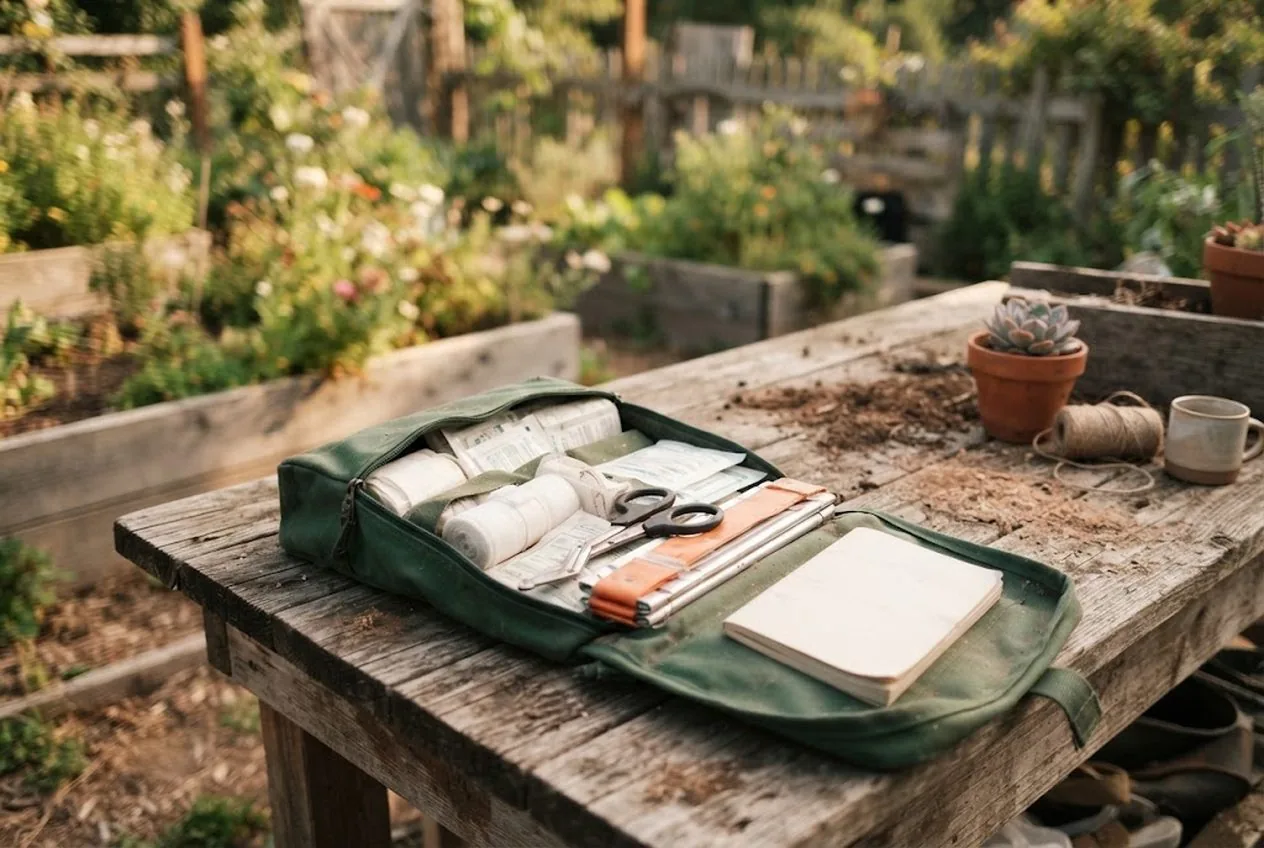
There’s a hard truth under every well-stocked first-aid kit: the supplies are worthless if you don’t know how to use them. Preppers spend freely on gear and almost nothing on the skills that make the gear work — yet in a real emergency, especially one where the power’s out and help is slow, what saves the day is what your hands already know how to do. Skills weigh nothing, never expire on a shelf, and can’t be forgotten in the other room. Winter is the season to sharpen them, because that’s when cold-weather risks pile up and help can get slower.
This is the working list: 10 first-aid skills every prepper should actually practice — not just read about — before the cold sets in. We’ll go roughly in order of how fast the injury turns life-threatening, then cover the high-frequency skills you’ll use far more often, and finish with how to back the training with the right kit and reference.
Short answer: master the life-savers first — bleeding control, CPR and airway, shock, and hypothermia — then build out the everyday skills: wound care, burns, sprains and fractures, and knowing your own kit. Take a hands-on course for the physical techniques, keep a printed reference on the shelf, and refresh it all twice a year.
The Life-Threatening Four: Learn These First
These are the skills that address what kills fastest. In an outage, with EMS potentially far away, they’re the difference between a survivable emergency and a tragedy.
1. Control Serious Bleeding
Bleeding is the number one cause of preventable death after injury (ACS Stop the Bleed), which makes it the single highest-priority skill. Learn to apply firm direct pressure, pack a wound, and use a tourniquet correctly on a limb — including when and how high to place it, and to note the time (MedlinePlus). This is a hands-on skill worth learning in a certified course, because doing it wrong wastes the minutes you don’t have. Keep trauma supplies in your kit and practice the motions until they’re automatic.
2. CPR and Opening an Airway
When someone stops breathing or their heart stops, immediate CPR buys the time until help arrives, and chest compressions are simple enough for anyone to learn and powerful enough to save a life. Learn to check responsiveness and breathing, open an airway, and deliver effective compressions. This is the clearest case for formal training — take a CPR class, build the muscle memory, and recertify on schedule (Red Cross CPR certification lasts two years (American Red Cross)), because technique under stress falls back on what your body has rehearsed.
3. Recognize and Treat Shock
Shock — the body’s collapse in response to serious injury, blood loss, or trauma — can kill even when the original injury wouldn’t. Learn to spot the signs (pale, cool, clammy skin, rapid weak pulse, confusion) and the basic response: keep the person still and warm, lay them down, elevate the legs if no injury forbids it, and get help moving (MedlinePlus). Recognizing shock early and keeping the person warm and calm is a skill that quietly saves lives in the gap before professional care.
4. Manage Hypothermia and Cold Injury
This one moves to the top of the list in winter. In a cold-weather outage — no heat, maybe wet clothes — hypothermia is a genuine threat, and frostbite close behind. Learn to recognize the early signs (shivering, clumsiness, confusion), get the person warm and dry, insulate them from the ground, and rewarm gradually, without direct heat (MedlinePlus). This is exactly why Mylar emergency blankets and warm layers belong in every room of a winter blackout kit; the skill is knowing how and how fast to use them.
The High-Frequency Skills You’ll Actually Use Most
Life-threatening emergencies are rare; cuts, burns, and twisted ankles are constant. In an outage, these “minor” injuries are the ones that can quietly turn serious without a quick trip to urgent care — so the skill to handle them well is the one you’ll draw on most.
5. Clean and Dress a Wound
The everyday skill. Learn to clean a wound properly (wash with mild soap and clean water, remove loose debris), dress it with a clean non-stick bandage, and — crucially — recognize the early signs of infection such as warmth, redness, swelling, or pus (MedlinePlus), which is the real danger when medical help is days away. In a grid-down stretch, a small cut that goes septic is a far bigger threat than most people appreciate. Practice on the scrapes and nicks of ordinary life so the technique is second nature.
6. Treat Burns
Between wood stoves, candles, and cooking on backup heat, burn risks rise in an outage. Learn to assess burn severity, cool a burn with cool water (not ice, not butter), cover it cleanly, and know which burns need professional care (MedlinePlus). The right immediate response dramatically improves how a burn heals; the wrong folk remedy makes it worse.
7. Stabilize Sprains, Strains, and Fractures
Ice and winter chores mean falls, and falls mean twisted ankles and possible breaks. Learn RICE (rest, ice, compression, elevation) for sprains, and how to improvise a splint to immobilize a suspected fracture so you can move someone safely (MedlinePlus). You don’t diagnose the break — you stabilize it and prevent further harm until it can be properly assessed.
8. Know Your Own Kit Cold
An underrated skill: know exactly what’s in your first-aid kit and how to use every item before you need it. Open it, inventory it, and handle the contents now, in daylight, so you’re not reading instructions by headlamp mid-emergency. Add what your household actually needs — daily medications, items for kids or chronic conditions, allergy treatments — and check expiration dates twice a year.
The Skills That Tie It All Together
9. Stay Calm and Assess the Scene
Panic is the enemy of good first aid. Learn the discipline of scene assessment — is it safe to approach, what happened, who’s hurt worst — and of prioritizing calmly under pressure. This is a practiced mindset as much as a skill, and it’s what lets every other skill on this list actually get used well. The calm responder helps; the panicked one often makes things worse.
10. Keep the Knowledge On the Shelf
Skills fade, and no one remembers everything. The final “skill” is maintaining a printed reference you can turn to when memory or the situation exceeds what you’ve practiced — and that works when the power and internet are down. A broad self-reliance reference like Storey’s Basic Country Skills keeps wider self-reliance knowledge within reach on paper, exactly when you can’t look it up online. For the old-time remedies and grid-down medicine angle specifically, see our Lost Frontier Handbook review.
Practice Beats Gear, Every Time
The point of this list isn’t to make you a medic — it’s to close the gap between owning a kit and being able to use it. Take a hands-on first-aid and CPR course for the physical skills, drill the basics with your household twice a year, keep your kit stocked and familiar, and back it with a reference on the shelf. Do that and you’ve built the one layer of preparedness that can’t run out, break, or be left in the other room.
Then fold it into the wider plan. First-aid skills sit at the center of a household that’s genuinely ready — our guide to building a blackout kit room by room shows where the kit lives and how the rest of your outage supplies support it when winter, and the power, go out together. And because good first-aid decisions depend on good information, a hand-crank weather radio that pulls in official guidance when the network is down belongs right beside the kit.
Frequently Asked Questions
- What first-aid skills matter most in an emergency?
- Prioritize the ones that address what kills or disables fastest: controlling serious bleeding, keeping an airway open and doing CPR, recognizing and treating shock, and managing hypothermia in cold weather. After those life-threatening basics come the high-frequency skills — wound cleaning and dressing, treating burns, and stabilizing sprains and possible fractures — because minor injuries are far more common and, left untreated in an outage, can turn serious. Learn the life-savers first, then build out the everyday skills.
- Do I need formal training or can I learn first aid from a book?
- A book and practice will teach you a great deal, but the life-saving physical skills — CPR, bleeding control, splinting — are best learned hands-on in a certified course where an instructor corrects your technique. The ideal is both: take a Red Cross or equivalent first-aid and CPR class to build the muscle memory, and keep a printed reference on the shelf to refresh and extend what you learned. In an emergency you fall back on what your hands already know, so practice beats reading alone.
- How often should I practice or refresh first-aid skills?
- Refresh the core skills at least once or twice a year, and formally recertify CPR on the schedule your course recommends — typically every two years, though guidance evolves. First aid is perishable: technique you learned once and never touched again degrades fast under stress. Twice-yearly practice sessions (the daylight-saving clock changes make a handy reminder) keep the skills sharp and are also the ideal time to restock and check the expiration dates in your first-aid kit.
- What should a prepper's first-aid kit include beyond the basics?
- Start with a solid pre-stocked kit, then add the items outages and injuries actually demand: extra trauma supplies for serious bleeding, a broader range of bandages and wound-cleaning supplies, a supply of any daily prescription medications, a good pair of tweezers and shears, a splint or improvisable materials, and a printed first-aid manual. Tailor it to your household — kids, chronic conditions, allergies — and to your climate, adding cold-weather items like extra blankets where hypothermia is a real risk.
- Why practice first aid specifically before winter?
- Winter raises both the stakes and the odds. Cold brings hypothermia and frostbite risk, ice brings falls and fractures, and winter storms bring the outages that leave you handling an injury without power, heat, or a quick trip to the ER. Practicing before the season means your skills and your kit are ready when help may be slow and conditions are working against you. It's the season when self-reliance in first aid matters most, so it's the right time to sharpen it.
Sources & references
- American College of Surgeons, Stop the Bleed (opens in new tab)
- MedlinePlus, Bleeding (opens in new tab)
- American Red Cross, CPR Renewal and Recertification (opens in new tab)
- MedlinePlus, Shock (opens in new tab)
- MedlinePlus, Hypothermia (opens in new tab)
- MedlinePlus, Cuts and Puncture Wounds (opens in new tab)
- MedlinePlus, Burns (opens in new tab)
- MedlinePlus, Sprains (opens in new tab)
Before you go
The Renter's Homestead Pack
Self-reliance projects for the yard you don't own — container yields, a raised bed built to move with you, balcony preservation basics, and the landlord questions to ask first.
Free guide
The Renter's Homestead Pack
Self-reliance projects for the yard you don't own — container yields, a raised bed built to move with you, balcony preservation basics, and the landlord questions to ask first.