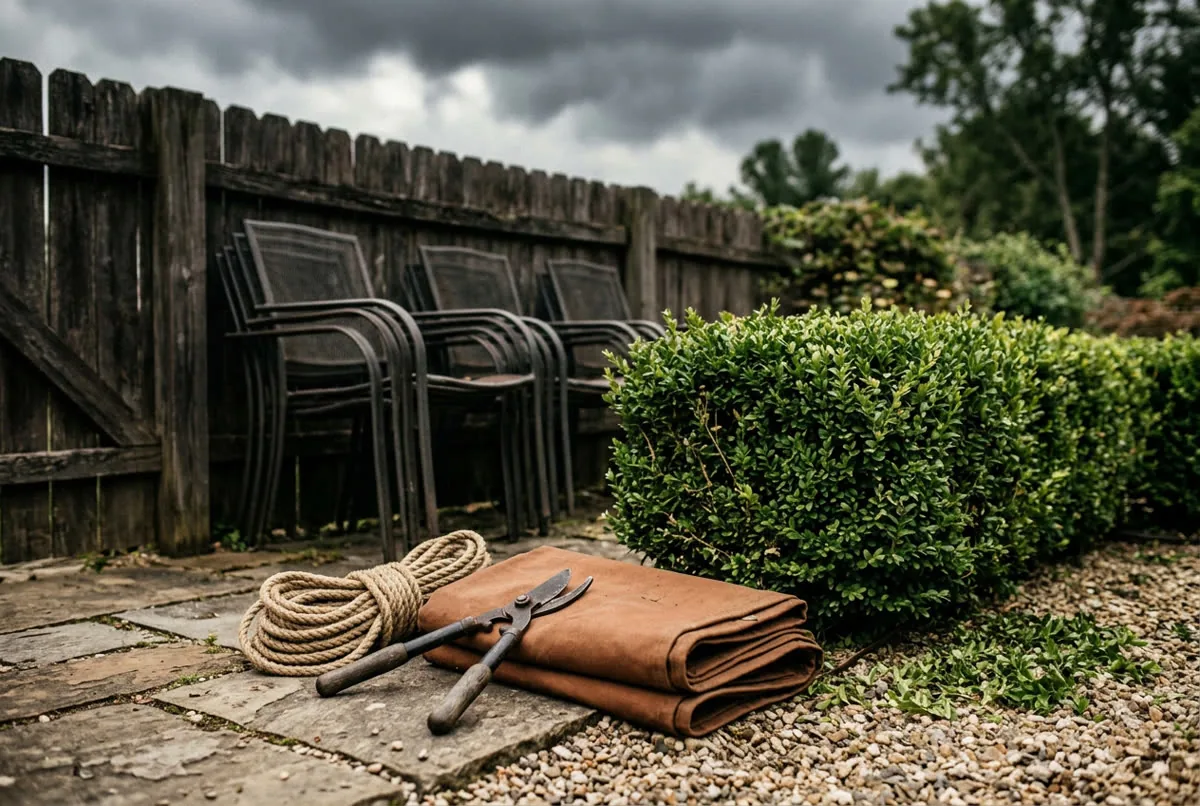
What’s the short answer?
- Prune only dead, diseased, or crossing wood before a storm; save major structural cuts for well before storm season.
- Never strip a palm to a few top fronds; palms are wind-flexible by design and need those fronds.
- Tie down or bring in potted plants, garden tools, decorations, and patio furniture; clear gutters and drains.
- Shallow-rooted trees near pavement or in saturated soil are more likely to uproot than break in high wind.
- A below-normal season forecast still allows for major hurricanes; treat every season as prep-worthy.
A storm watch goes up, and the yard turns into a list of decisions made under pressure: which pot comes inside, which branch has to go, which chair gets tied down before the wind decides for you. Most of that list gets handled in the last 24 hours, in the dark, with whatever rope is in the garage. This checklist moves that decision-making earlier, before the forecast turns urgent, using guidance from University of Florida extension horticulturists.
The short answer: Prune only dead, damaged, or crossing wood now, and save major structural work for well before storm season; never strip a palm down to a few top fronds; and treat loose yard items, gutters, and storm drains as one checklist, not an afterthought once the wind starts.
What to Actually Trim Before a Storm
The instinct before a storm is to prune hard, on the theory that a smaller tree is a safer tree. Extension guidance is more specific than that. UF/IFAS lists the storm-prep pruning targets as dead, diseased, and damaged wood, watersprouts, crossing branches, and branches growing toward the tree’s center, and adds that each tree should be assessed individually rather than pruned by default (UF/IFAS Extension, 2026-09-03). Cracked or broken limbs should come off, and limbs hanging over a roof should be shortened, ahead of the storm (UF/IFAS Extension, 2025), because tree debris left on the ground can be picked up and carried by strong winds (UF/IFAS Extension, 2026-09-03).
Species matters too. Fast-growing trees such as poinciana and mulberry tend to have weaker wood and break more easily in storms than slower-growing species (UF/IFAS Extension, 2026-09-03). If you know you’re working with a fast grower, that’s a reason to be more thorough about removing dead and crossing wood, not a reason to cut deeper into live growth.
Walking a tree for this kind of pruning is slower than it sounds, mostly because the targets are specific rather than obvious. A watersprout is the thin, straight, fast-growing shoot that pops up along a trunk or main limb, usually after a prior cut or stress; it’s weakly attached and rarely worth keeping. A crossing branch is any limb rubbing against another, wearing bark away at the contact point over time. Branches growing back toward the center of the canopy, instead of out and away from it, crowd the tree’s own structure and are the third target. None of that requires a chainsaw for a small or medium tree; hand pruners and a pole saw cover most of it. Anything above what you can reach from the ground, or anything close to a power line, goes on a professional’s list instead of yours.
Is It Too Late to Prune Once a Storm Is on the Forecast
Once a watch or warning is up, the calculus changes. Structural pruning, the kind that shapes how a tree carries wind load for years, is work that belongs well before storm season starts, not in the 48 hours before landfall. A common misconception is that heavy pruning right before a storm makes a tree safer; extension guidance instead says trees should not be pruned right before a storm because there may not be time to dispose of the fallen limbs, and trimmed branches left outdoors can become dangerous projectiles. It also warns against topping a tree with indiscriminate stub cuts, which typically cause decay (UF/IFAS Extension, 2025), and says each tree should be assessed individually rather than pruned by default (UF/IFAS Extension, 2026-09-03). With a storm already on the forecast, the reasonable move is to remove obviously dead or hanging wood you can reach safely and stop there. Anything requiring a ladder, a chainsaw, or work near power lines is a job for a professional, not one to start under time pressure.
Should You Strip the Fronds Off a Palm Tree
No. This is a common storm-prep mistake, and extension horticulturists call it out by name: the “hurricane cut,” which strips a palm down to just a few fronds at the top, is unnecessary and can be harmful (UF/IFAS Extension, 2026-09-03). Palms are naturally flexible and well adapted to hurricane-force winds, and they do not need excessive pruning to survive a storm. Cutting away green fronds removes tissue the palm needs to produce nutrients. Only dead fronds should generally be removed before a storm.
What Loose Yard Items Need to Be Tied Down or Brought In
Trees get most of the attention, but loose items are what turn a windstorm into a series of small, avoidable messes: a lawn chair through a window, a hanging basket into a car windshield. Extension experts list unsecured yard and patio items as a top pre-storm mistake: outdoor furniture, garden tools, potted plants, and decorations can become projectiles if not brought inside or properly stored (UF/IFAS Extension, 2025). Federal hurricane guidance adds de-cluttering drains and gutters and bringing in outside furniture (Ready.gov).
In practice, that’s easier as a two-pass job. First pass: walk the yard and sort everything loose into “goes inside” and “gets tied down,” rather than deciding item by item once the wind picks up. Second pass: actually move it. A garage, shed, or a set of lidded storage bins gives you somewhere to put the small stuff (planters, cushions, tools) so it isn’t a decision made in a hurry later. Anything too heavy or awkward to move, a grill, a fire pit, larger yard art, gets strapped down or laid flat instead of left standing.
Clearing gutters and storm drains belongs on the same pass, not a separate chore saved for later. Ready.gov’s hurricane guidance groups it with bringing in outside furniture (Ready.gov), which means leaves and debris get cleared out now, while it’s dry and calm, instead of dealt with once water is already moving.
What This Looks Like in a Small Yard or a Rental
Much of the extension guidance behind this checklist comes from UF/IFAS in Florida and addresses trees and landscapes, but the loose-item part of the list applies at any scale. A rental patio or a small suburban yard usually doesn’t have the tree-risk questions above to sort through, which actually shortens the job: skip straight to the loose-item walk-through. Potted herbs, a hanging basket, a folding chair, and a small grill are exactly the category of items the guidance already covers, just fewer of them. If there’s no garage or shed, a hall closet or even a bathtub works for the smallest items; the goal is getting anything that can become a projectile off an open patio or balcony, not finding a perfect storage solution. For anyone renting, it’s also worth checking the lease or asking a property manager whether shared trees or landscaping on the property are someone else’s responsibility to prep, since that removes the tree half of this checklist from your list entirely.
How to Tell If a Tree Is a Wind-Fall Risk
Not every tree fails the same way, and knowing which kind of failure to expect from a given tree changes what to watch for. Trees with shallow or restricted root systems, common near sidewalks, driveways, and other paved areas, or growing in marl, heavy clay, or soil that’s frequently saturated, are more likely to uproot entirely in high wind rather than break at a branch (UF/IFAS Extension, 2026-09-03). If a tree on your property fits that description, the thing to watch during and after wind events is soil heaving or lifting near the base, not just branch damage overhead.
Trunk shape matters too. Trees with multiple main trunks meeting in tight, V-shaped crotches are more prone to splitting between trunk and branch under wind load than trees with a single dominant leader (UF/IFAS Extension, 2026-09-03). That’s a structural issue best corrected while a tree is young, through selective pruning that establishes one dominant trunk, but it’s also useful to recognize now: a mature tree with a pronounced V-crotch is one worth having a professional evaluate, not one to leave as a wait-and-see.
Beyond root system and trunk shape, species itself plays a role; some trees are simply built to flex and shed wind better than others, and extension horticulturists maintain species-by-species wind-resistance guidance for homeowners trying to sort out which trees on their property are the higher-risk ones (UF/IFAS Gardening Solutions).
None of these three factors, shallow roots, V-shaped crotches, or a weaker-wood species, is a reason to remove a healthy tree on its own. They’re a reason to know which trees on your property carry more risk than others, so a walk-through after a wind event has a short list to check first: soil at the base for uprooting risk, the main crotch for splitting risk, and any dead wood the storm may have already loosened. A tree that checks more than one box, a fast-growing species with a V-crotch growing in saturated soil near a driveway, for instance, is a reasonable one to have a certified arborist look at before the next storm rather than after this one.
Does a Quiet Forecast Mean You Can Skip This
NOAA’s August 2026 outlook update calls for a 75% chance of a below-normal Atlantic season, with 7 to 13 named storms, 2 to 6 hurricanes, and 0 to 2 major hurricanes for the year (NOAA.gov, 2026-08-06). It’s easy to read “below-normal” as permission to skip the yard work this year. That reading misses the range built into the forecast itself: even a below-normal season allows for up to two major hurricanes, and the season runs through November 30, well past its climatological peak in September (NOAA.gov, 2026-08-06). A quiet outlook describes the season as a whole; it says nothing about whether the one storm that does form tracks toward your yard. The prep described above costs an afternoon whether or not a storm ever shows up, and it’s the same afternoon either way.
Next Step
Pick one weekend before the season’s peak passes and treat it as a single job: walk the yard once for trees (dead wood, crossing branches, any obvious V-crotch or shallow-rooted tree near pavement), then walk it again for loose items (pots, furniture, grills, gutters, storm drains). If wind knocks out power on top of knocking down branches, the same afternoon is a reasonable time to check whether your broader storm plan still holds; our Hurricane-Season Blackout Kit checklist covers the power and water side of that same prep window. And if hearing the watches and warnings in the first place is still a gap, our hand-crank weather radio review is worth a look before the next one forms.
Frequently Asked Questions
- What should I trim in my yard before a hurricane or big windstorm?
- UF/IFAS Extension lists dead, diseased, and damaged wood, watersprouts, crossing branches, and branches growing toward the tree's center as the storm-prep pruning targets, and says each tree should be assessed individually rather than pruned by default. It advises against pruning right before a storm, since there may not be time to dispose of the cut limbs.
- Is it too late to prune trees once a storm is already forecast?
- Structural pruning for wind resistance is meant to happen well before storm season, not in the days before landfall. Once a storm is on the forecast, stick to removing dead or clearly hazardous wood you can reach safely rather than starting major cuts.
- Should I remove all the fronds from my palm trees before a storm?
- No. Extension horticulturists specifically warn against the 'hurricane cut' that strips a palm down to a few top fronds, because palms are naturally flexible and well adapted to hurricane-force winds, and the practice removes green fronds the tree needs to produce nutrients. Only dead fronds should generally be removed.
- What outdoor items need to be tied down or brought inside before high wind?
- Outdoor furniture, garden tools, potted plants, and decorations can become projectiles, so bring them inside or secure them, and clear debris from gutters and drains before wind and rain arrive.
- Does a below-normal hurricane season forecast mean I can skip yard prep?
- No. NOAA's 2026 outlook still allows for 0-2 major hurricanes even in a below-normal season, and any single storm can cause local damage regardless of the season-wide count.
Sources & references
- NOAA, NOAA maintains prediction for below-normal Atlantic hurricane season (Aug 6, 2026) (opens in new tab)
- UF/IFAS Extension St. Lucie County, Preparing Your Landscape for a Hurricane (Sep 3, 2026) (opens in new tab)
- UF/IFAS News, Is your landscape ready for a major storm? (Sep 10, 2025) (opens in new tab)
- UF/IFAS Gardening Solutions, Preparing Trees for Hurricanes (opens in new tab)
- Ready.gov, Hurricanes (opens in new tab)
Before you go
The Renter's Homestead Pack
Self-reliance projects for the yard you don't own — container yields, a raised bed built to move with you, balcony preservation basics, and the landlord questions to ask first.
Free guide
The Renter's Homestead Pack
Self-reliance projects for the yard you don't own — container yields, a raised bed built to move with you, balcony preservation basics, and the landlord questions to ask first.