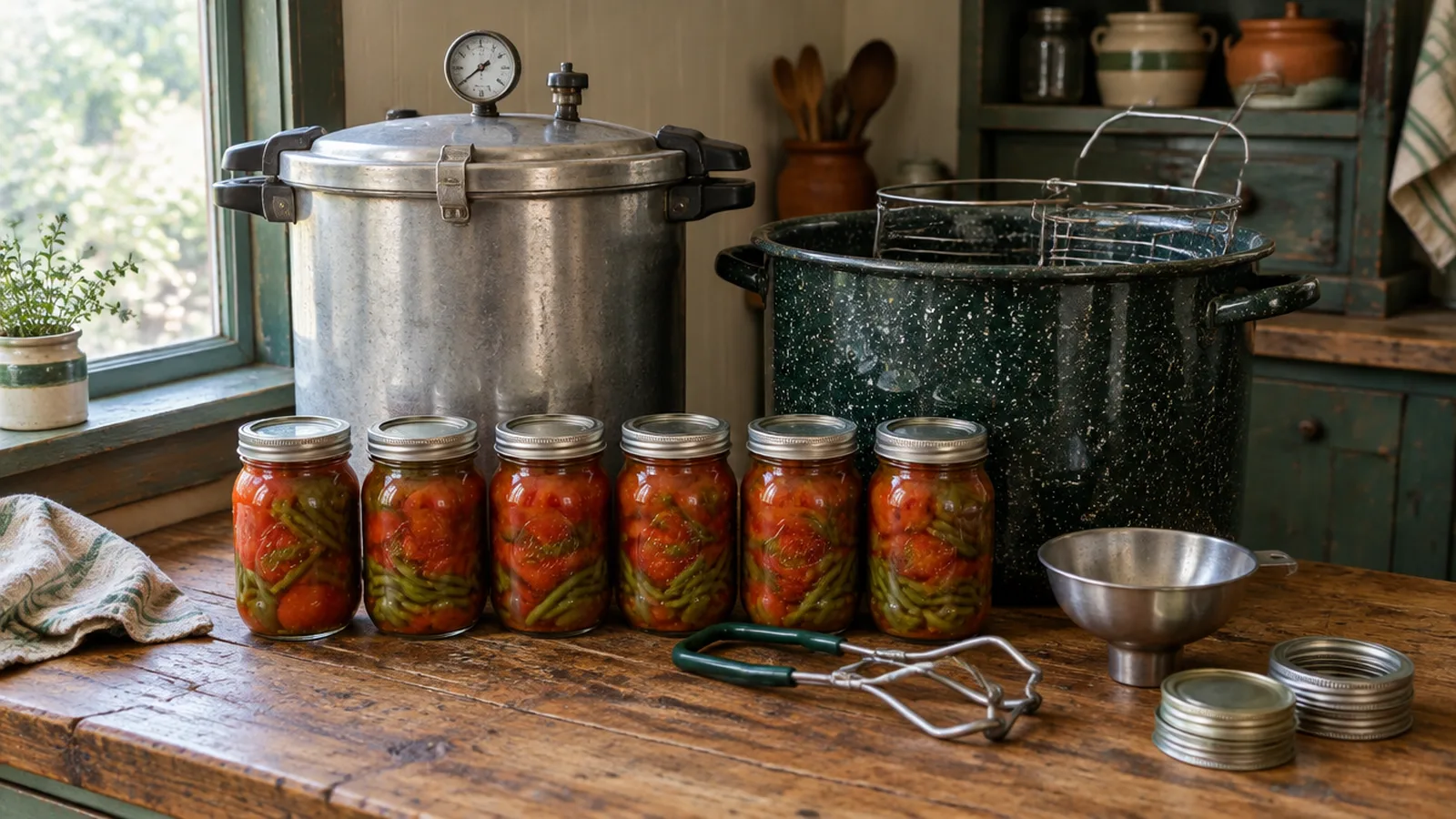
Which canning gear is worth waiting for until Black Friday?
- The food decides the canner, not the sale. The CDC says pressure canning is the only recommended method for low-acid foods, and a boiling-water canner is for high-acid foods only.
- Only the pressure canner is a big enough purchase for a sale to matter. The maker lists one 23-quart model at $185.99 (Nov. 2, 2026), so each 10 percent off is about $18.60.
- A multi-cooker with a canning button is not a canner. The National Center for Home Food Preservation does not support its USDA processes in electric multi-cookers.
- Some of the safety work costs nothing and cannot wait for a sale: find your elevation, get a dial gauge tested at a county extension office, and replace a worn gasket.
Canning gear sits at two ends of the price range. A few lids and a jar lifter cost little, and a pressure canner lists at close to $200 on one maker’s site. Only one of those purchases is big enough for a sale to change your plan, and none of the safety rules go on sale.
Black Friday is November 27. This is a way to sort your canning list before then: what to buy when you need it, what to price-check first, and what to skip.
The short answer: The food decides the canner. Low-acid foods such as vegetables and meat need a pressure canner, and high-acid foods such as most fruit, jams and pickles go in a boiling-water canner (CDC). A multi-cooker with a canning button does not count as either. Wait for a sale only on the pressure canner, and only after you have logged its regular price and a walk-away number. Do the free safety checks now.
This is a research-based planning guide. We have not bought or tested the products linked here. Facts come from the sources listed at the end, all opened on November 2, 2026. Some links below are affiliate links, so we may earn a commission if you buy through them, at no extra cost to you.
Why the Sale Is the Last Question
The CDC states the rule plainly. Pressure canning is the only recommended method for canning low-acid foods. Do not use a boiling-water canner for them, because it will not protect against botulism. Low-acid foods include all fresh vegetables, meats, poultry, fish and seafood, and some tomatoes (CDC, page dated Feb. 26, 2026). The CDC also notes that home-canned vegetables are the most common cause of botulism outbreaks in the United States (CDC, page dated Apr. 25, 2024).
The National Center for Home Food Preservation (NCHFP) explains why. The spores are very hard to destroy at boiling-water temperatures, so low-acid foods are processed at 240°F to 250°F, which a pressure canner reaches at 10 to 15 PSI (NCHFP, checked Nov. 2, 2026). That is the whole reason this gear is not interchangeable. If you want the full acid-line walkthrough, our water-bath vs. pressure canning guide covers it. Here we use it for one purpose: deciding what to buy.
Three Ways to Heat the Jars, Compared
| Boiling-water canner | Stovetop pressure canner | Electric multi-cooker with a “canning” button | |
|---|---|---|---|
| Food it is for | High-acid foods | Low-acid foods; can also stand in as a boiling-water canner | None for canning |
| Time per load (NCHFP) | 25 to 60 minutes for most acid foods | 55 to 100 minutes | Not applicable |
| Typical capacity (NCHFP) | Most hold 7 quart jars or 8 to 9 pints | Small models hold 4 quarts; most hold 7 quarts or 8 to 9 pints; some large ones hold 18 pints in two layers | Not applicable |
| What the agencies say | Recommended for acid foods | CDC: the only recommended method for low-acid foods | CDC: do not use. NCHFP: its processes are not supported in these appliances |
| Is a sale worth waiting for? | Only if you lack a deep pot with a rack | Yes, if you can wait until spring | Skip it for canning |
The NCHFP time range matters when you budget a weekend. A pressure canner needs 55 to 100 minutes for a load of jars, while most acid foods take 25 to 60 minutes in boiling water (NCHFP). NCHFP also notes that a pressure canner can process acid foods but recommends a boiling-water canner for them because it is faster.
The last column needs one more line. NCHFP says it does not recommend its canning processes for electric multi-cookers, because no USDA thermal process work has been done with jars inside them. Its point is that the temperature inside the jars is what counts, and a cooker reaching a given pressure does not prove the jars got there (NCHFP). The same post exempts one dedicated electric boiling-water canner for acid foods, which it says is not a multi-cooker, and its 2015 note does not tell us whether that model is still sold. Serious Eats also tested dedicated electric pressure canners in its July 2026 update. We have not checked what NCHFP says about those models, so ask your county extension office before you buy one.
What a Pressure Canner Has to Have
Check the specifications before the price, because these are the points where a cheap or old canner fails.
- Size. The CDC says to use a canner that holds at least four 1-quart jars upright on the rack. NCHFP says small pressure saucepans are not recommended for canning.
- Safety listing. NCHFP and Illinois Extension both say to use only canners with Underwriters Laboratories (UL) approval. Check the box or manual.
- Gauge type. A dial gauge needs a test every year. Penn State Extension says gauges on new canners and replacement gauges should be tested before use, and a gauge that reads off by more than 2 pounds should be replaced. A weighted gauge cannot go out of calibration and needs no test (Penn State Extension, Illinois Extension).
- Gasket. If the lid uses a rubber gasket, Penn State Extension says to replace it about every three years under normal use, or sooner if it is cracked, brittle or shrunken. Some canners seal metal to metal and have no gasket.
- Venting. NCHFP says every type of pressure canner must be vented for 10 minutes before it is pressurized, because trapped air lowers the temperature and leads to under-processing.
- Your stove. The maker’s page for the 23-quart Presto 01781 says it is designed for household range burners of 12,000 BTUs or less and for regular and smooth-top ranges. Check burner output and cooktop type before buying any canner.
- Replacement parts. Gaskets, gauges and plugs are matched by model number. Penn State Extension notes that parts may not be available for very old canners, so check that parts exist for the model before you buy an older or used one.
One independent test is worth knowing about. Serious Eats put 13 pressure canners through testing (page updated July 8, 2026). It reported that the dial gauge on the Presto 23-quart it received read 10 PSI at rest instead of 0, and that the replacement gauge did not move once the pot reached pressure. It dropped that model from its picks. That is one tester and two units, not a failure rate. The Presto 23-quart is also the maker’s list-price example below, and it shows why the gauge test is the first thing to do with any new dial-gauge canner.
The Cost Math
Here is the arithmetic with one published price. The maker lists the 23-quart Presto 01781 at $185.99 on its own site (checked Nov. 2, 2026), with capacity for 20 pints or 7 quarts. Amazon’s price is not verified, and we cannot confirm that the Amazon link below opens this exact model. The point of the table is the method, so replace $185.99 with the price of the canner you are considering.
| Jars you put up with it | Pints per load | Loads | Canner cost per jar at $185.99 |
|---|---|---|---|
| First weekend | 20 | 1 | $9.30 |
| First season | 60 | 3 | $3.10 |
| Two seasons | 100 | 5 | $1.86 |
| Heavy use | 200 | 10 | $0.93 |
That cost covers the canner only. It leaves out jars, lids, food and fuel. Three loads is 165 to 300 minutes in the canner by NCHFP’s 55 to 100 minutes per load, before heat-up and cooling.
Now the discount side:
| Discount | Saving on $185.99 | Price after |
|---|---|---|
| 10% | $18.60 | $167.39 |
| 20% | $37.20 | $148.79 |
| 30% | $55.80 | $130.19 |
Serious Eats’ July 2026 list shows what other models cost: a Presto 16-quart at $152 on sale ($180 regular), electric canners at $170 to $390, and All American cast-aluminum models at $400 to $500. Those are that site’s listed prices, not our check. A 20 percent discount on the Presto is real money, but it is smaller than the cost of an unusable batch, and it is much smaller than the gap between a Presto and a cast-aluminum canner. Pick the model for your stove and your use, then watch its price.
The Checklist, in Three Steps
Numbers are per canner load or per household. Nothing in the first row needs a sale.
| Step | Do this | Your number |
|---|---|---|
| Now (no purchase) | List what you want to can and mark each item low-acid or high-acid. Find your elevation. If you own a dial-gauge canner, call your county extension office about a free gauge test. Check gaskets and lids for cracks. Write down the regular price of any canner you are considering. | 1 canner per food type; 4 quart jars upright is the CDC minimum |
| This month (before Nov. 27) | Check the canner’s specs against the list above: size, UL listing, gauge type, burner limit. Set a walk-away price and compare it with the live price on Nov. 27 or Nov. 30. Buy lids new for each batch, since the Ball guide says to start with new ones. | 10% off is $18.60 on $185.99; decide your number first |
| Optional (winter and early spring) | Buy the pressure canner if you expect to can vegetables, beans or meat. Have a dial gauge tested before the season, as Penn State Extension advises. | 20 pints per load in a 23-quart; 55 to 100 minutes per load |
For storing what you put up, the CDC says to can only the amount you will use in a year unless a recipe says otherwise. It also says to label and date jars, and to keep them in a cool, dark place, for best quality between 50°F and 70°F and never above 95°F. Our pantry gap calculator shows how many days of food your shelves cover now, which helps you decide how many jars to plan for.
Water-Bath Gear: Who Needs to Buy It
Ball’s canning guide says you do not need special cookware for water-bath canning. A large, deep saucepot with a lid and a rack works, as long as it holds the jars covered by 1 to 2 inches of water and keeps a rolling boil when covered. If you lack a rack, Ball says a cake cooling rack or extra bands tied together will do. The guide also lists a jar lifter, a canning funnel and a bubble remover and headspace tool as the basic supplies (Ball, checked Nov. 2, 2026).
A starter kit fits a household that wants those pieces in one box and has no tall pot. It does not fit anyone who plans to can plain vegetables, beans or meat, since it cannot process them safely. It is cheap enough that a sale hardly changes the decision, so buy it when the first batch of fruit, jam or pickles is a few weeks away.
The Pressure Canner: Who It Fits
A stovetop pressure canner fits a household that wants to can vegetables, beans, meat or soup and has a burner that suits it. It does not fit a household that only makes jam, anyone cooking on an induction range unless the model is stated to work on induction, or anyone who is not willing to learn the vent, pressure and cool-down steps. Our existing Presto pressure canner review covers one model in more detail. Whichever you buy, test the gauge first, then use only tested recipes. The CDC says to use only recipes that follow the USDA Complete Guide to Home Canning, even if they come from a trusted friend or family member.
Where Black Friday Fits
Set the plan first, then use the sale to price it. Our price baseline guide shows the fields to log for each item. Add the canner’s regular price, your walk-away price and the date you checked. If a deal on November 27 or November 30 beats your number, it is a deal. If it does not, you have lost nothing, since canning season is months away.
A sale never changes the safety list. A cheaper canner still needs a gauge test, a sound gasket, a 10-minute vent and a tested recipe.
What We Could Not Confirm
- Amazon prices, stock and reviews. Amazon blocked our page checks on Nov. 2, so we cannot say which model each affiliate link opens or what buyers complain about. The one buyer-side data point here is Serious Eats’ testing, not Amazon reviews. Read the lowest-rated reviews on the live listing.
- Black Friday offers. We have not verified any 2026 sale on canners, kits or jars.
- Price history. We have no price history for these items, so we cannot say whether November is a low point.
- Dedicated electric canners. We did not find current NCHFP guidance on the electric pressure canners Serious Eats recommends.
- Page dates. Several NCHFP, extension and Ball pages show no date. We list them as checked on Nov. 2, 2026.
We will update this page when live November 27 listings can be checked.
The Takeaway
Sort your list by acid first. Do the free checks now: elevation, gauge test, gasket. Set a walk-away price for the pressure canner and compare it on November 27 or 30. Buy lids and small tools when you need them. Leave the multi-cooker out of it.
Frequently Asked Questions
- Do I need a pressure canner or a water-bath canner?
- The acidity of the food decides. The CDC says pressure canning is the only recommended method for low-acid foods, which include all fresh vegetables, meats, poultry and fish, and it says not to use a boiling-water canner for them. High-acid foods such as most fruit, jams and pickles are processed in a boiling-water canner. Many people end up owning both.
- Can I use an Instant Pot or other multi-cooker to can food?
- The CDC says not to use an electric multi-cooker, even if it has a canning or steam canning button. The National Center for Home Food Preservation says no USDA thermal process work has been done with jars inside an electric pressure cooker, and that what matters is the temperature inside the jars, not the pressure the appliance reaches.
- How often should a pressure canner gauge be tested?
- Penn State Extension and Illinois Extension both say dial gauges should be tested every year, and Penn State adds that gauges on new canners and replacement gauges should be tested before use. A gauge that is off by more than 2 pounds should be replaced. Weighted gauges do not go out of calibration and do not need testing. Many county extension offices test dial gauges for free.
- Do I need to buy a special canner for water-bath canning?
- Not always. Ball's canning guide says a large, deep saucepot with a lid and a rack works, as long as it holds the jars with 1 to 2 inches of water over them and can keep the water at a rolling boil. A dedicated canner or kit is a convenience, and it comes with a rack and a few tools.
- Is it worth waiting for Black Friday to buy a pressure canner?
- It can be, because it is the largest single purchase in home canning and it is not needed before spring. Log the regular price now, set a walk-away number, and compare it with the live price on Nov. 27 or Cyber Monday, Nov. 30. As of Nov. 2 we have not verified any Black Friday offer on canning gear.
Sources & references
- CDC, Home-Canned Foods (page dated Apr. 25, 2024; opened Nov. 2, 2026) (opens in new tab)
- CDC, Botulism Prevention (page dated Feb. 26, 2026) (opens in new tab)
- National Center for Home Food Preservation, How to Use Boiling Water and Pressure Canners (undated, checked Nov. 2, 2026; adapted from USDA Complete Guide to Home Canning, rev. 2009) (opens in new tab)
- National Center for Home Food Preservation, Ensuring Safe Canned Foods (undated, checked Nov. 2, 2026) (opens in new tab)
- National Center for Home Food Preservation, Can I Can in a Multi-Cooker? (blog post with a Feb. 12, 2015 editor's note, checked Nov. 2, 2026) (opens in new tab)
- Penn State Extension, Pressure Canner Dial Gauge Testing (undated, checked Nov. 2, 2026) (opens in new tab)
- Penn State Extension, Storing Canning Supplies (undated, checked Nov. 2, 2026) (opens in new tab)
- Illinois Extension, Pressure Canners (undated, checked Nov. 2, 2026) (opens in new tab)
- Presto, 23-Quart Pressure Canner and Cooker, stock no. 01781 (product page, checked Nov. 2, 2026) (opens in new tab)
- Ball Fresh Preserving, Water Bath Canning (undated, checked Nov. 2, 2026) (opens in new tab)
- Serious Eats, The Best Pressure Canners (updated July 8, 2026; opened Nov. 2, 2026) (opens in new tab)
Before you go
The Renter's Homestead Pack
Self-reliance projects for the yard you don't own — container yields, a raised bed built to move with you, balcony preservation basics, and the landlord questions to ask first.
Free guide
The Renter's Homestead Pack
Self-reliance projects for the yard you don't own — container yields, a raised bed built to move with you, balcony preservation basics, and the landlord questions to ask first.