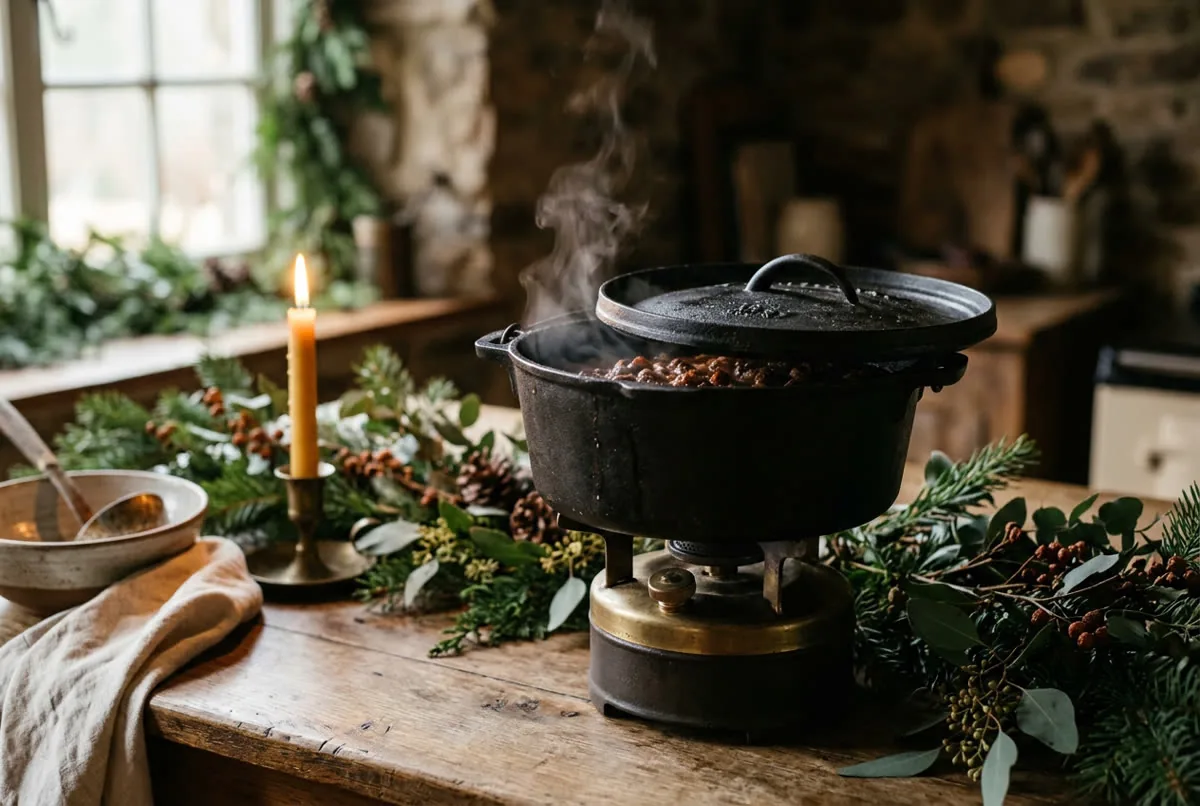
If your Christmas Day forecast includes a winter storm warning, you are not imagining the timing risk. Cooking a full holiday meal without power takes different planning than losing the lights on an ordinary Tuesday, especially with a house full of guests and food that cannot sit out indefinitely. The safest plan is also the plainest one.
The short answer: Cook and hold food only with equipment rated for indoor use (never a grill, camp stove, or generator brought inside), keep the fridge and freezer closed and monitored at or below 40°F and 0°F, and treat any perishable food that spends more than two hours above 40°F as unsafe to serve.
How Common Is a Christmas Blackout, Really?
A winter storm does not need to be rare to ruin a holiday dinner. In December 2022, a severe “bomb cyclone” left more than one million Americans and Canadians facing Christmas Day without power, in a storm that affected nearly 250 million people across North America (BBC, 2022-12-25). The same event was linked to at least 35 deaths, and on the morning of Christmas Day, about 275,856 US homes and businesses were without electricity, with outages exceeding one million customers at points during the storm (ABC7 via CNN, 2022-12-26).
We are not raising this to suggest a blackout is guaranteed this year, only that a mid-meal outage is a documented, recurring risk during the exact week most households cook their largest meal and host the most people. Planning for it costs an afternoon. Not planning for it costs a ruined dinner and, in the worst case, a food safety problem.
How Can You Safely Cook Christmas Dinner If the Power Goes Out Mid-Day?
Build the Menu Around the Risk, Not Around the Outage
The easiest fix happens before the storm, not during it. Choose dishes that finish cooking in stages, hold well at room temperature for a short window, or reheat cleanly rather than requiring a single uninterrupted multi-hour oven run. A turkey that goes into the oven at dawn is more exposed to a mid-morning outage than sides that can be prepped ahead and finished in smaller batches closer to serving time.
A few days ahead of the meal, work through a short checklist rather than leaving it to the morning of:
- Charge any battery-based power station fully, and confirm it actually powers the specific appliance you plan to run on it, not just that it turns on.
- Pull out and test your appliance thermometers for the fridge and freezer; a thermometer that has been in a drawer since last winter is worth a quick check before it matters.
- Pre-cook and refrigerate dishes that reheat well (mashed potatoes, most casseroles, cooked vegetables) so the oven’s uninterrupted run time is as short as possible on the day itself.
- Agree ahead of time on who is responsible for watching the clock if the power drops, so the two-hour rule below doesn’t get lost in the chaos of a house full of guests.
During the Outage
If the power drops with the turkey half-cooked, do not guess at doneness. An oven that loses power mid-roast stops cooking food safely, and a partially cooked bird that then sits at room temperature is a food safety risk, not just an inconvenience. If restoring power isn’t imminent, your safest paths are:
- A properly installed and vented gas or wood-burning fireplace or stove already in your home, used exactly as it was designed to be used.
- Small electric appliances (an induction burner, slow cooker, or electric kettle) run off a battery-based portable power station sized to the actual wattage draw of the appliance, not just the number of outlets it has.
What you should not do is bring an outdoor grill, camp stove, or portable generator inside to finish cooking. That single decision is where holiday blackout stories turn into emergency room stories, and it’s covered in more detail below.
While the oven is out of commission, protect what’s already cold rather than opening it to check. A cooler packed with ice or snow can hold a few at-risk items like cream-based sides or dairy for a while without depending on the fridge at all, which buys time and keeps the refrigerator door closed. Group the most perishable dishes together so you’re not opening the fridge repeatedly to hunt for one item.
What Off-Grid Cooking Options Are Safest Indoors During a Winter Storm?
A gas grill or charcoal cooker feels like an obvious backup, and that is exactly the assumption that makes it dangerous. Ready.gov’s power-outage guidance says generators, camp stoves, and charcoal grills should always be used outdoors and at least 20 feet away from windows, and warns that carbon monoxide is a colorless, odorless gas that can kill (FEMA). That warning is not regional or situational. It applies in a garage, a covered porch, or a “just for a few minutes” scenario as much as it does in an open kitchen.
The safest indoor backup during a winter storm is electric, not combustion. A battery-based power station can run a slow cooker, induction burner, or electric kettle for a meaningful stretch without introducing any exhaust into your home, which is why it is worth having charged and staged before a storm watch, not ordered after the lights go out. If your home already has a properly vented gas or wood stove installed to code, using it as intended is a separate and reasonable option. What is out of scope for any of this is wiring a generator into your home’s electrical panel or adding new circuits mid-storm. That work belongs to a licensed electrician and your local code official, not a holiday afternoon project. Plugging small appliances into a power station’s own built-in outlets, within its rated output, doesn’t involve your home’s wiring at all.
A working, battery-powered carbon monoxide detector is worth checking before the storm arrives too, even if you never plan to bring anything combustion-based indoors. It is a small, cheap backstop for the one mistake that turns a cold Christmas dinner into a genuine emergency.
For readers building out a broader no-electricity toolkit beyond the holiday season, 6 Food Preservation Methods That Don’t Need Electricity covers the storage side of the same problem.
Which Holiday Foods Are Safest to Keep and Reheat After an Outage?
Not every dish on the table is equally forgiving once the fridge stops running. Eggs in the shell keep for three to five weeks refrigerated but are not recommended for freezing, while butter freezes well for six to nine months, which is worth knowing before you decide what to prioritize as a warming freezer starts to thaw (NDSU Extension, revised 2020-05).
Keep the refrigerator at or below 40°F and the freezer at 0°F, and confirm both with an appliance thermometer rather than judging by touch, both during the outage and after power returns (Texas A&M AgriLife Extension). Keeping the doors closed matters more than almost anything else you can do; Ready.gov notes a closed refrigerator keeps food cold for about four hours and a full freezer holds its temperature for about 48 hours (FEMA), and every open-and-check trip lets warm air in and shortens that window.
If you plan to freeze extra portions of holiday leftovers for the months ahead rather than risk another warm-house scare, Is a Vacuum Sealer Worth It for Long-Term Storage? walks through whether that upgrade pays off for a household your size.
How Long Can Turkey and Sides Sit in a Warm House Before They’re Unsafe?
This is where a common assumption causes real harm. Food that still feels cool to the touch after the fridge has been off for a while is not automatically safe. Official guidance is built around measured temperature and elapsed time, not how food feels: Ready.gov’s outage advice is to throw away any food exposed to temperatures of 40°F or higher for two hours or more (FEMA), and 40°F to 140°F is the “danger zone” where bacteria grow rapidly (National Center for Home Food Preservation). Treat food past that limit as unsafe regardless of appearance or smell.
For a Christmas dinner specifically, that means tracking the clock from the moment the power drops or the moment a dish comes off heat, not from when you notice something looks off. A turkey, gravy, or stuffing that has been sitting at room temperature for more than two hours during an outage is a discard decision, not a reheat-and-hope one. Set a timer the moment the outage starts. It is the cheapest food-safety tool in the house.
Ice, Coolers, and Dry Ice to Line Up Before the Storm
Cold storage is easier to set up before an outage than to improvise during one. The FDA advises freezing containers of water for ice to keep the freezer, refrigerator, or coolers cold, and freezing leftovers, milk, and fresh meat and poultry you will not need right away so they stay at a safe temperature longer. Group food together in the freezer, which also helps it stay cold longer (U.S. Food and Drug Administration, 2024-03-05).
Have coolers on hand to keep refrigerated food cold if the power will be out for more than 4 hours, and make ice cubes and freeze gel packs ahead of time. Find out locally where dry ice and block ice are sold, in case you need them: 50 pounds of dry ice should keep an 18 cubic foot, fully stocked freezer cold for two days (U.S. Food and Drug Administration, 2024-03-05). Use care when handling dry ice, and wear dry, heavy gloves to avoid injury (FEMA Ready.gov, 2026-03-12).
If perishable food has been held at room temperature for 2 hours or more (1 hour if outdoor temperatures are above 90°F), discard it (U.S. Food and Drug Administration, 2024-03-05).
Building a Christmas Blackout Kit Before the Storm Arrives
Most of what makes a Christmas blackout survivable happens days before the storm, not during it. FEMA’s Ready.gov guidance recommends emergency kits include at least several days of non-perishable food and one gallon of water per person per day to cover basic needs during an outage (FEMA, 2026-07-01). That guidance also calls for storing canned foods in a cool, dry place, replacing expired items regularly, and reviewing the kit annually so it still matches your household’s actual needs rather than what it looked like a few years ago (FEMA, 2026-07-01).
For the holiday season specifically, that means checking your kit’s expiration dates before the relatives arrive, not after. A manual can opener, a working flashlight or headlamp for prepping in a dark kitchen, and a charged phone are easy to forget in the rush of hosting, and none of them depend on the power staying on. If you are building out pantry reserves beyond the holiday week, 15 Foods to Stockpile for a One-Year Pantry is a useful reference for what actually holds up long-term versus what just takes up shelf space.
Whatever the forecast looks like this December, the plan is the same one that works for any outage: know which appliances you can safely run without a wall outlet, know your fridge and freezer temperatures instead of guessing at them, and know when the two-hour clock on your turkey and sides has run out. Handle those three things before the storm arrives, and a Christmas blackout becomes a schedule change instead of a crisis.
Frequently Asked Questions
- How long can turkey and side dishes sit out safely if the power goes out on Christmas?
- Ready.gov's power-outage guidance is to throw away any food that has been exposed to temperatures of 40°F or higher for two hours or more, or that has an unusual odor, color, or texture (FEMA Ready.gov).
- Is it safe to bring a gas grill or camp stove inside during a blackout?
- No. Ready.gov's power-outage guidance says generators, camp stoves, and charcoal grills should always be used outdoors and at least 20 feet away from windows, because carbon monoxide is a colorless, odorless gas that can kill (FEMA Ready.gov).
- What temperature should my fridge and freezer stay at during an outage?
- Texas A&M AgriLife Extension recommends keeping the refrigerator at or below 40°F and the freezer at 0°F or below, monitored with an appliance thermometer rather than by feel.
- How much emergency food and water should a Christmas blackout kit include?
- FEMA's Ready.gov recommends at least a several-day supply of non-perishable food and one gallon of water per person per day for several days (FEMA Ready.gov).
Sources & references
- BBC (opens in new tab)
- ABC7 via CNN (opens in new tab)
- FEMA Ready.gov (opens in new tab)
- FEMA Ready.gov, Power Outages (opens in new tab)
- National Center for Home Food Preservation, Temperatures for Food Preservation (opens in new tab)
- Texas A&M AgriLife Extension (opens in new tab)
- NDSU Extension (opens in new tab)
- U.S. Food and Drug Administration, Food and Water Safety During Power Outages and Floods (opens in new tab)
- FEMA Ready.gov, Food (opens in new tab)
Before you go
The Renter's Homestead Pack
Self-reliance projects for the yard you don't own — container yields, a raised bed built to move with you, balcony preservation basics, and the landlord questions to ask first.
Free guide
The Renter's Homestead Pack
Self-reliance projects for the yard you don't own — container yields, a raised bed built to move with you, balcony preservation basics, and the landlord questions to ask first.