What is confirmed about the Pentagon's 90-day plan?
- FORTRESS America is a real program, established by a Department of War memo dated Sept. 30, 2026. The memo does not contain the number 90.
- The 90-day base requirement was reported by Fox News Digital from documents it reviewed. Snopes found the Pentagon had not confirmed it, and the department's Oct. 29 article says 30 days.
- An official did say on the record that a 90-day on-site stockpile of parts, fuels, propellants and ammunition is being mandated. Food was not part of that statement.
- No agency has told households to store 90 days. Ready.gov asks for several days, and the Red Cross and CDC suggest two weeks if you can.
The 90-day number has been everywhere this week, and most of what circulates folds three separate claims into one. A Pentagon program exists. A news report attached 90 days to it. An official used 90 days for something else. None of the three says anything about what a household should store.
Short answer: FORTRESS America is real and was established by a memo dated Sept. 30, 2026. The memo does not contain the number 90. Fox News Digital reported that major installations would be expected to operate 90 days without outside support, citing documents it reviewed. Snopes rated the claim “mostly true” on Oct. 26 and noted the Pentagon spokesman had not confirmed the 90-day figure. The department’s own article of Oct. 29 says 30 days. For households, the official baseline has not moved: several days, and two weeks if you can manage it.
Disclosure: some links on this page are affiliate links, so we may earn a commission if you buy through them, at no extra cost to you. This is a research-based explainer. We read the primary documents and agency guidance listed under Sources on Oct. 30, 2026, and we have not bought or tested any product mentioned here.
What FORTRESS America Is
On Sept. 30, 2026, a memo from the Secretary of War, Pete Hegseth, established FORTRESS America as a Department of War program. The memo calls it “the nation’s insurance policy” and names five pillars: energy independence, supply-chain and defense-industrial base resilience, a strategic defense reserve, installation hardening and cyber resilience, and resilience in space and spectrum. It orders a program office to be stood up within 30 days. It says nothing about civilians, food or water, and it contains no number of days (memo).
In his speech the same day, Hegseth said every major military installation would generate its own power independent of the civilian grid, a line Snopes quotes in its fact check. That is the core idea: bases that can keep running if the commercial grid fails for any reason.
What Is Confirmed, What Is Reported, and What Nobody Has Said
The 90-day figure shows up in three places, and each one means something different. Here is each claim next to the best source we could open.
| Claim | Status | Source |
|---|---|---|
| FORTRESS America exists and launched Sept. 30, 2026 | Confirmed | Department of War memo and release, Sept. 30 |
| Bases are to become independent of the civilian power grid | Confirmed as a goal | Hegseth speech (Snopes, Oct. 26); Marks, Breaking Defense, Oct. 30 |
| Installations designed to rely on their own infrastructure for 30 days | Stated by the department | War.gov article, Oct. 29 |
| Power goal of "30, 60, or even 90 days without a single watt of outside power" | Stated as a goal by a senior official | Dale Marks, public address reported by Breaking Defense, Oct. 30 |
| A 90-day on-site stockpile of critical parts, fuels, propellants and ammunition | Stated by a senior official as a mandate | Dale Marks, Breaking Defense, Oct. 30 |
| Major continental bases must operate 90 days without outside support (power, water, fuel, communications) | Reported, not published by the Pentagon | Fox News Digital, citing documents it reviewed; Snopes, Oct. 26: not confirmed by the spokesman |
| Bases or civilians have been told to stockpile food | No source found | Not in the memo, the release or any article we opened |
| Households should store 90 days | No source found | Official household guidance is unchanged (below) |
Two details are easy to miss. The 90-day stockpile quote comes from Dale Marks, the assistant secretary of war for energy, installations and environment, and it covers parts, fuels, propellants and ammunition, which are military supplies. And the Oct. 29 department article puts the self-reliance period for these installations at 30 days, not 90. Fox’s figure may come from a planning document that has not been released, or it may describe a different standard. We could not see the documents Fox cites, so we treat the number as reported, with the source named every time.
What It Changes for Your Household
Nothing official. The memo is about military capability, and none of the sources we opened asks civilians to do anything. Snopes put it plainly: it is unclear how the initiative would affect civilian disaster preparedness, and the federal government’s advice for households lives on Ready.gov.
That reframes the useful question. A 90-day figure for a military installation tells you very little about what a family needs, because the needs are different. A better question is which gaps in your own setup you can close this month for little money.
What Ready.gov, the CDC and the Red Cross Recommend
The numbers are modest and have been stable for years.
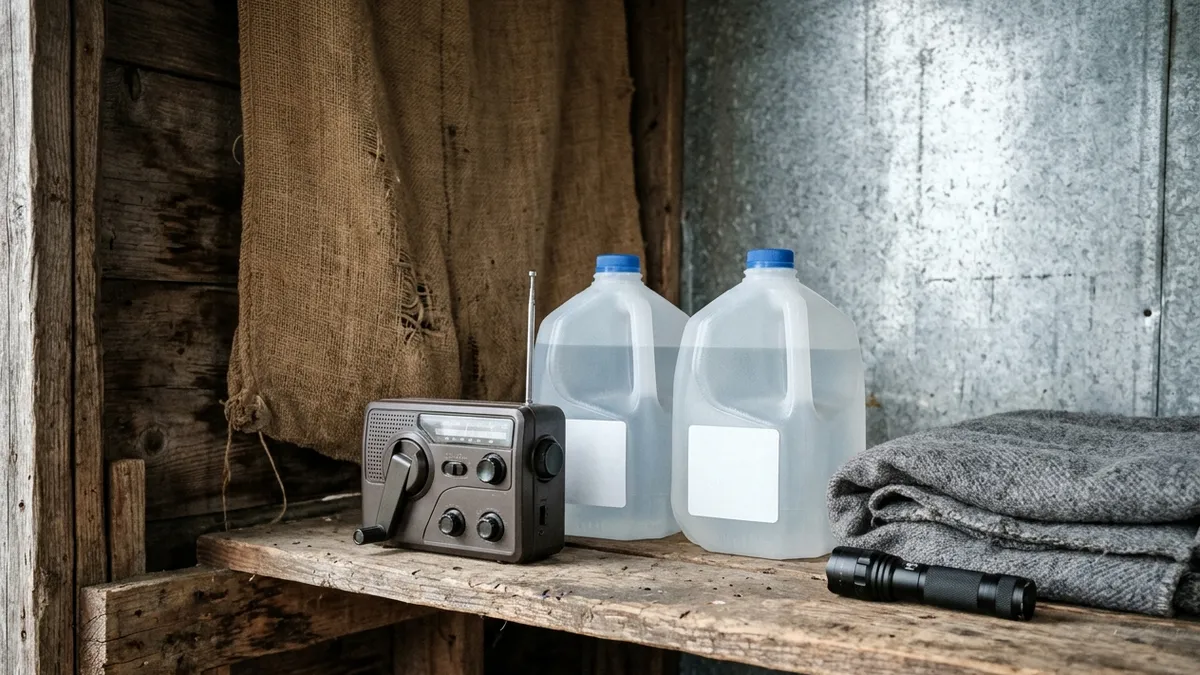
- Ready.gov (FEMA): after an emergency you may need to get by on your own for several days. The basic kit lists one gallon of water per person per day for several days, at least a several-day supply of non-perishable food, a battery-powered or hand-crank radio, a NOAA Weather Radio with tone alert, a flashlight, a first-aid kit, extra batteries and a manual can opener.
- American Red Cross: a 3-day supply of water and food for evacuation and a 2-week supply for home, plus a 7-day supply of medications.
- CDC: store at least 1 gallon of water per person per day for 3 days, and try for a 2-week supply if possible. Store more for pregnant women, sick people, pets, or a hot climate.
- Ready.gov on power outages: a refrigerator keeps food cold for about four hours, and a full freezer for about 48 hours. Throw out food that has reached 40 degrees Fahrenheit or higher.
So the official floor is three days and the official target is two weeks. Thirty days, or ninety, is a personal choice. It is a reasonable one for a household with the space and budget, and you can reach it in stages.
Build It in Three Steps: 3 Days, 2 Weeks, Then 30
Do the cheap step first and let each one carry into the next.
| Step | Water (stored) | Food | Information and light |
|---|---|---|---|
| 1. Three days (this weekend) | 3 gallons | 3 days of no-cook food you already eat, plus a manual can opener | Radio, flashlight, spare batteries, phone power bank |
| 2. Two weeks (this month) | 14 gallons, in food-grade containers | 14 days of shelf-stable food you rotate through normal cooking | Add a NOAA Weather Radio with tone alert if you started with a plain AM/FM radio |
| 3. Thirty days (optional) | Keep the 14 gallons, then add a way to make more safe (boil, filter, disinfect) | Dry staples and a rotation plan | Add a battery power station only if something in your home truly needs power |
Step 3 is optional for a reason. Thirty days of stored water would be 30 gallons per person, which few homes can hold, so the sensible plan is to store two weeks and add treatment capacity for everything beyond that. For the food side, our per-person guide to building a 30-day emergency food supply works through calories, pounds and storage with numbers for 1, 2 and 4 people. If you later want to build past 30 days, our one-year pantry list takes the staples one layer at a time.
Water: Store First, Then Add a Way to Make More
Stored water is the layer that works with no equipment and no skill. Our guide to storing emergency water at home covers containers, placement and rotation. The CDC recommends FDA-approved food-grade containers and says to use bottled water for drinking, cooking and brushing teeth when you have it. If your water comes from a private well, the pump needs power, so a manual backup is a separate question; our guide to pumping well water by hand when the grid goes down walks through the options.
Past what you can store, you are making water safe. The CDC calls boiling the best method, and the EPA says to bring water to a rolling boil for at least one minute. Boiling needs fuel and a heat source you can use safely, so filters and tablets are the backup.
- Gravity filter for home. A hollow-fiber gravity filter pushes water through a cartridge with no pumping. Platypus states that the GravityWorks removes bacteria and protozoa and is not effective against viruses, so treat a filter as one layer, not a guarantee.
- Tablets. The CDC says chemical disinfectants kill most bacteria and viruses but may not kill parasites. Chlorine and iodine tablets will not kill Cryptosporidium, while chlorine dioxide tablets will if you follow the label. Check the active ingredient before you buy, and note the expiry date. Ready.gov’s water page is stricter than the CDC: it describes only plain household bleach (5.25 to 6.0 percent sodium hypochlorite) and says other chemicals and camping-store treatment products are not recommended. The two agencies differ, so read the label and both pages before you choose.
- Filter plus disinfectant. A microfilter handles bacteria and protozoa, and a chlorine tablet handles most bacteria and viruses. Used together they cover more than either does alone, at the cost of extra steps and a waiting time.
The CDC adds one hard limit: water that contains fuel or toxic chemicals cannot be made safe by boiling or disinfecting. A filter does not change that, and we would not rely on one for water you suspect is chemically contaminated.
For a ranked look at the methods, including what to do with no tablets, see our guide to ways to purify water when the power is out.
Radio: Information When the Network Is Down
Ready.gov lists both a battery-powered or hand-crank radio and a NOAA Weather Radio with tone alert. They are two different jobs. A plain AM/FM radio brings local news. NOAA Weather Radio is a nationwide network of more than 1,000 transmitters that broadcasts National Weather Service warnings, watches and other hazard information 24 hours a day, and it needs a receiver able to pick up its VHF signal on one of seven frequencies between 162.400 and 162.550 MHz.
When you shop, check the listing for the NOAA band, and for SAME coding or Public Alert certification, which let a radio alert only for your county instead of for every warning on a shared transmitter. Our hand-crank weather radio review explains what to look for before you buy.
What We Could Not Confirm
We opened the Sept. 30 memo and release, the department’s Oct. 29 article, the Breaking Defense report of Oct. 30, Snopes and the Fox News article. We did not see the documents Fox says it reviewed, and we cannot tell whether the 90-day figure describes a final requirement, a draft or a goal. If the Pentagon publishes one, we will update this page and say what changed. If you see a post claiming “the Pentagon ordered 90 days of food,” it has no source in anything we read.
The Takeaway
A 90-day figure for a military installation does not set a number for your house. Three days is the floor, two weeks is the target Ready.gov, the CDC and the Red Cross point to, and anything past that is your call. The cheapest next move is the unglamorous one: store a few gallons of water at home, find a radio that works without the network, and write down where everything is.
If you want a way to fill the food side with more than canned goods, The Lost SuperFoods is a $37 digital preservation guide covering more than 126 historical foods. As of our Oct. 21, 2026 check, the sales page listed $37 with a 60-day money-back guarantee through ClickBank. It is a book, not food, and our review found the narrator on the sales page is a fictional persona and some of its shelf-life claims go beyond USDA and NCHFP guidance, so check the terms on the sales page before you buy.
Frequently Asked Questions
- Did the Pentagon tell civilians to stockpile food for 90 days?
- No. The FORTRESS America memo of Sept. 30, 2026 is an internal Department of War program memo about military installations, and it does not mention civilians or food. Snopes noted on Oct. 26 that it is unclear how the initiative would affect civilian disaster preparedness and pointed readers to Ready.gov, whose baseline is a several-day supply, with the Red Cross and CDC suggesting two weeks if you can manage it.
- Is the 90-day requirement for military bases real?
- It is reported but not confirmed. Fox News Digital wrote, citing documents it reviewed, that major continental installations would be expected to operate at least 90 days without outside support. The memo itself contains no such number, Snopes found the Pentagon spokesman had not confirmed it, and the department's own Oct. 29 article says Fortress America installations are designed to rely on their own infrastructure for 30 days. A senior official did say publicly that the department is mandating a 90-day on-site stockpile of parts, fuels, propellants and ammunition.
- How much food and water do Ready.gov and the Red Cross recommend?
- Ready.gov says to store at least a several-day supply of non-perishable food and one gallon of water per person per day for several days. The Red Cross lists a 3-day supply for evacuation and a 2-week supply for home. The CDC says to store at least 3 days of water and to try for 2 weeks if possible.
- Do I need a NOAA weather radio if I have a smartphone?
- Ready.gov lists a battery-powered or hand-crank radio and a NOAA Weather Radio with tone alert in its basic kit because cell service and internet can drop in an emergency. NOAA Weather Radio broadcasts National Weather Service warnings around the clock, but you need a receiver built to pick up its VHF signal.
- Can a water filter alone make emergency water safe?
- Not always. Common camping microfilters remove bacteria and protozoa but are not rated for viruses, and the CDC says water containing fuel or toxic chemicals cannot be made safe by boiling or disinfecting. Boiling is the CDC's first choice. Filters and tablets are the backup for when you cannot boil.
Sources & references
- Department of War, Establishment of FORTRESS America (memo, Sept. 30, 2026) (opens in new tab)
- War.gov, Secretary Hegseth announces six major initiatives (Sept. 30, 2026) (opens in new tab)
- War.gov, Assistant Secretary Says New Infrastructure Initiatives Are a National Calling (Oct. 29, 2026) (opens in new tab)
- Breaking Defense, Pentagon eyes public-private partnerships for FORTRESS America (Oct. 30, 2026) (opens in new tab)
- Fox News Digital, Inside the Pentagon's plan to keep America fighting (Oct. 25, 2026) (opens in new tab)
- Snopes, What we know about Pentagon's FORTRESS initiative (Oct. 26, 2026) (opens in new tab)
- Ready.gov (FEMA), Build a Kit (opens in new tab)
- Ready.gov (FEMA), Water (opens in new tab)
- Ready.gov (FEMA), Power Outages (opens in new tab)
- CDC, How to Create an Emergency Water Supply (opens in new tab)
- CDC, How to Make Water Safe in an Emergency (opens in new tab)
- EPA, Emergency Disinfection of Drinking Water (opens in new tab)
- American Red Cross, Survival Kit Supplies (opens in new tab)
- National Weather Service, NOAA Weather Radio All Hazards (opens in new tab)
Before you go
The 7-Step Blackout Plan
A calm, practical plan for getting a household through a multi-day power outage: power, water, food, temperature, light, medical and a written plan.
Free guide
The 7-Step Blackout Plan
A calm, practical plan for getting a household through a multi-day power outage: power, water, food, temperature, light, medical and a written plan.