What’s the short answer?
- Quarantine new hens for 30 days when possible; Penn State Extension's floor is three to four weeks and USDA APHIS recommends keeping new birds separate for 30 days.
- A separate pen isn't enough on its own: use dedicated equipment and limit visitor access during quarantine, since indirect contact can spread disease too.
- After quarantine clears, give new and existing birds about a week of visual-only contact through a barrier before any supervised physical mixing.
- Keep smaller or younger birds behind the barrier longer than near-laying pullets to reduce injury risk from a size mismatch.
- Never house different poultry species, like chickens and waterfowl, together on the same premises; Penn State Extension calls the combination potentially deadly for disease transmission.
Fall is when most backyard flocks change size: a hen was lost to a hawk, egg production is sliding as the days shorten, or a batch of pullets raised over the summer is finally old enough to move in with the adults. Whatever the reason, the instinct is to open the coop door and let everyone sort it out before the cold sets in. That instinct is what causes both the disease scares and the worst pecking-order fights.
The short answer: Quarantine new hens for at least three to four weeks, ideally closer to 30 days, in a fully separate space with no shared equipment, then let them see the existing flock through a barrier for about a week before any supervised physical mixing.
How Long Should You Actually Quarantine New Hens?
The number most backyard keepers have heard is somewhere between “a few days” and “two weeks.” Neither is what the agencies that actually study flock disease recommend.
Penn State Extension’s biosecurity guidance is direct on this: adult birds should never be introduced into an established flock unless they’ve passed quarantine, defined as three to four weeks of isolation, or have tested clean of disease (Penn State Extension, 2026). USDA APHIS’s Defend the Flock program goes further, recommending that new birds be kept separate from the rest of the flock for 30 days to prevent introducing disease (USDA APHIS, 2023).
So if you’re weighing three weeks against 30 days, use 30. That covers both sources’ recommendations for anything moving in from outside your existing flock, including birds bought at a swap, hatched by a friend, or your own birds coming home from a fair or show.
Setting Up a Proper Quarantine Space
The quarantine space doesn’t need to be elaborate; it needs to be separate. A spare coop, a large dog crate under a covered porch, or a partitioned corner of a garage or shed all work, as long as the new birds have their own airspace and aren’t sharing a wall vent or a run fence line with the main flock. Distance and airflow direction both matter more than square footage: put as much room as your property allows between the quarantine space and the main coop, and if the two share a yard, keep the quarantine pen downwind of the flock’s usual foot traffic where you can.
Treat the space as a closed loop for the full three to four weeks. Feed and water the quarantined birds last in your daily routine, not first, and wash your hands or change footwear before going back to the main flock. None of that is complicated, but it’s the part people skip once the new birds look healthy after a week, which is exactly the point in the timeline where the guidance says you still can’t tell.
Why a Few Days in a Different Pen Isn’t Quarantine
A short stint in a separate pen feels like quarantine, but it isn’t what protects the rest of the flock. Extension guidance is clear that a new pen alone doesn’t cut it: the birds also need dedicated equipment and limited visitor access to their space while isolated, because disease can also spread on boots, clothing, and equipment, not only through direct contact between birds (Penn State Extension, 2026; USDA APHIS, 2026). That means a separate feeder and waterer, not the ones already in rotation with the rest of the flock, and boots, gloves, or tools that don’t move between the two spaces without being cleaned first.
It also means keeping the timeline honest. If day 10 of quarantine looks calm, that isn’t evidence the quarantine worked; symptoms in poultry can take weeks to show up, which is exactly why the three-to-four-week and 30-day windows exist in the first place.
Can You Skip the Wait by Mixing New Hens in at Night?
A popular shortcut says you can slip new hens onto the roost after dark, when the existing flock is settled, and everyone wakes up together without a fight. It’s a real technique for reducing the initial pecking-order confrontation once quarantine is already behind you, but it isn’t a substitute for quarantine itself.
The guidance behind the 30-day and three-to-four-week windows exists for disease control, not flock harmony (USDA APHIS, 2023; Penn State Extension, 2026). Mixing birds in the dark doesn’t change whether a new hen is incubating something you can’t see yet. Save the night-roost trick for the day you’re already cleared to mix birds; don’t use it to shortcut the weeks that come before it.
The appeal is understandable. Fall days are already short, the coop chores are piling up, and a bird that’s been eating well and looking bright for a week feels like proof it’s healthy. It usually is. The guidance isn’t written for the usual case; it’s written for the outside chance it isn’t, because a bird incubating something contagious can look completely normal for weeks before it doesn’t, and by then it has already had a season’s worth of contact with the rest of the flock.
The Visual Acclimation Step Before Physical Mixing
Once quarantine has cleared, don’t go straight from separate pens to a shared run. Purina Animal Nutrition’s integration guidance recommends a visual-only acclimation period first: new and existing birds in side-by-side runs where they can see each other but not touch, for about one week, before any supervised physical mixing (Purina Animal Nutrition, 2026).
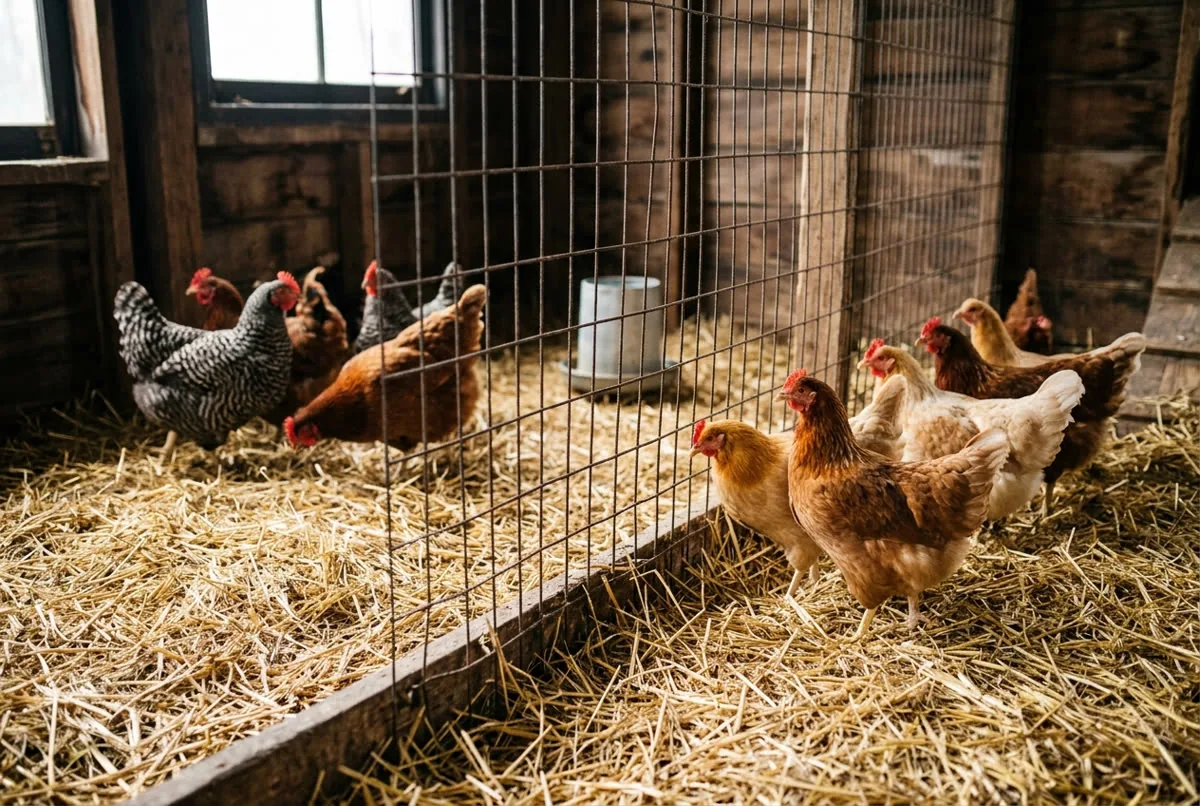
In practice that means a wire partition, a wire crate set inside the run, or a temporary pen wall, positioned where both groups can walk up to the barrier, posture at each other, and get bored of it before the barrier comes down. Fighting during a true introduction is rarely about the new birds being unfamiliar; it’s about the existing flock re-establishing a pecking order the moment there’s suddenly a new bird to rank. A few days of visual contact takes the shock out of that first meeting.
Sizing Matters More Than You’d Think
Age and size gaps make that first physical meeting riskier, not just slower. Smaller or younger birds should stay behind the visual barrier longer than started pullets close to laying age, because a size mismatch raises the odds of an injury once the barrier comes down (Purina Animal Nutrition, 2026). If you’re adding spring-hatched pullets to a flock of full-grown hens this fall, plan on the longer end of that window, and watch the first unsupervised hour closely rather than walking away once the gate opens.
What to Watch For Once You Let Them Mix
The first supervised session is where the visual-acclimation week either pays off or reveals it wasn’t long enough. Some chasing and posturing is normal; the existing flock is re-sorting a pecking order, and a new bird moving down a rank or two without contact is not a failure. What isn’t normal is a hen cornered with nowhere to run, or repeated pecking aimed at the same spot on the head or back until it draws blood. If you see that, separate the birds immediately and give the visual barrier more time before trying again.
Spreading out feed and water into two or more stations for the first week of physical mixing gives lower-ranking birds somewhere to eat without being cornered by the birds above them. It’s a small setup change, but it does more to prevent an actual fight than watching over the run for the first hour and then walking away.
Should You Worry About Mixing Breeds or Species?
These are two different questions, and the guidance treats them differently.
Mixing breeds of chicken with each other isn’t a disease or biosecurity issue on its own; the sequence above (quarantine, then visual acclimation, then a watchful physical introduction) applies the same way regardless of what breeds are involved. Where size and temperament differ between breeds, that’s really the size-mismatch issue from the section above, not a breed problem specifically.
Mixing species is a different matter. Penn State Extension advises never housing different poultry species, chickens with waterfowl or turkeys, for example, on the same premises, calling the combination potentially deadly for disease transmission (Penn State Extension, 2026). If your fall plans include adding ducks or geese alongside new hens, that’s a separate decision from the one this guide covers, and it’s worth reading the extension guidance on species separation before committing to sharing a run.
It’s worth saying plainly, since the two questions get asked in the same breath: a mixed-breed backyard flock (Orpingtons next to Leghorns next to a barnyard mix) carries none of that species-level disease risk on its own. The quarantine and visual-acclimation sequence in this guide is exactly what protects a mixed-breed flock during a fall introduction. It’s species-level mixing, sharing a coop or run with ducks, geese, or turkeys, where the extension guidance draws a hard line.
Bringing It Together Before the Cold Sets In
None of this has to happen in a single weekend. Start the quarantine clock the day new hens arrive, mark 30 days on a calendar, and use that separation window to also finish the fall chores the rest of the flock needs before temperatures drop (see 7 Fall Chores to Get Chickens and Bees Ready for Winter and Biosecurity-Proof Your Backyard Coop Against Avian Flu). If you’re still deciding how many hens actually make sense for your household through a slow-laying winter, that’s worth settling before you commit to an introduction at all (see How Many Chickens for a Self-Sufficient Holiday Table?). Once quarantine clears, give the visual-acclimation week its full run before the barrier comes down; it’s the cheapest insurance against a full-flock fight you’ll find all season.
Frequently Asked Questions
- How long do I need to quarantine new chickens before introducing them to my flock?
- At least three to four weeks, per Penn State Extension, with USDA APHIS recommending keeping new birds separate from the rest of the flock for 30 days to prevent introducing disease.
- Can I skip quarantine by placing new hens on the roost at night?
- Night-roosting can ease the pecking-order introduction after quarantine is already complete, but it doesn't address the disease-control reason quarantine exists, so it isn't a substitute for the three-to-four-week to 30-day window.
- Is a separate pen on the same property enough for quarantine?
- No. Extension guidance also calls for dedicated equipment and limited visitor access during quarantine, since disease can also spread on boots, clothing, and equipment, not only through direct contact between birds.
- What's the safest way to introduce new hens to an established flock?
- After quarantine clears, use a visual-only barrier for about a week so both groups can see but not touch, then move to a supervised physical introduction, giving smaller or younger birds extra time behind the barrier.
- Is it safe to house chickens with ducks or other poultry species?
- Penn State Extension advises against housing different poultry species, such as chickens with waterfowl or turkeys, together on the same premises, calling the combination potentially deadly for disease transmission.
Sources & references
Before you go
The Renter's Homestead Pack
Self-reliance projects for the yard you don't own — container yields, a raised bed built to move with you, balcony preservation basics, and the landlord questions to ask first.
Free guide
The Renter's Homestead Pack
Self-reliance projects for the yard you don't own — container yields, a raised bed built to move with you, balcony preservation basics, and the landlord questions to ask first.