What’s the short answer?
- Ready.gov's older-adults flyer adds documents, a DME contact, a medication list, and first-responder information to the basic FEMA kit (Ready.gov, 2023-09).
- Know each medical device's battery runtime in hours and set a relocation trigger well before it runs out; Ready.gov advises talking to your doctor about keeping powered equipment running in an outage.
- Refrigerated medications have their own safe-storage window once power fails, and Ready.gov advises finding out in advance how long each can be stored at higher temperatures.
- More than 4.5 million Medicare beneficiaries who live independently rely on electricity-dependent equipment or certain essential health care services (HHS emPOWER Program, 2024).
- Ready.gov advises asking your power provider to put you on a list for priority power restoration; you have to contact the utility to ask.
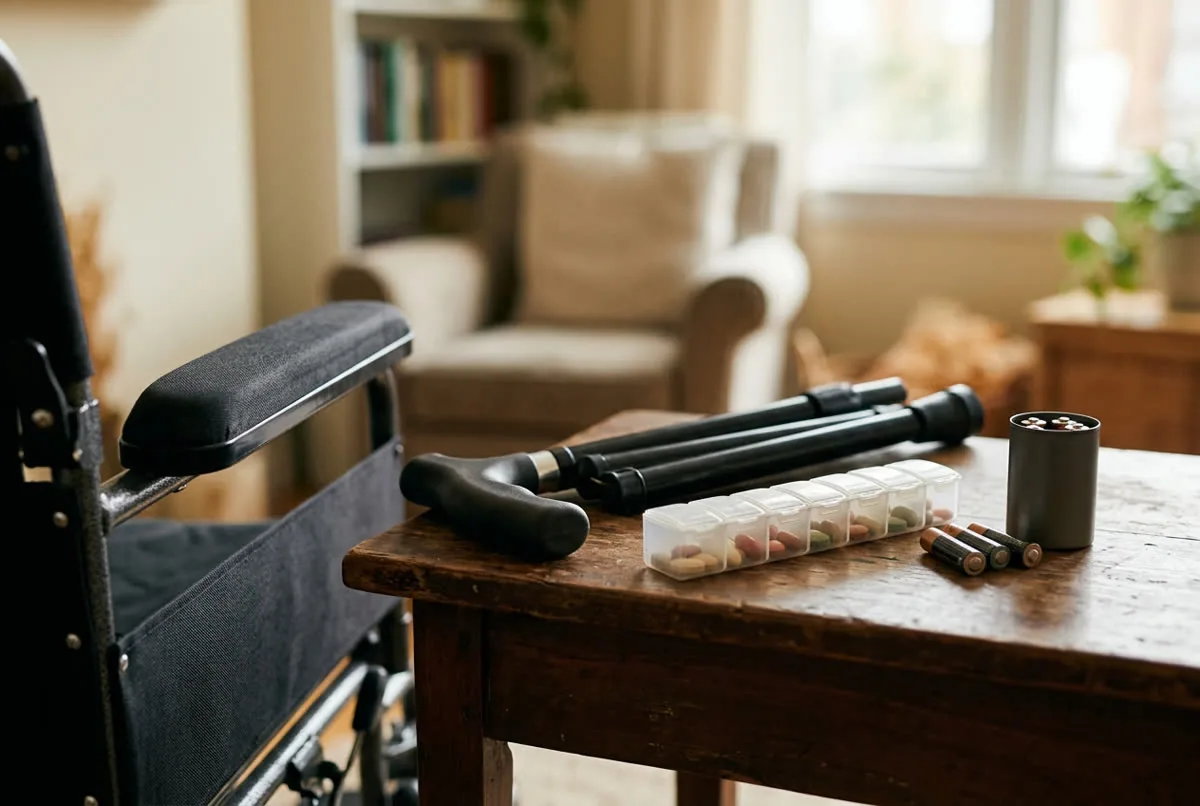
A parent living alone with an oxygen concentrator, a spouse who depends on a power wheelchair, an aunt who keeps insulin in the refrigerator: FEMA’s basic emergency kit checklist was not written with any of them specifically in mind. It covers water, food, flashlights, and a battery-powered radio, but it says nothing about how long a medical device will run once the power goes out, or what to do before that battery reaches zero.
The short answer: Ready.gov does publish a dedicated flyer for older adults and people with disabilities that adds document copies, medical contacts, and evacuation planning on top of the basic kit. It stops short of the two things that matter most for anyone who depends on powered equipment: knowing a device’s actual runtime, and knowing whether the local utility has a priority-restoration program for medically dependent households. Ready.gov’s separate disability page does point to the second one, but neither step shows up on the flyer or the basic kit checklist.
What Ready.gov’s Older-Adults Checklist Actually Adds
Ready.gov’s dedicated flyer, “Disaster Preparedness for Older Adults and People with Disabilities,” does go further than the general basic kit. It lists specific items a general checklist would not: copies of Medicaid, Medicare, and insurance cards, contact information for a durable medical equipment (DME) provider, a written list of medicines with dosage instructions and allergies, and a plan for evacuating with assistive devices (Ready.gov, 2023-09).
The flyer also calls for something the general FEMA basic-kit checklist does not mention at all: “need-to-know information for first responders and others who might need to help you,” kept as its own distinct kit item rather than folded into the general supply list (Ready.gov, 2023-09). That is a meaningful addition. A first responder who arrives at a home with no idea the resident is deaf, uses a ventilator, or cannot walk unassisted is working blind at exactly the moment that information matters most.
So the older-adults flyer is real, current, and worth building a kit around. Where it falls short is in the part of the plan that decides whether the rest of the kit is even enough: the power itself.
Evacuating With an Assistive Device Is Its Own Plan
The flyer’s call for a plan to evacuate with assistive devices is easy to read past, but it deserves its own written page rather than a bullet point. A wheelchair, walker, hearing aids, or a portable oxygen tank each has a different set of questions attached: does it fold, does it need a ramp or a vehicle with a lift, does a spare battery or spare tubing need to travel with it, and who else in the household knows how to operate it if the usual person cannot. None of that is answered by the general FEMA kit, and none of it is answered by “grab the go-bag” either.
The Gap: Planning Backup Power for a Specific Device
A general household can treat a power outage as an inconvenience to wait out. A household with electricity-dependent medical equipment cannot, because “wait and see” is not a plan when a device’s battery has a fixed number of hours left in it.
CDC’s power guidance notes that outages caused by a large-scale disaster can last longer and be life-threatening for people who depend on home-use medical devices, and tells households to identify backup power sources for medical equipment (CDC.gov, 2024-04-18). Ready.gov adds that anyone using medical equipment that requires electricity should talk to their doctor or health care provider about what they may be able to do to keep it running during a power outage (Ready.gov). Turning that into a plan means identifying every electricity-dependent device a person relies on, checking its battery runtime in hours, and setting a specific relocation trigger, meaning a decision point set well before the battery runs out, rather than waiting to see how long the outage lasts. That is a fundamentally different kind of planning than stocking a flashlight. It requires knowing your own equipment’s numbers ahead of time, not guessing them mid-outage.
Find the Runtime Before You Need It
For a device like an oxygen concentrator, a CPAP machine, or a power wheelchair, the manufacturer’s manual or the DME provider can usually supply the battery runtime in hours under normal use. That number should be written down next to the device, not left as something to look up during a blackout when the manual may be hard to find and the household is already under stress.
Set the Trigger, Not the Deadline
The relocation trigger is not “when the battery dies.” It is a point well before that, with enough buffer to reach an alternative power source, a relative’s home, or a shelter with backup power while the device still has charge left for the trip. Building that buffer into the plan in writing is the difference between a controlled move and an emergency one.
Writing the number down is only half the job. The other half is checking it against reality once, before an actual outage forces the question. A device that is rated for eight hours on a fresh battery may run shorter than that if the battery is a few years old, and the only way to know is to ask the DME provider whether the runtime should be retested or the battery replaced. That single phone call, made once, is cheaper than discovering the shortfall during a blackout.
Refrigerated Medication Has Its Own Clock
Backup power planning is not only about devices that plug in. Ready.gov also recommends finding out in advance how long medication can be stored at higher temperatures and getting specific guidance for any medication that is critical for life, since that window matters just as much as keeping a device charged (Ready.gov).
Insulin, certain injectable medications, and some other prescriptions do not all tolerate a warm refrigerator the same way. That information should come from the prescribing pharmacist or the medication’s own packaging, and it belongs in the same written plan as the device runtimes, not treated as a separate afterthought.
How Many Households This Actually Affects
This is not a narrow edge case. The HHS emPOWER Program, a partnership between the Administration for Strategic Preparedness and Response (ASPR) and the Centers for Medicare & Medicaid Services (CMS), works to protect the health of more than 4.5 million Medicare beneficiaries who live independently and rely on electricity-dependent durable medical and assistive equipment and devices, such as ventilators, and/or certain essential health care services, such as home health care (HHS emPOWER Program, 2024).
That scale is why this gap in general checklists matters. A household that assumes the basic FEMA kit already accounts for medical-device power needs is working from an incomplete plan, and the shortfall is not obvious until the power is already out.
Ask the Utility About a Priority-Restoration Registry
There is a step that depends on a single phone call: Ready.gov advises asking your power provider to put you on a list for priority power restoration (Ready.gov). That list is run by the utility, so it requires contacting the utility directly. It is not something FEMA administers and not something that happens automatically just because a household owns medical equipment.
This is easy to miss because it does not appear on Ready.gov’s older-adults flyer or basic kit checklist; it sits on Ready.gov’s separate disability page. It is worth calling the utility’s customer service line and asking, by name, whether they have a medical-priority or life-support registry and what documentation they require to add a household to it.
Two Assumptions Worth Checking Before an Outage
Two beliefs tend to make households skip this planning, and both are worth checking directly rather than assuming.
The first is thinking the basic FEMA kit already accounts for medical-device power needs simply because it mentions batteries and flashlights. It does not; the device-runtime and medication-storage planning described above comes from your own device numbers and Ready.gov’s separate power-outage and disability guidance, not from the general kit checklist, and it has to be added separately.
The second is thinking there is nothing to do beyond stocking spare batteries. A utility’s priority-restoration list is a real, separate step that is easy to skip because the basic kit checklist does not tell you to call and ask. Skipping it means missing out on priority restoration that could otherwise buy hours of runway for a device or a refrigerated medication.
Building the Full Kit: Documents, Devices, and a Backup Power Plan
Put together, a kit that actually closes the gap includes three layers that Ready.gov’s flyer and its power-outage and disability pages cover between them, but that no single checklist lists in one place.
Documents and contacts: copies of Medicaid, Medicare, and insurance cards, the DME provider’s phone number, a written medication list with dosages and allergies, a plan for evacuating with any assistive device, and the first-responder information Ready.gov specifically calls out (Ready.gov, 2023-09).
Device numbers: the battery runtime in hours for every electricity-dependent device in the home, and a relocation trigger set well ahead of that runtime running out.
Medication limits: how long each refrigerated medication can be stored at higher temperatures once the refrigerator stops running (Ready.gov), plus confirmation of whether the local utility has a priority-restoration registry and what it takes to enroll.
For general blackout supplies beyond this medical layer, our room-by-room blackout kit guide covers the rest of the household, and the hand-crank weather radio review is a reasonable place to start for a backup information source that does not draw down the same battery a medical device needs. A hurricane-season blackout kit built around water and power essentials pairs naturally with the medical layer described here, since the same outage triggers both needs at once.
The Next Step
Start with a single sheet of paper, not a shopping trip: list every electricity-dependent device in the household, call the manufacturer or DME provider for its battery runtime, write down a relocation trigger for each one, check the refrigerated-medication storage window with the pharmacist, and call the electric utility to ask about a life-sustaining-equipment registry. Once that sheet exists, a battery backup or portable power station becomes a decision grounded in real numbers instead of a guess, and the rest of the household’s kit can be built around it with confidence.
Frequently Asked Questions
- What does FEMA's basic emergency kit checklist leave out for someone with a medical device?
- The basic kit and Ready.gov's older-adults flyer do not address battery runtime for medical devices or utility priority-restoration lists. Ready.gov's separate disability page does tell you to ask your power provider about priority power restoration and to talk to your doctor or health care provider about keeping powered equipment running during an outage.
- How do I find out how long my medical equipment's battery will actually last in an outage?
- Identify every electricity-dependent device you rely on and ask the manufacturer or your durable medical equipment provider for its battery runtime in hours. Ready.gov also advises talking to your doctor or health care provider about what you may be able to do to keep the equipment running during a power outage.
- Is there a program that gets power restored faster for medically dependent households?
- Ready.gov advises asking your power provider to put you on a list for priority power restoration. These lists are run by the utility, so you have to contact it directly to ask.
- How long can refrigerated medication stay safe without power?
- It varies by medication. Ready.gov recommends finding out in advance how long each medication can be stored at higher temperatures and getting specific guidance for any medication that is critical for life; if the power is out for more than a day, it advises discarding medication that should be refrigerated unless the drug's label says otherwise.
- What should go in an emergency kit for an older adult living alone?
- Ready.gov's dedicated flyer recommends copies of Medicaid, Medicare, and insurance cards, a durable medical equipment provider's contact information, a written medication list with dosages and allergies, a plan for evacuating with assistive devices, and information for first responders (Ready.gov, 2023-09).
Sources & references
Before you go
The Renter's Homestead Pack
Self-reliance projects for the yard you don't own — container yields, a raised bed built to move with you, balcony preservation basics, and the landlord questions to ask first.
Free guide
The Renter's Homestead Pack
Self-reliance projects for the yard you don't own — container yields, a raised bed built to move with you, balcony preservation basics, and the landlord questions to ask first.