What’s the short answer?
- Sandless (SAP) flood bags fully expand in roughly 3-10 minutes per manufacturer data (StormBag about 3, Quick Dam about 10), faster to deploy than filling and hauling traditional sand.
- USACE's own guidance says sandbag construction is "satisfactory for use in most situations," but does not guarantee a water-tight seal.
- No independent government or lab test comparing sandless bags to traditional sandbags could be confirmed; performance claims are manufacturer-stated.
- FEMA says it does not approve, endorse, or certify any products, so "FEMA-approved" claims on sandless sandbag products are marketing, not certification.
- Base bag count on your actual doorway width and expected water depth, using USACE's 14-18 by 30-36 inch bag footprint as a reference, not a fixed number.
Water’s rising in the forecast, the driveway dips toward the garage door, and the sandbags you meant to buy last spring are still a line item on a to-do list. Traditional sand and burlap work, but they take a truck run, a shovel, and two people who don’t mind getting dirty an hour before a storm. The gear that actually gets used is the gear that was already in the shed when the sky turned green.
The short answer: For most homeowners, a stack of water-activated sandless bags kept in the garage covers doorways and low thresholds faster than filling and hauling traditional sand, but they are not a documented one-for-one substitute for U.S. Army Corps of Engineers-spec sandbags in serious, sustained flooding, and the claim that they’re “FEMA-approved” does not hold up.
What “Sandless” Bags Actually Are
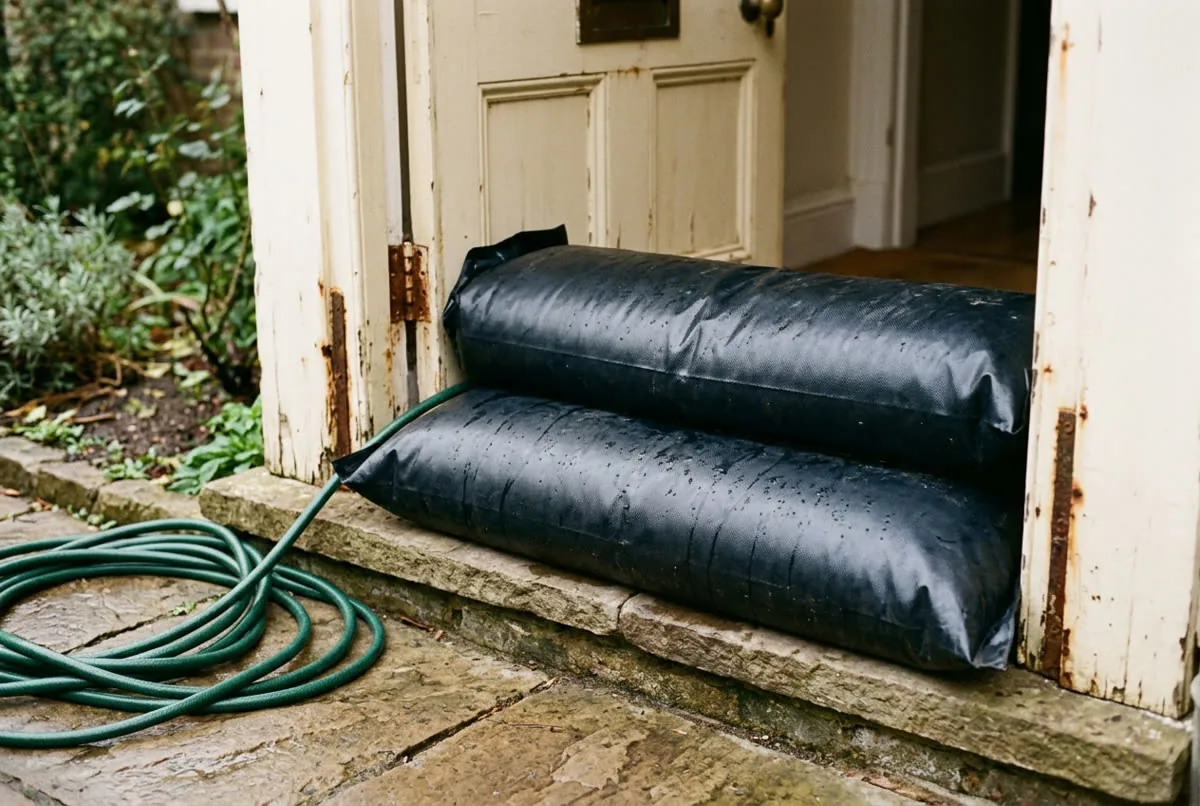
Sandless sandbags aren’t bags you fill yourself. They’re flat, lightweight pouches loaded with a super-absorbent polymer (SAP). Quick Dam’s product page says its bags contain a polymer that swells on contact with water, expanding to about 12 by 24 inches and 3.5 inches high and absorbing up to 4 gallons, and notes they are not for use with salt water, which causes deflation. StormBag’s page describes a 1 lb dry bag that expands to 33 lbs. Manufacturer data for these products describes full-expansion times of roughly three to ten minutes, depending on the specific product: about 3 minutes for StormBag and about 10 for Quick Dam (Quick Dam and StormBag manufacturer product pages). That’s the entire appeal: no sand pile, no shovel, no truck bed full of grit to haul out of the garage later.
Storage is the other practical difference. A stack of flat, dry sandless pouches takes up a shelf’s worth of space in a closet or garage, while the equivalent number of filled traditional sandbags needs floor space, a tarp underneath to keep the concrete clean, and enough sand or soil on hand to fill them in the first place. For a renter or a small-yard household with nowhere to keep a sand pile, that storage difference alone can decide the question before performance even enters the conversation.
How Traditional Sandbags Are Built: the USACE Baseline
Before comparing anything to sand, it helps to know what “correct” actually looks like on paper. The Army Corps of Engineers’ official flood-fighting guidance recommends untied bags for most situations, filled to between one-third and one-half of their capacity, using bags about 14 to 18 inches wide and 30 to 36 inches deep where possible (U.S. Army Corps of Engineers (Northwestern Division), November 2018). USACE says partial filling keeps a bag from getting too heavy and lets bags stack with a good seal, which overfilling defeats.
Placement matters as much as the fill level. USACE guidance calls for bags laid lengthwise, parallel to the direction of water flow, with the open end facing against the flow and the flaps tucked under. Each layer’s joints are staggered over the seams of the layer below, the same brick-laying logic that keeps a wall from splitting along one weak line (U.S. Army Corps of Engineers (Northwestern Division), November 2018).
Fill material matters too. USACE says a heavy-bodied or sandy soil is most desirable for filling sandbags, that coarse sand can leak through the bag weave (double bagging prevents it), and that gravelly or rocky soils are generally poor choices because of their permeability (U.S. Army Corps of Engineers (Northwestern Division), November 2018).
Do Sandless Bags Perform as Well as Real Sand?
This is the question worth sitting with before you buy anything. Even the Corps of Engineers doesn’t claim traditional sandbags create a fully waterproof seal. Its own guidance describes correctly built sandbag construction as “satisfactory for use in most situations,” not a guaranteed watertight barrier (U.S. Army Corps of Engineers (Northwestern Division), November 2018). Plan for some seepage even with the textbook method, since the guidance itself stops short of promising a water-tight seal.
Where this leaves sandless bags is genuinely unresolved by any independent source we could confirm. We looked for a government agency or peer-reviewed lab comparison of SAP-based sandless bags against traditional sandbags, including the specific seepage-rate figures that circulate in vendor marketing, and no primary government source verifying those numbers could be found. That doesn’t mean the products fail; it means the performance claims you’ll see on a product page are manufacturer-stated, not independently tested by an outside body. Treat them the way you’d treat any single seller’s own numbers: plausible, but unverified until someone without a sales interest checks them.
For a low-threshold entry, a garage door gap, a basement window well, a doorway with an inch or two of expected water, that gap between “manufacturer-stated” and “independently verified” is a reasonable risk for most homeowners. For a structure expecting sustained, deep floodwater, the correctly built USACE-spec sandbag wall remains the better-documented option.
Weight tells part of the story too. USACE puts a filled sandbag at approximately 30 to 50 pounds, depending on dampness and type of sand, which is real resistance against moving water but also real labor to carry and stack, especially for a layer three or four bags high (U.S. Army Corps of Engineers (Northwestern Division), November 2018). A dry sandless pouch weighs far less than that until it activates (StormBag lists a 1 lb bag that expands to 33 lbs), so it is easier to carry and place, and the water does the heavy lifting. The tradeoff is that until a bag is soaked and expanded, it isn’t doing anything, so there’s a short window between placement and full protection that a pre-filled sandbag doesn’t have.
How Long Does a Water-Activated Bag Take to Fully Expand?
Manufacturer data puts full expansion at roughly three to ten minutes once the pouch contacts water: StormBag’s page says about 3 minutes, while Quick Dam’s says about 10 minutes if enough water is present (StormBag and Quick Dam manufacturer product pages). That’s fast enough to deploy after a flash flood watch is issued rather than days ahead of time, which is the main practical advantage over a sand-and-shovel setup. It’s still worth testing one bag from a new package before you need the whole stack, since expansion speed is manufacturer-reported rather than independently benchmarked.
Are Sandless Bags Reusable After They Dry Out?
This is a common marketing claim, and it’s one the available sourcing doesn’t independently confirm one way or another. No government or independent testing data on SAP sandbag reuse cycles could be verified for this guide. If a specific product’s listing claims it’s good for multiple flood events after drying, treat that as a manufacturer specification to verify against the actual product page before you rely on it for a second storm, the same way you’d verify a price or a warranty term rather than assume it applies across every brand.
Practically, that means checking a product’s stated reuse count before you buy if reuse matters to your budget, and inspecting a bag after it dries rather than assuming it’s automatically good to go again. A pouch that split during expansion or lost polymer through a seam won’t perform the same way twice, no matter what the packaging claims for an unused bag.
How Many Bags Do You Actually Need?
Start with the door or opening you’re protecting, not a generic number. Using the USACE-recommended bag width of roughly 14 to 18 inches as a reference point, a typical 32- to 36-inch doorway works out to about two to three bags per layer by simple arithmetic (an estimate, not a USACE figure), with additional stacked layers, joints staggered, needed to reach a useful barrier height (U.S. Army Corps of Engineers (Northwestern Division), November 2018). Wider garage openings or a run along a low retaining wall will need proportionally more. Treat any exact per-door count on a product page as an estimate and buy a few extra rather than cutting it close, since actual doorway widths, sill heights, and expected water depth all vary by house.
Height works the same way. Each staggered layer adds only a few inches of barrier, so a threshold that could see six inches to a foot of standing water needs multiple stacked layers, not a single row set on end. Sketch your actual doorway width and expected water depth on paper before you buy, then round the bag count up rather than down. Running short mid-storm costs more time than buying one extra bag ever will.
Is It True Sandless Sandbags Are FEMA-Approved?
No. FEMA’s own FAQ says it does not approve, endorse, certify, or recommend any contractors, individuals, firms, or products, and that firms shall not state their products are “FEMA approved” or “FEMA certified” (FEMA). If you see that language on a sandless sandbag listing, read it as a marketing claim rather than a government endorsement, and make your buying decision on the manufacturer’s actual specifications instead.
One more distinction worth knowing: USACE’s cautions that filled burlap bags deteriorate quickly, that rodent control is strongly recommended during bag storage, and that polypropylene bags are not biodegradable and must be disposed of after use apply specifically to traditional sandbags (U.S. Army Corps of Engineers (Northwestern Division), November 2018). No sourced guidance here covers end-of-life disposal for SAP-based sandless bags specifically, so check the individual product’s instructions rather than assuming either way.
Next Step
Whichever method you land on, the useful move is deciding before the storm is on the radar, not during it. If you’ve got the storage space and don’t mind the extra labor, traditional USACE-spec sandbags remain the more thoroughly documented option for anything beyond a shallow, low-stakes doorway. If garage space or physical labor is the limiting factor, a stack of sandless bags staged now, tested once on a dry day so you know your specific product’s real expansion time, trades some of that documentation for much less labor. Either way, flood prep is one piece of a broader hurricane-season kit; our Hurricane-Season Blackout Kit: Power and Water Essentials covers the rest of what tends to go out along with the water, and if you want a broader reference for the skills side of prepping beyond gear, our Lost Frontier Handbook review breaks down whether that guide is worth adding to the shelf.
Frequently Asked Questions
- Do sandless sandbags actually work as well as real sand?
- No independent government or lab comparison of sandless (SAP) bags against traditional sandbags could be confirmed. Even USACE's own guidance describes correctly built traditional sandbag construction as "satisfactory for use in most situations," not a guaranteed watertight barrier, so treat vendor performance claims for sandless bags as manufacturer-stated rather than independently verified.
- How long does it take a water-activated flood bag to fully expand?
- Manufacturer data for sandless flood bags describes activation and full-expansion times of roughly three to ten minutes, depending on the specific product. This figure comes from manufacturer product pages, not independent testing.
- How many sandbags or sandless bags do I need for my door?
- Base it on your actual doorway width and expected water depth rather than a fixed number. Using USACE's reference bag width of about 14 to 18 inches, a typical 32- to 36-inch doorway works out to roughly two to three bags per layer by simple arithmetic (an estimate, not a USACE figure), with additional stacked, staggered layers needed to reach useful barrier height.
- Is it true sandless sandbags are FEMA-approved?
- No. FEMA's own FAQ says it does not approve, endorse, certify, or recommend any products, and that firms shall not state their products are "FEMA approved" or "FEMA certified." Read that language on a listing as a marketing claim, not a government certification.
- Are sandless sandbags reusable after they dry out?
- No independent testing data on SAP sandbag reuse cycles could be verified for this guide. Check the specific product's own reuse claim before buying, and inspect a used bag for splits or lost polymer before assuming it will perform the same way a second time.
Sources & references
- U.S. Army Corps of Engineers (Northwestern Division) (opens in new tab)
- Quick Dam, Flood Bags (manufacturer product page) (opens in new tab)
- StormBag, Box of StormBags (manufacturer product page) (opens in new tab)
- FEMA, Does FEMA approve, endorse, or certify any products or companies? (opens in new tab)
Before you go
The Renter's Homestead Pack
Self-reliance projects for the yard you don't own — container yields, a raised bed built to move with you, balcony preservation basics, and the landlord questions to ask first.
Free guide
The Renter's Homestead Pack
Self-reliance projects for the yard you don't own — container yields, a raised bed built to move with you, balcony preservation basics, and the landlord questions to ask first.