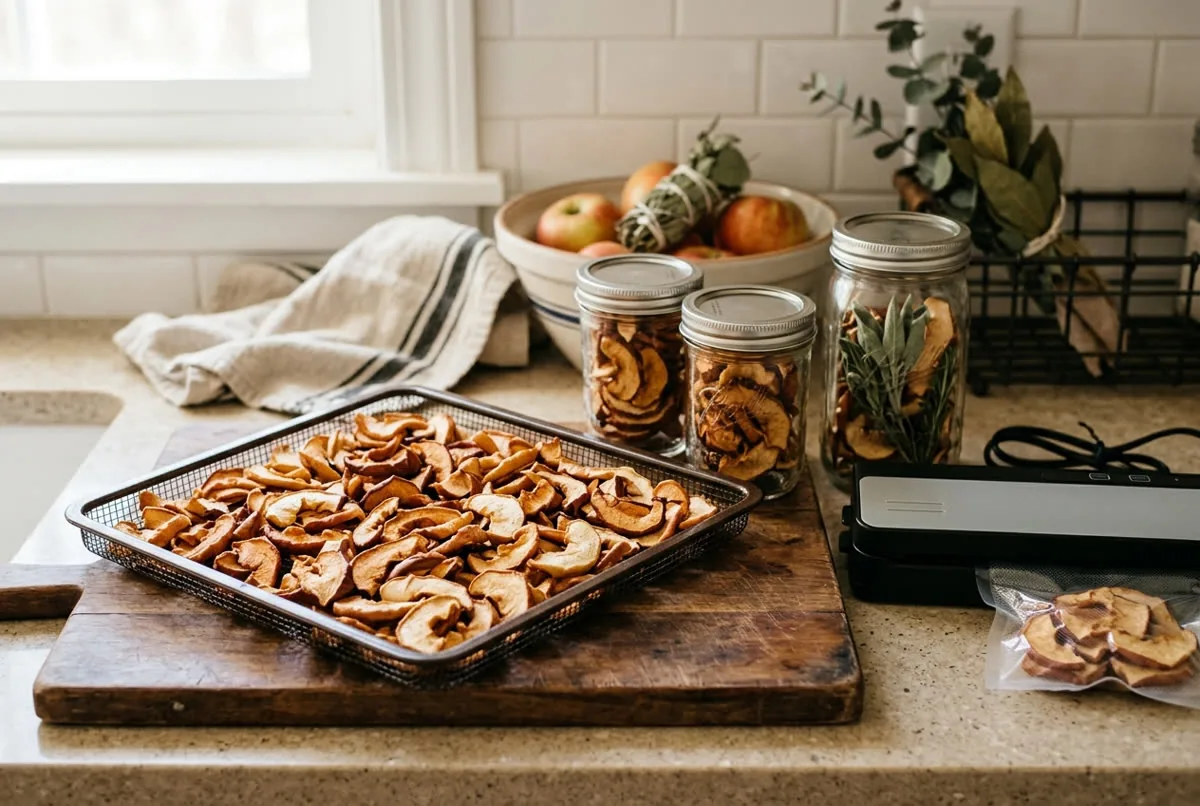
Your pantry shelves have gaps where a season’s worth of tomatoes, beans, and garden herbs should be, and the appliances that would close those gaps - a dehydrator, a vacuum sealer, a pressure canner - keep sliding to next month’s budget. Cyber Monday lands on November 30, 2026, the Monday right after Thanksgiving and Black Friday (Calendar Date), and it’s one of the few points in the year when preservation gear from several categories goes on sale at once.
The short answer: A dehydrator, a pressure canner, and a vacuum sealer solve three different storage problems, so buy based on which food category you actually put up most, check the specific listing’s price history before trusting a “deal” badge, and treat Cyber Monday as a good window to buy gear you’ve already decided you need rather than a reason to decide on the spot.
Which dehydrator features matter most for long-term storage
A dehydrator’s job is simple on paper: pull enough water out of food that spoilage organisms have little left to work with. Properly dried fruits, vegetables, and herbs can hold for many months at room temperature when they go into sealed, cool, dark storage afterward (National Center for Home Food Preservation). The appliance only does half the job - the other half is what you put the dried food into once it comes off the trays.
A few features are worth paying for over a bare-bones model:
- Adjustable, even temperature control. Different foods dry best at different temperatures - herbs and leafy greens at the low end, jerky and meats higher. A dehydrator that lets you set and hold a specific temperature gives you more consistent, safer results than a single fixed setting.
- A rear- or side-mounted fan. Horizontal-flow units with the fan and heater on the side give all trays equal heat penetration, while base-mounted (vertical-flow) designs can dry less evenly, which means more rotating and babysitting mid-cycle (National Center for Home Food Preservation).
- Enough usable tray space for your actual harvest volume. A six-tray unit that’s full after one afternoon of garden tomatoes will have you running back-to-back batches all week.
- A timer and auto shutoff. Overnight or all-day runs are common with dehydrating; an auto shutoff means you’re not leaving a heating appliance running unattended for safety and energy reasons alike.
Storage practice matters as much as the appliance itself. Dried food that goes straight into a loosely closed bag on the counter won’t hold anywhere near as long as the same food sealed and kept somewhere cool and dark - the appliance only buys you the shelf life you then protect afterward. That’s the direct link between a dehydrator purchase and a vacuum sealer purchase: one removes the moisture, the other keeps it from coming back.
Our full dehydrator review walks through specific models against these criteria if you want a side-by-side before Cyber Monday pricing lands.
Do you actually need a pressure canner, or will a water-bath canner do
This is the one place in this guide where the answer isn’t “it depends” - it depends on what you’re canning. Meat and low-acid vegetables (green beans, corn, most root vegetables) require pressure canning. A boiling-water bath tops out at 212°F, and that’s not hot enough to kill Clostridium botulinum spores, which is why pressure canning is treated as the single most important safety rule for these foods: it reaches the 240°F-plus temperatures actually needed for that job (National Center for Home Food Preservation). Using a water-bath canner for meat or low-acid vegetables isn’t a shortcut, it’s a real food-safety risk, not a matter of taste or tradition.
Water-bath canning is genuinely fine for what it’s built for: high-acid foods like most fruits, jams, pickles, and tomatoes with added acid. If that’s most of what you put up, a water-bath setup may be all you need for now. If you’re also putting away green beans, stock, or any meat, a pressure canner isn’t optional equipment - it’s the tool that makes those foods safe to store at room temperature at all. Our guide on canning beef and meat at home covers the process end to end once you have the right canner in hand.
Cyber Monday is a reasonable time to buy a pressure canner precisely because it’s not an impulse category - a canner is a piece of equipment you use for years, and getting a discount on a model you’d have bought anyway is a straightforward win. What doesn’t make sense is buying a pressure canner because it’s on sale and figuring out the process later. Pressure canning has a learning curve around altitude adjustments, processing times by food type, and jar headspace, and that’s not something to work out for the first time on a holiday-weekend batch of green beans. Read the manual and a tested recipe source before your first run, sale or no sale.
One caution that applies to canning and dehydrating both: neither one makes food safe indefinitely by itself. Drying and canning extend shelf life significantly, but they don’t replace proper technique, sanitation, and - for canning specifically - following a tested, pressure-appropriate process for the food in question.
What to look for in a vacuum sealer for bulk dry goods
Vacuum sealing solves a different problem than dehydrating or canning: it protects already-shelf-stable food from moisture and oxygen rather than removing water or applying heat. That makes it the right tool for dried foods coming off your dehydrator and for dry staples like rice, beans, and oats. Pairing vacuum sealing with mylar bags and oxygen absorbers, kept in cool, dark storage, helps keep oxygen and moisture away from those staples and preserve their quality (Utah State University Extension).
For bulk dry goods specifically, a few things matter more than for occasional leftover-bag use:
- A wide, adjustable sealing bar that can handle mylar bags, not just the manufacturer’s own vacuum rolls.
- A pulse or manual vacuum mode, so you can stop suction before crushing delicate dried items like herbs or fruit slices.
- Sealed-bag storage capacity, meaning it can actually pull a strong enough vacuum on a full quart or gallon-size bag, not just small sandwich-size pouches.
- Bag compatibility with your existing supplies - some machines are locked to proprietary rolls, which gets expensive fast if you’re sealing in bulk regularly.
One more distinction worth making: a vacuum sealer is not a canner and doesn’t replace one, and vacuum packaging is not a food preservation method by itself (Utah State University Extension). Vacuum sealing removes air but doesn’t apply the heat needed to make a low-acid food shelf-stable, so it’s a tool for protecting already-dry or already-canned food, not a shortcut around the pressure canning step for meat and low-acid vegetables described above.
Our vacuum sealer review breaks down which models handle bulk dry goods well versus which ones are better suited to weekly meal prep.
Are Cyber Monday appliance deals actually good, or should you buy earlier or later
Cyber Monday 2026 falls on November 30, the first Monday after Thanksgiving (Calendar Date). That timing matters less for whether a deal is “good” and more for whether it’s better than what came before or after it. The honest answer is that it varies by model and retailer, so the discipline that actually protects your money is the same every year:
- Track the specific model’s price for a few weeks beforehand if you can, rather than trusting a “was/now” badge at face value.
- Decide which appliance you need before the sale starts. Cyber Monday is a good time to buy gear you’ve already researched, not a good time to make a first decision about dehydrator brands under time pressure.
- Check that the listing is the actual current model, not a discontinued version being cleared out at a price that only looks like a discount.
- Compare against your own November-through-January budget, not just the sticker price, since a canner or dehydrator you buy now should still be part of a realistic winter preservation plan rather than an impulse purchase.
If you’ve already narrowed down a dehydrator, canner, or vacuum sealer from the reviews linked in this guide, Cyber Monday is a reasonable window to watch for a price drop on that specific model.
Multi-Cooker Canning Buttons and Pressure Canners
Some electric multi-cookers carry a “canning” or “steam canning” button, and a sale price can make one look like a stand-in for a pressure canner. The National Center for Home Food Preservation does not support using the USDA canning processes in these appliances, even when the manufacturer’s directions include pressure canning instructions (National Center for Home Food Preservation, February 1, 2019).
The reasoning comes down to temperature, not pressure. The USDA recommendations were determined for stovetop pressure canners that hold four or more quart-size jars standing upright, and a cooker that reaches the right pressure does not show that the food inside the jars heats the same way. Cooling matters too: a very small cooker can shorten that stage, so the food could cool down more quickly and be under-processed.
For meat and low-acid vegetables, that keeps a stovetop pressure canner on the Cyber Monday list and a multi-cooker off it as a substitute. Buy a multi-cooker for everyday cooking if it earns its counter space, and treat it as a separate decision from the canner.
How many preservation tools does a small household realistically need
For most small households, the honest starting point is one tool per storage method you actually use, not one of everything. If your garden mostly produces fruit, herbs, and high-acid vegetables, a dehydrator plus a water-bath canner may cover your real needs. If you’re also processing meat, stock, or low-acid vegetables from a garden, hunting, or bulk buys, a pressure canner moves from optional to necessary. A vacuum sealer earns its place once you’re regularly producing dried food or buying dry staples in bulk - it’s the tool that protects the work the other two appliances already did.
Buying three appliances at once because they’re all discounted the same week isn’t a strategy - it’s how counters end up cluttered with equipment that doesn’t match what’s actually coming out of the garden. Our list of foods for a one-year pantry and our root cellar storage guide are both useful starting points for figuring out which storage method your actual harvest calls for before you decide which appliance to prioritize this Cyber Monday.
Start with whichever gap is costing you food right now - spoiled produce points to a dehydrator, unsafe canning shortcuts point to a pressure canner, and staples going stale in their original bags point to a vacuum sealer - then use the November 30 sale window to fill that one gap well rather than three gaps cheaply.
Frequently Asked Questions
- Which features matter most when choosing a food dehydrator for long-term storage?
- Adjustable temperature control, an even-drying rear or side-mounted fan, enough tray space for your harvest volume, and a timer with auto shutoff. The dehydrator only handles half the job; sealed, cool, dark storage afterward is what actually determines shelf life.
- Do I really need a pressure canner, or is a water-bath canner enough?
- It depends what you're canning. Water-bath canning works for high-acid foods like fruit and pickles. Meat and low-acid vegetables require pressure canning, because a water bath can't reach the 240°F-plus temperatures needed to kill botulism spores.
- What should I look for in a vacuum sealer for bulk dry goods?
- A wide adjustable sealing bar that handles mylar bags, a pulse or manual vacuum mode for delicate items, enough vacuum strength for full quart or gallon bags, and bag compatibility that doesn't lock you into expensive proprietary rolls.
- Are Cyber Monday appliance deals actually good, or should I buy earlier or later?
- It varies by model and retailer. Track the specific model's price beforehand if you can, decide which appliance you need before the sale starts, and confirm the listing is the current model rather than a discontinued one priced to look like a discount.
- How many preservation tools does a small household realistically need?
- One tool per storage method you actually use. A dehydrator and water-bath canner cover fruit- and herb-heavy harvests; a pressure canner becomes necessary once meat or low-acid vegetables are involved; a vacuum sealer earns its place once you're regularly producing dried food or buying staples in bulk.
Sources & references
- Calendar Date (opens in new tab)
- National Center for Home Food Preservation, Ensuring safe canned foods (opens in new tab)
- National Center for Home Food Preservation, Food dehydrators (opens in new tab)
- National Center for Home Food Preservation, Packaging and storing dried foods (opens in new tab)
- Utah State University Extension, Food storage packaging (opens in new tab)
- National Center for Home Food Preservation, Canning in electric multi-cookers (opens in new tab)
Before you go
The Renter's Homestead Pack
Self-reliance projects for the yard you don't own — container yields, a raised bed built to move with you, balcony preservation basics, and the landlord questions to ask first.
Free guide
The Renter's Homestead Pack
Self-reliance projects for the yard you don't own — container yields, a raised bed built to move with you, balcony preservation basics, and the landlord questions to ask first.