What’s the short answer?
- A guide teaches concepts and sequencing; a starter kit teaches physical skill through repetition. Most beginners need both, not one instead of the other.
- No third-party study measures which builds skills faster; treat any such claim, including this one, as reasoned judgment rather than proven fact.
- We found no official standard bushcraft kit list from a government or accredited body. The common hobbyist starting point is a fixed-blade knife, fire-starting tool, cordage, shelter material, and a first aid kit.
- The Lost Frontier Handbook comes with the vendor's 60-day money-back guarantee, so you have time to evaluate the content before committing.
Say you have a free weekend, a spare corner of the shed, and a decision to make about where to put your effort next. One path is a comprehensive guide that walks through food preservation, water sourcing, and shelter building in order, page by page. The other is a basic kit of outdoor tools you learn by using, trial and error rather than instruction. The fastest way to stall on any hands-on skill is to keep reading about it instead of picking the tool up.
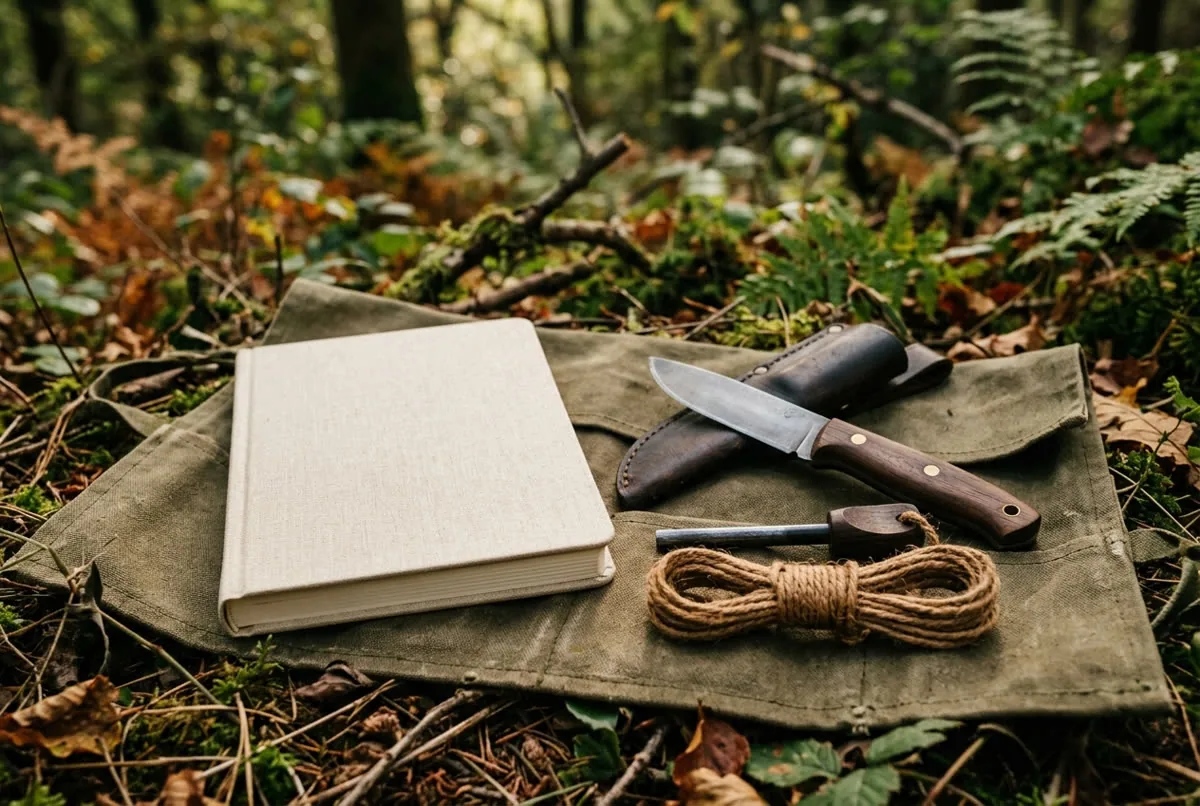
The short answer: A guide like the Lost Frontier Handbook teaches concepts, sequencing, and the reasoning behind a skill. A basic bushcraft kit teaches the skill itself, through repetition your hands remember and a book alone cannot substitute for. Most people end up needing both, just not necessarily in that order.
Is the Lost Frontier Handbook Actually Written by a Real Person?
The sales page credits the guide to Suzanne Sherman, described as a preparedness educator and radio personality. According to the sales page, she quit her legal work and moved from Los Angeles to Utah to live off-grid (The Lost Frontier Handbook), and her own website lists two self-reliance podcasts she hosts (SuzanneCSherman.com). Our full Lost Frontier Handbook Review covers her background in more detail.
That distinction matters more than it might seem for a comparison like this one. A guide’s usefulness depends partly on whether the person behind it has actually done the work being described. A disclosed, checkable track record is a reasonable baseline of credibility; an anonymous byline is not.
What Does the Lost Frontier Handbook Actually Cover?
The guide is sold as a downloadable book through its official sales page. Its stated content spans food preservation, water sourcing, natural and traditional remedies, shelter, foraging, and basic self-reliance skills (The Lost Frontier Handbook).
That breadth is the guide’s core pitch: one reference instead of six specialized books scattered across different authors and formats. Food preservation and water sourcing are areas many homesteaders already have some exposure to, through canning classes or a well pump manual. Natural and traditional remedies, shelter building, and foraging can be thinner shelves for a beginner, which is part of why a consolidated reference has appeal: it puts the topics you haven’t gotten around to next to the ones you already know something about, in a format you can work through in order.
Whether that breadth beats depth depends on what you already own and what you’re trying to learn next, which we get into below.
One practical note: before you buy anything, confirm you’re on the official sales page or its checkout rather than a copycat site, and check that the listing matches the content described above before you commit.
Does Reading a Survival Guide Build Usable Skills, or Do You Need to Practice With Real Gear?
This is the real question behind the “which builds skills faster” framing, and it deserves a direct answer instead of a marketing one.
A book, digital or physical, is instructional and reference content. It teaches through reading and following steps: what order to do things in, why a method works, what to avoid. That’s genuinely useful. It is not the same thing as physical skill. Fire starting, knife work, and plant identification are built through repeated hands-on practice, not through comprehension alone. You can read a chapter on bow-drill fire starting a dozen times and still not get an ember on your first real attempt, because the skill lives in your hands and eyes, not in the explanation.
We should be direct about the limits of the evidence here: we found no third-party, controlled comparison measuring how fast someone acquires self-reliance skills from reading a guide versus practicing with a physical kit. Any claim that one “builds skills faster” than the other is a reasoned judgment, not a cited finding. Our judgment, based on how skill acquisition generally works, is that reading builds knowledge and sequencing quickly, while physical skill requires the practice time a book cannot compress.
The common mistake here is assuming a thicker or more detailed guide automatically outperforms hands-on kit practice at building skill. It doesn’t, because the two aren’t measuring the same kind of learning. A guide builds the map. A kit builds the muscle memory to actually walk the route.
Think about how this plays out with a specific skill instead of in the abstract. A chapter on fire starting will walk you through tinder selection, the order of building a fire lay, and why a bow drill works the way it does. That’s real, transferable knowledge, and it will save you from a lot of trial and error the first time you’re outside with a kit. But the actual skill of getting an ember, keeping it alive, and building it into a sustained flame comes from doing it, failing at it a few times, and adjusting your grip, your angle, or your tinder. No amount of re-reading the chapter closes that last gap. The same pattern holds for knife work and for identifying plants by sight rather than by photograph: the reading shortens the learning curve, but it doesn’t replace the repetitions.
That’s also why we’d push back on treating this as a strict either-or choice. A reader who only ever buys books tends to accumulate theoretical knowledge that never gets tested against a real fire lay or a real blister from an unfamiliar tool grip. A reader who only ever buys gear without any structured reference tends to relearn the same lessons the guide would have handed them for free, the slow way, sometimes with an avoidable injury along the way. The two inputs solve different problems.
What’s a Reasonable Starter Bushcraft Kit If You’re New to This?
There’s no official answer here that we could find, and we want to be upfront about that. We found no standard from a U.S. government agency or accredited education body for what belongs in a “basic bushcraft kit.” The informal hobbyist convention is a fixed-blade knife, a fire-starting tool, cordage, a tarp or other shelter material, and a basic first aid kit. That’s hobbyist convention, not a verified checklist from an authoritative body, and it’s worth treating it that way rather than as gospel.
Each of those five categories has a plain practical rationale, even without a formal standard behind it. A fixed-blade knife has no hinge or lock to fail, which is why it is the usual beginner pick over a folding blade. A dedicated fire-starting tool, separate from matches or a lighter alone, gives you a backup method if your first attempt fails. Cordage shows up in almost every shelter and repair task. A tarp or other shelter material teaches the skill of building weather protection from a flat sheet and some knots, which a prebuilt tent doesn’t require you to learn. None of that is a certification checklist, just reasoning and hobbyist convention.
Where safety genuinely overlaps with an authoritative source is first aid. The American Red Cross publishes a recommended contents list for a family first aid kit (American Red Cross), and that reference holds regardless of which product you choose to learn from. If you want a deeper walkthrough of the skills that go with that kit, we’ve covered it separately in 10 First-Aid Skills Every Prepper Should Practice.
If you’re assembling a starter kit for the first time and want it framed as gifts or a beginner bundle rather than a solo purchase, our piece on Beginner Homestead Starter Kits covers adjacent starter gear in the same spirit.
Is the Guide Worth It If You Already Own Other Homesteading Books?
This depends entirely on where the gaps in your shelf actually are, and the honest answer is we can’t tell you that without knowing your library.
What we can tell you is what the guide claims to cover: food preservation, water sourcing, natural and traditional remedies, shelter, foraging, and off-grid living skills, in one reference rather than several. If you already own dedicated, well-regarded books on each of those topics individually, the overlap is likely real and the guide adds less. If your shelf is thin on two or three of those areas, or you’d rather have one consolidated reference than track down separate titles, the breadth argument holds up better. Either way, we’d point you to our full Lost Frontier Handbook Review before buying, since it goes deeper on the actual content than a comparison piece like this one can.
What’s the Refund Policy If the Guide Isn’t What You Expected?
The vendor’s refund policy promises a full refund if you’re dissatisfied at any time during the first 60 days after purchase (The Lost Frontier Handbook). That window gives you time to actually read the material and decide whether it fills a real gap, rather than committing on the strength of a sales page alone.
A basic bushcraft kit doesn’t come with an equivalent built-in guarantee; return terms vary by retailer and product, so check the specific listing before you buy.
Where This Leaves You
If your shelf is missing a single, organized reference that ties food preservation, water sourcing, shelter, and foraging together, a guide like this earns its place, with the understanding that it teaches you what to do and why, not the physical skill itself. If what you actually need is the muscle memory, fire starting on the first try, a knife that behaves the way you expect, that only comes from time outside with a basic kit in hand. For most people starting from zero, the two aren’t competitors so much as sequential steps: read first to understand the method, then practice to make it reliable.
Frequently Asked Questions
- Is the Lost Frontier Handbook actually written by a real person?
- The sales page credits the guide to Suzanne Sherman, whom it presents as a preparedness educator and radio personality who quit legal work and moved from Los Angeles to Utah. A named person with a public footprint does exist: her own website lists two podcasts she hosts, The Wasatch Report and The Red Hot Chilly Prepper Podcast. We could not independently confirm who wrote the book itself.
- Does reading a survival guide actually build usable skills, or do I need to practice with real gear?
- Reading builds knowledge and sequencing, understanding what to do and why. Physical skills like fire starting, knife work, and plant identification require repeated hands-on practice that a book alone can't substitute for. There's no controlled study comparing the two directly, so this is a reasoned judgment rather than a cited finding.
- What's a reasonable starter bushcraft kit if I'm new to this?
- We found no official standard for a basic bushcraft kit from a government agency or accredited body. The common hobbyist starting point is a fixed-blade knife, a fire-starting tool, cordage, a tarp or shelter material, and a basic first aid kit, the last of which the American Red Cross does publish a recommended contents list for.
- Is this guide worth it if I already own other homesteading books?
- It depends on where your library has gaps. The guide covers food preservation, water sourcing, natural and traditional remedies, shelter, foraging, and off-grid living skills in one reference. If you already own dedicated books on each topic, the overlap is real; if two or three of those areas are thin on your shelf, the consolidated format has more to offer.
- What's the refund policy if the guide isn't what I expected?
- The vendor's refund policy promises a full refund if you are dissatisfied at any time during the first 60 days after purchase, giving you time to review the material before deciding whether it fits.
Sources & references
Before you go
The Renter's Homestead Pack
Self-reliance projects for the yard you don't own — container yields, a raised bed built to move with you, balcony preservation basics, and the landlord questions to ask first.
Free guide
The Renter's Homestead Pack
Self-reliance projects for the yard you don't own — container yields, a raised bed built to move with you, balcony preservation basics, and the landlord questions to ask first.