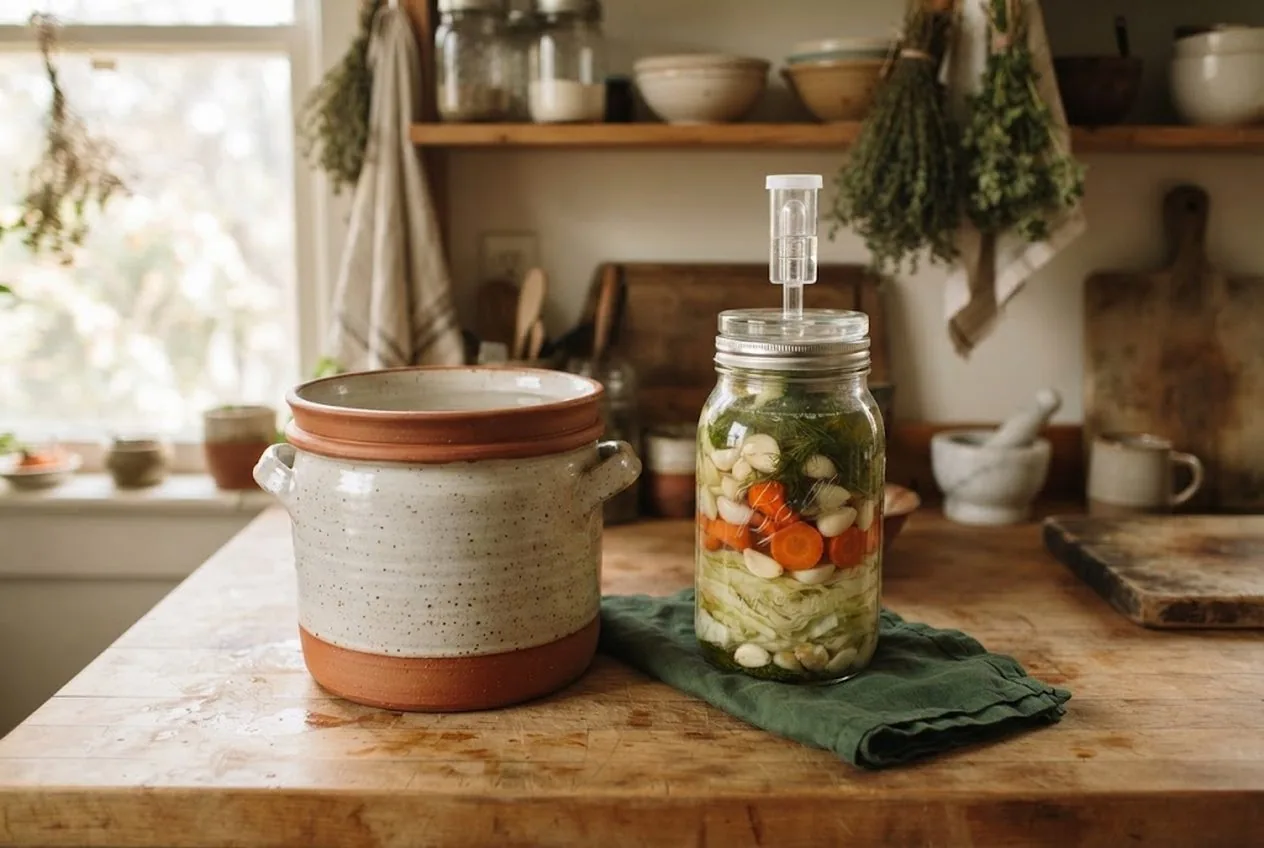
Once you decide to start fermenting, the first real question is what to ferment in. On one side sits the classic stoneware crock — heavy, handsome, a little pricey. On the other, the humble mason jar you already own by the dozen. The internet will happily tell you that you need the crock, or that the crock is a waste of money and a jar does everything. As usual, the truth depends on how much you actually ferment.
Here’s the honest version up front: both make excellent ferments. The bacteria doing the work don’t care what vessel they live in. What differs is convenience, batch size, and how much attention the setup asks of you. This guide lays out the real trade-offs so you buy the right one for your kitchen — not the one with the loudest fans.
What Both Have to Do
Every successful ferment solves the same two problems, whatever the container:
- Vent the gas. Lactic-acid fermentation gives off carbon dioxide. It has to escape, or pressure builds (UC Davis). A crock does this with a water-seal moat; a jar does it with an airlock lid or a daily “burp” of a loosened lid.
- Keep everything submerged. Vegetables above the brine meet air, and air brings mold and film (UC Davis). A crock uses heavy stoneware weights; a jar uses glass weights sized to fit the mouth.
Notice that both vessels need help to keep vegetables down (National Center for Home Food Preservation). This is why “crock vs. jar” is really “a complete crock system vs. a jar plus a few cheap accessories.” Judge them as complete setups, not bare containers.
Side-by-Side: Crock vs. Jar
| Fermentation Crock | Mason Jar | |
|---|---|---|
| Best batch size | Large (half-gallon to several gallons) | Small (pint to half-gallon) |
| Gas venting | Built-in water-seal moat | Airlock lid or daily burping |
| Keeping veg submerged | Heavy stoneware weights included | Add glass weights |
| Air exposure risk | Very low — sealed by design | Low with weights + airlock; higher if improvised |
| Daily attention | Minimal — top up the moat | Burp daily unless using an airlock |
| See the ferment? | No — opaque stoneware | Yes — watch the bubbles |
| Cost | $$ (higher upfront) | $ (jars you likely own + cheap weights) |
| Storage/space | Bulky, heavy | Stacks in any cupboard |
| Durability | Long-lasting if not dropped | Cheap to replace; lids wear out |
Read the table as a picture of scale and effort, not quality. The crock is a workhorse for volume; the jar is a nimble tool for small, frequent batches.
When the Mason Jar Wins
Reach for a jar if you’re new to fermenting, or if you make small, varied batches — a jar of kimchi here, a jar of pickled radishes there. Jars are cheap, they stack anywhere, and because each batch is small, a failure costs you almost nothing. NCHFP accepts quart and half-gallon Mason jars for sauerkraut but notes they may see more spoilage losses (National Center for Home Food Preservation). The clear glass is a genuine teaching aid, too: you can watch the bubbles rise and the color shift, which builds your instinct for what a healthy ferment looks like.
The only upgrade a jar really needs is a set of wide-mouth glass weights to hold the vegetables under the brine. That single accessory fixes the jar’s biggest weakness — floaters — and turns it into a reliable little fermenter.
Disclosure: the product links here are affiliate links, so we may earn a commission if you buy through them at no extra cost to you. Our recommendations follow long-standing fermentation practice and food-safety guidance, not brand marketing.
Pair those weights with either an inexpensive airlock lid or a simple daily burp of the jar, and you have a complete fermenting station for the cost of a few coffees.
When the Crock Wins
The crock earns its price the moment you start fermenting in volume. When a productive fall garden hands you three heads of cabbage at once, a half-gallon jar feels comically small. A crock swallows the whole harvest in one go, and its built-in water seal and heavy weights keep the surface air-free for weeks with almost no attention — you just keep the moat topped up with water.
That hands-off reliability is the real selling point. There’s no daily burping, no floaters to push down, no wondering whether today’s the day film appears. For anyone preserving seriously — gallons of kraut and kimchi to carry a household through winter — the crock turns fermenting from a fussy hobby into a dependable pipeline.
Its downsides are exactly what you’d expect from a big ceramic vessel: it’s heavy, it takes up real shelf space, and it hides the ferment behind opaque walls, so you learn to judge progress by smell and taste rather than sight.
So Which Should You Buy?
Let your volume and commitment decide, not the marketing:
- Buy a jar and glass weights first if you’re starting out or ferment small batches occasionally. It’s cheap, low-stakes, and everything you need to learn the craft well.
- Buy the crock if you already know you’ll ferment large, regular batches — a real harvest-season pipeline of kraut, kimchi, and pickles — and you’d rather set it and forget it than burp jars every day.
- The upgrade path is natural: learn on a jar, and when you find yourself running out of jar space every autumn, step up to a crock for the volume.
Whichever you choose, the method is the same — the walk-through in our how to ferment vegetables in a crock guide applies equally to a jar, just at a smaller scale. And fermenting slots neatly alongside the other no-power skills in our food preservation without electricity guide, giving you a way to put up the harvest that needs nothing but salt, time, and a cool corner.
The best fermenting vessel is the one that gets you fermenting. Start with a jar today if that’s what lowers the barrier; graduate to a crock when your harvest demands it.
Frequently Asked Questions
- Can you ferment vegetables in a regular mason jar?
- Yes. A wide-mouth mason jar is a perfectly good fermenting vessel for small batches — it's how most people start. The two things a bare jar doesn't do on its own are release carbon dioxide without letting air in, and keep the vegetables submerged. You solve both cheaply with a set of glass fermentation weights to hold the vegetables down and either a loosened lid you 'burp' daily or a small airlock lid. With those two additions, a jar works well for small batches, though the National Center for Home Food Preservation notes that fermenting in Mason jars may result in more spoilage losses.
- Do you need an airlock to ferment?
- No, but it makes life easier. Fermentation produces carbon dioxide that has to escape, or pressure builds up. An airlock — or a crock's water-seal moat — vents that gas automatically while blocking outside air. Without one, you simply loosen the lid or 'burp' the jar once a day to let pressure out. An airlock removes that daily step and lowers the odds of air reaching the surface, which is why serious fermenters gravitate toward sealed systems.
- Does a crock make better sauerkraut than a jar?
- The finished product is nearly identical when both are done right — the bacteria don't care what vessel they're in. Where the crock wins is consistency and scale: the water seal and heavy weights keep air off the surface with zero fuss, so large batches ferment cleanly week after week. A jar can match the quality on a small batch; it just asks a little more attention to keep everything submerged and burped.
- Is a fermentation crock worth the money?
- It's worth it if you ferment often or in volume. A good stoneware crock costs far more than a jar, but it pays back in convenience and reliability once you're making gallons of kraut and kimchi through harvest season — no daily burping, no floaters, no guesswork. If you ferment a jar or two a few times a year, that money is better left in your pocket; a jar and weights will serve you well.
- Which is better for a beginner, a crock or a jar?
- Start with a jar. It's cheap, it's small enough that a failed batch costs almost nothing, and it teaches you the feel of salt, submersion, and timing on a low-stakes scale. Once you know you'll ferment regularly and want bigger batches with less babysitting, graduate to a crock. Buying the crock first is fine too — just don't let its cost be the reason you never start.
Sources & references
Before you go
The Renter's Homestead Pack
Self-reliance projects for the yard you don't own — container yields, a raised bed built to move with you, balcony preservation basics, and the landlord questions to ask first.
Free guide
The Renter's Homestead Pack
Self-reliance projects for the yard you don't own — container yields, a raised bed built to move with you, balcony preservation basics, and the landlord questions to ask first.