What’s the short answer?
- Vegetable and yard trimmings compost fine; meat, dairy, fats, and diseased plants don't, per EPA.
- Raw or dry beans, green or sprouted potato peels, and avocado skin, pit, and leaves are common garden scraps UF/IFAS lists as unsafe for chickens.
- A scrap that fails both the compost test and the chicken test goes in the trash, not one bucket or the other.
- A well-built compost pile is usually ready to use in three to five months, per EPA.
- The "would a person eat this" rule of thumb works for chickens too: moldy or rotten scraps get tossed, not fed.
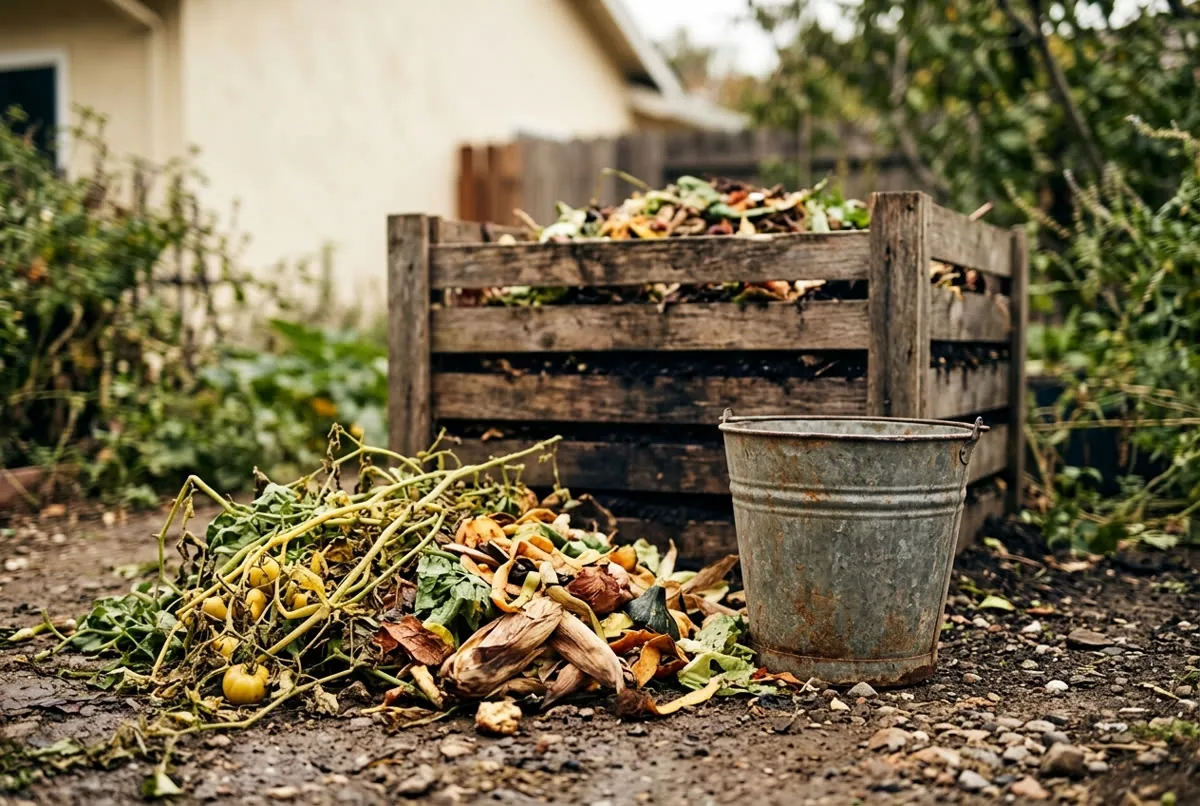
By the time the tomato vines go leggy and the squash beds get their September cleanout, most yards end up with three overflowing buckets: pulled plants, kitchen trimmings, and whatever’s left in the garden after the last harvest. Not everything in those buckets belongs in the same place, and mixing them up creates problems that show up weeks later, a smelly compost pile, a flock that turns up its beak, or worse. End-of-season is exactly when the volume is highest and the material is most mixed, healthy trimmings sitting right next to blighted foliage and half-rotten fruit, which is what makes the sorting call harder than it is in July. The sorting question matters more than the composting question.
The short answer: Most healthy vegetable and yard trimmings can go to either the compost pile or the flock, but there are exceptions on both sides: meat, dairy, fats, and diseased plants stay out of a home compost pile, while raw or dry beans, green potato peels, avocado trimmings, and anything moldy should not go to the flock. Sort against those lists first, then decide compost or coop.
What Actually Belongs in a Home Compost Pile
EPA’s home composting guidance is fairly permissive: food scraps and yard trimmings are generally compostable (U.S. EPA, 2026). That covers the bulk of a fall cleanup, spent squash and bean vines, bolted lettuce, corn stalks, deadheaded flowers, grass clippings, fallen leaves, and vegetable peels from the kitchen.
The pile works better when it’s built on a rough balance of two kinds of material. EPA describes this as “brown” material, carbon-heavy stuff like dried leaves, straw, and cardboard, balanced against “green” material, nitrogen-heavy stuff like fresh plant trimmings and kitchen scraps, with enough moisture to keep the pile active; EPA’s guidance is to add at least two to three times the volume of browns as greens (U.S. EPA, 2026). Most end-of-season cleanups are green-heavy, so this is the point to also toss in dried leaves, shredded cardboard, or last year’s straw if you have it, rather than piling on trimmings alone.
If you’re deciding between a tumbler and a worm bin for handling this volume, the tradeoffs (speed, smell, effort) are broken down in our compost tumbler vs. worm factory comparison.
Kitchen trimmings from the same harvest count toward the pile too. Onion ends, carrot tops, squash peels, and corn husks from canning or freezing a big end-of-season haul fall under the same “generally compostable” guidance as garden trimmings, so there’s no need to run a separate system for the kitchen bucket versus the garden bucket, only a separate check for the exceptions below.
What Should Stay Out of the Compost Pile
The same EPA guidance draws a clear line on what not to add: meat, bones, dairy products, fats, grease, and oils should be kept out of a home pile, along with diseased or pest-infested plants. EPA notes that meat, dairy, and fats can attract animals and that backyard piles generally do not reach high enough temperatures to fully decompose them (U.S. EPA, 2026). That last category matters more at end-of-season than any other time of year, since this is exactly when blighted tomato foliage, powdery-mildewed squash leaves, or vine-borer-riddled zucchini stems are coming out of the ground.
The practical rule: if a plant looks diseased or was clearly infested with pests, it’s a compost-pile exception even though it’s plant material. Composting it risks reintroducing the same problem into next year’s garden bed, since a home pile that isn’t well maintained may never get hot enough; EPA says a well-maintained one can reach 130 to 160 degrees F, and that heat helps reduce pathogens and weed seeds (U.S. EPA, 2026). When in doubt, the safer move is to bag diseased material for the trash rather than gamble on the pile burning it out. For a broader rundown of hot versus cold composting methods and which handles borderline material better, see our guide on building a backyard compost system.
The Overlap Between the Compost Pile and the Coop
Here’s where the two systems actually connect: diseased or moldy plant material fits neither destination, since EPA keeps diseased plants out of a home pile and UF/IFAS says food too moldy for you to eat shouldn’t be fed to chickens. That narrows the realistic “toss in the trash” category down to genuinely diseased or moldy plant material specifically.
Everything else that’s healthy plant material is a candidate for either destination, but “candidate for the coop” isn’t the same as “safe for the coop.” A handful of garden scraps that look like ordinary green material are specifically flagged as unsafe for chickens, even though they’d compost just fine. That’s the trap in an end-of-season cleanup: a bucket of mixed trimmings can look uniformly harmless at a glance, while a few specific plants in it are fine for one destination and off-limits for the other.
Garden Scraps That Are Toxic to Chickens
UF/IFAS Extension’s current guidance on foods to avoid feeding backyard chickens (posted May 25, 2026) calls out several items that show up constantly in an end-of-season cleanup bucket (UF/IFAS Extension Holmes County, 2026-05-25).
Raw and Dry Beans
Raw or dry beans contain a natural toxin, phytohemagglutinin (PHA), that can cause severe digestive problems and poisoning in chickens (UF/IFAS Extension Holmes County, 2026-05-25). This is one of the easiest mistakes to make, since leftover garden beans look like any other healthy scrap heading for the coop. Anyone pulling the last of the pole beans or bush beans at end-of-season is likely to have a whole bucket of pods and beans at once, which is what makes it worth flagging rather than assuming the flock will just sort it out on its own. UF/IFAS says cooked beans are generally safe, but raw or dry beans should never be fed to chickens. Beans are fine for the compost pile; raw or dry ones are not fine for the flock.
Green or Sprouted Potato Peels
Potato peels that have gone green or started sprouting contain solanine, a compound that can affect a chicken’s nervous system and cause digestive and cardiac issues (UF/IFAS Extension Holmes County, 2026-05-25). Plain cooked potatoes are safe for chickens in moderation, so the distinction is specifically about green or sprouted skins and peels coming out of the garden or the kitchen. A fall potato harvest that’s been sitting in storage before curing is exactly the kind of scrap source where a few peels have already gone green without anyone noticing, so it’s worth a second look before the peel bucket goes anywhere near the run.
Avocado Skin, Pit, and Leaves
If you’re growing or trimming an avocado tree, the skin, pit, and leaves contain persin, a toxin UF/IFAS flags as unsafe for chickens (UF/IFAS Extension Holmes County, 2026-05-25). UF/IFAS says the flesh is less dangerous than the skin, pit, and leaves but still recommends avoiding avocado entirely.
Onions and the “Would You Eat It” Rule
Onions land in a gray area rather than an outright ban. Large amounts of onion can damage a chicken’s red blood cells and cause anemia, and may also affect egg taste, though small amounts aren’t typically harmful (UF/IFAS Extension Holmes County, 2026-05-25). The practical takeaway is that spent onion tops and thinnings shouldn’t become a flock’s regular diet, even if the occasional scrap isn’t cause for alarm. An end-of-season onion harvest, where a whole bed’s worth of tops and culls comes out at once, is a “large amount” situation more than a “small amount” one, so it’s a reasonable default to route that particular batch to the compost pile instead of the run.
For anything moldy or visibly rotten, UF/IFAS gives a simpler rule of thumb: if a person wouldn’t eat it, it shouldn’t go to the flock either, since mold can produce harmful toxins that lead to respiratory issues, digestive problems, or poisoning (UF/IFAS Extension Holmes County, 2026-05-25). That same rule doubles as a compost-pile filter, since EPA already excludes diseased plant material from a home pile.
How Long Until the Compost Is Usable
One more variable that affects how you plan an end-of-season cleanup is timing. EPA states a well-maintained compost pile is typically finished and ready to use in about three to five months (U.S. EPA, 2026). On that timeline, scraps going into a well-maintained pile in late September would be finished roughly between late December and late February, ahead of bed prep for the next growing season. EPA adds that a pile left untended may take a year to decompose.
That timeline is also a reason to be deliberate about the diseased-plant exception above. Material that doesn’t fully break down, or that carries pathogens through the process, can undo months of composting effort right as you’re getting ready to use it. A pile started in September and maintained on the brown-green balance EPA describes is a reasonable candidate to be ready in time for spring bed prep; a pile that sits neglected over winter with no attention to that balance is not.
A Simple End-of-Season Sorting System
Rather than deciding scrap by scrap, it helps to run the whole cleanup bucket through three questions in order. First, is it diseased, moldy, or visibly rotten? If yes, it’s trash, not compost and not coop, regardless of what it is. Second, if it’s healthy plant material, is it one of the specific chicken exceptions: raw or dry beans, green or sprouted potato skins, avocado trimmings, or a large quantity of onion? If yes, it goes to compost, not the coop. Third, if it passed both filters, it’s fair game for either destination, and the deciding factor becomes practical: how much space is in the compost bin versus how much the flock will actually eat that day.
Running a fall cleanup at any real volume usually means having enough compost capacity to keep up with it, which is worth checking before the vines start coming out of the ground. If your current setup is a single small bin, it’s worth comparing options before the bucket backs up. Our review of Backyard Liberty’s Pocket Farm, an aquaponics growing guide rather than a composting product, is there if you’re weighing compact backyard growing setups more broadly. For the compost side, the hot-versus-cold breakdown linked earlier is worth a second look if the goal is finished compost in time for spring rather than just somewhere to put the vines.
Whatever system you land on, start the sort at the garden bed rather than after everything’s already mixed in one bucket. Pull diseased and moldy material straight into a separate trash bag as you clear each row, set aside beans, green potato skins, avocado trimmings, and any large batch of onion for the compost pile specifically, and let everything else go to either destination based on which one has room that day. It takes the same amount of time either way, and it means a batch of raw or dry beans or green potato peelings never ends up in front of the flock in the first place.
Frequently Asked Questions
- Can chickens eat the same garden scraps that go in the compost?
- Some, but not all. EPA composting guidance keeps meat, dairy, fats, and diseased plants out of a home pile, and UF/IFAS Extension flags several otherwise "green" garden scraps, like raw beans, green potato peels, and avocado trimmings, as unsafe for chickens specifically. Treat the two lists as overlapping, not identical, and check a scrap against both before deciding.
- Are raw beans from the garden safe to feed chickens?
- No. UF/IFAS Extension's current guidance lists raw or dry beans as containing a natural toxin called phytohemagglutinin (PHA) that can cause severe digestive problems and poisoning in chickens, even though leftover garden beans look like an ordinary healthy scrap. UF/IFAS notes that cooked beans are generally safe.
- What garden scraps should never go into a backyard compost pile?
- EPA's home composting guidance says to keep meat, bones, dairy products, fats, grease, oils, and diseased or pest-infested plants out of a home pile. EPA notes that meat, dairy, and fats can attract animals and that backyard piles generally do not get hot enough to fully decompose them. Food scraps and yard trimmings in general are compostable.
- Is it safe to give chickens green or sprouted potatoes from the garden?
- No. UF/IFAS Extension lists green or sprouting potato peels as unsafe for chickens because they contain solanine, which can affect a chicken's nervous system and cause digestive and cardiac issues. Plain cooked potatoes are safe for chickens in moderation.
- How long does compost actually take to be usable?
- EPA guidance says a well-maintained compost pile is typically finished and ready to use in about three to five months, built with at least two to three times as much "brown" carbon material as "green" nitrogen material by volume, plus moisture.
Sources & references
Before you go
The Renter's Homestead Pack
Self-reliance projects for the yard you don't own — container yields, a raised bed built to move with you, balcony preservation basics, and the landlord questions to ask first.
Free guide
The Renter's Homestead Pack
Self-reliance projects for the yard you don't own — container yields, a raised bed built to move with you, balcony preservation basics, and the landlord questions to ask first.