What’s the short answer?
- A full perimeter fence needs to be at least 8 feet tall.
- A small enclosed area under 8 by 16 feet can get by with fencing as short as 50 inches.
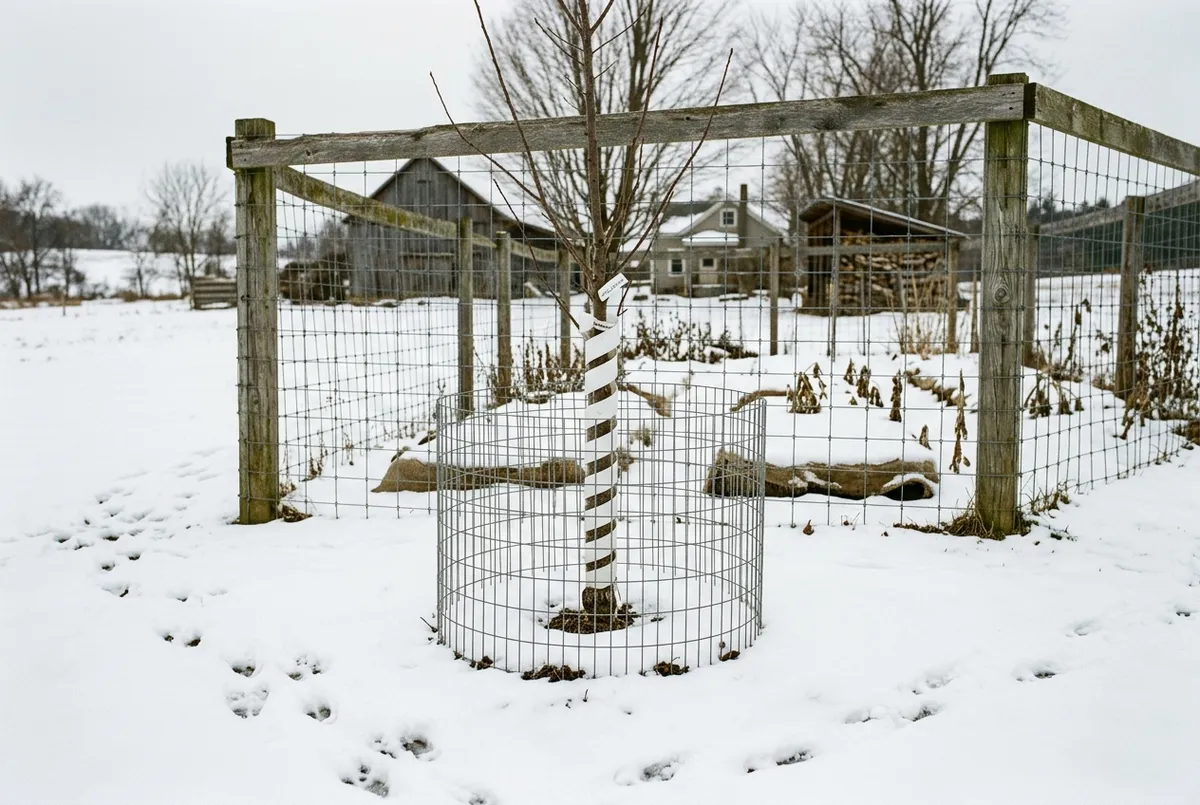
- Individual fruit trees need wire cylinders or trunk guards at least 6 feet tall, or shorter only if the top is closed.
- Buck antler rubbing hits lower on the trunk (1.5-3.5 feet) than browsing does, but one trunk guard covers both.
- Repellents work best applied early and often in dry, above-freezing conditions and have limited success over winter, so treat them as a backup to physical barriers.
Winter strips the woods bare of almost everything a deer would normally eat, and that is exactly when your garden beds and young fruit trees start looking like the only buffet in the neighborhood. A fence line that held up fine in August can turn into an open invitation once snow buries the natural browse, and a fruit tree that looked untouched in October can be girdled by February. The gap between a garden that survives the season and one that doesn’t usually comes down to a handful of physical specs: how tall the fence is, how the trunks are guarded, and how much you’re relying on repellents to do work that only a barrier can actually do.
The short answer: A full perimeter fence needs to be at least 8 feet tall to reliably stop deer, individual fruit trees need wire cylinders or trunk guards at least 6 feet tall, and repellents are a supplement to physical barriers in winter, not a replacement for them.
Why Fence Height Decides Everything
Deer are capable jumpers, and a fence that looks tall enough from the ground often isn’t. Cornell Cooperative Extension puts a full perimeter deer fence at a minimum of 8 feet for that reason (Cornell Cooperative Extension), and Iowa State University Extension and Outreach lands on the same 8-foot baseline (Iowa State University Extension and Outreach), which is worth noting because two extension programs in different regions arriving at the identical number suggests it isn’t a local quirk. Utah State University Extension is blunter still, calling an 8-foot or higher fence the only way to truly protect a landscape from browsing deer (Utah State University Extension). The logic behind the height itself is straightforward: around an open area, a deer has room for a running start, and anything shorter than 8 feet won’t reliably stop it.
That height requirement is the single biggest planning decision for anyone fencing a full garden perimeter. It affects material choice, post spacing, and cost, since a taller fence needs sturdier posts and more wire or mesh than a standard 4-foot garden fence built to keep out rabbits, and it can also affect what your local zoning or HOA allows, which is worth checking before you commit to a height. If you’re mapping out a new perimeter this winter, start with the 8-foot minimum as your baseline.
The Small-Plot Exception You Can Use Instead
Not every garden needs a full 8-foot wall, and this is the detail most people miss. Iowa State University Extension and Outreach notes that a planting area smaller than 8 by 16 feet can be protected with fencing as short as 50 inches (Iowa State University Extension and Outreach). Deer will not jump into a small, fenced enclosure even though they could easily clear that height if the same fence surrounded an open field.
That exception matters most for raised bed clusters, a fenced kitchen garden tucked against a shed wall, or a small season-extension setup like a hoop house over raised beds. If your growing space is naturally compact, a shorter, cheaper fence fully enclosing it can do the job that would otherwise require a full 8-foot perimeter. It’s worth measuring your actual planting footprint before you assume you need the tall version.
Protecting Individual Fruit Trees
Fruit trees need a different approach than a garden bed, because the threat isn’t a deer jumping in from outside a fence line, it’s a deer standing right next to the trunk. Iowa State Extension recommends wire cylinders or trunk guards at least 6 feet tall around individual trees, since deer browse damage runs from about 6 feet down to the ground (Iowa State University Extension and Outreach). A shorter guard is only acceptable if the top is closed off, otherwise a deer can simply reach over it.
Half-inch hardware cloth formed into a cylinder around the trunk and lower branches is a common way to build this kind of guard, since it’s sturdy enough to hold its shape through winter weather and open enough to let the tree breathe, unlike solid wraps that can trap moisture against the bark. Building one is a matter of cutting a length of hardware cloth long enough to circle the trunk with a little overlap, forming it into a cylinder a few inches wider than the trunk’s eventual mature width so the tree has room to grow into it without the guard cutting into the bark, and securing the seam with wire ties or hog rings rather than anything that fuses the cylinder shut permanently. Leaving that extra width matters more than it sounds like it should, since a guard sized tight to a young sapling’s current trunk diameter can end up girdling the tree itself within a season or two of growth, turning a protective measure into the very problem it was meant to prevent.
For a young orchard or a handful of newly planted fruit trees, guarding each trunk individually is often more practical and less expensive than fencing the whole planting area, especially if the trees aren’t clustered together. A handful of trunk guards costs a fraction of what perimeter fencing runs once you account for taller posts, more linear feet of wire or mesh, and the gates needed to get equipment and people in and out. The tradeoff runs the other way once a planting is dense enough, or once it includes garden beds mixed in alongside the trees, since guarding dozens of individual trunks plus fencing the vegetable rows separately can end up costing more in materials and labor than one continuous 8-foot perimeter would have. As a rough planning rule, scattered or widely spaced trees favor individual guards, while a tight orchard block or a mixed garden-and-orchard layout usually favors a single perimeter fence sized to the whole planting.
Antler Rubbing Is a Separate Threat, Same Fix
Browsing isn’t the only way deer damage a young tree. Bucks also rub their antlers against trunks, and that damage happens lower on the tree than browsing does, roughly 1.5 to 3.5 feet above ground according to Iowa State Extension guidance (Iowa State University Extension and Outreach). Antler rubbing can strip bark and girdle a young trunk just as effectively as browsing can, and it’s easy to miss if you’re only thinking about how high deer can reach to eat.
The good news is that the same wire cylinder or trunk guard built to stop browsing, at least 6 feet tall, also covers the antler-rub zone, since it starts at ground level and extends well past 3.5 feet. Timing is the catch: Iowa State notes that barriers against antler rubbing must be in place by mid-August to avoid damage, well before winter. There’s no need to build a separate defense for each threat. One properly sized guard around the trunk handles both browsing damage and antler rubbing at the same time, which is one of the reasons trunk guards are usually the first line of defense recommended for young or newly planted fruit trees.
Why Winter Makes the Problem Worse
Deer pressure on a garden or orchard isn’t constant through the year, it spikes in winter. As natural browse becomes scarce under snow cover, deer that would otherwise ignore garden plantings and evergreens start turning to them out of necessity. Iowa State notes that damage is most likely when food is scarce during prolonged snow cover (Iowa State University Extension and Outreach), and Utah State warns that deeper winter snow raises the chance of hungry deer visiting yards for food (Utah State University Extension). That shift is why a fence or guard that seemed unnecessary in summer can suddenly matter once the ground freezes and food gets harder to find in the surrounding woods.
This is also why timing matters for anyone still finishing up fall garden work. If you’re building cold-hardy crops for a fall harvest or setting up season-extension structures, it’s worth pairing that work with deer protection before the first heavy snow, rather than waiting until you spot browse damage. Once deer establish a pattern of visiting a particular garden or orchard, they tend to keep coming back to it, which makes late-season protection less effective than protection put in place before pressure builds.
Where Repellents Actually Fit
Repellents are part of the toolkit, but they come with real limitations in winter. Iowa State Extension advises applying deer repellents early and often when conditions are dry and temperatures are above freezing, and notes that over the winter months repellents have limited success (Iowa State University Extension and Outreach). Long stretches of below-freezing temperatures are exactly the condition that makes repellents hardest to keep effective through the coldest months.
That doesn’t make repellents useless. They can help in shoulder seasons, on plants that are hard to fence individually, or as a backup layer alongside a physical barrier. But treating a repellent as your primary defense for a winter garden or orchard is a mistake the extension guidance doesn’t support. Physical barriers, fence height for the perimeter and trunk guards for individual trees, are the more reliable foundation, with repellents filling in around the edges rather than carrying the main load.
Building a Plan for Your Yard
Putting this together starts with sorting your growing space into categories. A full garden perimeter with open exposure on most sides needs an 8-foot fence at minimum. A small, fully enclosed bed cluster, under 8 by 16 feet, can often get by with something as short as 50 inches. Individual fruit trees, whether newly planted or established, need a wire cylinder or trunk guard at least 6 feet tall that closes off the top if you build it any shorter, which also protects against antler rubbing lower on the trunk. Repellents can round out the plan, but they’re a supplement, not the main defense, especially once winter weather sets in.
If you’re weighing whether it’s worth building out a fuller food-growing setup this winter, our Backyard Liberty review walks through what a compact, defensible food-growing system looks like in practice, and the broader planning below covers how a garden and orchard hold up against wildlife pressure over multiple seasons. Whichever combination of fencing, trunk guards and repellents you land on, the extension research is consistent on one point: get the physical barriers in place before the snow flies, because deer that establish a pattern of visiting your garden are far harder to redirect once winter pressure is already pushing them toward it.
Frequently Asked Questions
- How tall does a deer fence need to be?
- Cornell Cooperative Extension and Iowa State University Extension and Outreach both put a full perimeter deer fence at a minimum of 8 feet, and Utah State University Extension calls an 8-foot or higher fence the only way to truly protect a landscape from browsing deer, since deer are capable jumpers that clear anything shorter around an open area.
- Can a shorter fence ever work for a garden?
- Yes. Iowa State University Extension and Outreach notes that a planting area smaller than 8 by 16 feet can be protected with fencing as short as 50 inches, because deer will not jump into a small, fenced enclosure even though they could clear that height in the open.
- How do I protect individual fruit trees from deer?
- Iowa State Extension recommends wire cylinders or trunk guards at least 6 feet tall, since deer browse damage on trees runs from about 6 feet down; a shorter guard is only acceptable if the top is closed off.
- Is antler rubbing a different problem than browsing?
- Yes. Buck antler rubbing happens lower on the trunk, roughly 1.5 to 3.5 feet above ground, according to Iowa State Extension guidance. It's a distinct threat from browsing, but the same wire cylinder or trunk guard addresses both.
- Do deer repellents work in winter?
- They're a supplement, not a substitute for barriers. Iowa State Extension advises applying deer repellents early and often when conditions are dry and temperatures are above freezing, and notes that repellents have limited success over the winter months.
Sources & references
Before you go
The Renter's Homestead Pack
Self-reliance projects for the yard you don't own — container yields, a raised bed built to move with you, balcony preservation basics, and the landlord questions to ask first.
Free guide
The Renter's Homestead Pack
Self-reliance projects for the yard you don't own — container yields, a raised bed built to move with you, balcony preservation basics, and the landlord questions to ask first.