What’s the short answer?
- Cooking oil heated beyond its cooking temperature (375°F) can ignite, so check it often with a thermometer (NC OSFM, Illinois SFM).
- A turkey has to be completely thawed before it goes into hot oil; partially frozen birds cause splatter or hot steam (NC OSFM, Illinois SFM).
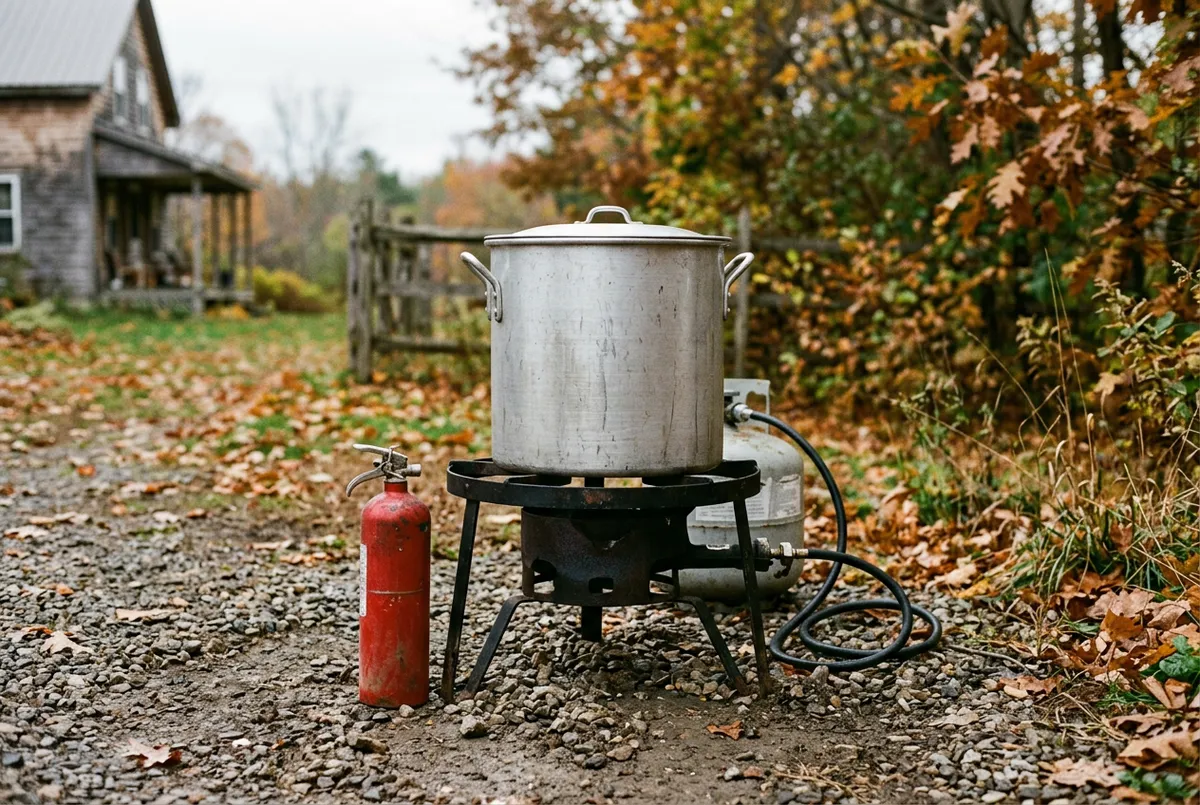
- Fryers belong outdoors only, at least 10 feet from the house and never under a garage, deck, breezeway, porch, or barn (USFA, NC OSFM).
- Keep a 3-foot kid- and pet-free zone around an operating fryer (Illinois SFM).
- 165°F in the thigh, wing, and breast is the safety line for roasted, smoked, or fried turkey, and a turkey you plan to fry or smoke should not be stuffed (Penn State Extension).
You’ve got a fryer or a smoker sitting in the garage, a bird thawing in the fridge, and a crowd expecting a good meal outdoors this Thanksgiving. Penn State Extension calls deep frying a quick way to cook a turkey that can be dangerous if not done correctly (Penn State Extension). Two variables matter most for the fryer: oil temperature and how thawed that turkey really is.
The short answer: Keep frying oil under 375°F and watched the entire time, make sure the turkey is completely thawed and dried before it goes near the oil, run the fryer outdoors and at least 10 feet from any structure with a 3-foot kid- and pet-free zone around it, and pull both fried and smoked birds only once a food thermometer reads 165°F in the thigh, wing, and breast.
Why Fryer Safety Gets Its Own Rulebook
Turkey fryer fires are not a rare fluke. They cause an average of 5 deaths, 60 injuries, and more than $15 million in property damage every year (North Carolina Office of State Fire Marshal). The same page lists the recurring hazards: hot oil that spills or splashes onto the flame, oil heated beyond its cooking temperature, a fryer used under a structure that can catch fire, and a frozen or partially frozen turkey. The office also discourages outdoor, gas-fueled turkey fryers unless they’re used by a properly trained professional (North Carolina Office of State Fire Marshal).
Smoking a turkey does not carry the oil-fire risk that frying does, since there’s no vat of hot oil to splatter or ignite. But the fire marshals’ guidance above is specific to fryers, and it’s worth being honest about that distinction rather than stretching a fryer statistic to cover every outdoor cooking method. What both methods do share is the food-safety finish line, which is covered further down.
Getting the Oil Temperature Right
Cooking oil heated beyond its cooking temperature (375°F) can ignite (North Carolina Office of State Fire Marshal). The Illinois State Fire Marshal says turkey fryers can easily overheat and start a fire, and to check the temperature often with a cooking thermometer so the oil won’t overheat (Illinois State Fire Marshal). The U.S. Fire Administration adds that fryers without thermostat controls can overheat oil to the point of starting a fire, and suggests a kitchen thermometer that attaches to the side of the pot (U.S. Fire Administration).
Recommended starting temperatures vary slightly. Penn State Extension, relaying USDA guidance, says to heat the oil to 350°F before submerging a fully defrosted turkey (Penn State Extension), while Illinois Extension says to preheat to between 365 and 375°F when adding the turkey (Illinois Extension). The practical takeaway is the habit: a dedicated oil thermometer stays on the pot, someone stays with the fryer the entire time it’s running (Illinois Extension says never to leave hot oil unattended), and the burner gets adjusted down the moment the reading climbs rather than after it’s already too hot.
Why a Half-Thawed Turkey Is So Dangerous
A turkey has to be completely thawed before it goes into the fryer. A frozen or partially frozen bird causes hot oil to splatter or produce hot steam, which leads to burns (North Carolina Office of State Fire Marshal). The Illinois State Fire Marshal puts it plainly: a partially frozen turkey will cause hot oil to splatter, so make sure the turkey is completely thawed before you fry it (Illinois State Fire Marshal).
A bird that looks thawed on the outside may not be thawed inside. The U.S. Fire Administration says to make sure the turkey is fully thawed without frost on it before you fry it (U.S. Fire Administration), and the Consumer Product Safety Commission advises thawing the turkey completely (USDA says about 24 hours for every 4 to 5 pounds) and drying it before cooking (CPSC). If there’s any doubt about whether the inside of the cavity is still icy, that doubt is the answer: it needs more time before frying, not less.
Where You Can (and Can’t) Set Up a Fryer
Turkey fryers have to be operated outdoors, and never under a garage, deck, breezeway, porch, or barn, or any other structure that can catch fire (North Carolina Office of State Fire Marshal). That rules out a covered patio, and the U.S. Fire Administration adds that the fryer should be at least 10 feet from your home and not under roof eaves (U.S. Fire Administration). Illinois also advises using the fryer on a sturdy, level surface well away from things that can burn.
On top of structural clearance, maintain a 3-foot kid- and pet-free zone around an operating turkey fryer (Illinois State Fire Marshal). A fryer full of hot oil sitting at ankle height for a toddler or a dog is a hazard the whole time it’s running, not just at the moment the bird goes in or comes out. Picking the spot before the fryer is even lit, somewhere flat, open, clear of overhangs, and away from foot traffic, removes most of the decision-making pressure later when the oil is already hot and everyone’s attention is split between the bird and the sides.
If you haven’t walked your own yard specifically looking for this kind of risk, our backyard fire risk breakdown covers the spots people miss before the holidays, and it’s worth doing before the fryer comes out of storage, not after.
The Internal Temperature That Actually Matters
Whether the bird is roasted, smoked, or deep fried, Penn State Extension says to cook the turkey until it reaches an internal temperature of 165°F, using a calibrated food thermometer to check the three thickest parts: the innermost parts of the thigh and the wing, and the thickest part of the breast (Penn State Extension). University of Illinois Extension gives the same 165°F minimum and the same three spots (University of Illinois Extension). A smoker running low and slow and a fryer running hot and fast both have to clear the same bar before the bird comes off.
Stuffing is where the cooking method matters. Penn State Extension, relaying USDA advice, says not to deep fry a stuffed turkey and never to smoke a stuffed one, because it takes too long for the stuffing to reach the safe temperature of 165°F. Illinois Extension adds that if you stuff the turkey, the stuffing’s internal temperature may not reach a safe bacteria-killing temperature of 165°F or higher, and that stuffing cooked separately can be just as delicious and is safer.
The reliable safety check is a food thermometer reading 165°F in the thigh, wing, and breast, not appearance or a cook-time estimate alone. Penn State Extension says that if the bird has not reached 165°F after the estimated frying time, you continue frying until it does. The thermometer is the instrument in this whole process that actually answers the question.
Smoking Doesn’t Get a Pass Either
It’s tempting to treat smoking as the “safer” alternative to frying, and in one specific sense, it is: there’s no vat of hot oil that can splatter, flare up, or ignite at the 375°F ignition ceiling fryers carry. That removes an entire category of burn and fire risk that fryers carry.
What smoking does not remove is the food-safety requirement. The 165°F internal temperature standard applies to roasting, smoking, and deep frying alike (Penn State Extension), which means a smoked turkey that’s been in the smoker for hours still needs the same thermometer check in the same three spots before anyone eats it. A longer cook time or a lower cooking temperature doesn’t automatically mean the bird has cleared the safe threshold; the only way to know is to check.
Smoker Temperature and Timing for a Whole Turkey
A smoker has its own numbers, and they are not the fryer’s oil ceiling. Penn State Extension says to keep the smoker’s temperature between 225°F and 300°F, adding charcoal every 1 to 2 hours to help maintain it (Penn State Extension, 2024-11-08). The same page says smoking usually takes 20 to 30 minutes per pound of turkey, which works out to roughly 4 to 6 hours for a 12-pound bird.
Treat that figure as a planning estimate. Penn State is clear that cooking times will vary, so the per-pound math tells you when to start checking, not when the turkey is done. Doneness is still the 165°F reading in the innermost parts of the thigh and wing and the thickest part of the breast. If the smoker burns charcoal, put the 1-to-2-hour refuel on the same schedule as the cook-time estimate, so the temperature range stays in the window while the bird is in.
What to Have Ready Before the Bird Goes On
Between hot oil, an open flame, and a bird that needs its temperature checked in three places, this is a day where a few basic precautions do most of the work. A dedicated oil or meat thermometer, a clear and flat spot chosen ahead of time, and someone whose job is specifically to watch the fryer rather than split attention with the rest of the meal cover the fire-prevention side. On the food-safety side, it comes down to one habit: check the thermometer in the thigh, wing, and breast, and skip the stuffing for any bird that’s going in the fryer or smoker.
It’s also worth having basic burn response knowledge refreshed before the day gets busy, since hot oil and open flames are both present even when every rule above gets followed correctly. Our rundown of first-aid skills worth practicing before winter covers burn care alongside the other basics that tend to get rusty between one holiday season and the next.
None of this requires new equipment beyond what most people already own for outdoor cooking: a working thermometer is the one piece of gear that shows up in nearly every rule above, from the oil to the meat. Whether the bird ends up fried or smoked this year, the same short list applies: fully thawed, watched the whole time, kept away from structures and kids and pets, and pulled only once the thermometer confirms 165°F where it counts.
Frequently Asked Questions
- What temperature should the oil be for deep-frying a turkey?
- Sources differ on the starting point: Penn State Extension, relaying USDA guidance, says to heat the oil to 350°F before lowering in a fully defrosted turkey, and Illinois Extension says to preheat to between 365 and 375°F. They agree on the ceiling: the North Carolina Office of State Fire Marshal says cooking oil heated beyond its cooking temperature (375°F) can ignite, and the Illinois State Fire Marshal says to check the temperature often with a cooking thermometer so the oil won't overheat.
- How long does it take to fully thaw a turkey before frying?
- USDA guidance, as relayed by Penn State Extension, is about 24 hours in the refrigerator for every 4 to 5 pounds of turkey. The requirement itself is unambiguous: the turkey must be completely thawed before it goes into the fryer, since a frozen or partially frozen bird causes hot oil to splatter or produce hot steam, which leads to burns (North Carolina Office of State Fire Marshal).
- How far away from the house should a turkey fryer be?
- The U.S. Fire Administration says to keep a turkey fryer at least 10 feet from your home and not under roof eaves. Fryers must be operated outdoors and never under a garage, deck, breezeway, porch, or barn, or any other structure that can catch fire, and you should also keep a 3-foot kid- and pet-free zone around the fryer while it's running (North Carolina Office of State Fire Marshal; Illinois State Fire Marshal).
- What internal temperature makes a smoked or fried turkey safe to eat?
- Penn State Extension says a turkey is safe to eat once it reaches an internal temperature of 165°F, checked with a calibrated food thermometer in the three thickest parts: the innermost parts of the thigh and the wing and the thickest part of the breast. That guidance covers roasting, smoking, and deep frying alike. Do not deep fry or smoke a stuffed turkey; USDA advice relayed by Penn State Extension says not to fry a stuffed bird and never to smoke one.
- Is it actually dangerous to fry a partially frozen turkey?
- Yes. The North Carolina Office of State Fire Marshal says frozen or partially frozen turkeys cause hot oil to splatter or produce hot steam, which leads to burns. The U.S. Fire Administration says to make sure the turkey is fully thawed without frost on it before you fry it, and the Consumer Product Safety Commission advises completely thawing and drying the turkey before cooking.
Sources & references
- North Carolina Office of State Fire Marshal, Cooking - Turkey Fryers (opens in new tab)
- Illinois State Fire Marshal, Turkey Fryer Safety (opens in new tab)
- U.S. Fire Administration, Turkey Fryer Fire Safety (opens in new tab)
- U.S. Consumer Product Safety Commission, Safety Tips for Turkey Fryers (opens in new tab)
- Penn State Extension, How to Safely Prepare Your Holiday Turkey (updated Nov. 8, 2024) (opens in new tab)
- University of Illinois Extension, Fried Turkey (opens in new tab)
- University of Illinois Extension, Turkey FAQs (opens in new tab)
Before you go
The Renter's Homestead Pack
Self-reliance projects for the yard you don't own — container yields, a raised bed built to move with you, balcony preservation basics, and the landlord questions to ask first.
Free guide
The Renter's Homestead Pack
Self-reliance projects for the yard you don't own — container yields, a raised bed built to move with you, balcony preservation basics, and the landlord questions to ask first.