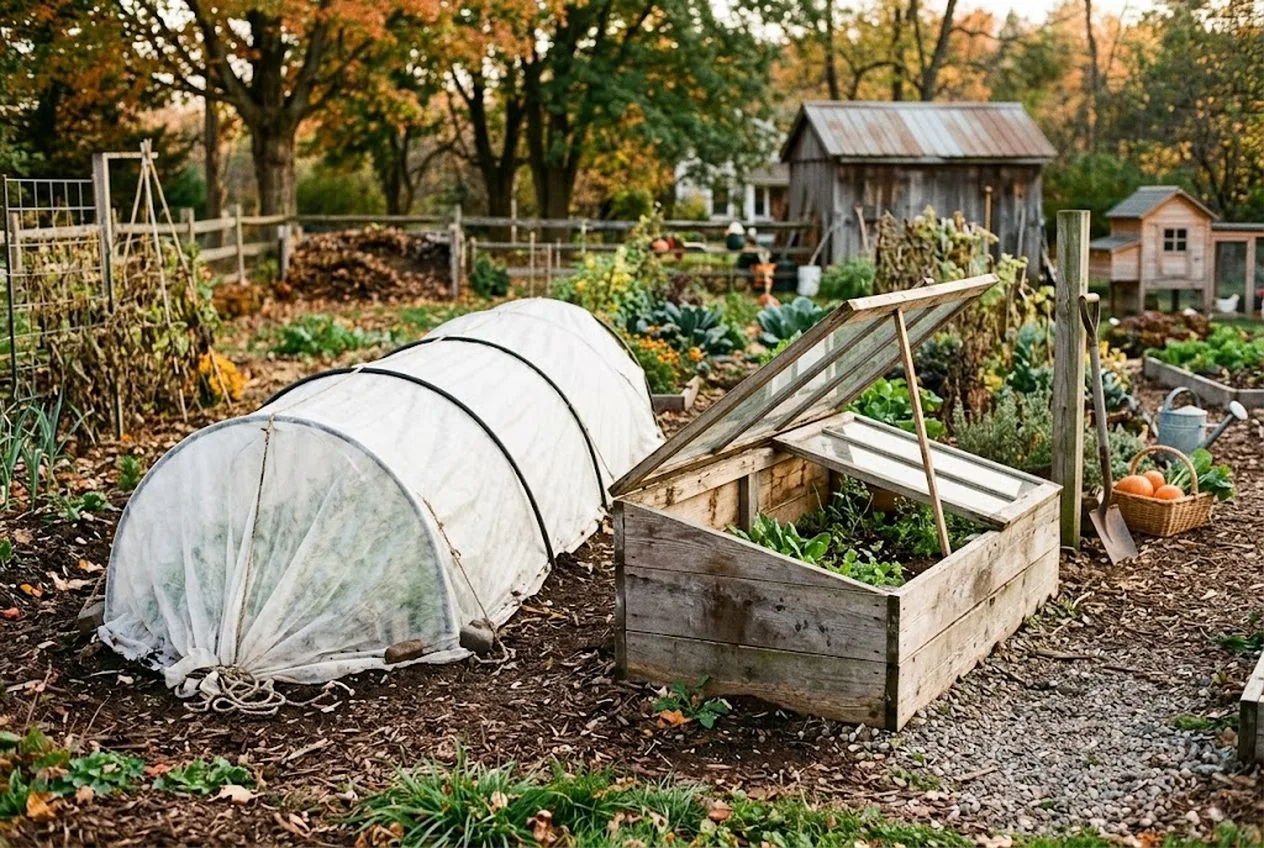
Every gardener who wants to keep eating past the first frost hits the same fork: a lightweight fabric you throw over the beds, or a glazed box you build in a corner of the garden. Row covers and cold frames both extend the season, but they solve different problems — and buying the wrong one for your garden means either not enough protection or a lot of effort you didn’t need.
Here it is in one sentence: row cover protects a lot of ground with a little warmth, while a cold frame protects a little ground with a lot of warmth. Pick based on scale and ambition — whole beds you want to nudge past frost, or a small patch you want to actively grow through winter.
The rest of this compares exactly how much each protects, what each costs, which crops suit which, and how to choose your first one.
The Core Difference: Warmth vs. Coverage
Both tools do the same fundamental thing — trap solar heat during the day and slow its loss at night — but they sit at opposite ends of a trade-off between how warm they get and how much area they cover.
- Floating row cover is a spun fabric laid over crops (directly or on hoops). It adds roughly 2–8°F depending on weight (University of Maryland Extension), transmits most of the light, lets rain through, and can blanket an entire bed for a few dollars. It’s protection you can roll out in minutes over as much ground as you own.
- A cold frame is a rigid, insulated box with a transparent lid. Its soil and frame soak up solar heat by day and radiate it back at night, keeping the inside warmer than the open garden (Iowa State University Extension) and creating a true microclimate you can grow in — not just survive frost, but keep greens actively producing. The catch: it only covers the footprint of the box.
That single contrast — a few degrees over everything versus many degrees over a little — drives every other decision below.
How Much Protection Each Really Gives
Match the tool to the cold you’re fighting:
| Floating Row Cover | Cold Frame | |
|---|---|---|
| Temperature gain | ~2–8°F (by fabric weight) | Warmer than ambient; stores daytime heat |
| What it does | Holds off frost, survives cold | Actively grows crops in cold |
| Area covered | Whole beds, large plots | The box footprint only |
| Light transmission | 70–95% (lighter weights) | ~76–82% (clear twin-wall polycarbonate) |
| Best season role | Push harvests past frost | Winter greens, early seed starting |
| Weakness | Modest warmth; wind can lift it | Small area; must be vented daily |
Notice that row cover is a frost tool and a cold frame is a cold-weather-growing tool. Row cover keeps hardy crops alive through the frosts that would otherwise end them; a cold frame keeps those crops growing when the open garden is frozen solid.
When to Reach for Row Cover
Start here if your goal is to stretch a fall harvest across several beds without a building project. Row cover is cheap, fast, and endlessly flexible — you drape it the night a frost is forecast and pull it off when the risk passes, or leave a lightweight cover on all season over cool-season crops. It’s also the tool for large in-ground plantings, where a cold frame simply can’t reach.
Disclosure: the product links here are affiliate links, so we may earn a commission if you buy through them at no extra cost to you. The comparisons here reflect long-standing extension-service and manufacturer guidance on season extension, not brand marketing.
Row cover does have limits. Its warmth is modest, so in a hard freeze even a heavy blanket only buys hardy crops a little margin. And because it’s light, it must be secured at every edge or the wind will peel it back. Our full guide to using row covers for fall frost protection covers weights, hooping, and anchoring in detail.
When to Build a Cold Frame
Reach for a cold frame when you want to actively grow a small patch of greens through the cold, or start transplants weeks early in spring. A cold frame’s trapped warmth lets spinach, lettuce, arugula, and kale keep producing after the open garden quits; Iowa State University Extension puts the typical gain at two to four weeks in both fall and spring (Iowa State University Extension). It’s also more durable and more permanent: build it once and it works every year.
The classic build uses a bottomless wooden box with a transparent lid. Reclaimed glass windows make a free lid if you can find one, but for a new build, twin-wall polycarbonate is the better modern glazing — lightweight, insulating, and cut to size with a fine-tooth saw (Palram).
A cold frame’s cost is effort and attention. It’s a small build, and it must be vented on sunny days: Iowa State University Extension says to raise the lid once the inside air passes 85°F, because temperatures inside can change rapidly and kill the plants (Iowa State University Extension). An automatic solar vent opener handles that for you, but a frame will always ask more of you than a sheet of fabric. Our DIY cold frame guide walks through two builds under $80 and the ventilation rule that keeps crops alive.
The Best Move: Use Both
These tools aren’t rivals so much as layers. The most resilient fall-to-winter setup uses row cover to protect the broad beds and a cold frame to hold a dedicated patch of greens through the deepest cold — and on the very hardest nights, you combine them, draping row cover over the plants inside the closed cold frame for several extra degrees right at leaf level.
Think of it as a ladder of protection:
- Bare hardy crops survive light frost on their own.
- Row cover adds a few degrees and pushes them weeks further.
- A cold frame creates a growing microclimate for a small patch.
- Row cover inside a cold frame stacks both for the coldest nights.
So Which Should You Buy or Build First?
Let your garden — and your honest ambitions — decide:
- Start with row cover if you want to push a fall harvest across several beds with minimal fuss and cost. It’s the fastest win, needs no building, and teaches you how season extension works.
- Build a cold frame if you want to actively grow winter greens or start transplants early in a dedicated spot, and you don’t mind a small build and daily venting.
- Own both eventually and you cover the whole range — broad frost protection from the fabric, a true cold-weather growing space from the frame, and the two stacked when it really freezes.
Whichever you choose, season extension is one of the highest-return skills in a self-reliant garden: it turns the “end” of the growing year into extra weeks of fresh food. Pair either tool with the cold-hardy crops you sow in late summer, and the first frost stops being a deadline and becomes just another cold night the garden shrugs off.
Frequently Asked Questions
- What's the real difference between a row cover and a cold frame?
- Row cover is a lightweight fabric you drape over crops to trap a few degrees of warmth over a large area; a cold frame is a rigid, glazed box that creates a much warmer, more controlled microclimate over a small area. Row cover is cheap, portable, and covers whole beds with about 2–8°F of protection depending on weight. A cold frame stores the day's solar heat in its soil and frame and releases it overnight, letting you keep greens growing into the cold, but it only covers the footprint of the box.
- Which gives more frost protection?
- Generally a cold frame. A well-built cold frame soaks up solar heat by day and radiates it back overnight, keeping the inside warmer than the open garden, while floating row cover adds roughly 2–8°F depending on fabric weight. For deep cold and for actually growing plants through winter rather than just surviving a frost, the cold frame wins. Row cover's advantage is that it protects far more ground for far less money.
- Can I use both together?
- Yes, and it's one of the best cold-weather tricks there is. On the hardest nights, drape row cover over the plants inside a closed cold frame and you stack two layers of protection — the frame's trapped warmth plus the fabric's extra couple of degrees right at leaf level. Many growers who own a cold frame keep row cover on hand precisely for this.
- Which should a beginner buy first?
- Row cover, in most cases. It's inexpensive, requires no building, protects large beds immediately, and teaches you how season extension works. A cold frame is the next step up — a small building project that pays off if you want to actively grow winter greens in a dedicated spot. If your goal is simply to push a fall harvest a few weeks longer across several beds, row cover alone often does the job.
- Do cold frames need more management than row cover?
- Yes. Temperatures inside a closed cold frame can climb fast on a sunny day and kill the crops inside, so Iowa State University Extension advises raising the lid once the inside air passes 85°F and closing it before sunset. Lightweight row cover is much more forgiving and can often stay on continuously. Automatic vent openers reduce the cold frame's daily workload, but a frame still asks for more attention than a sheet of fabric.
Sources & references
Before you go
The Renter's Homestead Pack
Self-reliance projects for the yard you don't own — container yields, a raised bed built to move with you, balcony preservation basics, and the landlord questions to ask first.
Free guide
The Renter's Homestead Pack
Self-reliance projects for the yard you don't own — container yields, a raised bed built to move with you, balcony preservation basics, and the landlord questions to ask first.