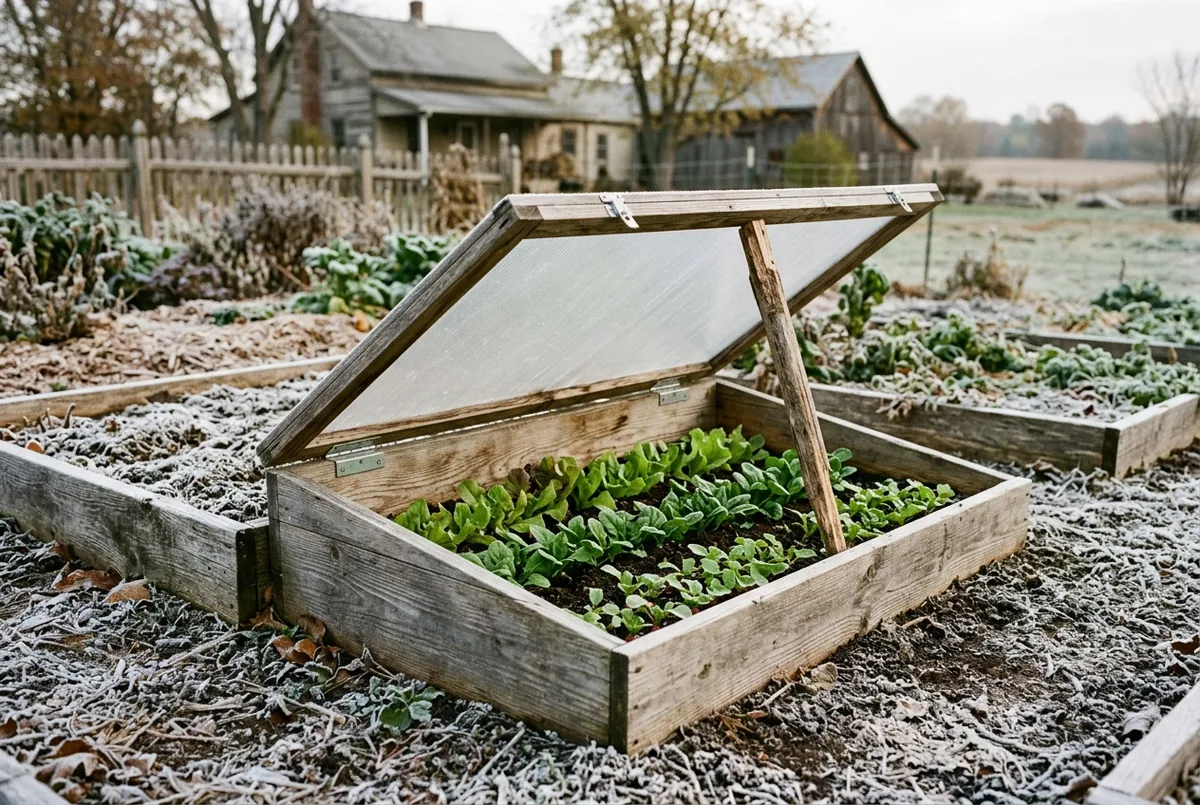
Frost is creeping earlier into the overnight forecast, and the last rows of lettuce, spinach, and radishes are running out of days before a hard freeze ends them for good. A cold frame is a low, boxed structure with a transparent, hinged lid that traps daytime heat and holds onto it through a cold night, buying a garden extra weeks of production without the cost of a heated greenhouse.
The short answer: A well-built, well-sited cold frame typically extends a fall harvest by two to four weeks, and closing the lid overnight as frost threatens can keep cool-season crops like lettuce, spinach, and radishes growing well into November in most growing seasons (Iowa State University Extension and Outreach).
How Much Extra Growing Time a Cold Frame Actually Buys
A cold frame is a low box that captures solar heat during the day and slows heat loss overnight. Used consistently through fall, that combination extends the growing season by roughly two to four weeks compared to an unprotected bed, and closing the lid as frost threatens lets a garden “continue growing and harvesting well into November in most growing seasons” (Iowa State University Extension and Outreach). The same structure works in reverse each spring, giving transplants a two-to-four-week head start before the last frost date.
Inside the box, the air runs meaningfully warmer than what’s happening outside. Expect the interior to sit roughly 5 to 10 degrees warmer than the outside air on a given day (University of Vermont Extension, Feb 22, 2024). That margin won’t carry tomatoes through a hard freeze, but it’s exactly the buffer that keeps cool-season leafy crops alive when the forecast dips to a light frost.
What a Cold Frame Can (and Can’t) Do
It’s worth being clear about what “extending the harvest” means here. A cold frame gets described online as a mini greenhouse that grows anything, but extension guidance frames it more narrowly: a tool for stretching the harvest window of cool-season crops, think lettuce, spinach, kale, and radishes, by a few weeks, not a structure for growing warm-season vegetables year-round. If a fall garden is full of cold-tolerant greens and root crops, a cold frame is a strong match. If it’s full of tomatoes and peppers, the frame buys very little once a hard freeze arrives.
Which Crops Make Sense in a Cold Frame Right Now
Not every plant in a fall garden benefits equally from a cold frame, and picking the right ones is most of what makes the two-to-four-week extension actually pay off. Leafy greens and root crops tolerate the light frosts and shorter days a cold frame is built to buffer against: lettuce, spinach, kale, mustard greens, and radishes are the standard choices, along with carrots and beets already sized up in the ground. Herbs like parsley and cilantro hold up well too, since they prefer cooler growing conditions to begin with. None of these need the frame to be warm in any absolute sense, just protected from the hard freezes that would otherwise end their season on a single bad night.
What doesn’t belong under the lid is anything still trying to fruit. Tomatoes, peppers, squash, and beans are warm-season crops, and the 5-to-10-degree bump a cold frame provides isn’t close to what they need once nights start dipping toward freezing. Trying to nurse a tomato plant through October under a cold frame usually just delays the inevitable by a week, while the same frame over a bed of spinach can keep producing for a month or more. If a fall garden still has warm-season plants in it heading into cold-frame season, the more productive move is usually to clear that bed and use the frame space for a quick-growing cool-season crop instead.
What Size to Build
Dimensions That Work
Keep the frame no more than 3 feet deep front to back. Any deeper and the plants at the rear are out of reach without stepping into the bed. A working slope for the lid runs about 12 inches high at the front and 18 inches high at the back, so the transparent, hinged lid tilts toward the sun and sheds rain instead of pooling it (Iowa State University Extension and Outreach). Length is flexible and should match whatever bed the frame is protecting.
What to Build It From
The box itself is typically wood, concrete block, or straw bales. The lid is the part that has to be transparent, and a salvaged storm window or old glass door panel, hinged along the top edge, does the job without buying new materials. Whatever ends up as the lid needs to be rigid enough to stay hinged and seal tightly, since a lid that won’t close fully loses most of the overnight heat advantage the frame is built for.
Sealing and Insulating the Box
Gaps around the edges of the lid are an easy place for a cold frame’s heat to escape overnight, so a strip of weatherstripping or foam tape along the top edge of the frame walls closes the seal the same way it would on a drafty door. Banking straw bales or bagged leaves against the outside walls adds another layer of insulation without adding cost, and it’s easy to remove once the coldest stretch passes. Rigid foam board cut to fit the inside walls does the same job if straw or leaves aren’t available, though it takes up growing space the loose insulation doesn’t.
Where to Put It
Siting matters as much as the build itself. Look for a south- or southeast-facing spot with a slight slope for drainage and a wall or hedge to the north to block winter wind, and sink the frame partway into the ground where possible. That combination, southern exposure for sun, a windbreak at the back, and ground contact for extra insulation, is what NC State Extension recommends for cold frame placement (NC State Extension, Extension Gardener Handbook). A frame sitting in full shade or exposed to open wind will run cold no matter how well it’s built.
Deciduous trees are worth a second look before settling on a spot. A corner that’s fully shaded in July can end up in direct fall sun once the leaves drop, which makes early autumn a deceptive time to judge a site. Standing in the prospective spot in mid-morning and again in mid-afternoon over a few days gives a better read on actual winter sun exposure than a single glance. Drainage matters too: a low spot that collects runoff from a roofline or a slope will stay soggy and cold, undoing whatever insulation the frame provides.
Why a Cold Frame Needs Daily Attention
A closed cold frame isn’t something to build once and walk away from. Internal temperatures can swing fast enough on a sunny day, even a cold one, to overheat and kill the plants inside, so the frame needs venting and checking on a frequent basis rather than staying sealed for the week (Iowa State University Extension and Outreach). In practice, that means propping the lid open on mild or sunny days and closing it again as the temperature drops toward evening, then repeating the check the next morning. Skipping a day of venting during a warm stretch is an easy way to lose a cold frame’s contents to heat instead of cold.
A morning-and-evening check works for anyone home during the day, but it’s not realistic for everyone’s schedule. Automatic vent openers, small cylinders that expand with heat and push the lid open past a set temperature, then close it again as things cool off, exist specifically to cover that gap. They won’t replace an occasional manual check, but they take the highest-risk failure mode, a warm midday sun on a lid left sealed, off the table for anyone who can’t be home to catch it.
Cold Frame vs. Row Cover: Which One Fits the Setup
If a cold frame sounds like more carpentry than the fall calls for, a floating row cover is the lighter alternative. Draped directly over a bed, a floating row cover can provide up to 10°F of frost protection on its own, depending on the material and grade (Colorado State University Extension). It won’t match the two-to-four-week season extension a cold frame delivers, and it doesn’t create the same daytime heat trap, but it takes minutes to deploy and needs almost no venting management. Plenty of gardeners run both: a row cover for a single light-frost warning, and the cold frame reserved for the beds they want producing into November.
Once the frame is up, pairing it with a backyard compost system, hot or cold, gives a steady supply of amended soil to top off the bed every time one crop swaps out for the next. And if the carpentry itch is already running, a cold frame slots in well alongside other slow-winter backyard homestead projects worth lining up for the same stretch of weekends.
For a first cold frame, start small. Pick one existing bed of cool-season crops, build a frame sized to fit it using the 3-foot depth and 12-to-18-inch slope above, and site it against whatever wind block the yard already offers. Once a season of venting habits is in place, adding a second frame next fall is a much smaller project than the first one was, and the same box can be reused every year with nothing more than a fresh coat of exterior paint or sealant on the wood every few seasons.
Frequently Asked Questions
- How much longer can a cold frame keep my vegetable garden going in fall?
- A cold frame typically adds two to four weeks to the harvest window, and closing the lid overnight as frost threatens can keep crops going well into November in most growing seasons (Iowa State University Extension and Outreach).
- How do I build a cold frame out of an old window?
- Use the old window or storm sash as the transparent lid, hinged along the top edge of a low wood, block, or straw-bale frame no more than 3 feet deep, sloped from about 12 inches high in front to 18 inches in back so it faces the sun (Iowa State University Extension and Outreach).
- How many degrees of frost protection does a cold frame actually give?
- Expect the air inside a cold frame to run about 5 to 10 degrees warmer than the outside air (University of Vermont Extension, Feb 22, 2024).
- Can a cold frame really keep vegetables growing into November?
- Yes, for cool-season crops. Iowa State University Extension and Outreach describes closing the lid overnight as frost threatens as a way to continue growing and harvesting well into November in most growing seasons.
- What size should a DIY cold frame be?
- No more than 3 feet deep so the back of the bed stays within reach, about 12 inches high in front and 18 inches high in back for the sloped lid (Iowa State University Extension and Outreach).
Sources & references
Before you go
The Renter's Homestead Pack
Self-reliance projects for the yard you don't own — container yields, a raised bed built to move with you, balcony preservation basics, and the landlord questions to ask first.
Free guide
The Renter's Homestead Pack
Self-reliance projects for the yard you don't own — container yields, a raised bed built to move with you, balcony preservation basics, and the landlord questions to ask first.