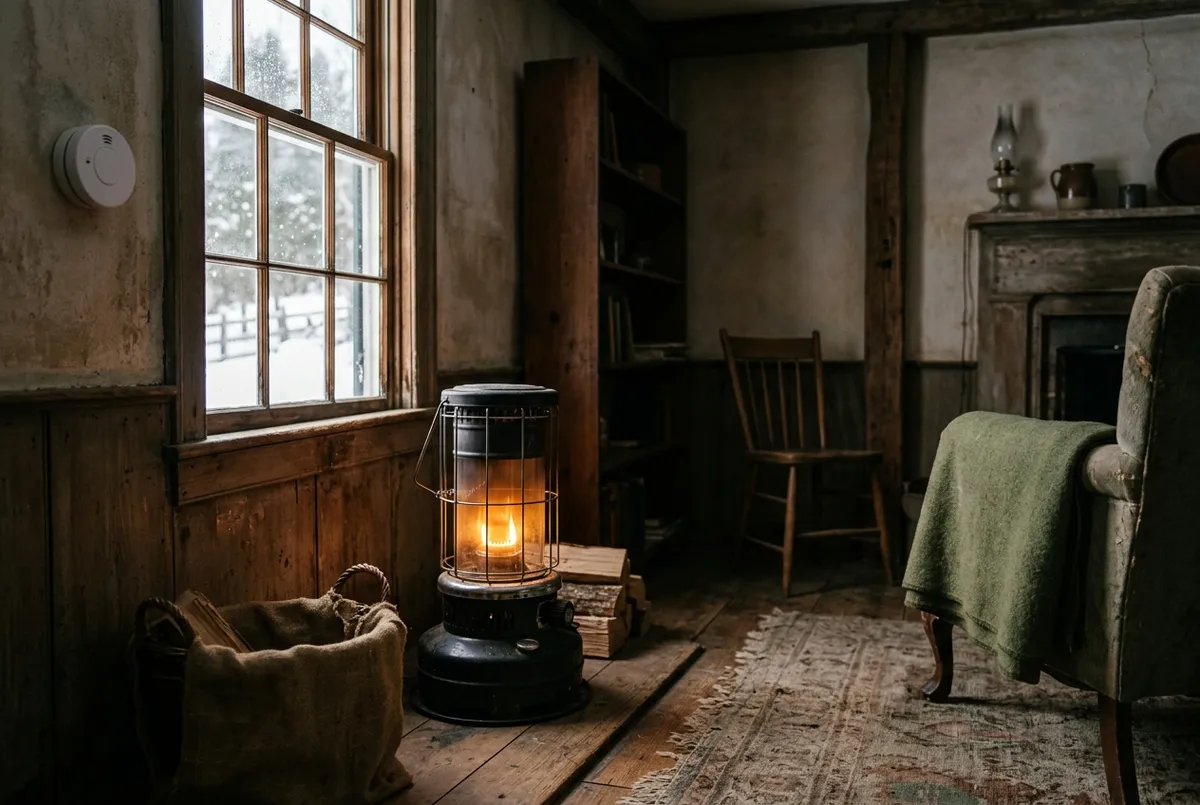
What’s the short answer?
- A kerosene heater can run indoors during an outage only with a cracked window, a working CO detector, and constant attendance.
- Carbon monoxide from kerosene combustion is colorless and odorless; common symptoms like headache, dizziness, and weakness are often described as flu-like.
- Never leave a kerosene heater running unattended or while anyone sleeps; shut it off first.
- Keep at least three feet of clearance between the heater and anything flammable.
- A cracked window or door, at least one inch, is the commonly cited minimum fresh-air path.
The power drops mid-December and the thermostat starts sliding before the storm even clears the ridge. Somewhere in the shed is a kerosene heater bought years ago for exactly this, still sealed in its box. Can it actually run in the house, or does it belong outside no matter what?
The short answer: A kerosene heater can run indoors during a power outage, but only inside a narrow set of conditions: a cracked window or door for fresh air, a working carbon monoxide detector, someone awake in the room the entire time, and it shut off before anyone sleeps or leaves. Skip any one of those conditions and the honest answer changes to no.
What a Kerosene Heater Actually Does to the Air in a Closed Room
Burning kerosene consumes oxygen from the room and can produce carbon dioxide, sulfur dioxide, nitrogen dioxide, and carbon monoxide (Insurance Information Institute). None of that is unique to a cheap or poorly maintained unit. It is what combustion does, in any kerosene heater, in any closed space.
Carbon monoxide is the one that matters most, and it is also the one you have no chance of noticing on your own. It is colorless and odorless. The most common symptoms are headache, dizziness, weakness, upset stomach, vomiting, chest pain, and confusion, often described as flu-like, the kind of unwell that feels like it is just from the cold and the stress of the outage. Breathing in a lot of it can make you pass out or kill you (CDC, Jan. 12, 2026). A heater that looks and smells fine can still be filling the room with something you cannot detect until the symptoms are already underway.
That is the entire reason the rest of this article exists as rules rather than suggestions. You are not managing a smell or a visible hazard. You are managing something with no warning signs of its own.
Do not count on a home’s natural leakiness to supply that fresh air. The Insurance Information Institute’s rule is an open window or door whenever the heater runs, not a draft you hope is there. A well-sealed home has less passive air exchange than a drafty one, so treat the ventilation step as deliberate rather than assumed.
Recognizing Exposure Before It Becomes an Emergency
Because carbon monoxide gives no sensory warning, the only reliable signals are the ones your body produces, and by the time those show up, exposure is already underway. Headache, dizziness, and weakness are among the most common symptoms, easy to mistake for ordinary tiredness on a cold, stressful night. Upset stomach, vomiting, chest pain, and confusion are also common, and people who are sleeping can die from CO poisoning before they have symptoms (CDC, Jan. 12, 2026).
The practical takeaway is not to memorize a symptom checklist and wait to see how far it progresses. It is to treat any headache, dizziness, or unusual drowsiness in a room with a running kerosene heater as a reason to get everyone into fresh air immediately and shut the heater off, rather than waiting to see if it passes. A working detector should sound before anyone reaches that point, which is the entire argument for making sure it is working before you rely on it.
The Ventilation Rule That Decides Whether This Is Safe
Adequate ventilation is required any time a kerosene heater runs indoors. In practice, that means a path for fresh outside air, commonly cited as a window or door open at least one inch, for the entire time the heater is running (Insurance Information Institute). That fresh air does two jobs at once: it replaces the oxygen the heater is consuming, and it helps clear the combustion gases the heater is producing.
This is not a one-time step you do before lighting the heater and then forget. The crack needs to stay open the whole time the heater runs, which means the room will not seal in heat the way it would with the windows shut. That tradeoff is the actual cost of using a kerosene heater indoors: some of the heat you are generating is deliberately being let out, because the air exchange is what keeps the room survivable. If a space is small enough that cracking a window defeats the purpose of running the heater at all, that is a sign this is the wrong tool for that room.
Why the Carbon Monoxide Detector Isn’t Optional
The CDC recommends battery-operated or battery back-up carbon monoxide detectors near every sleeping area in your home (CDC, Jan. 12, 2026). With a fuel-burning heater running indoors, treat a working one as essential, not just recommended. Given that carbon monoxide gives no smell, color, or taste to warn you, the detector is the only early warning system you have between normal use and a medical emergency.
Test it before the outage starts, not during it. A detector with a dead battery is functionally the same as no detector at all, and a power outage is exactly the scenario where you would rather find that out ahead of time than in the middle of the night. It is a small, unglamorous line item, which is probably why it is the kind of thing that ends up on our own list of 12 Gifts for the Prepper or Homesteader in Your Life more often than the flashier gear does.
Attendance and Clearance Rules You Cannot Skip
Never Unattended, Never Overnight
A kerosene heater should never be left running unattended or while anyone is sleeping. Shut it off before bed, and shut it off before anyone leaves the room, even briefly (Insurance Information Institute; U.S. Fire Administration). This is the rule most likely to get bent during an actual outage, because a cold house at 2 a.m. makes leaving the heater on and going to sleep feel reasonable in the moment. It is the one place where the short answer to this article’s title actually turns to no.
Three Feet From Anything Flammable
Keep the heater at least three feet from curtains, furniture, bedding, and anything else that burns (U.S. Fire Administration). In a small room during an outage, furniture tends to migrate closer to the heat source as people try to stay warm. That three-foot buffer needs to hold regardless of how the room gets rearranged over the course of the outage.
When a Kerosene Heater Is the Wrong Tool for the Job
Some households and some rooms are not a good match for this, even with every rule followed correctly. A small bedroom where the only way to crack a window undoes most of the heating benefit is one example. A household where the person managing the heater cannot reasonably stay awake and monitoring it, whether that is because of young kids, an overnight work schedule, or anyone with a health condition that makes them the wrong person to be solely responsible for a combustion appliance, is another.
In those situations, the safer route is heat that does not burn anything at all. A battery-based power station sized for a space heater or an electric blanket removes the ventilation requirement and the carbon monoxide risk in one move (electric space heaters should still be turned off when you leave the room or go to bed, per the U.S. Fire Administration), at the cost of needing the battery charged ahead of time and accepting a shorter run time than a tank of kerosene offers. It is a real tradeoff, not a strictly better option, but for a room where the ventilation math does not work, it is the tradeoff worth making.
Renters and Small Spaces: A Different Calculation
Everything above assumes a room where you control the windows, the lease terms, and whatever fire code applies to your building. That is not everyone’s situation. Many rental agreements and multi-unit buildings restrict or outright prohibit fuel-burning space heaters indoors, independent of anything in this article, and that restriction overrides any of the conditional guidance here. Check the lease and the building’s posted fire safety rules before assuming the option is even on the table.
Smaller spaces carry a second problem on top of any lease restriction: the same square footage that heats up fast with a kerosene heater also fills with combustion gases fast, which shrinks the margin for error if the ventilation step gets skipped or the window gets shut partway through the night without anyone noticing. A studio apartment or a single small bedroom is exactly the scenario where a battery-based alternative is worth the tradeoff, even for someone who has run a kerosene heater safely in a larger space before.
Folding This Into a Broader Outage Plan
A kerosene heater, used correctly, is one piece of a larger plan rather than the whole plan. It covers heat in a specific room for a specific stretch of time, with someone present. It does not cover the rest of the house, and it does not cover the hours when everyone is asleep. Building out the rest of that plan, room by room, including where the cold actually gets dangerous first and what needs power versus what does not, is covered in How to Build a Blackout Kit That Works, Room by Room.
The heater, the detector, the cracked window, and the clock you are watching for bedtime are all part of the same decision, not four separate ones. Treat any single piece as optional and the whole arrangement stops being the conditional yes it was designed to be.
Before the next outage, not during it, walk through the actual conditions: confirm the heater’s fuel and wick are in working order, replace the batteries in the carbon monoxide detector, pick the room you would actually use and check whether its windows crack far enough for real airflow, and decide now who is responsible for staying awake with it running. Deciding those things in advance is what turns this from a risk you are managing on the fly into a plan you already trust.
Frequently Asked Questions
- Is it ever safe to run a kerosene heater indoors during a power outage?
- Only conditionally. It needs a window or door open for fresh outside air, a working carbon monoxide detector, and it must never be left running unattended or while anyone sleeps, per guidance from the Insurance Information Institute, the CDC, and the U.S. Fire Administration.
- How much ventilation does a kerosene heater actually need?
- The Insurance Information Institute calls for a source of fresh, outside air, such as a window or door open at least one inch, whenever the heater is running, so fresh air can replace the oxygen the heater consumes and help clear combustion gases.
- What gases does a kerosene heater put into the room?
- Burning kerosene consumes oxygen and can produce carbon monoxide, nitrogen dioxide, carbon dioxide, and sulfur dioxide, according to the Insurance Information Institute.
- Do I need a carbon monoxide detector even for a short outage?
- Yes. Carbon monoxide is odorless and colorless, and the CDC recommends battery-operated or battery back-up CO detectors near every sleeping area, which keeps working when the power is out.
- How far does a kerosene heater need to be from furniture or bedding?
- The U.S. Fire Administration recommends keeping anything that can burn at least three feet from heat sources, including space heaters, which covers curtains, furniture, and bedding.
Sources & references
Before you go
The Renter's Homestead Pack
Self-reliance projects for the yard you don't own — container yields, a raised bed built to move with you, balcony preservation basics, and the landlord questions to ask first.
Free guide
The Renter's Homestead Pack
Self-reliance projects for the yard you don't own — container yields, a raised bed built to move with you, balcony preservation basics, and the landlord questions to ask first.