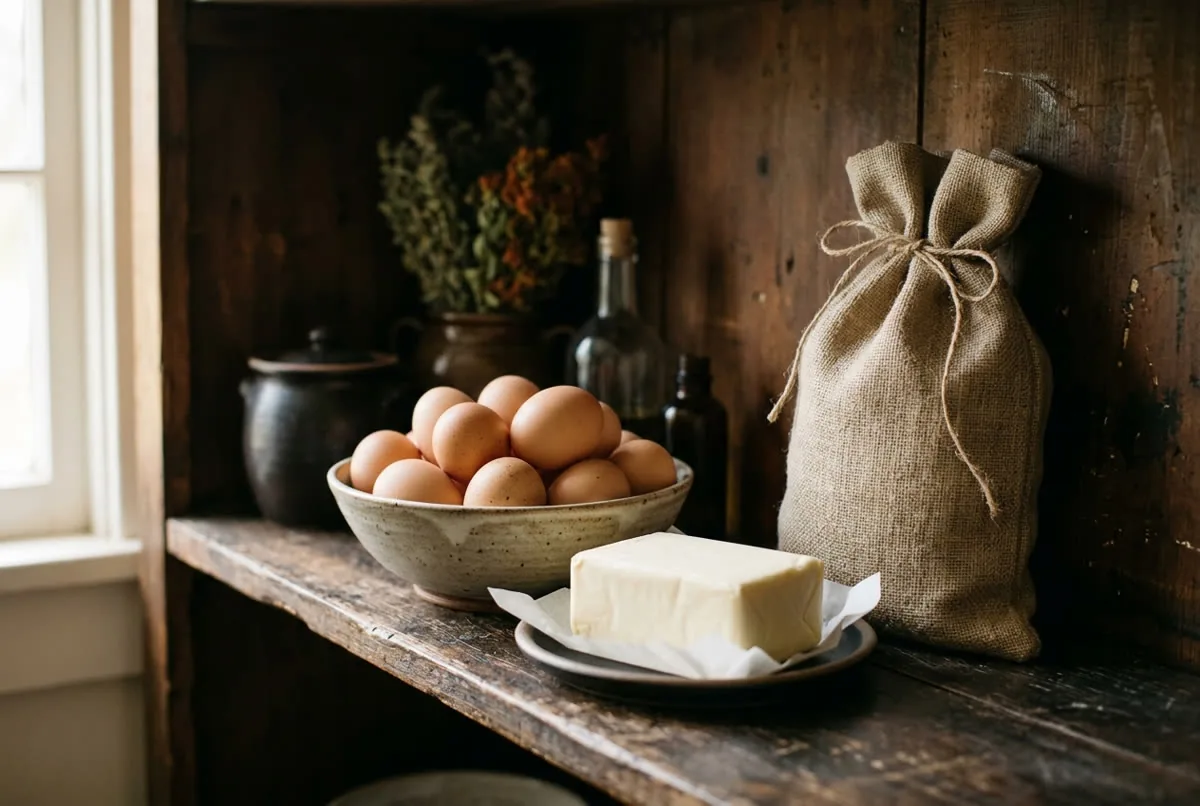
What’s the short answer?
- Shell eggs keep 3-5 weeks refrigerated at 32-40°F; raw whites or yolks keep 2-4 days refrigerated or up to 12 months frozen (The Food Keeper, 2014 ed.).
- Butter keeps 1-2 months refrigerated or 6-9 months frozen at 0°F when tightly wrapped (NDSU Extension, revised May 2020).
- White flour keeps 6-12 months unopened in a cool pantry; whole-wheat flour keeps only 3-6 months unopened because its natural oils go rancid faster (NDSU Extension, revised May 2020).
- Keep pantry staples cool, ideally about 50°F with 60-70°F acceptable, refrigerators at or below 40°F, and freezers at 0°F, checked with appliance thermometers (NMSU Extension; FDA).
Grocery aisles fill up with holiday baking supplies from late October through December, and the eggs, butter, and flour on sale this week are the same staples most kitchens burn through fastest in the six weeks around Christmas. Buying extra while prices are down only pays off if that extra actually survives until it’s needed, whether that is three weeks from now for a cookie exchange or well into the new year for pie crusts and bread. The rules for how long each ingredient lasts, and where it needs to sit, are different enough that guessing gets expensive.
The short answer: Shell eggs keep 3-5 weeks refrigerated at 32-40°F, butter holds 1-2 months refrigerated or 6-9 months frozen at 0°F, and flour keeps 6-12 months unopened in a cool pantry and longer in the freezer, though whole-wheat flour spoils faster than white.
How Long Can I Keep Extra Eggs for Baking?
Shell eggs kept in the refrigerator at 32-40°F keep for 3-5 weeks (NDSU Extension, revised May 2020), though FDA advises using eggs in their original carton within 3 weeks for best quality (FDA). That window covers most holiday timelines: eggs bought during a late-November sale are still good for a batch of cutout cookies in mid-December, but they are not a January ingredient unless something changes about how they’re stored.
Once an egg is cracked, the clock moves faster. Raw egg whites or yolks held in the refrigerator only keep 2-4 days (The Food Keeper, 2014 ed.). That matters for recipes that split eggs, like eggnog or a custard pie that uses yolks and leaves whites over for a meringue later in the week; plan to use the leftover half within a few days rather than setting it aside for later.
Freezing Eggs for a Longer Window
Raw whites and yolks can be frozen and will hold for up to 12 months (The Food Keeper, 2014 ed.). That’s the option for anyone who wants to buy eggs well ahead of the holiday baking rush: separate them, freeze in a labeled container, and thaw only what a recipe calls for. New Mexico State University Extension says uncooked whites can be frozen as they are, but yolks and whole eggs need 1/8 teaspoon salt or 1 1/2 teaspoons corn syrup per 1/4 cup (4 yolks or 2 whole eggs) added first (NMSU Extension).
One common assumption doesn’t hold up. Storing eggs on the counter because the kitchen “runs cool” falls outside the guidance cited here: FDA advises storing eggs promptly in a clean refrigerator at 40°F or below (FDA). A kitchen that feels cool to a person is still well above refrigerator temperature, and none of the sources cited here gives a shelf life for eggs held outside the fridge.
A carton bought specifically to stretch through the holidays is also worth checking over before it goes in the fridge. FDA advises buying only eggs whose shells are clean and not cracked (FDA). Keeping eggs in their original carton on a shelf in the coldest part of the refrigerator, not in the door, is a small habit that protects the full 3-5 week window rather than shortening it (NMSU Extension; The Food Keeper).
Does Butter Need to Go in the Freezer?
Butter kept refrigerated at 32-40°F holds for 1-2 months (NDSU Extension, revised May 2020). For someone stocking up during a holiday sale two months or more before they plan to bake, that refrigerator window alone isn’t enough.
The freezer changes the math substantially. Butter that is tightly wrapped and frozen at 0°F keeps for 6-9 months (NDSU Extension, revised May 2020). That’s long enough to buy butter on a November or December sale and still have usable stock for spring baking. NDSU’s note for butter is simply “wrap or cover tightly,” and the original wrapper plus a second layer, or a sealed container, is an easy way to follow it.
Because both numbers depend on the appliance actually holding the stated temperature, it’s worth confirming the refrigerator is running at or below 40°F and the freezer at 0°F with an appliance thermometer rather than trusting the dial (FDA).
Buying extra butter for the holidays is also a good moment to portion it before it goes into the freezer instead of after. A pound cut into recipe-sized pieces, or left in its original quarter-pound sticks with an outer freezer bag added, thaws faster and in smaller amounts than a single frozen brick, so a recipe that calls for half a stick doesn’t force the rest to thaw and refreeze along with it.
Does Flour Really Need to Go in the Freezer for Long-Term Storage?
White flour stored unopened in the pantry keeps 6-12 months, and once opened it drops to about 6-8 months in the pantry (NDSU Extension, revised May 2020). Refrigeration extends opened flour’s usable life to around a year (NDSU Extension, revised May 2020).
That’s longer than most people expect, and it feeds a common misconception: that flour “never goes bad” and freezing it is unnecessary. Extension shelf-life tables say otherwise, particularly once a bag is opened and exposed to air and moisture. For anyone buying multiple bags ahead of a holiday baking season, the freezer is the way to push that timeline out further than the pantry or refrigerator numbers above (NDSU says white flour can be frozen for indefinite storage). Oregon State University’s pest guidance also recommends keeping seldom-used grains and spices in the freezer (Oregon State University).
Pantry conditions matter for whatever flour is not in the freezer. New Mexico State University Extension recommends storing food in a cool, dry, dark spot, ideally about 50°F, with 60-70°F acceptable (New Mexico State University Extension, revised April 2025). A cabinet next to the oven or a shelf that gets afternoon sun works against the ingredient, even if the bag is sealed.
If a freezer is already tight on space around the holidays, a vacuum sealer can help flour and other dry goods take up less room in whatever space is left; our review of whether a vacuum sealer is worth it for long-term storage covers what that upgrade actually buys.
An airtight container matters as much as the location: NDSU’s entries for both white and whole-wheat flour say to keep it in an airtight container. Transferring flour to a sealed container as soon as it’s brought home, and doing that before it ever goes in the freezer, is the simplest way to follow that advice.
White Flour vs. Whole-Wheat Flour: Why the Storage Life Is Different
Whole-wheat flour doesn’t keep as long as white flour, and the gap is significant enough to plan around. Unopened, it holds roughly 3-6 months in the pantry, and once opened and refrigerated it holds about 6-8 months (NDSU Extension, revised May 2020). The reason is the natural oils in whole-wheat flour, which can turn rancid; New Mexico State University Extension notes that refrigerating whole wheat flour slows that rancidity (NMSU Extension).
For a holiday reserve, that difference argues for buying whole-wheat flour closer to when it will actually be used, in smaller quantities, and treating white flour as the ingredient that can be bought further ahead and frozen without much risk. Someone building a stock of both should expect to rotate the whole-wheat bag out well before the white flour needs attention.
How to Build a Small Baking-Ingredient Reserve Without Waste
Start With the Temperatures, Not the Ingredients
Every number above assumes the refrigerator and freezer are actually holding 40°F and 0°F. An appliance thermometer in each, checked periodically, is the best way to know that rather than guess from the dial (FDA). A freezer that runs warmer than 0°F falls outside the conditions behind the 6-9 month butter window, which NDSU lists for storage at 0°F.
Label Everything With a Date
A reserve only works if it gets used in the right order. Writing the purchase or freeze date on eggs, butter, and flour containers, then pulling the oldest one first, avoids the situation where a bag pushed to the back of the freezer outlasts its usefulness and gets thrown out unopened.
Buy to Match How Each Ingredient Actually Behaves
Butter and white flour tolerate a real reserve because they freeze well and hold for months. Eggs need either a firm 3-5 week refrigerated plan or a freezer plan for the whites and yolks specifically. Whole-wheat flour is the ingredient to buy light and replace often rather than stockpile. Building the reserve around those differences, instead of buying equal amounts of everything on sale, is what keeps the pantry from turning into a rotation of ingredients that quietly go rancid before they get used.
For a wider view of what else stores well long-term alongside these baking staples, our list of 15 foods to stockpile for a one-year pantry covers the categories that hold up best outside the refrigerator entirely.
Keep the Reserve Small Enough to Actually Rotate
A reserve that’s bigger than what a household bakes through in a year isn’t saving money, it’s just delaying the point where something gets thrown out. Before buying multiple bags of flour or a stack of butter on sale, it helps to have a rough sense of how much holiday and everyday baking the household actually does, then size the reserve to that instead of to how deep the discount is.
Baking Powder, Yeast, and Salt on the Pantry Shelf
Salt, baking powder, baking soda, and yeast are the cooking essentials used mostly to make bread from stored grains, and moisture is the main threat to all four. With moisture, salt will cake, baking powder and baking soda react and change chemically, and yeast loses viability. Temperature extremes do less harm: these items can freeze without damage, though excessive heat may lead to deterioration (Utah State University Extension).
Baking powder has a best-if-used-by date of 18-24 months, and an opened can lasts approximately 6 months. Yeast in nitrogen-flushed foil packaging has a best-if-used-by date of approximately 1 year, though it stays viable much longer if it remains sealed and stored in a cool to cold place. Keep baking powder in its original sealed can. Keep salt, baking soda, and yeast packets in their original containers, placed inside stronger packaging such as a Mylar-type bag.
To check opened baking powder, mix 1 tsp. in 1/3 cup warm water: if bubbles form, there is activity left (Utah State University Extension).
Common Mistakes That Waste Holiday Baking Stock
The most common mistake is treating “keeps a long time” as “keeps indefinitely,” particularly with flour. The second is storing eggs somewhere other than a refrigerator running at or below 40°F, on the assumption that a cool kitchen is close enough; the sources cited here give the 3-5 week window only for refrigerated eggs (The Food Keeper, 2014 ed.; FDA). The third is buying whole-wheat and white flour in the same quantities and storing them the same way, when the shelf-life tables show they need different timelines. The fourth is skipping the appliance thermometer and trusting a refrigerator or freezer dial that may not reflect the actual internal temperature. The fifth is freezing a whole stick of butter or a full bag of flour as one block, which forces a much larger portion to thaw than any single recipe actually calls for.
Start with what’s already in the kitchen: check the refrigerator and freezer temperatures with a thermometer, sort eggs, butter, and flour by purchase date, and decide which bags of flour are white versus whole-wheat before assuming they have the same shelf life. From there, holiday sales on these three staples become a genuine opportunity to save money instead of a bet on whether everything gets used before it turns.
Frequently Asked Questions
- How long can I safely keep extra holiday eggs and butter for baking next month?
- Shell eggs keep 3-5 weeks in a refrigerator at 32-40°F, and butter keeps 1-2 months refrigerated at the same temperature or 6-9 months frozen at 0°F when tightly wrapped, per NDSU Extension and The Food Keeper guide. Butter fits a one-month timeline comfortably, and eggs fit it only at the long end of their range (FDA advises using eggs within 3 weeks for best quality), as long as the refrigerator or freezer is actually holding those temperatures.
- Does flour really need to go in the freezer for long-term storage?
- Not necessarily. Unopened white flour keeps 6-12 months in a cool pantry, and opened flour keeps 6-8 months in the pantry or about a year refrigerated, per NDSU Extension. NDSU says white flour can be frozen for indefinite storage, and the freezer also helps guard against pantry pests, but it isn't required for short-term storage.
- What's the difference between storing white and whole-wheat flour?
- Whole-wheat flour has a shorter shelf life than white flour because it still contains the wheat's natural oils, which turn rancid faster. NDSU Extension lists whole-wheat flour at roughly 3-6 months unopened and 6-8 months once opened and refrigerated, compared to white flour's 6-12 months unopened.
- How do I build a small baking-ingredient reserve without anything going rancid?
- Confirm the refrigerator holds at or below 40°F and the freezer holds 0°F with an appliance thermometer, label each container with a purchase or freeze date, and buy whole-wheat flour in smaller amounts closer to when it will be used while treating butter and white flour as the ingredients that tolerate a longer freezer-based reserve.
Sources & references
- NDSU Extension, Food Storage Guide (FN579, revised May 2020) (opens in new tab)
- Cornell University, Food Marketing Institute and USDA Meat and Poultry Hotline, The Food Keeper (4th ed., 2014) (opens in new tab)
- New Mexico State University Extension, Storing Food Safely (E-118, revised April 2025) (opens in new tab)
- FDA, Are You Storing Food Safely? (opens in new tab)
- FDA, What You Need to Know About Egg Safety (opens in new tab)
- Oregon State University, Insects in Stored Food (opens in new tab)
- Utah State University Extension, Cooking Food Storage (opens in new tab)
Before you go
The Renter's Homestead Pack
Self-reliance projects for the yard you don't own — container yields, a raised bed built to move with you, balcony preservation basics, and the landlord questions to ask first.
Free guide
The Renter's Homestead Pack
Self-reliance projects for the yard you don't own — container yields, a raised bed built to move with you, balcony preservation basics, and the landlord questions to ask first.