What’s the short answer?
- USDA forecasts beef and veal retail prices up about 9.4% in 2026 (annual average) and wholesale beef up 8.5%; August 2026 retail beef and veal prices ran 5.9% above August 2025.
- Freeze raw cuts the same day you bring them home rather than letting them sit in the refrigerator.
- Pressure can a portion of your bulk meat so part of your stockpile is shelf-stable and doesn't depend on the freezer staying powered.
- Meat must be pressure canned, never water-bath canned, because boiling water can't reach the temperature needed to destroy botulism spores.
- Vacuum sealing extends shelf life but does not replace freezing or pressure canning.
You bought extra beef this fall while prices were still reasonable, and now the freezer is packed tighter than planned. The real question isn’t whether you got a good deal, it’s whether that meat will still be good when you need it. A full freezer can turn into freezer-burned regret, and the fix starts before the first pound goes in.
The short answer: Split your bulk buy by how you’ll use it. Freeze what you expect to cook within the next several months, vacuum-sealed or tightly wrapped to slow freezer burn, and consider pressure canning a portion so part of your stockpile stays shelf-stable and doesn’t depend on the freezer staying powered.
Why This Bulk Buy Was the Right Call
In its September 2026 Food Price Outlook, USDA’s Economic Research Service forecasts beef and veal retail prices to climb about 9.4% in 2026, a far faster pace than the 2.4% forecast for food-at-home prices overall and above beef’s own 20-year average rate of increase (USDA ERS, 2026-09-25). Wholesale beef is forecast up 8.5% and farm-level cattle prices up 7.1% for the year, with beef production expected to stay below year-ago levels through the end of 2026 (USDA ERS, 2026-09-25). This isn’t a future guess: ERS data show beef and veal prices in August 2026 already running 5.9% higher than August 2025 (USDA ERS, 2026-09-25). Month to month the picture is mixed, though: ERS reports beef and veal prices dipped 0.6 percent from July to August 2026, and farm-level cattle prices were 3.9 percent below August 2025, so the 2026 figures are annual-average forecasts rather than a promise of steady monthly increases (USDA ERS, 2026-09-25). Buying ahead made sense. Storing it correctly is what makes the purchase pay off.
That forecast matters for how you store what you already bought, not just for whether buying ahead was smart. A rising price trend means the meat sitting in your freezer or pantry right now is worth more, in replacement-cost terms, than what you paid for it. Losing even a portion of it to freezer burn, an unnoticed power outage, or a spoiled unlabeled cut is a bigger loss today than it would have been a year ago, which is exactly why the storage method matters as much as the buying decision did.
How Long Can Raw and Cooked Bulk Beef Safely Stay in the Freezer?
Start with the part of your haul you already cooked or portioned. USDA guidance on leftovers gives a working benchmark: cooked meat can be kept in the refrigerator for 3 to 4 days or frozen for 3 to 4 months (USDA FSIS, Leftovers and Food Safety), and FSIS’s freezer chart lists cooked meat at 2 to 3 months for best quality (USDA FSIS, Freezing and Food Safety). Those freezer times are about quality, since food kept at 0°F stays safe indefinitely. That window is for cooked and leftover meat specifically, so if you browned ground beef or portioned cooked roasts before freezing, use that timeline for those containers.
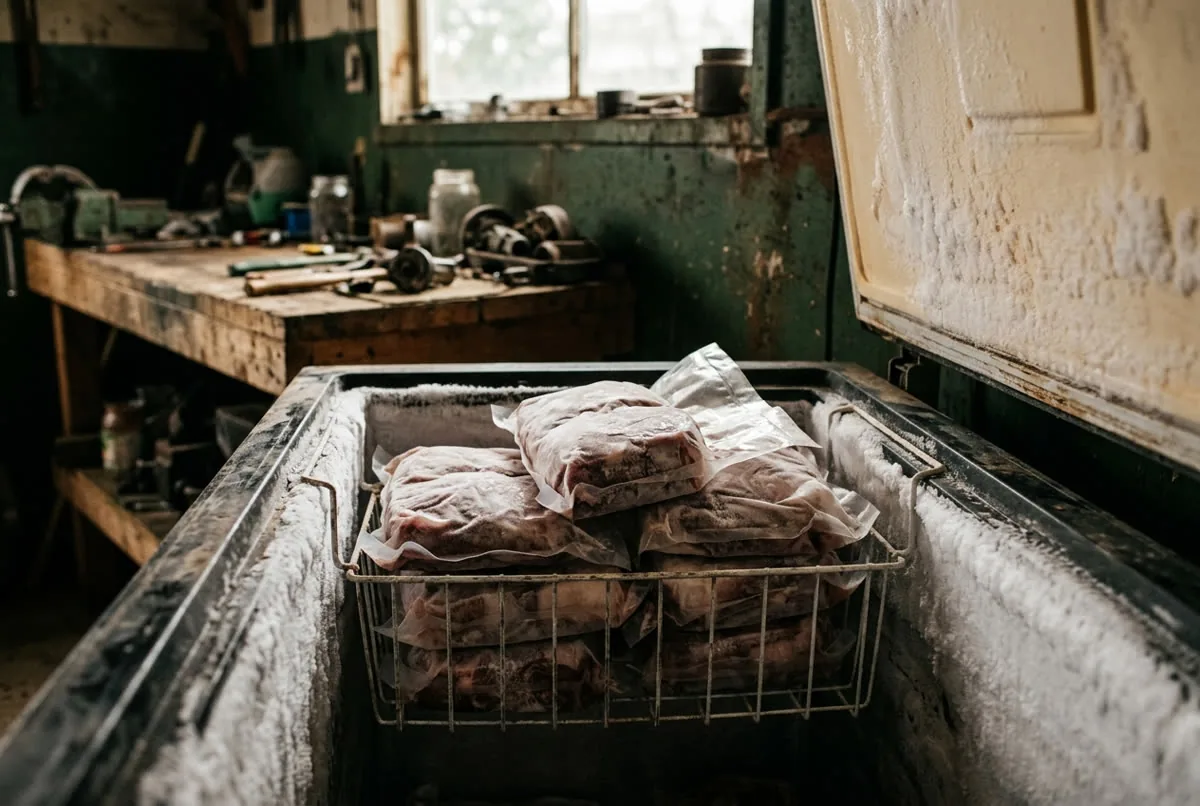
For the raw cuts still in their original packaging, the priority is speed, not a specific countdown. Get them into the freezer the same day you bring them home rather than letting a large volume sit in the refrigerator while you find space. The National Center for Home Food Preservation advises using refrigerated ground beef within 2 days and red meats within 3 to 5 days, or freezing them for later use (National Center for Home Food Preservation), a window a bulk haul rarely fits inside. Once frozen, FSIS’s freezer chart lists uncooked roasts, steaks and chops at 4 to 12 months and uncooked ground meat at 3 to 4 months for best quality (USDA FSIS, Freezing and Food Safety).
How You Wrap and Label Freezer Meat Changes How Long It Lasts
Freezer burn is dehydration, not spoilage: USDA FSIS says it does not make food unsafe, merely dry in spots, and that it is caused by air coming in contact with the surface of the food (USDA FSIS, Freezing and Food Safety). Air is the enemy. FSIS notes meat is safe to freeze in its original packaging, but that wrap is permeable to air and quality may diminish over time, so for prolonged storage overwrap it in freezer paper or a heavy-duty freezer bag with as much air pressed out as you can manage, or run it through a vacuum sealer if you have one. Thinner packages also freeze faster, and FSIS advises spreading packages out in a single layer to freeze and stacking them only once frozen solid.
Label every package before it goes in, not after. Write the cut, the weight or portion count, and the date it was frozen directly on the wrap. When a chest freezer fills up with a season’s worth of bulk buying, packages without dates get pushed to the bottom and forgotten, which is how good meat turns into meat you’re afraid to cook. A simple first-in, first-out system, oldest dates toward the front or top, keeps the stockpile actually getting used instead of just accumulating.
Should You Pressure Can Some of Your Bulk Meat Instead of Freezing All of It?
Freezing everything puts all your storage in one basket, and that basket depends on continuous power. Turning part of a meat purchase into pressure-canned meat, rather than relying strictly on mechanical refrigeration, matters most for households without a generator or with limited backup power.
This is also where the rules stop being flexible. Meat and low-acid vegetables must be pressure canned, never water-bath canned. Botulinum spores are very hard to destroy at boiling-water temperatures, so low-acid foods need to be processed at 240-250°F, which only a pressure canner reaches (National Center for Home Food Preservation). If you haven’t canned meat before, our guide on how to can beef and meat at home walks through the process and the equipment a pressure canner requires.
What’s the Safest Way to Store Meat During a Long Power Outage?
The freezer is only as reliable as the grid, a generator, or a backup battery bank feeding it. A stockpile that’s entirely frozen has a single point of failure. Splitting your bulk buy so a portion is pressure canned means that portion sits shelf-stable in jars and stays safe to eat through an outage of any length, no power required at all.
Dehydrated meat is a third option worth layering in, with a shorter shelf life than people expect: properly dried jerky keeps about two weeks at room temperature in a sealed container, and refrigerating or freezing it extends shelf life and holds flavor (National Center for Home Food Preservation). That doesn’t replace correct canning practice for meat safety, but it does give you a lightweight format that takes up far less space than jars. A vacuum sealer is one way to keep air out of freezer packages, since air contact is what causes freezer burn, and it is handy for packing jerky before you refrigerate or freeze it.
During the outage itself, the single most useful habit costs nothing: keep the freezer door closed. USDA FSIS says a full freezer will hold its temperature for approximately 48 hours, or 24 hours if it is half full, and every time the door opens, cold air spills out and is replaced by warmer room air. If you know an outage is coming, FSIS suggests keeping the freezer full by filling empty spaces with frozen plastic jugs of water, bags of ice, or gel packs, which helps it hold its temperature longer (USDA FSIS, Keep Your Food Safe During Emergencies).
How Do You Decide Which Cuts to Freeze, Can, or Dehydrate?
There’s no single right split, but the cut and how you plan to cook it point toward an answer.
Cuts that freeze well
Steaks, roasts, and chops hold their texture through freezing and thawing better than most other formats. If you plan to cook a cut the way you’d cook it fresh, freezing keeps that option open.
Cuts suited to the pressure canner
Ground meat, stew meat, and tougher cuts that you’d braise or slow-cook anyway are strong pressure-canning candidates. The National Center for Home Food Preservation publishes tested pressure-canner processes for ground or chopped meat and for strips, cubes or chunks of meat, beef included, and since those cuts get long, moist cooking anyway, a jar suits them.
Cuts suited to the dehydrator
Lean cuts are the ones to dehydrate into jerky; the National Center for Home Food Preservation recommends lean meat and trimming off all fat, because fat becomes rancid quickly (National Center for Home Food Preservation). A food dehydrator built for real volume makes this route practical if you’re processing more than a few pounds at a time.
Most bulk buyers land on a mix of all three rather than committing everything to one method. A common split freezes the roasts and steaks you already have plans for, cans the ground meat and stew cuts that would otherwise crowd out freezer space, and dehydrates whatever lean trim is left over. None of the three needs to dominate; the point is not depending on just one.
Does Vacuum Sealing Alone Make Meat Shelf-Stable?
No. Vacuum sealing reduces the oxygen around the meat, which slows freezer burn and some spoilage pathways, but it does not stop microbial growth on its own. Vacuum-sealed meat still needs to be frozen or properly pressure canned to be safe; sealing is a quality and shelf-life step layered on top of one of those two methods, not a replacement for either. Botulinum bacteria grow only in the absence of air, in moist, low-acid food between 40°F and 120°F (National Center for Home Food Preservation), so removing oxygen does not make meat safe on its own.
The same logic applies to the idea that a very cold refrigerator can substitute for freezing over the long term. USDA’s time limits for refrigerated meat are measured in days, not weeks: 3 to 4 days for cooked leftovers (USDA FSIS, Leftovers and Food Safety) and 3 to 5 days for raw red meats (National Center for Home Food Preservation). Long-term storage requires freezing, pressure canning, or a tested dehydration method, not just a colder setting.
Building a Rotation So the Stockpile Actually Gets Used
A bulk buy only pays off if it gets eaten before quality drops, not because it goes bad exactly, but because forgotten freezer meat and unlabeled jars are the most common reason bulk buying stops feeling worth it. Keep a running list, even a simple one taped to the freezer lid, noting what went in and when. Cross items off as you use them so you always know what’s oldest and what still needs a home in the canner or dehydrator.
Plan your next few weeks of meals around what’s already stored before buying anything new. Rotating stock this way means the beef you bought ahead of the price increase actually displaces beef you would have bought at the higher price, which is the entire point of stocking up in the first place.
Start by sorting what’s already in your freezer or fridge into three piles: cuts you’ll cook as-is within the next few months, cuts better suited to the pressure canner, and lean cuts worth dehydrating. Handle the raw portion first since it’s the most time-sensitive, then work through canning and dehydrating as your schedule allows. The goal isn’t to convert the whole purchase into jars or jerky, it’s to spread the risk so a freezer failure or a long outage doesn’t put your entire investment at risk at once.
Frequently Asked Questions
- How long can raw and cooked bulk beef safely stay in the freezer?
- USDA FSIS says food kept constantly at 0°F stays safe indefinitely, and its freezer storage times are for quality only: uncooked roasts, steaks and chops 4-12 months, uncooked ground meat 3-4 months, cooked meat 2-3 months. Refrigerated cooked meat and leftovers should be eaten within 3-4 days. Raw bulk cuts should go into the freezer the same day you bring them home rather than sitting in the refrigerator.
- Should I pressure can some of my bulk meat instead of freezing all of it?
- It's worth considering. Relying only on the freezer means your whole stockpile depends on continuous power. Turning part of a bulk purchase into pressure-canned meat gives you a shelf-stable portion that doesn't need electricity, which is especially useful for off-grid or generator-limited households.
- What's the safest way to store meat during a long power outage?
- Splitting your stockpile matters more than any single trick. A portion that's pressure canned stays safe in jars regardless of outage length. Keeping the freezer door closed and filling empty space with frozen jugs of water ahead of time helps the rest hold cold longer, and properly dried jerky adds a third, lightweight option, though the National Center for Home Food Preservation puts its room-temperature life at about two weeks in a sealed container and recommends refrigerating or freezing it for longer storage.
- How do I decide which cuts to freeze, can, or dehydrate?
- Steaks, roasts, and chops generally freeze best since they keep their texture. Ground meat and tougher, slow-cook cuts are strong pressure-canning candidates, and the National Center for Home Food Preservation publishes tested pressure-canner processes for ground or chopped meat and for strips, cubes or chunks of meat. Lean, low-fat cuts are the best fit for dehydrating.
- Does vacuum sealing alone make meat shelf-stable without refrigeration?
- No. Vacuum sealing reduces oxygen and slows freezer burn, but it does not stop microbial growth on its own. Vacuum-sealed meat still needs to be frozen or properly pressure canned to be safe.
Sources & references
- USDA ERS (opens in new tab)
- National Center for Home Food Preservation, Ensuring Safe Canned Foods (opens in new tab)
- USDA FSIS, Freezing and Food Safety (opens in new tab)
- USDA FSIS, Leftovers and Food Safety (opens in new tab)
- USDA FSIS, Keep Your Food Safe During Emergencies (opens in new tab)
- National Center for Home Food Preservation, Jerky (opens in new tab)
- National Center for Home Food Preservation, Meat, Ground or Chopped (opens in new tab)
- National Center for Home Food Preservation, Meat, Strips, Cubes or Chunks (opens in new tab)
Before you go
The Renter's Homestead Pack
Self-reliance projects for the yard you don't own — container yields, a raised bed built to move with you, balcony preservation basics, and the landlord questions to ask first.
Free guide
The Renter's Homestead Pack
Self-reliance projects for the yard you don't own — container yields, a raised bed built to move with you, balcony preservation basics, and the landlord questions to ask first.