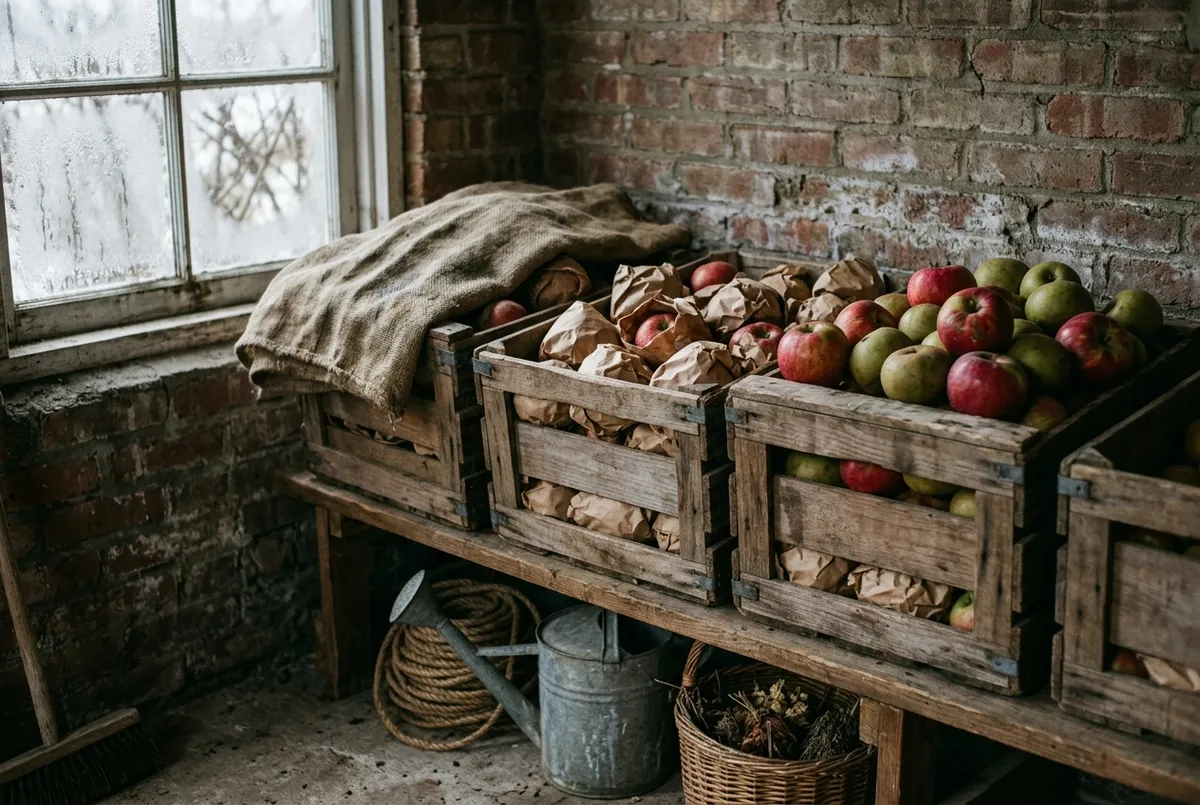
Every fall, apples come in faster than anyone can eat, can, or give away, and the freezer is already full of everything else from the garden. A root cellar would solve the surplus, but most yards, garages, and rented houses do not have one. A bad storage spot ruins more of a harvest than a slow picking season ever does.
The short answer: You can keep apples fresh for months without a root cellar by getting them into any unheated, humid space that holds close to 32-39°F, such as an insulated garage corner, an unheated basement stairwell, or a cooler you keep packed with ice. Expect somewhat faster softening than a true root cellar gives you, but still longer than a bowl on the counter.
When Apple Harvest Season Actually Runs
New-crop apple harvest in the United States starts in August and continues through October nationally (USDA Economic Research Service, Sept. 25, 2025). It is not one national event; harvest is staggered by variety and region, and some years finish well ahead of schedule. New York’s 2025 harvest ran ahead of its five-year average through September and was expected to be largely complete by the end of October (USDA Economic Research Service, Sept. 25, 2025). Pennsylvania moved even faster: its 2025 crop was 90 percent harvested by the week ending Sept. 21, well ahead of the state’s five-year average of 60 percent by that point in the season (USDA Economic Research Service, Sept. 25, 2025).
The scale matters for anyone planning storage space. The 2025 U.S. apple crop was forecast at 11.5 billion pounds across the seven states USDA’s National Agricultural Statistics Service surveys, up 6 percent year over year, with top producer Washington forecast at a record 8 billion pounds (USDA Economic Research Service, Sept. 25, 2025). If your local orchard or your own trees are part of a bigger-than-usual year, you are not the only one scrambling for a place to put a full basket.
Can You Actually Store Apples Without a Root Cellar or Fridge
Yes, with a caveat: what you are really building is a stand-in for a root cellar’s two jobs, cold and humid, not a replacement for either one done perfectly. A root cellar holds a narrow temperature band and high humidity because it sits underground or against the earth. Without one, you are looking for the next-best space in your house or yard that gets close to those numbers and stays there.
That rules out a kitchen counter, a heated pantry, or a garage that shares a wall with a heated room. It points you toward an unheated basement, an enclosed but unheated porch, a detached garage or shed in a cold climate, or, for smaller quantities, a cooler stocked with ice packs that you refresh on a schedule. None of these will match a true root cellar’s consistency, but extension research shows the temperature difference matters more than people expect, which is the next question.
A refrigerator crisper drawer can hold a few apples, ideally in a perforated bag, since University of Wisconsin Extension notes that apples commonly shrivel in a refrigerator unless they are in perforated plastic bags (University of Wisconsin Extension), but it was never built to hold a season’s harvest, and most households do not have the spare fridge space for a full bushel. The same cold, humid environment a root cellar provides can come from a smaller, low-tech setup instead, as long as the space actually holds its temperature rather than swinging back toward room temperature every time a nearby door opens.
The Temperature and Humidity Apples Actually Need
Optimum apple storage is 30-32°F at 90-95 percent relative humidity (Iowa State University Extension and Outreach, updated Feb. 21, 2022). At that temperature and humidity, Jonathan and Red Delicious apples can be stored up to 3 to 6 months, and apples overall spoil 2 to 3 times faster at 50°F than they do at 32°F (Iowa State University Extension and Outreach, updated Feb. 21, 2022).
Michigan State University Extension puts the workable range slightly wider: mature apples generally store well at 32-39°F with humidity near 95 percent to keep them from drying out and going soft (Michigan State University Extension, Oct. 27, 2022). The tradeoff for the warmer end of that range is real but smaller than most people assume. Fruit held there degrades roughly twice as fast at 40°F, and six times faster at 60°F, compared with 32°F (Michigan State University Extension, Oct. 27, 2022).
That last point is the one worth remembering if your only option is an imperfect space. An unheated garage that hovers at 39-40°F is not failing at apple storage. It is running at roughly double the spoilage rate of a perfect root cellar, which for most households still beats leaving the harvest in a heated kitchen.
How Long Stored Apples Actually Last
The extension data gives a real number to plan around, not a guess: at 30-32°F and 90-95 percent humidity, Jonathan and Red Delicious can be stored up to 3 to 6 months (Iowa State University Extension and Outreach, updated Feb. 21, 2022). That is the window a true root cellar, or a very good stand-in, buys you between an October harvest and a spring that still has fresh apples in it.
Move up the temperature scale and that window shrinks. Since spoilage roughly doubles at 40°F and multiplies six-fold at 60°F relative to 32°F (Michigan State University Extension, Oct. 27, 2022), a space that only manages the high 30s to low 40s is still worth using. It just means checking your stock more often and eating or processing the softer ones first, rather than assuming they will hold until spring untouched.
Which Apple Varieties Keep Longest
Not every apple is worth the storage effort equally. The extension research names Jonathan and Red Delicious specifically as varieties that can be stored up to 3 to 6 months under optimum conditions (Iowa State University Extension and Outreach, updated Feb. 21, 2022). If you are choosing what to prioritize for cold storage versus what to eat, cook, or process first, apples known for long storage life are the ones worth the space in your coldest, most humid spot. University of Wisconsin Extension notes that late-maturing apples are best suited for storage, so earlier-ripening apples are better eaten or processed sooner (University of Wisconsin Extension).
If you are growing or buying a variety not covered above, your regional extension office is the most reliable place to ask how it holds up in storage, since keeping quality varies enough between varieties that a general rule of thumb will not cover every case.
Building a No-Root-Cellar Storage Spot
A workable setup does not need to be elaborate. It needs to hit the temperature and humidity numbers above as closely as your space allows.
Pick the coldest stable spot you have
An unheated basement, an attached but unheated garage, a cold closet against an exterior wall, or an enclosed porch are the usual candidates. Avoid anywhere that shares a wall or ductwork with a heated room; even a few degrees of creep toward room temperature works against you, per the spoilage-rate data above.
Keep humidity up, not just cold
Both extension sources point to humidity near 90-95 percent as part of the target, not an afterthought (Iowa State University Extension and Outreach, updated Feb. 21, 2022; Michigan State University Extension, Oct. 27, 2022). A space heater or dehumidifier running nearby works against you by drying the air, and the container advice below helps the fruit hold its moisture.
Separate the apples from each other and from other produce
Apples are high producers of ethylene gas, and softening is the symptom of ethylene exposure in apples (University of Wisconsin Extension). Spacing fruit in shallow layers rather than piling it deep, and checking periodically for soft or bruised apples, keeps one bad piece from taking down its neighbors faster than the temperature alone would.
Choose the right container
Put apples in shallow crates, cardboard boxes with ventilation holes, or perforated produce bags rather than a sealed bin. University of Wisconsin Extension recommends baskets or boxes lined with perforated plastic to help apples retain moisture, and says individual fruit can be wrapped in tissue paper or newspaper (University of Wisconsin Extension). A fully sealed container can trap the ethylene gas apples give off, and softening is the exposure symptom in apples.
Check on a schedule, not just when you remember
A space in the high 30s or low 40s is doing real work, but it is not a root cellar on autopilot. Since the spoilage rate roughly doubles at 40°F versus 32°F (Michigan State University Extension, Oct. 27, 2022), plan to check every week or two rather than every month, and pull anything going soft before it affects the rest.
What to Do With Apples That Will Not Keep
Not every apple in a big harvest is a storage apple, and not every storage spot holds a full winter’s worth. Softer or bruised fruit, and anything from a variety not suited to long storage, is worth processing rather than banking. Canning applesauce, apple butter, or pie filling from a tested recipe in mason jars turns a surplus that would spoil into something shelf-stable for the rest of the year, and it is a reasonable next step once your best keepers are already set aside in the coldest spot you have. Freezing sliced apples, or drying them into rings or leather, are two more ways to use up fruit that will not make it through a long cold-storage stretch. Neither requires a root cellar or a shelf full of canning jars, and both stretch a big harvest well past the point fresh storage alone would carry it.
Checking a cold-storage spot and rotating stock is exactly the kind of low-effort task that fits into a slow winter homestead week alongside other seasonal maintenance. And any cores, peels, or apples too far gone to save are a straightforward addition to a backyard compost system, rather than waste.
Next Step
Start with the coldest, most humid space you already have, whether that is an unheated basement corner, a garage that never gets warm, or a rotation of coolers with ice packs, and sort your harvest by variety before you store anything. Put the known long keepers, like Jonathan and Red Delicious, in the best spot you have, process the rest into something shelf-stable, and check the pile every week or two rather than assuming it will take care of itself until spring.
Frequently Asked Questions
- When does apple harvest season run in the U.S.?
- New-crop apple harvest starts in August and continues through October nationally, though timing varies by state and can run ahead of the five-year average in some years (USDA Economic Research Service, Sept. 25, 2025).
- What temperature should I store apples at?
- Optimum storage is 30-32°F at 90-95% relative humidity. A workable range without a root cellar is 32-39°F with humidity near 95% (Iowa State University Extension and Outreach, 2022; Michigan State University Extension, 2022).
- How long do stored apples actually last?
- At 30-32°F and 90-95% humidity, Jonathan and Red Delicious apples can be stored up to 3 to 6 months (Iowa State University Extension and Outreach, 2022).
- Does storage temperature really make that big a difference?
- Yes. Apples spoil 2-3 times faster at 50°F than at 32°F, and fruit degrades roughly twice as fast at 40°F and six times faster at 60°F compared with 32°F (Iowa State University Extension and Outreach, 2022; Michigan State University Extension, 2022).
- Which apple varieties keep longest in storage?
- Jonathan and Red Delicious are specifically noted to store up to 3 to 6 months under optimum cold, humid storage conditions (Iowa State University Extension and Outreach, 2022).
Sources & references
Before you go
The Renter's Homestead Pack
Self-reliance projects for the yard you don't own — container yields, a raised bed built to move with you, balcony preservation basics, and the landlord questions to ask first.
Free guide
The Renter's Homestead Pack
Self-reliance projects for the yard you don't own — container yields, a raised bed built to move with you, balcony preservation basics, and the landlord questions to ask first.