What’s the short answer?
- Non-fat dry milk's shelf life ranges from about 3 months to 3-5 years, with storage temperature as the deciding factor (Utah State University Extension).
- At 90°F milk turned unacceptable by 24 months; at 70°F it was rated unacceptable after 4 years; at 50°F it stayed nearly unchanged past 52 months.
- Once opened, powdered milk's shelf life drops to about 3 months no matter how it was stored before.
- Cans outperformed plain plastic bags in a 4-year comparison; Mylar-type barrier bags are the better plastic option.
- Unopened dried eggs in original packaging are rated for about 26 months at 70°F in typical home storage.
A five-gallon bucket of powdered milk sits in the back of your pantry, bought a while back on sale, and you’re wondering if it’s still good enough to pour on cereal or if it quietly went stale sometime last summer. The same question comes up with the powdered eggs stacked next to it: the label says one thing, storage folklore says another, and nobody agrees on how much the temperature of your storage room actually matters. When it comes to shelf life, the honest answer from actual extension research is more useful than the reassuring one.
The short answer: Properly packaged and kept cool, non-fat dry milk can hold acceptable quality for 3-5 years, and unopened dried eggs in their original package are commonly rated for around 26 months in typical home storage, but temperature is the deciding factor, and once the seal is broken that window shrinks to about 3 months no matter how well it was stored before (Utah State University Extension).
Do powdered milk and powdered eggs actually go bad, or do they last forever?
Many stockpiles get treated as though drying stops time. It doesn’t. Non-fat dry milk’s shelf life actually spans a wide range, from as short as 3 months up to 3-5 years, and the single biggest variable isn’t the powder itself but the temperature it sits at (Utah State University Extension, “Storing Dried Milk”). In a broader household storage comparison, unopened dried eggs kept in their original package at 70°F in a cool basement are rated for about 26 months, while dry milk products in their original container at 60-70°F are rated for about 24 months (Utah State University Extension, “Food Storage in the Home”). Put those numbers together and a pattern shows up: unopened and cool means years of usable life; unopened but warm, or opened at all, and the clock runs down fast.
That range, from 3 months on the low end to 3-5 years on the high end, is a wide enough spread that “how long does powdered milk last” doesn’t really have a single answer worth memorizing. It has a set of conditions worth checking against your own pantry, shed, or root cellar. Two containers of the exact same product, bought the same week, can end up with genuinely different usable lives if one sits in a hot garage and the other sits in a cool interior closet. That’s not a knock on the product; it’s what the research actually shows when the same milk is tracked under different conditions rather than just assigned one blanket number on a label.
Does storage temperature really make that big a difference for shelf life?
Yes, and Utah State University Extension put actual numbers on it with a controlled taste-panel study, tracking non-fat dry milk at three storage temperatures over time (Utah State University Extension, “Storing Dried Milk”). At 90°F, off-flavors started developing within 6 months, and the panel rated the milk unacceptable by 24 months. At a more typical pantry temperature of 70°F, the same milk held up far longer but was rated unacceptable after 4 years of storage. Drop the temperature to a cool 50°F, the kind of range a basement or root cellar can hold, and the panel found only minimal flavor change even after 52 months, well past the 4-year mark.
That’s a large difference in usable life between the hottest and coolest test conditions, off the same product and the same packaging, with nothing changed but degrees. The practical takeaway: if you’re storing powdered milk in a garage, attic, or shed that swings into the 80s and 90s during summer, expect that container to be the first one you rotate out, regardless of what the date on the package says. A consistently cool interior closet or basement buys years of extra life for free.
Think of it as three rough storage bins rather than one number. A hot bin, roughly 90°F and up, where quality starts sliding within months and the product should be used and rotated on a short timeline. A moderate bin, around 70°F, typical of an unconditioned pantry or closet in most homes, where the 4-year window applies. And a cool bin, near 50°F, typical of a basement or root cellar, where the same product barely changed after more than 4 years in USU Extension’s testing. Where a given container falls in your own home matters more to its usable life than the brand, the price, or how it was packaged at the store.
What’s the best container to store powdered milk or eggs long-term?
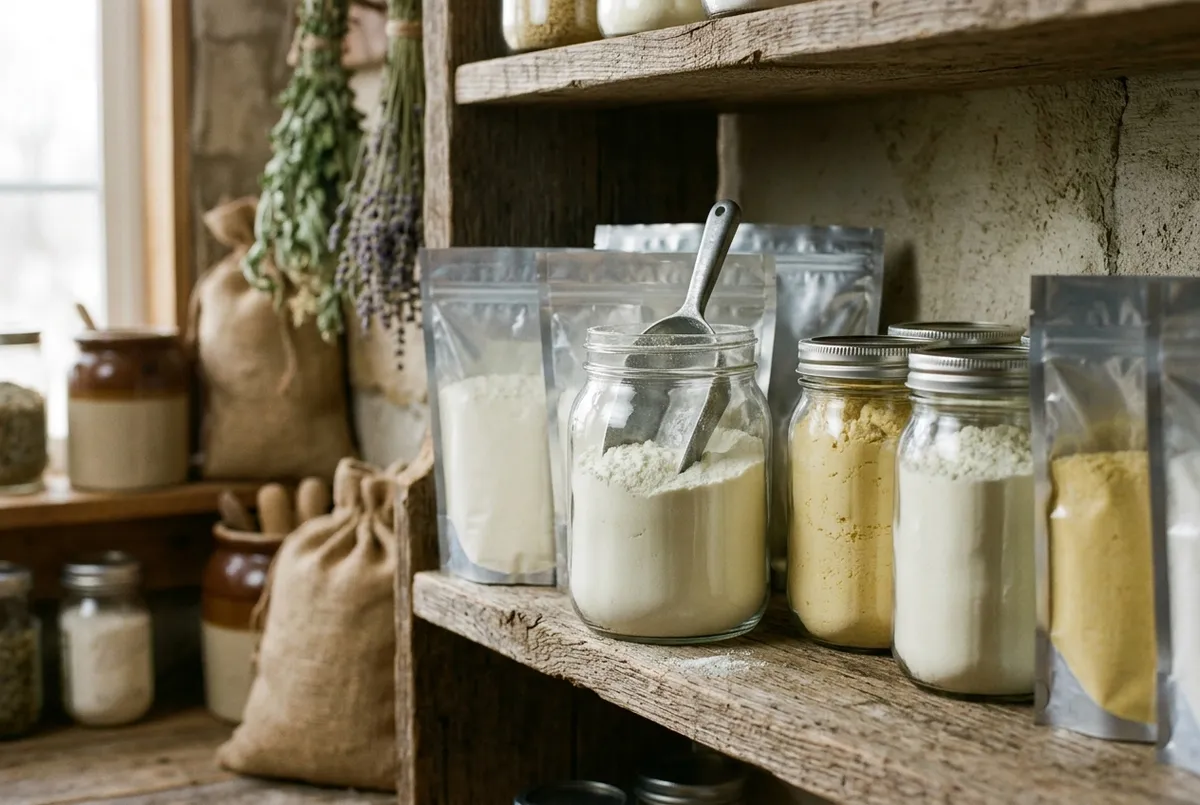
USU Extension’s research also compared packaging types directly, not just temperature. Non-fat dry milk stored in plain plastic bags, as opposed to Mylar-type barrier bags, was rated statistically less acceptable after 4 years compared to the same milk stored in cans (Utah State University Extension, “Storing Dried Milk”). Plastics aren’t very resistant to oxygen transfer and can let significant oxygen into a container within 1 to 2 years (Utah State University Extension, “Packaging Foods”), and the milk’s quality loss showed up as an oxidized, stale flavor in taste-panel ratings, not just a theoretical concern.
That lines up with why the oxygen-absorber-and-Mylar-bag combination has become the standard approach for long-term dry goods: the foil layer in Mylar-type bags dramatically reduces the oxygen and moisture that pass through, and oxygen absorbers remove the oxygen left inside to minimize off-flavors (Utah State University Extension, “Packaging Foods”). If you’re not sure your absorbers are still doing their job, we cover how to test whether oxygen absorbers have expired. And if you’re weighing whether vacuum-sealing dry goods before they go into cans or buckets is worth the extra step, our vacuum sealer review breaks down what it buys you for this kind of storage and what it doesn’t.
None of this means a thin plastic bag or the original store packaging is useless. It means it’s the weakest link in the chain if long-term storage is the goal, and the USU Extension comparison gives an actual measured reason to upgrade rather than a vague sense that “better packaging is probably better.” For bulk buys of either powdered milk or powdered eggs that you’re planning to hold for a year or more, the meaningful upgrade path is repackaging into something with a real oxygen and moisture barrier, whether that’s a can, a food-grade bucket, or Mylar-type bags, rather than leaving the product in the bag it shipped in.
Is it safe to use powdered milk or eggs years past the date on the package?
This is where it helps to be precise about what the research actually measured. The USU Extension studies tracked acceptability, meaning how the product performed in a taste panel, not a hard safety cutoff. “Unacceptable” in that data means the flavor had drifted enough that testers rated it as failing, not that the food became hazardous at that exact month. A bucket of powdered milk stored at 90°F and rated unacceptable at 24 months is a quality judgment, and the same product stored at 50°F held up for more than double that time with barely any change (Utah State University Extension, “Storing Dried Milk”).
None of that means the printed date is meaningless. It means the date on the package and the “still good” window are two different questions, and the honest answer depends heavily on how and where the product was stored, whether it was ever opened, and how it smells and tastes when you actually open it. If a container has ever gotten wet or shows signs of pests, treat that as a separate problem from shelf-life math, and don’t let any date override what your own senses are telling you.
This is also why the temperature history of a specific container matters more than a generic “is old powdered milk safe” answer can capture. A bucket that spent two summers in a hot shed and a bucket that spent the same two years in a cool basement are not really comparable, even if both carry the same purchase date. When you’re deciding what to actually use from a stockpile, the practical approach is to go by conditions and a quick sensory check rather than by the calendar alone, and to keep the products that have spent time in warmer spots in the front of the rotation rather than the back.
How can you tell if powdered milk or eggs have gone bad?
For non-fat dry milk, USU Extension’s own testing method is the best clue here: researchers used off-flavor development as the marker, meaning taste and smell change before anything else does (Utah State University Extension, “Storing Dried Milk”). If milk that used to taste clean or neutral now tastes stale, sour, or otherwise off when reconstituted, that’s the same signal the taste panel used to call a batch unacceptable, whether it’s been 6 months at a hot storage temperature or several years at a cool one.
The extension research is less detailed publicly on specific sensory changes for dried eggs, but the same general logic applies: an opened package degrades faster than a sealed one, and the 26-month figure for dried eggs in original packaging at 70°F (Utah State University Extension, “Food Storage in the Home”) is a reasonable baseline for what properly stored looks like before it’s worth smelling, checking closely, and rehydrating a small test amount rather than committing a whole batch to a recipe.
Once you open either product, plan around the shorter window rather than the multi-year one. Non-fat dry milk drops to roughly 3 months of good quality once opened, regardless of how well it was stored before that point (Utah State University Extension, “Storing Dried Milk”). That’s a steep drop from a potential multi-year shelf life, and it’s the number to plan rotation around for anything you’re opening and using regularly rather than storing sealed for the long term.
If your powdered milk and eggs are still sealed, the highest-value thing to do this week is check where they’re actually sitting: an 80-90°F shed shelf is working against you in a way a cool interior closet or basement isn’t, and moving containers costs nothing. For anything you plan to open and use regularly, treat the seal-break date as day one of a roughly 3-month clock rather than the multi-year date on the outside of the container, and if you’re building out a broader rotation system, our FIFO pantry rotation guide covers how to keep older stock moving to the front instead of quietly aging past its window.
Frequently Asked Questions
- Do powdered milk and powdered eggs really go bad, or do they last indefinitely once dried?
- They do go bad. Non-fat dry milk's shelf life ranges from about 3 months to 3-5 years depending mainly on storage temperature, and unopened dried eggs in original packaging are commonly rated for around 26 months at 70°F (Utah State University Extension).
- Does storage temperature really change how long powdered milk lasts?
- Yes. USU Extension testing found non-fat dry milk developed off-flavors within 6 months at 90°F and was rated unacceptable by 24 months, was rated unacceptable after 4 years at 70°F, and showed only minimal flavor change after 52 months at 50°F.
- How long does powdered milk last once you open the container?
- About 3 months, regardless of how well it was stored before opening, according to Utah State University Extension.
- What's the best container for storing powdered milk or eggs long-term?
- Cans performed better than plain plastic bags in USU Extension testing; milk stored in plastic bags (not Mylar-type) was rated statistically less acceptable after 4 years than milk stored in cans.
- How can you tell if powdered milk or eggs have gone bad?
- Watch for off-flavor development, which is the marker Extension researchers used to rate batches unacceptable. If reconstituted milk or eggs taste stale, sour, or off, treat that as a sign quality has declined, especially in anything that's been opened or stored warm.
Sources & references
Before you go
The Renter's Homestead Pack
Self-reliance projects for the yard you don't own — container yields, a raised bed built to move with you, balcony preservation basics, and the landlord questions to ask first.
Free guide
The Renter's Homestead Pack
Self-reliance projects for the yard you don't own — container yields, a raised bed built to move with you, balcony preservation basics, and the landlord questions to ask first.