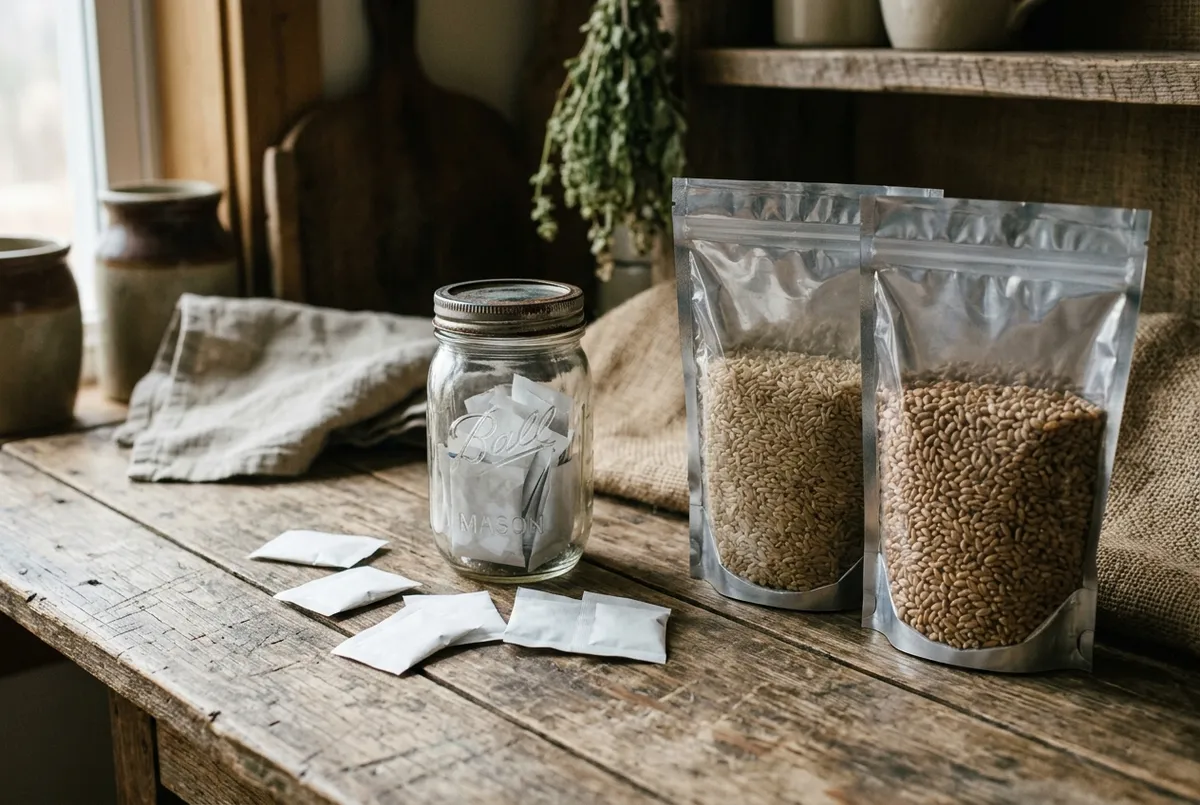
What’s the short answer?
- Oxygen absorbers are packets of iron powder that take up the remaining oxygen in a sealed container.
- Some absorber types depend on surrounding humidity; Mitsubishi recommends at least 55% relative humidity for its Ageless-Z type.
- Absorbers are single-use: once they've taken in their rated oxygen capacity, they stop working and can't be recharged.
- Where the manufacturer includes an indicating card, that card, not the packet's softness, is the sign to go by.
- Unused absorbers need to stay in an airtight container until the moment you use them, since open air starts using up their capacity.
You’ve got mylar bags of rice, beans, or wheat sealed up in the pantry, oxygen absorber packets tucked inside each one, and no obvious way to know if those packets actually did their job. Maybe you found a spare packet in a drawer that’s been open for months. Maybe you just don’t trust the ones already sealed in with your food anymore, and you’re weighing whether to break the seal and check. I’ll walk through what’s actually happening inside that little packet, and how you can check whether yours is still working before you commit food to it.
The short answer: Oxygen absorbers don’t “expire” the way food does, but they can stop working long before you ever use them, and once they’ve used up their capacity they’re finished for good. The reliable way to check a packet is its built-in color-change indicator, not how soft or firm it feels.
Do Oxygen Absorbers Actually Expire?
Not in the sense of a use-by date printed on a label. What’s inside a typical oxygen absorber packet is iron powder, and the way it works is straightforward oxidation, the same basic chemistry that turns exposed iron into rust. As that iron oxidizes, it pulls oxygen out of the air around it; placed in a sealed container, the iron powder absorbs the remaining oxygen (University of Arkansas Cooperative Extension).
That reaction has one variable a lot of stockpilers don’t know about: some absorber types depend on moisture from their surroundings. For its Ageless-Z type, Mitsubishi recommends a minimum of 55% relative humidity, and in a conservation study, packets kept at 33% relative humidity reacted at a steady rate for four months, then slowed to one-seventh of that rate by the end of a year (WAAC Newsletter). A packet in very dry conditions can work more slowly than expected, even though nothing about it looks wrong from the outside. So the honest answer to “do they expire” is that they don’t age the way food does on a calendar. Some types can slow down if the humidity around them stays low, and separately, once they’ve finished the job they’re built to do, they’re done, whether that took a day or a year.
How to Tell If a Packet Still Works
The reliable check isn’t a smell test or a squeeze. Some manufacturers include an indicating card that changes color to show whether the absorbers are still active; Multisorb, for example, includes one with its absorbers (Multisorb Technologies FAQ). That card is the manufacturer’s own built-in signal, and it’s worth reading the specific product’s instructions for what “active” versus “spent” looks like on that brand’s card, since the exact colors can vary between manufacturers.
If you’re working with absorbers that don’t include an indicator card at all, the only genuinely trustworthy option is to stop relying on the packet’s appearance. Use fresh, properly stored absorbers from a sealed source, follow the manufacturer’s sizing guidance for your container size, and treat any packet that’s been sitting open on a counter for more than a few minutes as already partially spent before it even goes in the bag. When you’re buying in bulk for a stockpile, an indicator card built into the product is worth paying for, since it’s the only part of the whole process that gives you a direct answer instead of a guess.
Why the Squeeze Test Can Fool You
A common shortcut is to squeeze a packet and judge it by feel: soft and pliable means good, hard and crumbly means used up. That test isn’t nothing, but it isn’t proof either, and leaning on it alone is where a lot of stockpiles quietly fail. Because some absorber types react more slowly in dry conditions, a packet can still feel roughly the way it did fresh out of the package without that telling you how much capacity it has left. Softness by itself doesn’t confirm remaining capacity, and it doesn’t confirm the packet has done anything either. The indicator card, on products that include one, is the only signal built specifically to answer that question.
The safer habit is to treat the squeeze test as a tiebreaker, not a verdict. If a packet feels obviously hard and crumbly, that’s a reasonable sign to swap it out before it goes into a fresh bucket. But a packet that feels soft doesn’t earn a pass just for feeling soft. It earns a pass when the product’s own indicator card says it’s still active, or when it’s fresh from a sealed source you trust. That’s a small shift in habit, but it’s the difference between a check that actually tells you something and one that just makes you feel better in the moment.
Can You Reuse a Packet Once It’s Spent?
No. Oxygen absorbers are single-use by design. Once a packet has taken in its full rated oxygen capacity, it stops functioning and can’t be “recharged,” no matter how it looks or feels afterward (Multisorb Technologies FAQ). There’s no drying-out step and no re-sealing trick that restores a spent packet’s ability to pull oxygen back out of a container. If you open a bucket or bag for any reason, treat the absorber that was already in it as done, and put a fresh one in when you reseal, the same way you wouldn’t reuse a canning lid that’s already sealed once.
That single-use design is also why “one packet for the whole shelf” doesn’t work as a habit. Every time you open a sealed bag or bucket to pull out a portion, you’re letting in fresh air and giving the existing absorber more work to do, work it may already be too spent to handle. Reopening a container for regular use is a different situation than long-term sealed storage, and it’s worth planning for separately: either reseal with a new absorber each time, or keep that particular batch as one you’re actively working through rather than treating it as sealed long-term storage.
Storing Unused Absorbers So They Actually Last
The packets you haven’t used yet need the same respect. Exposure to open air starts the absorption process immediately, and every minute a packet sits out of its original sealed pouch is capacity it’s using up before it ever reaches your food (Multisorb Technologies FAQ). That means the bulk container of loose absorbers in your pantry needs to go straight back into an airtight jar or a resealed pouch of its own the moment you’ve pulled out what you need for that batch, rather than sitting open on the counter while you finish sealing three more buckets.
If you’re already building out your setup for long-term storage, it’s worth thinking about oxygen absorbers and a vacuum sealer as two different tools that solve overlapping problems, not a choice between one or the other. A vacuum sealer removes most of the air mechanically before you ever seal a bag, which reduces how much work an absorber has to do once it’s inside, and it’s a reasonable question to ask which combination is worth the money for your particular setup.
Building This Into Your Rotation
None of this matters much if oxygen absorbers are a one-time purchase you use once and forget about. The stockpiles that hold up are the ones with a system behind them: buckets and bags labeled with dates, absorbers stored properly between uses, and a habit of checking what’s actually in the pantry before more goes in. A FIFO rotation system gives you a built-in reason to open containers periodically anyway, and that’s also your chance to glance at an indicator card and catch a problem early instead of finding it years later, when you actually need the food.
Most stockpiles don’t fail in a crisis; they fail years earlier, quietly, in a bucket nobody reopened until it mattered. An oxygen absorber that worked more slowly than expected, or one that was already spent before it went in, doesn’t announce itself. The food just sits there looking fine on the outside while the protection it was supposed to have never actually happened. Building a five-minute check into whatever rotation habit you already have, glancing at indicator cards when you’re already in the pantry for something else, costs almost nothing and closes exactly that gap.
The next time you’re sealing up rice, beans, or dehydrated food for long-term storage, build the indicator card habit into your routine from the start. Buy absorbers with a visible indicator where you can, keep unused packets sealed until the moment you actually need them, and treat “soft” as a hint rather than a verdict. That one habit, checked at the moment of sealing and again whenever you rotate stock, is what separates a stockpile that works when you open it from one that quietly failed years before you noticed.
Frequently Asked Questions
- Do oxygen absorbers actually expire?
- Not the way food does, but they can stop working. Once exposed to air, an absorber starts taking in oxygen, so a packet left outside an airtight container keeps using up its capacity, and once it has used that capacity, it's spent for good.
- How can you tell if an oxygen absorber packet still works?
- Some manufacturers, such as Multisorb, include an indicating card that changes color to show whether the absorbers are still active. Where one is included, that card, not how the packet feels, is the signal to go by.
- Can you reuse an oxygen absorber packet?
- No. Oxygen absorbers are single-use by design. Once they've taken in their full rated oxygen capacity, they stop functioning and can't be recharged, no matter how they look or feel.
- Why does an oxygen absorber feel hard instead of soft?
- A soft feel isn't reliable evidence either way. Some absorber types react more slowly in dry conditions, so texture alone doesn't confirm how much capacity a packet has left.
- How should you store unused oxygen absorbers?
- Keep them sealed in an airtight container until the moment you're ready to use them. Exposure to open air starts the absorption process immediately, using up capacity before the packet ever reaches your food.
Sources & references
Before you go
The Renter's Homestead Pack
Self-reliance projects for the yard you don't own — container yields, a raised bed built to move with you, balcony preservation basics, and the landlord questions to ask first.
Free guide
The Renter's Homestead Pack
Self-reliance projects for the yard you don't own — container yields, a raised bed built to move with you, balcony preservation basics, and the landlord questions to ask first.