What’s the short answer?
- An unopened refrigerator holds a safe temperature for about 4 hours after power fails (Ready.gov); a full freezer holds about 48 hours, or about 24 if half full, with the door closed (FoodSafety.gov).
- Any perishable food (meat, poultry, fish, eggs, leftovers) above 40°F for 2 or more hours should be discarded, no matter how it feels to the touch (Ready.gov).
- Save meat, dairy, and eggs first; garden harvest and staples second; already-thawed items need an immediate decision, not a guess.
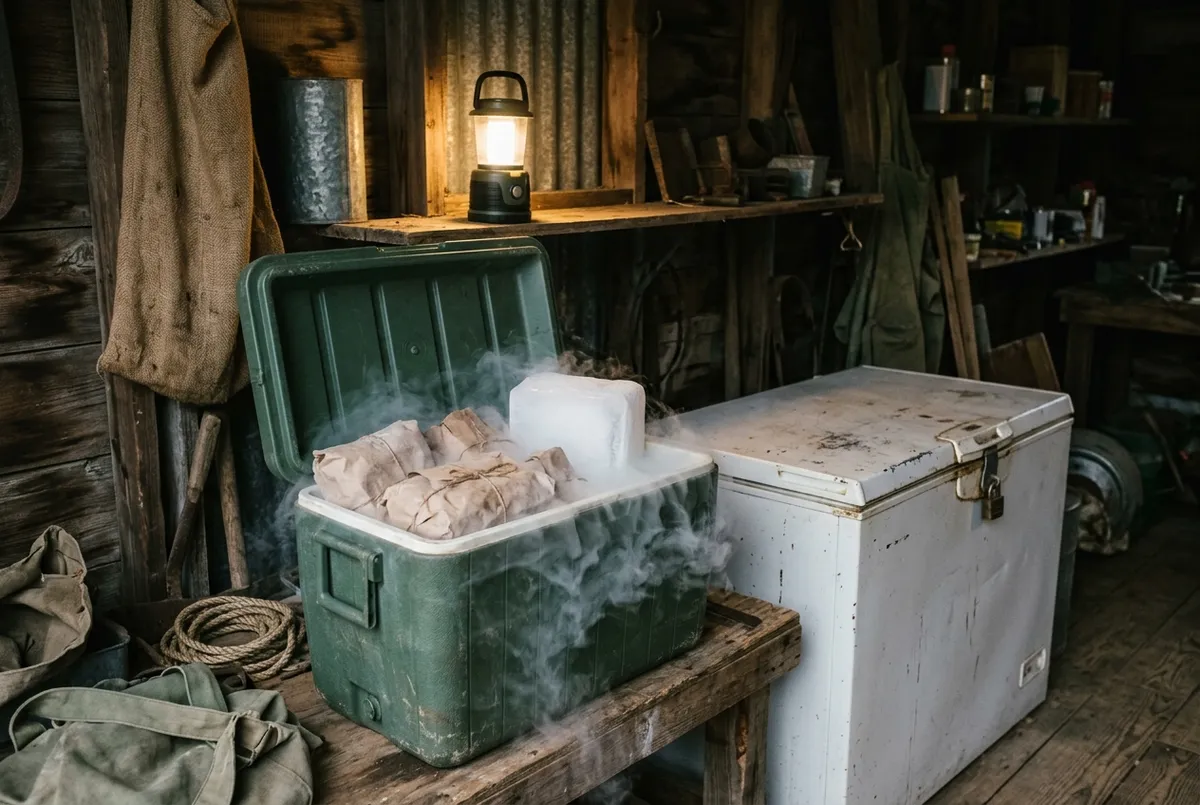
- 25 lbs of dry ice keeps a 10-cubic-foot freezer below freezing for about 3 to 4 days (Ready.gov); scale up for larger units.
- Freezers should normally run at 0°F or below (CDC); check a freezer's performance for a few days after an outage before fully trusting it again.
The power goes out during a winter storm, and somewhere in the garage or the shed sits a chest freezer holding a season’s worth of garden harvest, a quarter of beef, and months of home-canned overflow that never made it to a pantry shelf. Every hour the lid stays shut is borrowed time, and the pressure to make good calls fast is real: what to save, what to let go, and what to throw out before it becomes a bigger problem than a ruined freezer full of food. Triage under those conditions rewards a plan made in advance, not a decision made in the dark with a flashlight.
The short answer: When a chest freezer fails, triage by what spoils fastest and costs the most to replace, not by what sits closest to the lid. Save meat, dairy, and anything that has been thawing the longest first. Treat any perishable food that has spent two or more hours above 40°F as unsafe to keep. Use dry ice or block ice to buy time if you can get it and handle it correctly, since a full freezer behaves very differently than an open refrigerator door.
How Long Will Food Stay Frozen in a Power Outage?
There is only a rough countdown clock, and it depends on how full the freezer is. A full freezer will hold a safe temperature for approximately 48 hours, or about 24 hours if it is half full, as long as the door stays closed (FoodSafety.gov). An unopened refrigerator, by comparison, holds a safe temperature for only about four hours once the power cuts (Ready.gov). A chest freezer is not a refrigerator. Packed full and left shut, it holds cold air far longer, because dense, frozen contents act as thermal mass and there is less air volume to warm up in the first place. A freezer that is only half full, or one that gets opened repeatedly to check on things, loses that advantage fast.
What does not change between the two appliances is the danger zone. Bacteria multiply rapidly in food held between 40°F and 140°F (Ready.gov), and that range is the actual threat, not the thermometer reading at any single moment. A freezer is normally run at 0°F or below (CDC, Food Safety), so it starts with a large buffer. The triage question is not “how many hours until the freezer fails,” because that number depends on how full it is, the outdoor temperature, insulation, and how often the lid opens. The useful question is “which contents will hit the danger zone first,” and that is answerable without a stopwatch: whatever is smallest, thinnest, or already partly thawed goes first.
Should You Open the Freezer to Check on Food?
Only when necessary, and never out of curiosity. Every time the lid comes up, cold air spills out and warmer air replaces it, and that exchange happens fast because cold air is heavier and pours out of a chest freezer the moment the seal breaks. The same principle that gives an unopened refrigerator its four-hour window (Ready.gov) applies here in reverse: opening the appliance for no reason shortens whatever buffer the contents have left.
A better approach is to plan the check before it happens. Decide in advance what you need to know (is the freezer still cold, does it need dry ice, has anything visibly thawed) and open the lid once, do everything at once, and close it. If a thermometer is already inside the unit, read it as part of that single planned opening rather than a separate trip. Repeated short peeks add up quickly, and they are harder to plan around because they happen out of habit rather than necessity.
A freezer failure is easier to handle when the triage order was written down before the storm, not during it. A short index card taped inside the lid, or a note saved on a phone, listing which shelf holds tier one contents and where the backup cooler and ice source are kept, turns a stressful single opening into a checklist instead of a search. That preparation costs almost nothing and pays off exactly once, on the night it matters.
What Food Should You Save First If a Freezer Dies in Winter?
Once the lid opens for the planned check, work through contents in order of spoilage risk and replacement cost, not convenience. Sort into three rough tiers.
Tier one: meat, poultry, fish, eggs, and dairy
These are the items where the two-hour danger zone rule bites hardest. Any perishable food, including meat, poultry, fish, eggs, or leftovers, that has been above 40°F for two hours or more should be discarded (Ready.gov). These items are also usually the most expensive to replace, whether that is a side of beef from a fall harvest or a season’s worth of eggs from a backyard flock. Move them to the coldest, most insulated spot available, whether that is a second freezer, a cooler packed with ice or dry ice, or an unheated space that reliably stays near or below freezing.
Tier two: garden harvest, bulk staples, and home-canned overflow
Vegetables, fruit, and bread generally tolerate a longer stretch in the danger zone before they become unsafe, though quality suffers the longer they sit: FoodSafety.gov’s chart allows thawed vegetables up to 6 hours above 40°F, and fruit and plain breads can generally be refrozen (FoodSafety.gov). These items buy time to focus effort on tier one first, but they should not be ignored entirely. If dry ice or a backup cooler runs out of room, this tier goes second, not last.
Tier three: anything already partly thawed with no clear path back to solid frozen
If something has visibly softened, has ice crystals only on the surface, or feels warm in the middle, it needs a decision now rather than later. Either it moves to active use (cook it soon, can it, or otherwise process it) or it goes in the discard pile, particularly if it is meat, dairy, or anything else covered by the two-hour rule. Do not put a partly thawed item back in the freezer and hope it refreezes solid before it becomes a problem; verify its status directly instead.
How Much Dry Ice Do You Need to Keep a Freezer Cold?
Dry ice is the most efficient option if it is available locally, and one documented figure is useful for scale: 25 pounds of dry ice will keep a 10-cubic-foot freezer below freezing for about three to four days (Ready.gov). Freezers larger or smaller than that reference size will need proportionally more or less, and the supplier where you buy dry ice can usually help scale the amount to a specific unit; do not guess at the ratio for a freezer well outside that 10-cubic-foot range.
Handling matters as much as quantity. Dry ice is extremely cold and can injure bare skin on contact, so use insulated gloves or a thick towel whenever you place or move it. It sublimates directly into carbon dioxide gas rather than melting into liquid, and that gas needs somewhere to go: keep the area around the freezer ventilated, and avoid storing dry ice in a sealed room, vehicle, or airtight container where the gas has no way to disperse. Wrap it in newspaper or cardboard rather than letting it touch food or plastic packaging directly, and place it on top of the frozen contents rather than at the bottom, since cold air sinks and this lets it chill the whole compartment as it sublimates.
Block ice is a slower, lower-risk substitute if dry ice is not available locally, though it will not hold a freezer below freezing the way dry ice does. It buys time rather than truly preserving the freeze, which circles back to the same triage priority: use whichever cold source is on hand on the tier one items first.
Can You Safely Refreeze Food That Partially Thawed?
This is where the most common mistake happens, and it usually comes from guessing. Food may be safely refrozen if it still contains ice crystals or is at 40°F or below, though its quality may suffer (FoodSafety.gov). “Feels cold to the touch” is not the same as a thermometer reading, though, and the other half of the rule is time: any perishable food that has been above 40°F for two or more hours should be discarded (Ready.gov), because bacteria multiply rapidly across that 40°F to 140°F range the whole time it sits there (Ready.gov).
If you know, or can reasonably estimate, that an item stayed below 40°F the entire time and was never in the danger zone for two hours or more, refreezing is generally fine, though texture and quality will suffer compared to the original freeze. If the timeline cannot be verified, the safer call is to treat the item as though it spent time in the danger zone, especially for meat, poultry, fish, eggs, or dairy. A cooler stocked with ice or dry ice during the outage, combined with a simple log of when the power went out and when contents were first checked, makes this call far easier the next time a freezer fails, since there is an actual timestamp to work from instead of a guess.
Once power is back and the triage is done, the freezer itself deserves a second look. A unit that struggled to hold 0°F or below during the outage (CDC, Food Safety) is worth monitoring for a few days rather than trusting immediately, since a compressor or seal problem that caused the failure in the first place may still be there. For food that survived the triage but is now on the edge, extending its usable life with proper packaging is worth the extra step; our vacuum sealer review walks through whether that equipment earns its price for long-term storage. For readers who want backup methods that do not depend on the freezer working at all, the roundup of food preservation methods that don’t need electricity covers canning, dehydrating, and root-cellar options that hold up through the next outage regardless of how the compressor behaves.
Frequently Asked Questions
- How long will food stay frozen in a freezer during a power outage?
- A full freezer will hold a safe temperature for approximately 48 hours, or about 24 hours if it is half full, as long as the door stays closed (FoodSafety.gov). An unopened refrigerator, by comparison, keeps food cold for only about 4 hours (Ready.gov). Real-world time also depends on the outdoor temperature and how often the lid opens.
- Should you open the freezer to check on food during an outage?
- Only for a single planned check, not repeated peeks. Every opening lets cold air spill out and shortens whatever buffer the contents have left, the same principle that limits an unopened refrigerator to about 4 hours of safe cold (Ready.gov).
- What food should you save first if a freezer dies in winter?
- Prioritize meat, poultry, fish, eggs, and dairy first, since these fall under the 2-hour danger zone rule and are usually the most expensive to replace (Ready.gov). Garden harvest and bulk staples come second, and anything already partly thawed needs an immediate decision rather than being left to chance.
- Can you safely refreeze food that partially thawed?
- Yes, if it still contains ice crystals or is at 40°F or below, though its quality may suffer (FoodSafety.gov). Perishable food such as meat, poultry, fish, eggs, or leftovers that has been above 40°F for 2 hours or more should be discarded (Ready.gov). Never taste food to decide whether it is safe.
- How much dry ice do you need to keep a freezer cold?
- 25 pounds of dry ice will keep a 10-cubic-foot freezer below freezing for about 3 to 4 days (Ready.gov). Larger or smaller freezers need proportionally more or less; ask the dry ice supplier to help scale the amount for a specific unit.
Sources & references
Before you go
The Renter's Homestead Pack
Self-reliance projects for the yard you don't own — container yields, a raised bed built to move with you, balcony preservation basics, and the landlord questions to ask first.
Free guide
The Renter's Homestead Pack
Self-reliance projects for the yard you don't own — container yields, a raised bed built to move with you, balcony preservation basics, and the landlord questions to ask first.