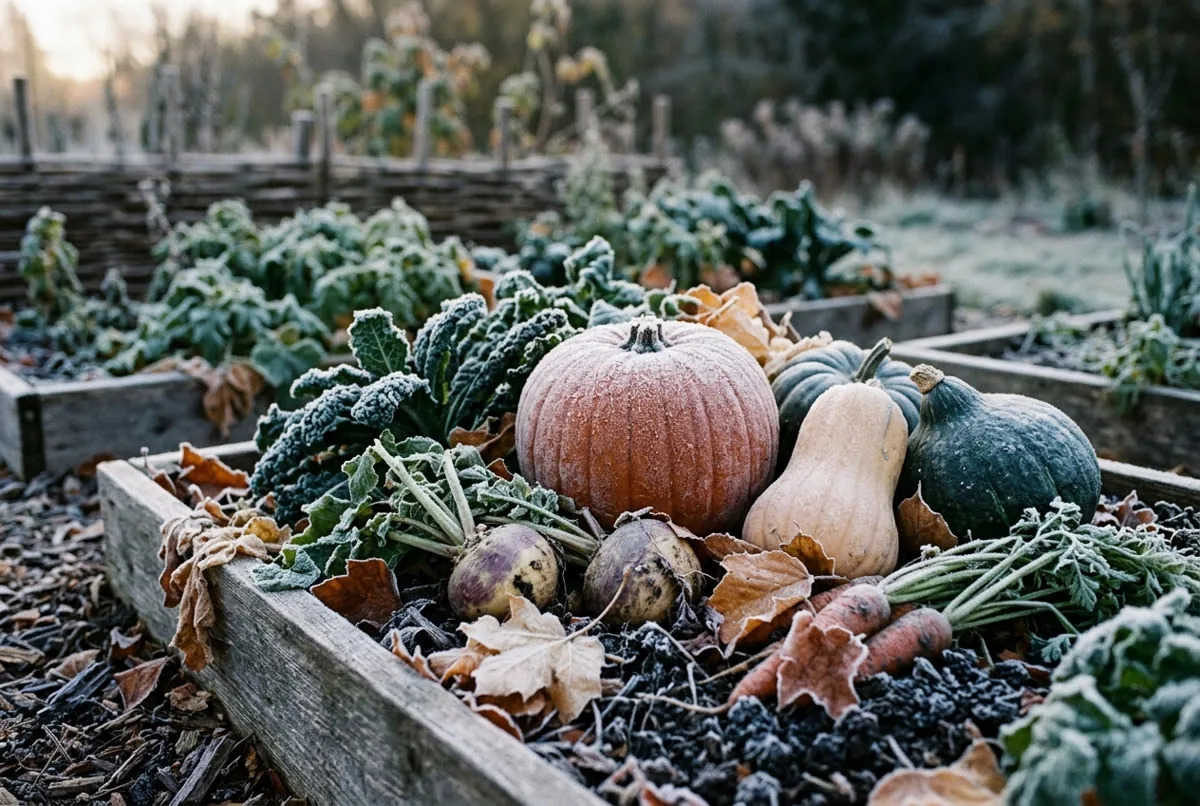
What’s the short answer?
- Zone-based frost tables put average first frost around September 8-15 in Zone 3 and November 7-28 in Zone 8; USDA zones themselves are based on winter lows, not frost dates.
- Zone charts give a historical median, not a forecast; elevation, topography, development, and nearby water can all shift the real date.
- Elevation, latitude, topography, and urban development are the factors NOAA cites for differences in first freeze timing.
- A ZIP-code or city-level frost date tool narrows the estimate to a specific address using the same NOAA climate normals.
- Harvest or cover tender crops like tomatoes and peppers ahead of the first freeze; frost-tolerant crops like carrots and beets can stay in the ground through a light frost.
The row covers are half unpacked in the shed, the last tomatoes on the vine are still a shade too green, and the forecast keeps mentioning an overnight low in the 30s. Deciding what to pick, what to cover, and what to let ride out one more week depends on a date that shifts by a full two months depending on where the yard sits on the map.
The short answer: Zone-based frost tables put average first frost anywhere from early September in USDA Zone 3 to November in Zone 8, but that number is a decades-long historical median, not a forecast. Pair a zone or ZIP-code lookup with the actual week-ahead forecast before deciding what to harvest.
What Is the Average First Frost Date for My USDA Zone?
NOAA’s analysis of 1991-2020 climate normals shows the first fall freeze (32°F) across most of the interior and northern United States lands somewhere between September and November, with the exact week shaped by elevation, latitude, topography, and development (NOAA NCEI, 2023-10-23). Broken down by zone in one garden-publication table, the typical windows look roughly like this:
- Zone 3: first frost usually arrives September 8-15 (Garden Design)
- Zone 4: first frost typically falls between September 21 and October 7 (Garden Design)
- Zone 7: first frost usually lands between late October and mid-November (Garden Design)
- Zone 8: first frost typically runs from around November 7 to November 28 (Garden Design)
The same table puts Zones 5 and 6 at roughly October 13-21 and October 17-31 (Garden Design). Treat all of these as approximations: the USDA Plant Hardiness Zone Map is based on the average annual extreme minimum winter temperature, not on frost dates (USDA ARS), so a ZIP-code-level tool built on NOAA climate normals is the more precise place to check an exact window (The Garden Ledger, 2024).
These dates also set the length of the growing season. A location with an early first frost and a late last frost in spring has fewer frost-free days to work with than one where the zone number is the same but the surrounding terrain runs milder, which is part of why two gardens in the same zone can have noticeably different harvest windows.
How Many Frost-Free Days Does My Zone Typically Have?
The first frost date only tells half the story; the other half is how many frost-free days it leaves for the season, counted from the last spring frost to the first fall frost. ZIP-code frost tools report both numbers together for exactly this reason: entering a location returns not just a median first and last frost date, but an estimated growing season length calculated from the same 1991-2020 climate normals (The Garden Ledger, 2024).
That number matters more than the zone label by itself. Two gardens can share a USDA zone and still have noticeably different frost-free day counts once elevation, latitude within the zone, and local microclimate are factored in, which is why this guide doesn’t assign a single frost-free day count to any zone. A ZIP-code lookup for the exact address is the more reliable way to get that number than interpolating between the published zone ranges.
Can I Trust a Frost Date Chart for Planning?
Partly, and it’s worth knowing which part. NOAA’s own first-freeze maps draw on the 1991-2020 climate normals to show a median first freeze date for a given area, and NOAA itself calls those maps a generalization rather than absolute (NOAA NCEI, 2023-10-23). That makes them a solid baseline, not a forecast for this particular week. A USDA zone number alone doesn’t pin down exactly when frost will hit a specific yard; elevation, topography, urban development, and closeness to a shoreline can all shift the real date (NOAA NCEI, 2023-10-23).
The more reliable approach layers three things: the historical median from a zone or ZIP-code chart, a season or two of watching what actually happens in that specific yard, and the real-time forecast once frost is close, including the frost and freeze watches and warnings NOAA’s National Weather Service issues (NOAA NCEI, 2023-10-23). A single chart printed once and never checked against local conditions is the version of frost planning that gets caught out.
How Do Elevation and Microclimate Change My First Frost Date?
Elevation is one of the factors NOAA points to, alongside latitude, topography, and development, when it explains why first freeze timing varies so much even within a single region (NOAA NCEI, 2023-10-23). Cold air is denser than warm air and settles into low ground, so a garden at the bottom of a slope or in a valley tends to frost earlier and harder than one on higher ground nearby, even at the same latitude.
Beyond elevation, a handful of local factors nudge the date further:
- Urban and near-pavement heat. Urban areas run warmer and tend to see a later first freeze than rural areas, which is part of why frost maps built at the zone level can undercount how late frost actually arrives in a paved or built-up yard compared with an open field a few miles away (NOAA NCEI, 2023-10-23).
- Proximity to open water. Shoreline areas also tend to see a later first freeze than inland areas (NOAA NCEI, 2023-10-23), often delaying the first frost for gardens close to the water relative to the wider zone average.
- Air drainage. A bed tucked against a fence or hedge at the bottom of a slope can trap cold air the way a valley does, creating a frost pocket that reads colder than the rest of the property on the same night.
None of this shows up on a zone map, which is exactly why the map is a starting point rather than the final word.
How to Look Up My Exact First Frost Date
Zone charts group broad regions together, but frost pools in low spots and skips high ground within the same block, so narrowing down to an address-level estimate is worth the extra step. ZIP-code frost date tools use the same underlying climate data as the national charts: entering a location returns a median first and last frost date along with an estimated growing season length, built on the 1991-2020 climate normals (The Garden Ledger, 2024). Running a specific address through one of these tools, then checking the result against a season of direct observation, gets meaningfully closer to a real date than reading a zone number off a map. A min-max thermometer left in the garden overnight through the shoulder season is the simplest way to build that local record: it logs how many degrees colder (or warmer) that particular bed runs compared with the nearest weather station, which is the gap a zone chart can’t account for.
What to Harvest and Protect This Week
Frost tolerance splits crops into two clear groups, and the group determines the urgency.
Tender crops have no frost tolerance. Tomatoes, peppers, squash, cucumbers, and beans are injured or killed by frost (University of Illinois Extension). In the days before a forecast frost, the realistic choices are to harvest what’s ripe or close to it, cover what’s staying in the ground overnight, or accept the loss on anything left exposed. Green tomatoes picked just ahead of frost will often still ripen indoors over the following weeks, and peppers hold up reasonably well once picked, even underripe.
Cold-hardy crops tolerate a light frost and don’t need the same urgency. Carrots, beets, cabbage, and cauliflower can withstand a light frost, and broccoli is rated very hardy (University of Illinois Extension). These can generally stay in the ground through the first frost or two without emergency action.
A practical sequence for the week the forecast turns cold:
- Check the forecast low against the local reading, not just the zone median, using whatever local temperature record has been kept over the season.
- Harvest tender crops that are ripe or close to it. Anything on a tomato plant that’s showing color will likely finish ripening off the vine; fully green fruit is a longer shot but still worth pulling before a hard freeze rather than losing outright.
- Cover what’s staying in the ground overnight. A floating row cover pulled over the bed before sundown can provide up to 10°F of frost protection depending on its material and grade (Colorado State University Extension), which is often enough to turn a light frost into a non-event for tender plants. It’s a cheap layer of insurance for a marginal night, not a fix for a hard freeze.
- Leave cold-hardy crops uncovered unless a harder freeze is forecast well below the first-frost threshold; light frost exposure doesn’t need the same protection tender crops do.
None of this requires guessing. A soil thermometer confirms how cold the root zone actually is running, which matters more for root crops than the air temperature alone, and a min-max thermometer left in the bed overnight records the actual low reached in that specific spot rather than the nearest official station’s reading.
Two related reads are worth checking before frost hits: 9 Cold-Hardy Crops to Sow in Late Summer for a Fall Harvest covers which crops are worth planting for exactly this kind of frost-tolerant fall harvest, and Is a Cedar Raised Bed Worth It for Fall Planting? looks at whether upgrading the bed itself pays off before winter. If the growing season needs to stretch further past the first frost date, DIY Cold Frame: Add 2 to 4 Weeks to Your Growing Season walks through a low-cost way to buy extra weeks.
Next Step
Start with the zone-level window above to know roughly which week is in play, then run the specific address through a ZIP-code or city frost date tool to narrow it down, and keep a soil or min-max thermometer in the bed itself for the two weeks around that date. That combination, historical median plus local reading plus the week’s actual forecast, is what turns a frost date chart from a rough guess into a plan for what gets picked this week and what gets covered.
Frequently Asked Questions
- How many frost-free days does USDA Zone 5 usually have?
- Zone tables don't give a reliable frost-free day count, because USDA zones are based on average annual extreme minimum winter temperature, not frost dates. One garden-publication zone table puts Zone 5's average last spring frost at April 7-30 and first fall frost at October 13-21. A ZIP-code frost date tool built on NOAA's 1991-2020 climate normals gives a more precise figure for a specific address than a zone table.
- Can I trust a first frost date chart for planning?
- Partly. NOAA's own first-freeze maps use 1991-2020 climate normals, which makes them a solid historical baseline, but NOAA describes them as a generalization, not absolute. A USDA zone number alone does not pin down the exact date for a specific yard, since elevation, topography, urban development, and nearby water can all shift it. Pair the chart with local observation and the week's actual forecast.
- How does elevation change my first frost date?
- Elevation is one of the factors NOAA points to, along with latitude, topography, and urban versus rural development, when explaining differences in first freeze timing. Cold air is denser than warm air and settles into low ground, so a garden at the bottom of a slope tends to frost earlier and harder than one on higher ground nearby, even within the same USDA zone.
Sources & references
- NOAA NCEI, When to Expect Your First Fall Freeze (opens in new tab)
- USDA ARS, Plant Hardiness Zone Map (opens in new tab)
- Garden Design, Frost Dates by Zone (opens in new tab)
- The Garden Ledger, Frost Dates by ZIP Code (opens in new tab)
- University of Illinois Extension, Time Your Vegetable Plantings by Cold Hardiness (opens in new tab)
- Colorado State University Extension, Frost Protection and Extending the Growing Season (opens in new tab)
Before you go
The Renter's Homestead Pack
Self-reliance projects for the yard you don't own — container yields, a raised bed built to move with you, balcony preservation basics, and the landlord questions to ask first.
Free guide
The Renter's Homestead Pack
Self-reliance projects for the yard you don't own — container yields, a raised bed built to move with you, balcony preservation basics, and the landlord questions to ask first.