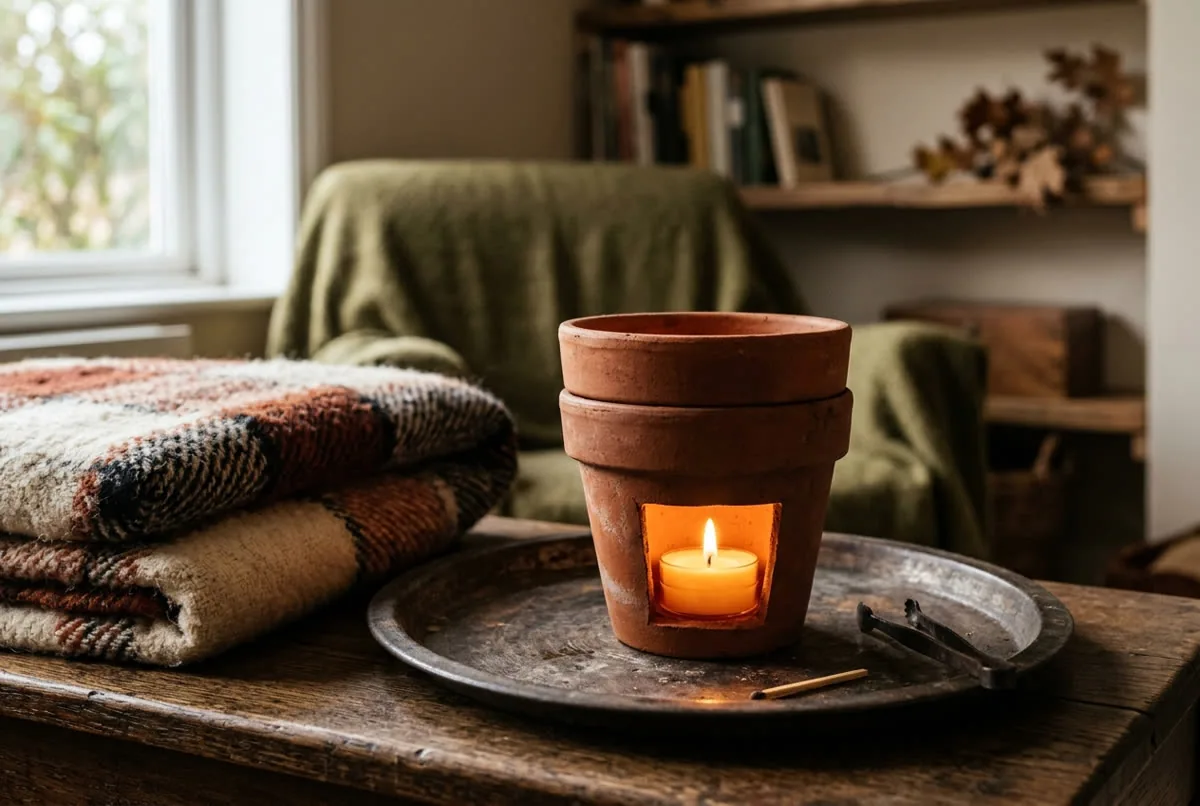
What’s the short answer?
- Candle heaters produce very little usable heat, far below what is needed to warm a room in freezing weather.
- FEMA's outage guidance says not to use candles to heat a home, as a fire-safety measure, and local guidance favors flashlights over candles.
- Terracotta-pot designs concentrate warmth near the device without meaningfully raising room temperature, and add tipping and burn risk.
- FEMA guidance points to warm clothing, blankets, safe use of portable heaters, and taking refuge elsewhere when a home loses heat.
Winter storm, grid down, and someone’s shared a video of a terracotta-pot candle heater that promises to warm a whole room. Before spending money on clay pots and candles, it’s worth checking what the guidance from FEMA and local emergency managers actually says about heating a room with an open flame. Claims like this one deserve a close look, and this is where it starts to fall apart.
The short answer: No. A candle heater, terracotta-pot design or not, produces far too little heat to warm a room, and official outage guidance actively discourages using candles for home heating because of fire risk.
Can a candle heater really keep one room warm during a winter outage?
A single candle burns at a small, steady rate, and clustering a few of them under an inverted terracotta pot doesn’t change that in any meaningful way. Official outage guidance isn’t built around candles as a heat source at all; it’s built around avoiding fire and carbon monoxide hazards while people wait out an outage. FEMA’s power-outage hazard sheet is explicit that gas stoves, ovens, grills, and dryers should not be used to heat a home, and it lists candles under fire-safety cautions rather than approved heat sources (FEMA, 2024-03). That placement is a strong signal about where candles rank on the list of things that reliably heat a room: they don’t.
The claim usually rests on a felt sensation rather than a measured one. Hold a hand a few inches from a lit candle or a warmed terracotta pot and there’s real heat right there. That part isn’t the misconception. The misconception is assuming that local warmth scales up to the whole room. A thermometer a few feet away, especially near a floor or a drafty window, tells a different story than a hand held directly over the flame.
Part of why the video version of this claim looks convincing is framing. A close shot of a hand or a thermometer probe held right against the warmed pot shows a real number, and it’s an accurate number for that spot. What the shot leaves out is everything else in the room: the volume of air the device is supposedly heating, the heat leaking out through windows and door gaps, and the cold air replacing it. A room is a large, leaky container, and a handful of candles is a small, steady source. That mismatch is the whole story, and it’s also why official guidance never frames candles as a heating appliance in the first place, only as a fire and light-source consideration.
Why official guidance treats candle heaters as a fire risk, not a heat source
The same FEMA hazard sheet that warns against gas appliances also tells readers to stay fire safe and avoid using candles to heat a home, treating improvised candle-based heating as outside safe practice rather than a fallback option (FEMA, 2024-03). Local emergency management offices echo the same priority. The City of New Orleans’s outage guidance instructs residents to use flashlights instead of candles for light, and to keep generators outside and away from the home, reflecting an institutional preference for non-flame options wherever one exists (City of New Orleans, “Prepping for Power Outages”). FEMA’s own preparedness guide says the same: during a power outage, only use flashlights for lighting, and avoid candles because they could be a fire hazard (FEMA, “Are You Ready?”). None of this guidance singles out terracotta-pot heaters by name, but the underlying reasoning applies directly: an open flame indoors is a fire-risk decision before it’s a heating decision, attended or not.
The carbon monoxide piece deserves its own mention rather than a passing one. FEMA’s caution against gas stoves, ovens, grills, and dryers for indoor heating exists because burning fuel indoors, in an enclosed and often poorly ventilated space during an outage, produces carbon monoxide that can build up before anyone notices (FEMA, 2024-03). A single small candle is not the same combustion load as a gas oven left running, but the same category of concern applies to any open flame burning for hours in a closed bedroom: it consumes oxygen and produces combustion byproducts the whole time it’s lit. Guidance built around that category of risk doesn’t carve out an exception for candles once someone puts a clay pot over them.
Are terracotta-pot candle heaters safe around kids and pets?
The terracotta-pot design multiplies the surface that gets hot, which is the entire point of the design. A clay pot inverted over lit candles absorbs and re-radiates heat rather than losing it straight up, which also means the pot reaches temperatures well above what’s comfortable to touch. It can tip if bumped, brushing against curtains, bedding, or a curious pet. Kids and pets sharing a room with open flame and a hot ceramic surface changes the risk calculation substantially, and it’s a large part of why fire and burn hazards, not heat efficiency, sit at the center of official caution around candle-based heating.
There’s a secondary issue worth naming honestly: indoor combustion, even from a source as small as a candle, adds soot and moisture to the air in a closed room. In a winter home already sealed up against drafts, that combination can worsen indoor air quality and contribute to condensation over time. This isn’t the primary reason official guidance avoids candle heaters, but it’s a real cost that a felt-warmth video doesn’t show, and it’s another factor that argues against running several candles in a small, sealed bedroom overnight.
An unattended flame is the other half of the kids-and-pets problem, and it’s easy to overlook in an outage because attention is already stretched thin. A power outage tends to mean managing several things at once: checking on other rooms, dealing with a phone that’s low on charge, or trying to sleep through the cold. A candle heater left running while an adult in the house is asleep or occupied elsewhere is functionally unattended, and that’s the exact condition fire-safety guidance around candles is written to prevent, regardless of whether anyone in the room is a toddler or a pet.
How many candles would it take to noticeably warm a small bedroom?
This is the wrong question to ask, and it’s worth explaining why rather than answering it with a number. Scaling up a low-output heat source by adding more units doesn’t scale up safely; it scales up the number of open flames, the total fire load, and the amount of combustion byproduct in the room at the same time. No official guidance treats “more candles” as a heating strategy at any quantity. FEMA’s broader preparedness guidance instead points to warm clothing and blankets in the emergency kit, and to taking refuge with family or friends if a home loses power or heat for more than a few hours, which is a clear signal about where institutional risk assessments land: candles are treated as a fire hazard to avoid even for lighting, not as a scalable heat source (FEMA, “Are You Ready?”).
What are safer low-tech alternatives to candle heaters for emergency warmth?
The guidance that discourages candle heaters is specific about what to use instead, and none of it requires an open flame. Layered clothing and blankets come first, since trapped air near the body does more for comfort than a distant heat source ever will. Emergency blankets built to reflect body heat back toward the wearer are worth having staged in a kit before an outage, rather than shopped for during one. Heaters rated for indoor use, run according to their instructions, are the next step up from there; FEMA’s outage sheet says to always use portable heaters safely (FEMA). If a home still can’t be kept livable, FEMA’s guidance points toward taking refuge with family or friends, or using a designated public shelter if no other safe refuge is available, rather than improvising further (FEMA, “Are You Ready?”).
A blackout kit built room by room, the way we cover in How to Build a Blackout Kit That Works, Room by Room, gives a structured way to stage these items before the power goes out instead of sorting it out mid-storm. Light matters here too, and a hand-crank weather radio covers both the light and the information gap that candles often get pulled in to solve, without the fire risk that comes with an open flame.
Sequencing matters as much as the items themselves. Layered clothing and blankets cost nothing to deploy and carry zero fire or air-quality risk, so they’re the first move the moment the power drops, not a last resort after a candle setup has already failed to warm the room. An indoor-rated heater, staged with its instructions on hand and used exactly as the manufacturer specifies, is worth the added expense for a household that expects multi-day outages to be a real possibility this winter rather than a rare event. None of these alternatives require an open flame indoors, which is precisely the property official guidance is steering households toward.
Fresh air and a CO alarm when a flame is lit indoors
A thermometer reading says nothing about the air in the room, and the EPA’s outage guidance covers that side. It says that if you use candles, you should make sure the area is ventilated, because candles emit combustion products, and that a candle left unattended can be a fire hazard. It also recommends flashlights or battery-powered lanterns over candles when they are available. For heat, it says not to try to heat your home with combustion appliances, including gas stoves or ovens, barbecue grills, or dryers, and never to run a gas-burning heater or other appliance in a poorly vented or closed room, or where you are sleeping (EPA, 2026-02-18).
Carbon monoxide (CO) is invisible and odorless, can build up quickly indoors, and can linger for hours. At elevated levels it can quickly cause significant harm and even death. The EPA says to make sure your home has working CO alarms with a digital display and battery backup, and to check or replace the battery when you change your clocks each spring and fall. It also notes the U.S. Consumer Product Safety Commission’s recommendation of a CO alarm on each level outside each sleeping area (EPA, 2026-02-18).
Do emergency services or fire departments approve any form of candle-based heater?
Nothing in official outage guidance approves a candle-based heater in any form. FEMA’s hazard sheet tells readers not to use gas stoves or candles to heat a home, under its fire-safety advice, and separately warns never to heat a home with a gas stovetop, oven, grill, or dryer because of carbon monoxide (FEMA, 2024-03). Local guidance, like New Orleans’s outage page, steers residents toward flashlights over candles for the light function alone, without ever framing candles as a heat source (City of New Orleans). The absence of an approval is itself the answer: no named authority in this guidance treats candle heaters, terracotta pot or otherwise, as a sanctioned emergency heating method.
If a winter outage is a real possibility this season, the next step isn’t a clay pot and a few candles. It’s a blackout kit staged by room, blankets and layered clothing sized for the coldest bedroom in the house, and a heater rated for indoor use if the budget allows for one. Build that before the storm shows up, not during it.
Frequently Asked Questions
- Can a candle heater really keep one room warm during a winter outage?
- No official guidance supports that claim. A candle produces a small, steady amount of heat that feels warm up close but does not raise the temperature of a whole room, and FEMA's outage guidance treats candles as a fire-safety caution rather than an approved heat source.
- Are terracotta-pot candle heaters safe around kids and pets?
- The design concentrates heat on the pot's surface, which reaches temperatures well above what's comfortable to touch and can tip if bumped. Combined with an open flame, that makes a room with kids or pets a higher-risk setting, which is part of why official guidance discourages candle-based heating.
- How many candles would it take to noticeably warm a small bedroom?
- No official guidance frames this as a matter of adding more candles. Increasing the number of open flames increases fire load and combustion byproducts in the room without official guidance ever treating candles as a scalable heat source.
- What are safer low-tech alternatives to candle heaters for emergency warmth?
- FEMA guidance points to warm clothing and blankets in your kit, using portable heaters safely, and taking refuge with family or friends, or at a designated public shelter, if your home loses power or heat for more than a few hours. None of these involve an improvised open flame.
- Do emergency services or fire departments approve any form of candle-based heater?
- No named authority in official outage guidance approves candle heaters. FEMA's power outage sheet tells readers not to use gas stoves or candles to heat a home as a fire-safety measure, and separately warns never to heat a home with a gas stovetop, oven, grill, or dryer because of carbon monoxide.
Sources & references
Before you go
The Renter's Homestead Pack
Self-reliance projects for the yard you don't own — container yields, a raised bed built to move with you, balcony preservation basics, and the landlord questions to ask first.
Free guide
The Renter's Homestead Pack
Self-reliance projects for the yard you don't own — container yields, a raised bed built to move with you, balcony preservation basics, and the landlord questions to ask first.