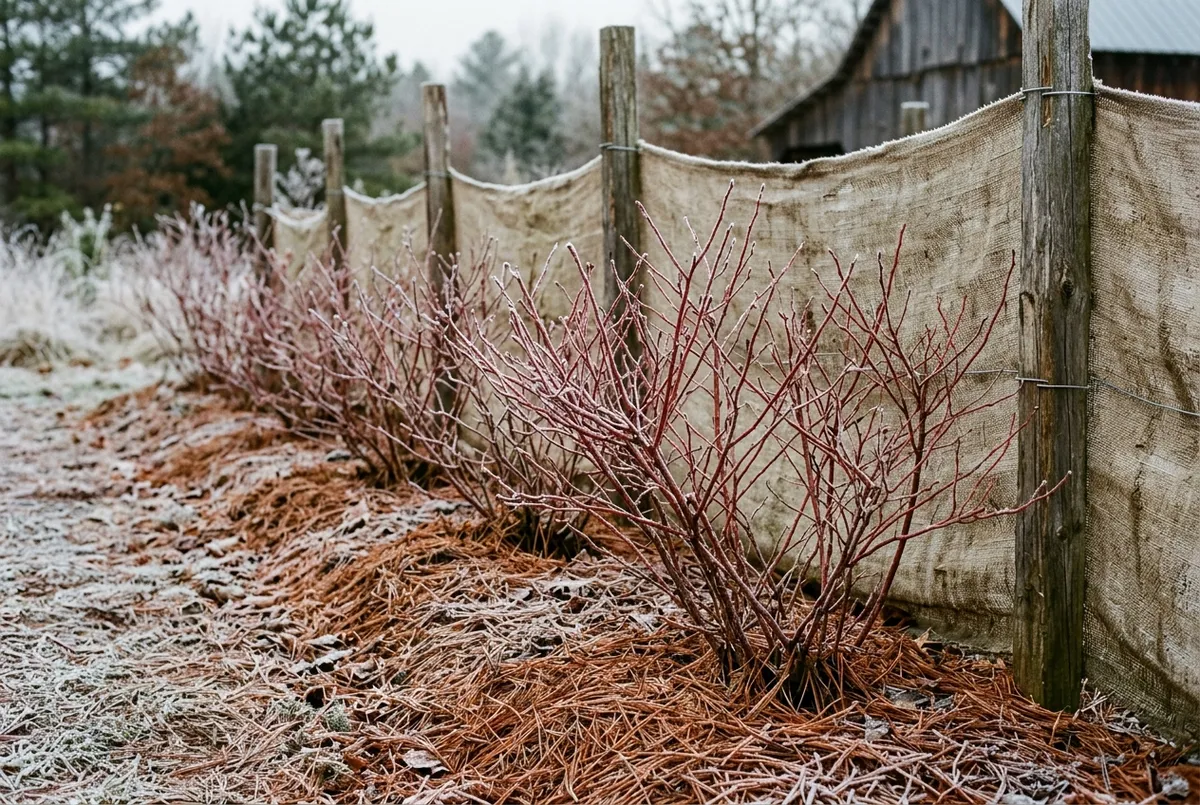
What’s the short answer?
- Pruning timing varies by blueberry type and region: Clemson prunes young plants in dormancy and older rabbiteye or southern highbush plants right after harvest; Oregon State prunes northern highbush each winter while dormant.
- Start new plantings with a 2- to 3-inch organic mulch layer and replace about 1 inch per year as it breaks down (Clemson).
- Pine bark or sawdust (pH 3.5-4.5) is preferred over hardwood mulch (pH above 5.0), though Clemson notes hardwood mulches have been satisfactory.
- Chilling hours vary widely even within one state, so match variety to your actual local winter, not a regional average.
- Choose a blueberry type that is cold hardy for your region (Oregon State); in colder regions mulch may prevent frost heaving.
Your blueberry bushes have dropped their leaves, and the question now is what to actually do before the ground locks up for the season. Established plants look tough enough to ignore, but a handful of technique choices made in the next few weeks, mulch depth, mulch type, and pruning timing, are what separate a bush that comes back stronger from one that limps through spring. The same questions come up every fall for anyone growing raspberries, blackberries, or other perennial berry crops alongside blueberries, so this guide covers the blueberry-specific numbers in detail and then walks through how much of that approach carries over to the rest of the berry patch. No shortcut beats getting these basics right before hard freezes settle in.
The short answer: Winterizing blueberry bushes means applying the right type and depth of mulch, pruning at the correct time for the plant’s age, and choosing varieties whose chilling-hour needs match your actual climate; other perennial berries follow the same dormant-season logic even where the specific numbers differ by species.
When Should You Prune Blueberry Bushes for Winter?
Pruning timing depends on the blueberry type, your region and how old the plant is, not on the calendar alone. For rabbiteye and southern highbush blueberries in South Carolina, Clemson says to prune young plants during the dormant season and older plants immediately after harvest, and adds that for southern highbush, dormant-season pruning in late winter is most desirable, especially in the mountains (Clemson Cooperative Extension). For northern highbush, Oregon State advises pruning every plant each winter while it is dormant and before bud break, and pruning later in winter in regions with colder winters to remove any frost or disease-damaged wood (Oregon State University Extension). University of Maryland Extension has gardeners prune plants in their second through fifth seasons in February or March, removing weak, spindly shoots and low shoots, and renewal-prune older plants each spring by removing some of the oldest canes at the crown (University of Maryland Extension).
Young Plants vs. Established Plants
That distinction matters more than it looks. Under Clemson’s South Carolina schedule, the dormant-season timing is for young plants getting their structure established, while older bushes are handled on a harvest-driven schedule instead. Under Oregon State’s northern highbush guidance, every plant is pruned each winter. Check which blueberry type you have and which guidance fits your region before you pick up shears, rather than pruning everything on the same day.
On established bushes, the goal is opening up the center of the plant to light and air rather than a heavy overall cut. Clemson advises removing dead, damaged and weak growth and branches growing through the center of the bush, and removing about one-third of the older canes in winter if plants become too tall to harvest easily (Clemson Cooperative Extension). It also recommends renewal pruning of highbush plants starting at about 6 years old to maintain vigor and fruit quality.
How Much Mulch Do Blueberry Bushes Need Before Winter?
Mulch does real work for blueberries going into winter, and the extension guidance is specific about depth. Clemson says organic material such as bark, wood chips, sawdust or pine straw applied as a 2- to 3-inch layer after planting results in more uniform soil moisture and moderates soil temperature, and that mulch replaced at the rate of 1 inch per year keeps weed problems down (Clemson Cooperative Extension). Oregon State adds that in colder regions mulch may prevent plants from heaving out of the soil from alternate freezing and thawing (Oregon State University Extension).
In practice, that means winterizing an established bed isn’t a one-time deep mulch job. It’s a maintenance layer: check what’s already down and top it off as it breaks down. Oregon State notes mulch decomposes at about an inch per year in the Willamette Valley and that, over the first five to six years, depth is gradually increased to 4 to 6 inches total when the plants are mature (Oregon State University Extension).
If this is your first winter with a newly planted bed, or you’ve never measured what’s actually down, now is the time to check rather than assume. Pull back the existing layer at a few spots around the root zone with your hand or a hori-hori knife and measure it. If it’s thinner than 2 inches, build it back up toward the 2- to 3-inch starting range, and add about an inch as it breaks down; a mature bed that has built up deeper than that isn’t necessarily over-mulched, given Oregon State’s 4 to 6 inches for mature plants. Keep the mulch pulled back slightly from the base of each stem rather than piled directly against it, a general mulching precaution rather than a blueberry-specific rule.
What Type of Mulch Is Best for Blueberries?
Mulch type comes down partly to pH, because blueberries need acidic soil. Clemson says pine bark chips or sawdust, which have a pH between 3.5 and 4.5, are more desirable than the same mulches from hardwoods, which have a pH above 5.0, although it notes that surface-applied hardwood mulches have been satisfactory (Clemson Cooperative Extension). Clemson also calls pine straw, which is acidic, an excellent mulch, and warns against sticky hardwood sawdust that can “seal” the bed and prevent water infiltration. University of Maryland Extension recommends a year-round organic mulch of wood chips, pine bark, aged sawdust or pine needles (University of Maryland Extension). Oregon State says sawdust from any tree other than redwood, cedar or black walnut can be used in any region (Oregon State University Extension).
If you’re buying mulch for a blueberry bed rather than using material you already have on hand, checking whether it’s pine bark, sawdust, or pine straw, rather than a generic hardwood blend, is a quick check worth making. If you’re comparing mulch options for a wider bed that includes non-acid-loving plants as well, our breakdown of cover crops versus mulch versus bare soil for raised beds looks at the tradeoffs for beds where a single mulch choice has to work for more than one crop.
Matching Blueberry Varieties to Your Winter Chill
Winterizing isn’t only about mulch and pruning. It’s also about whether the variety in the ground is suited to your winter in the first place. Chilling hours, the hours of winter temperatures below 45°F that blueberry plants need in order to produce flowers, are listed for many cultivars, and the hours a location receives vary significantly even within a single state. In South Carolina, for example, chilling hours range from 1,000 to 1,200 in the upper Piedmont down to as low as 400 to 600 near the coast, so variety selection has to match local winter chill rather than a regional average (Clemson Cooperative Extension).
The lesson generalizes past South Carolina even though the exact hour counts don’t: a variety picked for the wrong chilling zone can struggle no matter how well you mulch or prune it. If you’re not certain your bushes are suited to your actual local winter, rather than the general climate of your state, your regional extension office is the source to check for the specific numbers that apply where you garden.
This is also the piece of winterizing that’s easiest to get wrong once and live with for years, since chilling-hour mismatch isn’t something mulch or pruning can fix. Because blueberry plants need enough chilling hours to produce flowers, a cultivar whose requirement is higher than your winters deliver may flower poorly however well the rest of your care is dialed in. If you inherited an established planting and don’t know what variety is in the ground, or you’re deciding what to add to an existing row, matching the plant tag or catalog listing to your local chilling-hour range before you buy is worth the extra step, especially given how much that range can shift within a single state.
Do Blueberry Bushes Need to Be Covered in Freezing Weather?
The Clemson and Oregon State guides cited here cover mulch, pruning timing and choosing a blueberry type suited to your climate; neither describes covering established plants against freezing weather. Mulch moderates soil temperature, and in colder regions it may prevent plants from heaving out of the soil during alternating freezing and thawing. Oregon State also advises choosing a blueberry type that is cold hardy for your region, and notes that northern highbush cultivars suit USDA cold hardiness zones 4 to 8 (Oregon State University Extension).
That doesn’t mean every bush in every climate is automatically fine on its own; it means the documented measures are the mulch program covered above and choosing a type and variety whose cold hardiness and chilling-hour needs fit your winters. If your area is colder than the zones listed for your blueberry type, check with your regional extension office.
Applying the Same Approach to Other Perennial Berries
Blueberries aren’t the only perennial berry crop that goes dormant for winter, and the underlying logic, dormant-season structural pruning, an organic mulch layer to protect the root zone, and matching plant selection to your actual climate, carries over to other perennial berries in general terms. What doesn’t carry over automatically are the specific numbers: mulch depth, pH preferences, and chilling-hour requirements are dialed in per species, and a mulch or pruning schedule built for blueberries shouldn’t be assumed to transfer exactly to raspberries, blackberries, or other bramble and shrub berries without checking guidance specific to that crop.
If you’re winterizing a mixed berry patch rather than a blueberry planting alone, treat the blueberry numbers above as the model for the kind of information you need, not as a substitute for pulling species-specific guidance for whatever else is in the ground. Your extension office is the same starting point either way.
Getting the Rest of the Bed Ready
Winterizing blueberries doesn’t happen in isolation from the rest of the garden. If your pruning shears and loppers have been sitting in the shed since the last harvest, cleaning, sharpening, and oiling them before you make dormant-season cuts is worth doing first, both for cleaner cuts and for tool life; our guide to prepping garden tools for winter covers that process. And if you’re thinking beyond this year’s berry patch toward a more self-sufficient backyard setup overall, our Backyard Liberty review looks at one system built around exactly that kind of small-space food production.
The next step is simple: check your existing mulch depth against the 2- to 3-inch starting point and annual replenishing, check whether it’s pine bark, sawdust, or pine straw rather than hardwood, and note your plant’s age so you prune on the correct schedule rather than on the calendar alone.
Frequently Asked Questions
- When should you prune blueberry bushes for winter?
- It depends on the blueberry type, your region and the plant's age. For rabbiteye and southern highbush in South Carolina, Clemson Cooperative Extension says to prune young plants during the dormant season and older plants immediately after harvest, with late winter most desirable for southern highbush, especially in the mountains. Oregon State University Extension advises pruning northern highbush each winter while dormant and before bud break, later in winter in colder regions.
- How much mulch do blueberry bushes need before winter?
- Clemson Cooperative Extension recommends organic mulch such as bark, wood chips, sawdust, or pine straw as a 2- to 3-inch layer after planting, replaced at the rate of about 1 inch per year. Oregon State University Extension notes mulch decomposes at about an inch per year in the Willamette Valley and that, for mature plants, depth is gradually built up to 4 to 6 inches total.
- What type of mulch is best for blueberries?
- Clemson Cooperative Extension says pine bark chips or sawdust, with a pH between 3.5 and 4.5, are more desirable than the same mulches from hardwoods, which have a pH above 5.0, although it notes surface-applied hardwood mulches have been satisfactory. Clemson also calls pine straw, which is acidic, an excellent mulch.
- Do blueberry bushes need to be covered in freezing weather?
- The Clemson and Oregon State University extension guides cover mulch, pruning timing and choosing a blueberry type suited to your climate rather than describing covering established plants. Oregon State advises choosing a blueberry type that is cold hardy for your region, and notes that in colder regions mulch may prevent plants from heaving out of the soil during alternating freezing and thawing.
- Why do chilling-hour requirements matter for blueberry varieties?
- Blueberry plants need enough hours of winter temperatures below 45°F to produce flowers, and chilling hours vary significantly even within one state. Clemson Cooperative Extension reports that in South Carolina they range from 1,000 to 1,200 hours in the upper Piedmont to as low as 400 to 600 hours near the coast, so variety choice has to match local winter chill.
Sources & references
Before you go
The Renter's Homestead Pack
Self-reliance projects for the yard you don't own — container yields, a raised bed built to move with you, balcony preservation basics, and the landlord questions to ask first.
Free guide
The Renter's Homestead Pack
Self-reliance projects for the yard you don't own — container yields, a raised bed built to move with you, balcony preservation basics, and the landlord questions to ask first.