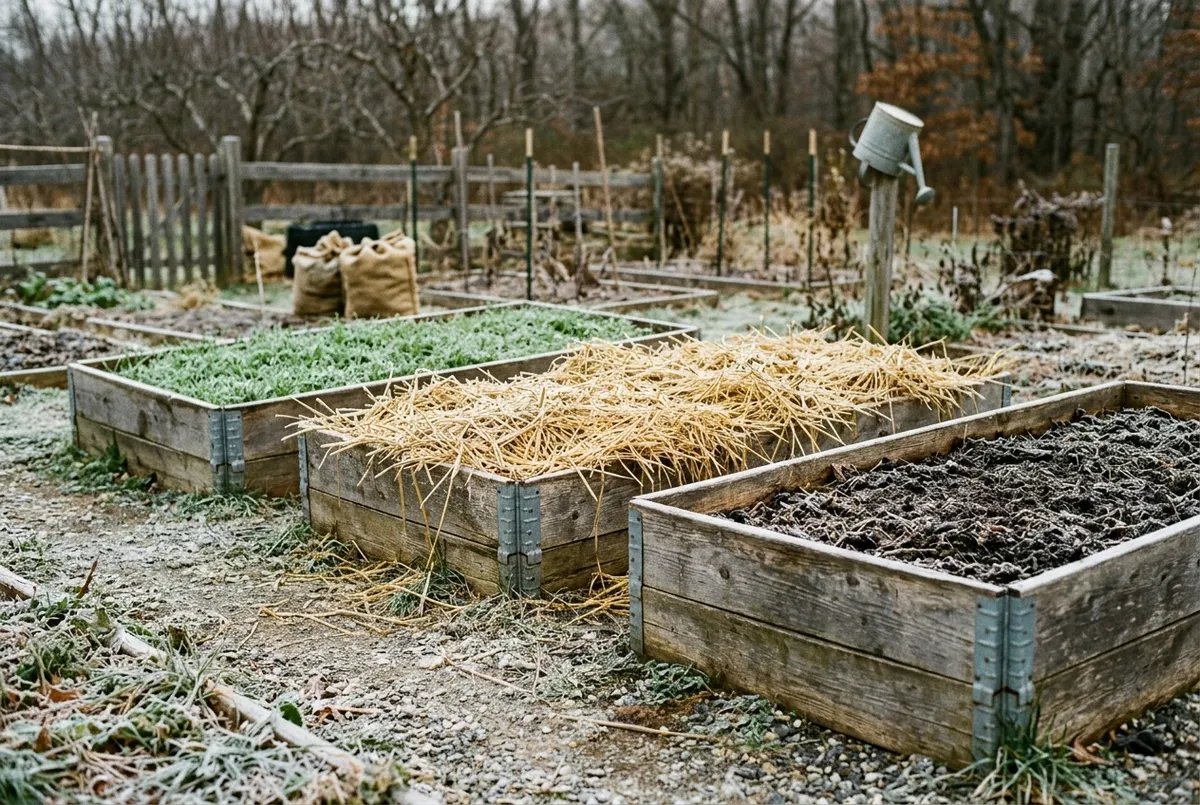
What’s the short answer?
- Winter rye still germinates at temperatures as low as 34°F (SARE), so early-to-mid November isn't too late to seed a cover crop in most raised beds.
- Straw mulch should go on at least 3 inches deep, close to Thanksgiving or just before the first snow, whichever comes first.
- Cover crops cut sediment losses from erosion by an average of 20.8 tons per acre on conventional-till fields compared with no cover (SARE).
- Mulch's main job is stopping freeze-thaw heaving, not warming the soil (UW-Madison Extension).
- Live cover crop roots keep soil microbes active and more diverse through winter; mulch alone does not add that benefit (Clemson HGIC).
The last tomato vines came out of your raised beds weeks ago, and now you’re staring at rectangles of bare dirt with the first hard frost somewhere in the next few weeks. Some neighbors are spreading straw, some are broadcasting a cover crop seed mix over what’s left of the season, and at least one bed on the block is just sitting there, exposed, with no plan at all.
The short answer: A living cover crop like winter rye is still plantable across most of the U.S. right now and does the most for long-term soil health, straw mulch put down close to Thanksgiving protects soil structure with far less ongoing effort, and bare soil is the only one of the three that actively loses ground to erosion over the winter months.
What’s the best cover crop for an empty raised bed this late in the season?
For raised beds specifically, winter rye (also called cereal rye) is the standard answer, mostly because of how cold it can tolerate before it gives up. SARE’s Managing Cover Crops Profitably notes that rye will germinate at temperatures as low as 34°F and needs 38°F or higher for vegetative growth (SARE). SARE calls it the hardiest of the cereals, which makes it a strong fit for northern raised beds, which is exactly the situation most gardeners are in by early November. If you’re also still working on the soil itself before you seed, building fall garden soil with coco coir and a broadfork is worth doing first.
The reason to bother with a living crop instead of just mulch comes down to what’s happening underground. Clemson Cooperative Extension’s Home & Garden Information Center notes that in raised beds specifically, live cover crop roots keep soil microbes active straight through the dormant season, increase microbial diversity ahead of spring planting, and physically intercept raindrops that would otherwise erode the mounded soil surface of a raised bed (Clemson Cooperative Extension HGIC, Aug 26, 2021). Mulch protects the surface. A cover crop does that and keeps the biology underneath it working too.
Is it too late to plant winter rye this far into fall?
Not yet, and this is worth being specific about because a lot of gardeners assume the cover crop window closes with the first light frost. It doesn’t, at least not for rye. SARE puts rye’s germination floor at 34°F (SARE). In much of the country, raised bed soil in early-to-mid November often hasn’t dropped that low yet, especially in a bed that’s been sitting exposed to sun during the day.
The tradeoff is coverage, not viability. A later planting means less top growth before the ground truly locks up, so you’re leaning more on the root system’s erosion control than a thick canopy. That’s still a real benefit, just a smaller one than you’d get from an early-fall seeding. If your bed is already frozen solid, rye won’t establish, and mulch becomes the better option by default.
How thick should mulch be, and when do you put it down?
If a cover crop isn’t realistic anymore, straw mulch is the fallback, and the extension guidance on it is fairly specific. University of Wisconsin-Madison Division of Extension notes that a bale of straw covers about 100 square feet at least 3 inches deep, and that winter mulch typically goes on when the ground is about to freeze (UW-Madison Division of Extension, Nov 13, 2020). Because that moment is hard to predict, their guidance frames the ideal timing as close to Thanksgiving weekend or right before the first snow, whichever comes first in your area.
It’s worth correcting a common assumption here: mulch isn’t primarily doing its job by keeping the soil warm. According to the same extension source, its main function is preventing repeated freeze-thaw cycles, the kind where soil heaves upward on a cold night and settles back down the next warm afternoon, which is what actually pulls plant roots and crowns loose from the ground over a winter (UW-Madison Division of Extension, Nov 13, 2020). A thin, patchy layer of mulch does little against that cycle. A full layer of at least 3 inches is what the extension guidance calls for.
Cover crop vs. mulch vs. bare soil: which actually protects the soil
Erosion control
This is where bare soil loses badly, and the numbers make the case better than any general warning would. Sustainable Agriculture Research & Education (SARE) reports that cover crops reduced sediment loss from erosion by an average of 20.8 tons per acre on conventional-till soil, 6.5 tons per acre on reduced-till soil, and 1.2 tons per acre on no-till soil, compared to soil left bare (SARE). Non-legume cover crops like rye, ryegrass, triticale, barley, and wheat cut erosion by 31 to 100 percent versus unprotected bare soil, while legume covers such as clover, pea, and lentil cut it by 38 to 69 percent (SARE). Mulch isn’t covered by those same trial numbers, but it works on the same basic principle: it’s a physical barrier between falling water and exposed soil, which is the mechanism the cover crop data is measuring in the first place.
Soil biology in a raised bed
A cover crop is the only one of the three that keeps anything alive underground through winter. That live-root activity is what Clemson’s HGIC points to when it comes to raised beds specifically, keeping soil microbes active and increasing microbial diversity heading into spring (Clemson Cooperative Extension HGIC, Aug 26, 2021). Mulch protects the biology that’s already there by moderating temperature swings, but it isn’t adding to it. Bare soil offers neither protection.
Effort and timing
Mulch is the lowest-effort option once it’s down: spread it, walk away, and rake it off or work it in come spring. A cover crop needs a seeding step now and a termination step later, whether that’s cutting it or turning it under, but it does more work for you in between. Bare soil demands nothing from you upfront, and costs the most, which is the tradeoff every reader landing on this question is actually weighing.
The two active options aren’t mutually exclusive either. A young stand of winter rye, seeded now, benefits from the same freeze-thaw protection mulch provides once growth slows for the season, and a light mulch layer over emerging rye doesn’t stop the root system from doing the underground work the Clemson HGIC research describes. If your raised bed still has enough of the season left to establish rye and you also have straw on hand, doing both is not overkill; it’s just applying the same erosion-control mechanism SARE’s data measures from two directions at once.
Do you till cover crops into the soil in spring, or just cut them back?
Both approaches are used, and which one fits depends on how much you value keeping soil disturbance low in a raised bed. Cutting or mowing the cover crop down and leaving the residue on the surface as a mulch layer disturbs the soil structure less than turning it under with a fork or tiller, and it keeps decomposing organic matter in contact with the bed’s surface rather than burying it. Given that the main reason to plant a cover crop in a raised bed is the underground microbial activity Clemson’s extension research describes, an approach that avoids deep disturbance tends to preserve more of that benefit than a full till-under does. If you’d rather pull the cut residue out and actively compost it instead of leaving it as surface mulch, our comparison of hot vs. cold composting systems covers both approaches for a backyard setup. Either way, plan on terminating the cover crop with enough time before it goes to seed and before your spring planting date, since a cover crop left to mature and drop seed turns into a weed problem instead of a soil amendment.
Letting winter end the cover crop for you
Not every cover crop needs a spring cleanup. Many of the cover crops recommended for home gardens winter-kill, so they terminate naturally over the winter, and for most home gardeners a winter-killing species is the best option: it has the lowest risk of becoming a weed later and needs the least management (Iowa State University Extension and Outreach, Aug 2026). The residue left behind can still help with weed suppression and erosion control in early spring.
Winter rye, the main pick earlier in this guide, is chosen for its cold tolerance, so it is not that kind of crop and needs a plan (SARE). For cover crops that survive, the Iowa State guide says to terminate them 2 to 3 weeks before planting vegetables, typically between late March and late April. Count back from your own spring planting date to find your week. To keep a cover crop from reseeding, end it about a week after flowering starts, or mow the flowers off before or just after they bloom.
Will leaving a raised bed bare over winter actually hurt the soil?
Yes, measurably. The idea that bare soil is fine as long as you’re going to till or amend it in spring anyway doesn’t hold up against the erosion data. Bare, unprotected soil loses significantly more sediment than cover-cropped soil, an average of 20.8 tons per acre more on conventional-till fields (SARE). In a raised bed, that erosion shows up as soil level dropping season over season, along with fewer of the microbial benefits a Clemson-documented living root system provides (Clemson Cooperative Extension HGIC, Aug 26, 2021). Tilling in spring doesn’t undo a winter’s worth of lost topsoil or a freeze-thaw cycle that already heaved your bed’s structure around; both of those happen before spring tilling is ever an option.
Between the three choices, the decision mostly comes down to how much time is left before the ground locks up and how much ongoing effort you’re willing to put in. If your soil is still workable, a cover crop like winter rye does the most for the bed long-term, and it’s still viable to seed in most parts of the country right now. If your bed has already gone hard, mulch at the recommended depth is still a meaningful upgrade over leaving the bed exposed, and it takes an afternoon rather than a full growing window. What doesn’t hold up under the data, from either the erosion numbers or the soil biology research, is doing nothing at all and hoping the bed sorts itself out by spring.
Check your bed’s soil now, while you can still work a hand into it. If it gives at all, get rye seed down this week rather than next. If it’s already firming up, buy or gather straw and get at least 3 inches on before the next hard freeze. Either choice puts real, measured protection between your soil and the winter ahead; the only losing move is leaving the bed the way it is.
Frequently Asked Questions
- What's the best cover crop to plant in a raised bed this late in fall?
- Winter rye (cereal rye) is the standard choice for raised beds this late in the season because it's the hardiest of the cereal cover crops, germinating at temperatures as low as 34°F, with vegetative growth needing 38°F or higher (SARE).
- Is it too late to plant winter rye in November?
- Not necessarily. Winter rye still germinates at temperatures as low as 34°F, so as long as your raised bed soil hasn't fully frozen, it can still be seeded, though a later planting means less top growth before winter sets in (SARE).
- How thick should straw mulch be on a raised garden bed?
- University of Wisconsin-Madison Extension points to straw at least 3 inches deep, applied in late fall close to Thanksgiving weekend or just before the first snow, whichever comes first.
- Will leaving a raised bed bare over winter actually hurt the soil?
- Yes. Data reported by SARE found cover crops reduced sediment losses from erosion by an average of 20.8 tons per acre on conventional-till fields compared with fields left without a cover crop.
- Does mulch keep raised bed soil warm over winter?
- Not primarily. According to UW-Madison Extension, mulch's main function is preventing freeze-thaw cycles that heave roots and crowns out of the ground, not raising soil temperature.
Sources & references
Before you go
The Renter's Homestead Pack
Self-reliance projects for the yard you don't own — container yields, a raised bed built to move with you, balcony preservation basics, and the landlord questions to ask first.
Free guide
The Renter's Homestead Pack
Self-reliance projects for the yard you don't own — container yields, a raised bed built to move with you, balcony preservation basics, and the landlord questions to ask first.