What’s the short answer?
- Winter sowing works for frost-tolerant seeds and seeds that need cold-moist stratification; the jug sits outdoors and the seeds go through the winter temperature swings.
- No grow lights needed, and winter-sown seedlings naturally harden off; open the jug on sunny days once they emerge.
- Frost-sensitive plants such as tomatoes and squash need to wait until March or April.
- Drainage holes in the bottom and a way for water to get in at the top keep the jug from being airtight.
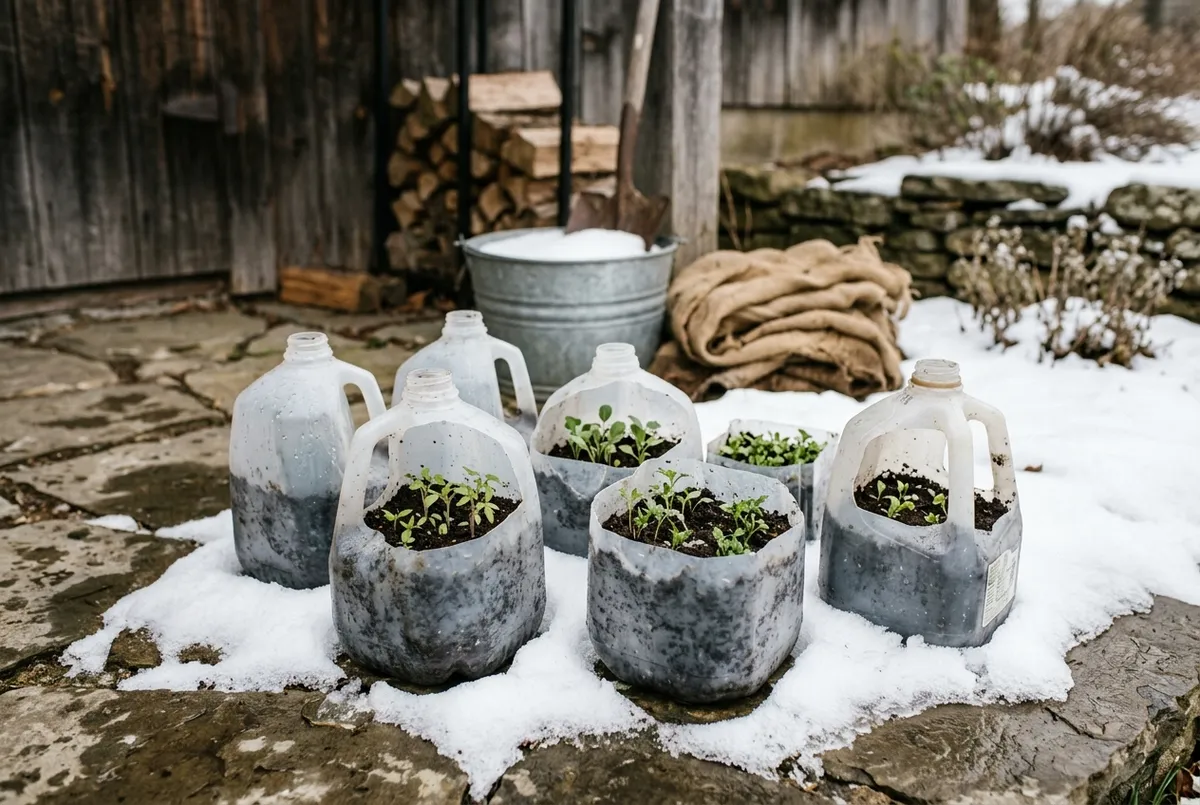
Milk jugs pile up fast once the holidays are over, and if you’ve got a stack of them sitting next to a seed catalog, you’ve probably seen the winter sowing method mentioned somewhere on your feed. It looks almost too simple: cut a hinge in the plastic, fill the bottom with soil, sow the seeds, tape it shut, and set the jug outside for the winter.
The short answer: Yes, for frost-tolerant seeds and anything that needs cold-moist stratification. The milk jug works as a mini-greenhouse set outdoors, where the temperature variation prepares the seeds for germination at the proper time (University of Illinois Extension, December 6, 2019), with no grow lights or other expensive indoor equipment required (Almanac.com, May 9, 2025). It is not built for warm-season vegetables that want steady heat to sprout.
What Winter Sowing In A Milk Jug Actually Does
The mechanism is straightforward once you see it laid out. A milk jug cut around below the handle, left hinged like a lid, with drainage holes in the base, becomes a small greenhouse sitting outdoors where it can take in sun, rain, and snow (University of Illinois Extension, December 6, 2019). Winter sowing lets the seeds go through cold-moist stratification, a period of cold, damp conditions that some seeds need before they will germinate (Gardening Know How; Cornell Cooperative Extension, October 24, 2025).
That is the part that separates winter sowing from just tossing seeds in a pot and hoping. You are not trying to protect the seeds from the cold. You are using the cold on purpose, at a scale you can manage on a porch, a patio, or a spot along the side of the house that gets some sun. Illinois Extension says the containers should get sunlight and exposure to rain and snow but sit where they are safe from strong winds, and Cornell notes the jug also helps protect the seeds from predation.
Timing matters, because a warm spell can trigger germination too early. Illinois Extension advises waiting to begin winter sowing until January or February, since seeds that germinate during a warm spell may not be hardy enough to survive when temperatures fall (University of Illinois Extension, December 6, 2019). Cornell Cooperative Extension says most perennials can be sown from the December solstice through January or February, and annuals later, in February or March (Cornell Cooperative Extension, October 24, 2025). The method is low-maintenance through the cold months, though once seedlings emerge you will need to open the jug on sunny days and close it at dusk.
Why It Skips Grow Lights And The Hardening-Off Step
Two of the more tedious parts of starting seeds indoors are the equipment and the transition period. Indoor seed-starting setups typically call for grow lights, trays, humidity domes, and a warm spot that does not compete with the rest of the household for space. Before those seedlings can go in the ground, they also need a hardening-off period, several days of gradually increasing outdoor exposure so the tender growth does not scorch or snap in real wind and sun.
Winter sowing in a jug largely sidesteps both problems. The method requires no expensive indoor equipment such as grow lights, and it grows seedlings that naturally harden off, already acclimated to outdoor temperatures (Almanac.com, May 9, 2025). Illinois Extension says the same: the seedlings naturally harden off and can be transplanted when soil temperatures reach proper levels (University of Illinois Extension, December 6, 2019). They germinate on their own schedule, once conditions arrive, rather than on a timeline set by a grow light timer.
For a household weighing indoor seed shelves against jugs on the porch, the trade is fairly direct. Indoor starting gives you more control over exact timing and a longer runway before the last frost, at the cost of equipment, electricity, and floor or shelf space that most homes are short on by late winter. Winter sowing gives up that fine control in exchange for skipping the equipment entirely and handing the acclimation step to the outdoor conditions the seedlings will live in anyway.
What “Vented” Really Means In Practice
The vents are the part that trips up a lot of first-time winter sowers. Cornell Cooperative Extension explains that the bottom of the container needs drainage holes so the water drains and the seeds don’t swim, and the top needs holes so water can seep in. For a milk jug, that means removing the cap and, if you don’t cut the jug completely in half, adding one or two holes on top in addition to the holes in the bottom (Cornell Cooperative Extension, October 24, 2025). Cornell’s writer cuts the jug in half and jams the top into the bottom, leaving the jug opening open, which leaves vents for air to circulate and water to seep in while keeping the greenhouse effect.
Many other guides, including Illinois Extension and Almanac.com, describe a hinged jug with drainage holes whose lid is secured with duct tape. Almanac.com adds that you open and vent the seedlings once they have germinated and spring temperatures warm up, opening the lids on days that reach 50°F or above and covering them again at night (Almanac.com, May 9, 2025). Either way, the jug is a mini greenhouse with drainage and water access, not a sealed container.
Which Seeds Are A Good Match
Winter sowing is not a universal substitute for every seed packet in a drawer. It works particularly well for seeds that need cold-moist stratification: Cornell notes that not all perennial seeds require it but most native species, like milkweed, do (Cornell Cooperative Extension, October 24, 2025). Illinois Extension names frost-tolerant flowers and vegetables such as petunias, cosmos, kale, broccoli, spinach, and Brussels sprouts as plants that withstand early winter, while frost-sensitive species such as zinnias, tomatoes, and squash need to wait until March or April (University of Illinois Extension, December 6, 2019). Cornell puts tomatoes in jugs last because they need warm soil to germinate and can rot if left in moist soil too long.
For a backyard grower planning a seed order, that generally points toward frost-tolerant vegetables and flowers, and native perennials that need stratification, as reasonable winter sowing candidates, and toward holding anything frost-sensitive until March or April. If you are not sure which category a given packet falls into, the seed packet itself or the supplier’s growing notes are the place to check before you commit a jug to it.
Where The Method Comes Up Short
Winter sowing solves the equipment problem and the hardening-off problem, but it does not solve every constraint. Germination timing is set by the weather rather than by you, so a jug that would have sprouted on a grow-light schedule in March might wait longer for real warmth to arrive, and that timing can run earlier or later depending on the year and your region. Jugs also take up outdoor space, typically one per variety, which adds up fast if you are sowing a long list of seeds.
It is also not a fit for anything that needs consistent, controlled warmth to break dormancy, or for crops you want on the earliest possible harvest schedule, since indoor starting under lights can give you more control over timing. Treat winter sowing as one tool among several in a seed-starting plan rather than a full replacement for every tray in the shed.
There is also a physical limit worth planning around: Gardening Know How suggests a container with room for at least 2 inches of soil and at least 4 inches for growth (Gardening Know How), so a milk jug suits small-seeded or shallow-rooted starts better than anything that wants to grow a long taproot before transplant. Crowding too many seeds into one jug creates the same thinning and competition problems you would get in an overcrowded indoor tray, just with less visibility until you crack the lid open in spring.
Getting Your Jugs Ready For The Season
If the method fits what you are trying to grow, the practical side is mostly logistics: clean jugs, drainage holes in the bottom, a hinge cut near the handle so the top folds back without separating, a good quality seed-starting mix, and a permanent label, since faded marker on plastic is a common source of mixed-up seedlings by spring. Grouping jugs by species or planting depth makes it easier to keep track of which cluster of seedlings is which once things start coming up.
A few details help a jug overwinter cleanly. Remove the cap, as Cornell Cooperative Extension directs for milk jugs. Set the jugs where they get sunlight and exposure to rain and snow but are sheltered from strong wind (Illinois Extension). And check on them after heavy snow or rain, since the drainage holes only help if they stay clear.
Because germination depends on the seed itself doing the work once conditions are right, starting with seed stock suited to your growing zone and to each plant’s stratification needs is worth the attention. A dependable source of heirloom or open-pollinated seed, chosen with your zone and each plant’s stratification needs in mind, is worth more attention than the container itself.
If you’re mapping out other low-cost projects for the slow weeks of winter, 5 Backyard Homestead Projects to Tackle During Slow Winter Weeks covers a few more that pair well with a stack of jugs on the porch. And if you’re curious whether other cold-weather techniques hold up the same way, Backyard Winter Composting: Does It Work Below Freezing? walks through a similar does-it-actually-work question for compost. For the soil side of the equation, Build Fall Garden Soil with Coco Coir and a Broadfork is worth a look before your seed-starting mix goes into the jugs.
Start with two or three jugs of seed you already know you want, cold-hardy varieties or anything that calls for stratification, before committing a full seed order to the method. That small first batch will tell you more about how winter sowing performs in your yard, your climate, and your particular spot of sun or shade than any general guide can.
Frequently Asked Questions
- Does winter sowing in milk jugs really work as well as starting seeds indoors?
- For frost-tolerant seeds and anything needing cold-moist stratification, yes. University of Illinois Extension describes winter sowing as working with nature to prepare seeds for growth, using only a recycled container, soil, and seeds (University of Illinois Extension, December 6, 2019). It is not a substitute for indoor starting with warm-season vegetables, which need to wait until March or April.
- What does a "vented" milk jug actually mean in practice?
- It means the container has drainage holes in the bottom and a way for rain and snowmelt to get in, such as the cap removed or holes in the top, rather than being airtight. Cornell Cooperative Extension says the bottom needs to drain so seeds don't swim and the top needs holes so water can seep in (Cornell Cooperative Extension, October 24, 2025).
- Which seeds are a good fit for the milk jug method?
- Seeds that need cold-moist stratification, including most native species, plus frost-tolerant flowers and vegetables such as kale, broccoli, spinach, and Brussels sprouts. Frost-sensitive plants such as zinnias, tomatoes, and squash need to wait until the warmer temperatures of March or April (University of Illinois Extension, December 6, 2019; Cornell Cooperative Extension, October 24, 2025).
- Do winter-sown seedlings need grow lights or a hardening-off period like indoor-started seeds?
- The method needs no grow lights or other expensive indoor equipment, and the seedlings naturally harden off outdoors, though you still open the jug on sunny days once they emerge and close it at dusk to protect them from cold nights (University of Illinois Extension, December 6, 2019; Almanac.com, May 9, 2025).
Sources & references
Before you go
The Renter's Homestead Pack
Self-reliance projects for the yard you don't own — container yields, a raised bed built to move with you, balcony preservation basics, and the landlord questions to ask first.
Free guide
The Renter's Homestead Pack
Self-reliance projects for the yard you don't own — container yields, a raised bed built to move with you, balcony preservation basics, and the landlord questions to ask first.