What’s the short answer?
- Tilapias stop feeding and growing below 17°C (63°F) and die below 12°C (54°F) (FAO); blue tilapia is among the most cold-tolerant, with reported lower lethal limits of roughly 6-11°C (43-52°F) (Stauffer et al., 1988).
- Tilapias may not be appropriate for winter in a temperate climate unless the water is heated (FAO); for greenhouses, Nelson and Pade advise checking heating equipment, using an interior energy curtain, and insulating the lower sidewall.
- Before extreme cold, Nelson and Pade advise checking each piece of vital equipment, especially anything essential for providing heat, and testing monitoring and alarm equipment, backup equipment, and generators.
- Nelson and Pade call stability in temperature critical to success in an aquaponic system, and advise raising greenhouse heat ahead of a snow or ice storm to help melt snow and ice off the roof.
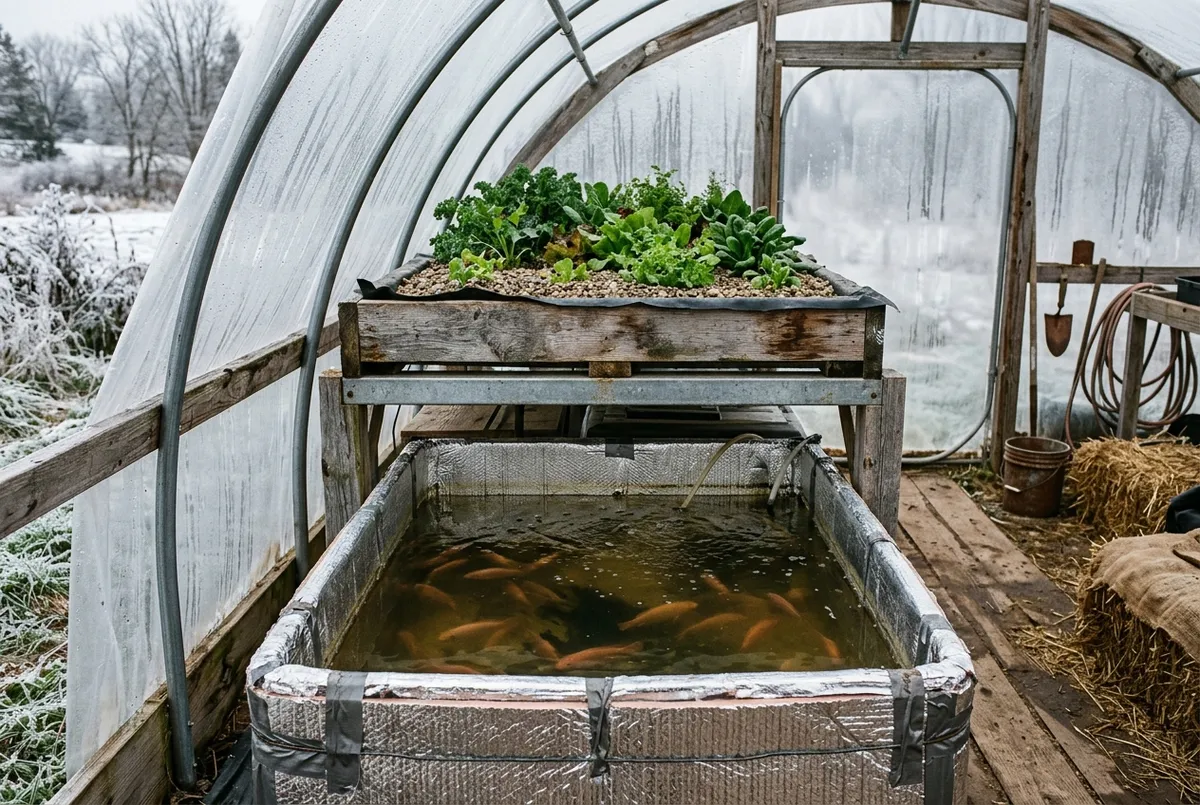
Nights are dropping into the 30s in much of the country, and if your aquaponics system lives outside or in an unheated greenhouse, the fish tank is the one part of the setup with little margin for error. A tank full of tilapia does not tolerate a cold snap, and by FAO’s figures the gap between “stops feeding” and “dies” is only about 5°C (9°F). Overwintering is a planning problem, not a weather problem.
The short answer: An unheated backyard aquaponics system with tilapia is likely to lose its fish in a real winter, because tilapia have a hard lethal floor in the 40s to mid-50s Fahrenheit, depending on the species. Keeping fish alive through the cold months means keeping a heater running, having a backup plan for when that heater fails, and insulating the tank against sudden temperature swings. The greenhouse structure alone is not enough.
What’s the Minimum Water Temperature Before Aquaponics Fish Start Dying?
Tilapia are one of the most popular freshwater fish for aquaponics because they tolerate a wide range of water quality conditions, but FAO’s small-scale aquaponics manual is clear that they do best in warm water (FAO). That reputation for toughness is real, but it has a hard floor, and it’s higher than most beginners assume until the first real cold snap arrives.
According to FAO, tilapias do not feed or grow below 17°C (63°F) and die below 12°C (54°F) (FAO). Blue tilapia (Oreochromis aureus) is among the most cold-tolerant tilapia (Frontiers in Genetics), but published studies still put its lower lethal limit at roughly 6-11°C (43-52°F), depending on the population and how fast the water cools (Stauffer et al., 1988). That’s not a “fish get lazy and stop eating” number. It’s the point where the fish die.
This is where a common misconception costs people their whole tank: the idea that tilapia just get sluggish in cold water rather than actually dying. Reduced activity and reduced feeding do happen as temperatures drop, and that’s a useful early warning sign. But the published data is specific about a lethal floor, not just an activity dip: blue tilapia held at 8°C (46°F) died in the Stauffer study, in some tests within hours, and FAO lists 12°C as the point below which tilapias die (Stauffer et al., 1988; FAO).
For a practical target, treat water that has fallen below about 63°F (17°C) as already outside the feeding and growing range, and treat anything heading toward the mid-50s °F as an active problem to fix, not a “check on it tomorrow” situation, since by FAO’s numbers you’re only a few degrees from the point where tilapias die. If you’re running a strain other than blue tilapia, your safety margin is likely smaller, because blue tilapia is among the most cold-tolerant.
The practical upshot for planning: don’t calibrate your winter setup to your region’s average low. Calibrate it to your region’s coldest realistic night, because that’s the one that decides whether the tank survives the season.
Can Tilapia Stay Outdoors Through Winter, or Do They Have to Come Inside?
The honest answer is that neither framing is quite right. It’s not “outdoors versus indoors.” It’s “heated versus unheated,” and a lot of growers assume a greenhouse solves that problem by itself.
It doesn’t. FAO says tilapias may not be appropriate for winter in temperate climates unless the water is heated (FAO). Commercial aquaponics guidance for cold weather covers checking the heating equipment, using an interior energy curtain to retain heat, and installing foam insulation around the lower part of the greenhouse sidewall (Nelson and Pade, Inc.), which are steps a greenhouse does not come with automatically.
So the real decision isn’t where the tank physically sits. It’s whether you have a reliable way to keep the water above the lethal floor discussed above, with margin, on the coldest night your region can produce. An open-air stock tank with a solid heater, thermostat, and insulated cover can outperform a glass greenhouse with no supplemental heat. A greenhouse with working heating equipment and insulation is safer than either extreme on its own.
If your setup is a smaller stock-tank or IBC-tote system rather than a full commercial-scale greenhouse, the same principle scales down: what protects the fish is a heat source you can trust plus insulation that slows how fast that heat escapes overnight, not the presence of a roof over the tank.
Do You Need a Water Heater for a Backyard Aquaponics System in Winter?
For much of the continental U.S., yes. If your outdoor low temperatures regularly drop anywhere near or below the tilapia floor covered above, a water heater sized to your tank volume isn’t optional equipment: it’s the piece that keeps the fish alive.
But the more important point in the guidance isn’t “buy a heater.” It’s what happens after you already own one. Growers are advised to check each piece of vital equipment, especially those “essential for providing heat,” before extreme cold, including cleaning water heaters and pumps and testing monitoring and alarm equipment, backup equipment, and generators (Nelson and Pade, Inc.). A heater that’s been running fine since spring can fail quietly on the one night it matters most, and a tank with no working backup heat source has no cushion when that happens.
That’s a familiar failure pattern to anyone who’s dealt with backup heating for other livestock. The same “the equipment fails before the weather does” logic applies to supplemental heat sources used in coops, and it’s worth seeing how that risk gets managed elsewhere on the homestead: see the DIY chicken coop heater built with fire safety in mind for how a similar reliability check applies to backup heat generally.
Two things worth building into your winter routine because of this: a way to know your heater has actually failed before the water temperature drops far enough to matter (a thermometer you check daily, or an alarm setup), and a backup heat or power plan for when the primary heater does fail, since the guidance includes testing backup equipment and generators. Low-voltage DC options exist for backup heating and monitoring in small systems; anything involving mains AC wiring, sockets, or breakers near an aquaponics tank should go through a licensed electrician and your local code official rather than a DIY fix, since water and household wiring aren’t a place to guess.
Will Your Plants and Beneficial Bacteria Survive Cold Water Even If the Fish Do?
Nelson and Pade’s cold-weather guidance doesn’t single out plants and nitrifying bacteria with their own temperature thresholds, but it makes a broader point that applies to the whole system, not just the fish: stability in temperature is “critical to success” in an aquaponic system (Nelson and Pade, Inc.).
FAO does give ranges. It lists 14-34°C (57-93°F) as the general tolerance range for nitrifying bacteria and 16-30°C (61-86°F) for hydroponic plants, puts the optimal range for nitrifying bacteria at 17-34°C (63-93°F), and says bacterial productivity tends to decrease below that range, with the Nitrobacter group less tolerant of cold than Nitrosomonas, so nitrite should be monitored more carefully in colder periods (FAO). FAO also notes that aquaponic systems are more productive when day-to-night temperature fluctuations are minimal.
Practically, that means the plants and bacteria in your system aren’t a separate winterizing project. They benefit from the same equipment checks and insulation steps you’re already doing for the fish. If you’re keeping the water in a stable range that is safe for tilapia, you’re also keeping it near the range where FAO says nitrifying bacteria do best, so the same checks cover both.
When the Power Goes Out and the Pump Stops
A winter outage takes out the heater and the pump or filter together. NC State’s veterinary college publishes general guidance for aquariums and ponds, written mainly around temperate species such as goldfish and koi, and notes that the basic principles apply to many species (NC State University College of Veterinary Medicine, 2016-10-12).
Do not feed the fish during the outage. Winter metabolism is slow, so fish are probably uninterested in food anyway, and uneaten food only adds nitrogen to the water. The same source says fish in winter are likely to have plenty of oxygen.
To keep the water warm, it suggests running the heater and the pump or filter from an alternate power supply, and insulating the tank with a blanket, sleeping bag or newspapers. If an outage drags on and a pond’s surface freezes over, ice can be broken to form an air hole.
Tilapia are warm-water fish, so the heat steps matter more for them than for goldfish. If the alternate supply is a generator, OSHA says never to attach it directly to a structure’s electrical system unless a qualified electrician has properly installed a transfer switch (OSHA).
How Do You Stop an Aquaponics System From Freezing Overnight?
Overnight cold is the scenario that can kill fish, since it’s the daily low, not the daily average, that decides whether you cross that lethal floor. Three specific measures show up in the guidance, and they work together rather than as alternatives to each other.
First, insulation that slows how fast the system loses heat after dark: an interior energy curtain and foam insulation along the lower part of the greenhouse sidewall are the specific measures Nelson and Pade name for heat retention (Nelson and Pade, Inc.). For a smaller backyard setup without a full greenhouse, the same principle applies to an insulated tank cover and wrapping exposed pipes and grow beds, since FAO notes that an aquaponic unit can be thermally protected with insulation against cool night temperatures (FAO), and the goal is the same: slow the rate of heat loss overnight, when there’s no sun and no active warming from daylight.
Second, get ahead of specific weather events rather than reacting to them. Ahead of an incoming snow or ice storm, growers are told to raise the greenhouse’s internal heat, because warming the greenhouse puts heat in the ceiling area to help melt snow and ice on the roof and keeps too much weight from accumulating on the structure (Nelson and Pade, Inc.). Waiting until the storm has already dropped the water temperature is waiting too long; the guidance is specifically about acting before the cold arrives.
Third, treat stability as the goal, not just a warm average. A system that spends most of the day comfortably warm but takes a hard overnight dip is still a system where fish can cross that lethal threshold once, which is all it takes.
None of this is a one-time setup task. It’s a seasonal routine, the same way checking a coop or a hive ahead of the first freeze is a routine rather than a single chore. If you haven’t gone through your full winter prep list yet this year, this fall winterizing chores rundown covers the same before-the-freeze mindset for the rest of a backyard setup.
Before the first hard freeze hits your area, walk your system with two questions in mind: what’s your actual heater failure plan, and what’s insulated versus exposed right now. Confirm your heater and thermostat are both working, not just plugged in, and decide today what backup heat or power option kicks in if the primary heater fails overnight. Add or check insulation on the tank, exposed pipes, and grow beds before the forecast forces the issue. None of this needs to be complicated to work, it needs to be checked before the cold arrives rather than after the fish are already in trouble. Aquaponics overwintering rewards the person who did the boring equipment check in early November, not the person scrambling after the first freeze.
Frequently Asked Questions
- What's the minimum water temperature before my aquaponics fish start dying?
- FAO's small-scale aquaponics manual says tilapias stop feeding and growing below 17°C (63°F) and die below 12°C (54°F). Blue tilapia, among the most cold-tolerant tilapia, has reported lower lethal limits of roughly 6-11°C (43-52°F) in published studies, depending on the population and how fast the water cools.
- Can I keep tilapia outdoors through winter, or do they have to come inside?
- An unheated outdoor tank can cross a tilapia's lethal cold threshold in much of the U.S. in winter. FAO says tilapias may not be appropriate for winter in temperate climates unless the water is heated, and Nelson and Pade's greenhouse guidance includes checking heating equipment, using an interior energy curtain, and insulating the lower sidewall.
- Do I need a water heater for a backyard aquaponics system in winter?
- Yes, in much of the U.S. if the tank is outdoors or in an unheated space. Nelson and Pade advise checking each piece of vital equipment, especially those "essential for providing heat," before extreme cold, including testing monitoring and alarm equipment, backup equipment, and generators.
- How do I stop my aquaponics system from freezing overnight?
- Nelson and Pade's greenhouse guidance points to an interior energy curtain and foam insulation along the lower part of the sidewall to retain heat, plus raising the greenhouse heat ahead of an incoming snow or ice storm so the warm air near the ceiling helps melt snow and ice off the roof. FAO also notes that an aquaponic unit can be thermally protected with insulation against cool night temperatures.
- Will my plants and beneficial bacteria survive cold water even if the fish do?
- Nelson and Pade call stability in temperature "critical to success" in an aquaponic system. FAO puts the best range for nitrifying bacteria at 17-34°C (63-93°F), says their productivity tends to decrease below that, and advises watching nitrite more carefully in colder periods.
Sources & references
- FAO, Small-scale Aquaponic Food Production (Technical Paper 589) (opens in new tab)
- Stauffer et al., Cold Shock Susceptibility of Blue Tilapia (North American Journal of Fisheries Management, 1988) (opens in new tab)
- Frontiers in Genetics, Low Temperature Response in Blue Tilapia (2019) (opens in new tab)
- Nelson and Pade, Inc. (opens in new tab)
- NC State University College of Veterinary Medicine, Dealing With Aquariums and Ponds During Power Outages (opens in new tab)
- Occupational Safety and Health Administration, Using Portable Generators Safely (opens in new tab)
Before you go
The Renter's Homestead Pack
Self-reliance projects for the yard you don't own — container yields, a raised bed built to move with you, balcony preservation basics, and the landlord questions to ask first.
Free guide
The Renter's Homestead Pack
Self-reliance projects for the yard you don't own — container yields, a raised bed built to move with you, balcony preservation basics, and the landlord questions to ask first.