What’s the short answer?
- Yes: use a GFCI-protected outlet or a plug-in GFCI adapter for any outdoor holiday light display, and treat any outdoor extension cord as needing GFCI protection.
- About 150 home fires a year start specifically from holiday lights and other decorative lighting, per NFPA data (a 2004-2008 average) cited by ESFI ([ESFI](https://www.esfi.org/holiday-data-and-statistics-proven-need-for-holiday-safety-awareness/), 2026-09-10).
- ESFI reports an 81% drop in U.S. electrocutions since GFCIs were introduced, and CPSC estimates 47% of current electrocutions could be prevented by GFCIs ([ESFI](https://www.esfi.org/ground-fault-circuit-interrupters-preventing-electrocution-since-1973/), 2026-10-04).
- The 2026 NEC, Section 210.8(F), requires GFCI protection on dwelling outdoor outlets, with outdoor lighting outlets excepted ([Minnesota Department of Labor and Industry](https://www.dli.mn.gov/sites/default/files/pdf/NECFAQ26.pdf), 2026-10-04).
- Actual wiring, breaker, or outlet work is a job for a licensed electrician and your local code official; this guide covers consumer-level setup and inspection only.
Most people hang outdoor holiday lights the same way every year: run a cord out a window or through a gap under the garage door, plug into whichever outlet is closest, and check back after dark to see if everything still lights up. Add snowmelt pooling under a shrub, a sleet storm halfway through the display, or a cord that has been coiled in slush since Thanksgiving weekend, and that outlet is doing a different job than it was doing in July.
The short answer: Yes. Any outdoor holiday light display should run through a GFCI-protected outlet or a plug-in GFCI adapter, and any extension cord running outdoors needs GFCI protection too. Wet winter weather does not change the electrical code, but it raises the odds that a damaged cord or a loose connection actually meets water.
Why Rain and Snow Change the Risk for Holiday Lights
Electrical decorations are already a meaningful driver of holiday-season home fires. Roughly 25% of holiday-season home fires are caused by electrical decorations, and an estimated 860 home fires per year come from holiday decorations broadly (ESFI, Prevent Holiday Fires, 2026-09-10). About 150 home fires per year start specifically from holiday lights and other decorative lighting, causing roughly 8 deaths, 16 injuries, and $8.9 million in property damage annually, based on NFPA data from 2004-2008 (ESFI Holiday Data and Statistics, 2026-09-10).
Wiring and lighting equipment fail for a lot of reasons that have nothing to do with weather. Water is simply one more path for a fault to find, and outdoor holiday displays sit exposed to it for weeks at a time.
A ground-fault circuit interrupter, or GFCI, is built for exactly that path. It monitors the current going out to a device and the current coming back, and if it senses even a small amount leaking somewhere it should not, such as through damp insulation or into a puddle, it cuts power in a fraction of a second. That is a different job than a standard circuit breaker does, which is sized to catch overloads and short circuits, not the small leaks that show up when water gets where it should not be.
What GFCI Protection Actually Means for an Outdoor Display
ESFI’s guidance for holiday lighting is direct on this point: use only extension cords and decorations marked for outdoor use outdoors, and plug outdoor lights and decorations into circuits protected by GFCIs (ESFI, Outdoor Decoration Safety Tips, 2026-10-04). ESFI also says to always plug into a GFCI-protected outlet when using an extension cord outdoors (ESFI, Extension Cord Safety, 2026-10-04), and that GFCIs should be installed where electricity and water may come in contact (ESFI, Prevent Holiday Fires, 2026-09-10).
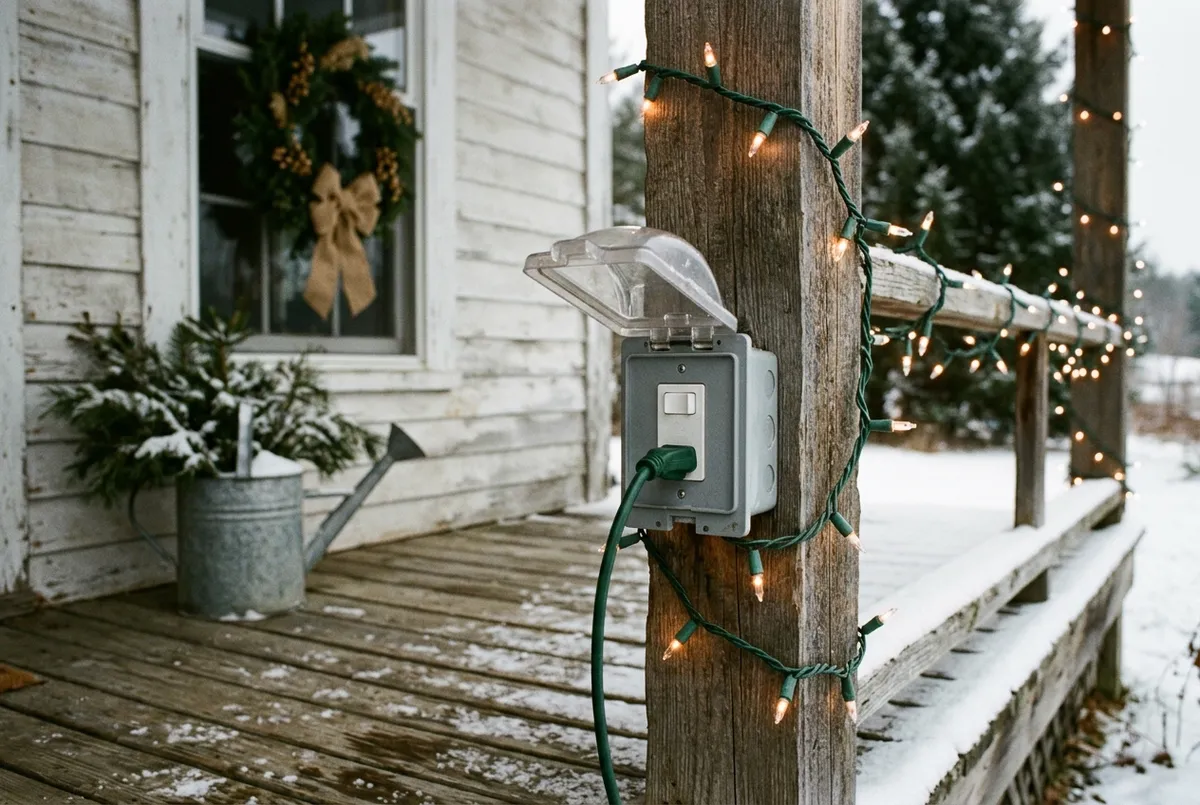
In practice, homeowners run into this in one of two situations. The first is an outdoor outlet that already has GFCI protection built in, usually visible as a receptacle with small “test” and “reset” buttons on its face. If that describes the outlet you are using, you already have the protection the guidance calls for, and it is worth pressing test and reset once before you plug in a full display, just to confirm it trips and resets the way it should.
The second situation is an existing outdoor outlet that does not have that protection, which can happen in older homes where the outdoor circuit was never upgraded (CPSC estimates there are potentially 43 million American homes without GFCI protection, per ESFI, 2026-10-04), and it is also a situation renters often face, since altering an outlet is rarely something a lease allows. A plug-in GFCI adapter sits between the cord and that outlet and performs the same monitoring and shutoff function without any wiring work. It plugs in exactly like an extension cord would, and it carries its own test and reset buttons, so the display’s cord plugs into the adapter rather than straight into the wall. It is a straightforward way to add the protection ESFI recommends to an outlet that lacks it, without touching anything behind the faceplate: ESFI notes that portable outdoor GFCIs are sold where electrical supplies are sold and require no special knowledge or equipment to install (ESFI, Outdoor Decoration Safety Tips, 2026-10-04).
What we are not going to walk you through here is how to test or replace the actual wiring, breaker, or outlet itself. Mains AC wiring is a job for a licensed electrician, and any question about what your specific outlet or panel needs should go to that electrician or your local code official rather than to a guess made from a guide like this one.
Outdoor-Rated Lights Are the Baseline, GFCI Is the Backup
GFCI protection is not a substitute for using the right lights in the first place, it is a backstop for when something still goes wrong. ESFI’s guidance pairs the two together for a reason: use only decorations and extension cords marked for outdoor use outdoors, and back that up with GFCI protection on the circuit (ESFI, Outdoor Decoration Safety Tips, 2026-10-04).
Outdoor-rated strings and cords are marked for outdoor use, so check the packaging or tag. ESFI warns against using indoor decorations outside, since water and electricity should never mix (ESFI, Prevent Holiday Fires, 2026-09-10). Indoor-only strings are not made for that exposure, which gives water an easier path to a live connection right at the socket, the same point where GFCI protection would otherwise be catching a leak before it becomes a shock. This matters most for renters and smaller-yard setups, where it is common to reuse whatever box of lights is already in the closet rather than buy new ones every season. Even a display on a covered porch is worth checking against the tag, since wind-driven rain and blowing snow reach spots that look sheltered from directly overhead.
What the 2026 Electrical Code Says About Outdoor Lighting Circuits
Code requirements have moved in the same direction as ESFI’s safety guidance. The 2026 National Electrical Code, Section 210.8(F), requires GFCI protection on outdoor receptacles and outlets for dwellings. It’s the plug-in outlets a seasonal display actually uses that fall under that requirement; most permanently installed, hardwired outdoor light fixtures are exempt, because the 2026 code does not apply 210.8(F) to outdoor lighting outlets (Minnesota Department of Labor and Industry, 2026 NEC FAQ, 2026-10-04).
Two things are worth knowing about how that code plays out at the address level. First, the NEC itself is a model code, and individual states and municipalities adopt and enforce it on their own timelines, so what applies to your outdoor circuit right now depends on which code version your local jurisdiction has adopted. Second, a code requirement for new or altered circuits is not the same as a mandate to retrofit every existing outlet on a home built decades ago. If you are not sure which category your outdoor outlet falls into, that is a question for your local code official or a licensed electrician, not a guess to make on your own.
ESFI reports an 81% drop in electrocutions since GFCIs were first introduced in homes, and the Consumer Product Safety Commission estimates that 47% of current electrocutions could be prevented with proper GFCI protection (ESFI, 2026-10-04). That kind of protection only helps if it is there and working, which is why testing it matters as much as having it.
Signs a Light String or Cord Should Be Retired
None of the numbers above matter much if the cord itself is already compromised. A few things to check before you plug in this season, and again periodically through a wet winter:
- Insulation that is cracked, brittle, or visibly faded from sun exposure over past seasons.
- Any point where bare copper wire is exposed, even a small nick.
- A plug or socket that feels warm to the touch, looks melted, or shows discoloration.
- A cord or connection that has been sitting in standing water, snowmelt, or ice rather than staying elevated and dry.
- Flickering or dimming that gets noticeably worse when the cord or connection is damp.
If a string or cord shows any of those signs, the reasonable move is to retire it rather than tape it up and hope. Electrical tape is not a weatherproof seal, and wrapping it around a cracked section of insulation does not restore the barrier that cracked, it only hides where the barrier failed. A replacement string costs far less than the fire or shock risk that a damaged one is carrying, and it is a smaller expense than most other items on a holiday budget.
A Simple Winter Setup Checklist
Put together, ESFI’s guidance and the current code point toward a short list rather than a complicated one:
- Use only outdoor-rated lights and outdoor-rated extension cords outside; check the tag before you buy or reuse one from storage.
- Confirm the outlet you are using is GFCI-protected, or add a plug-in GFCI adapter if it is not.
- Keep splices and connections elevated off the ground, away from snow, puddles, and downspout runoff.
- Test any GFCI’s test and reset buttons periodically through the season, not just once at setup.
- Route cords so they do not run through areas that collect standing water or snowmelt.
- If a GFCI trips repeatedly, stop resetting it and call a licensed electrician instead of continuing to reset it.
Winter storms also raise a related question for a lot of readers: what happens to a display, or to anything else plugged in outside, if the power goes out mid-storm. That is a separate topic from GFCI protection, but if you are weighing backup power for the season anyway, we have compared 300W and 1000W portable solar generators for what each size can actually run, and looked at whether backyard wind turbines hold up in winter conditions specifically.
Outlet Covers for Lights You Leave Running
Most holiday displays run while nobody is standing next to them, and that changes which kind of outlet cover matters. OSHA’s wiring standard, 1910.305, sorts wet-location receptacles into two groups, based on whether the product plugged in is attended while in use (OSHA).
For a product that is not attended, the examples it gives are “sprinkler system controllers, landscape lighting, and holiday lights.” The receptacle for those needs an enclosure that is weatherproof with the attachment plug cap inserted or removed. In plain terms, the protection has to hold while the cord is plugged in, not only after you unplug it.
For a product that is attended while in use, such as a portable tool, the enclosure must be weatherproof when the plug is removed.
That standard comes from OSHA’s occupational safety rules, not a home electrical code, so treat it as a benchmark rather than a rule for your porch. Your local code official or a licensed electrician can tell you what applies at your address, and any outlet or wiring change stays their job.
Next Step
Before you plug in this year’s display, walk the cord from the outlet to the last light and check it against the list above, then confirm the outlet itself is GFCI-protected or add an adapter that makes it so. That is a fifteen-minute check against a risk that ESFI’s data ties to real fires and real electrocutions every holiday season, and it costs a lot less than either one.
Frequently Asked Questions
- Why does rain or snow make outdoor holiday lights more dangerous than indoor lights?
- Water and electricity raise the risk of shock, which is why ESFI guidance calls for GFCI protection any time an extension cord runs outdoors or anywhere water and electricity can mix.
- What's the difference between a GFCI outlet and a plug-in GFCI adapter?
- A GFCI outlet is a receptacle already wired into the electrical box, identifiable by its test and reset buttons. A plug-in GFCI adapter plugs into an existing standard outdoor outlet and provides the same monitoring and shutoff function without any wiring work. Actual outlet or wiring changes should go to a licensed electrician or your local code official.
- What are signs a light string or extension cord has water damage and should be retired?
- Cracked, brittle, or faded insulation, any point of exposed bare wire, a plug or socket that feels warm or looks melted or discolored, a cord that has been sitting in standing water or snowmelt, and flickering that gets worse when the connection is damp are all reasons to retire a string or cord rather than keep using it.
- How much does GFCI protection reduce the risk of electrocution?
- ESFI reports an 81% drop in electrocutions since GFCIs were first introduced in homes, and the Consumer Product Safety Commission estimates that 47% of current electrocutions could be prevented with proper GFCI protection.
- Does the current electrical code require GFCI protection for outdoor lighting circuits?
- The 2026 National Electrical Code, Section 210.8(F), requires GFCI protection on outdoor receptacles and outlets for dwellings. Most permanently installed, hardwired outdoor light fixtures are exempt from that requirement; it's the plug-in outlets you use for a seasonal display that are covered. Local adoption and enforcement timelines vary, so check with your local code official or a licensed electrician for what applies to your home.
Sources & references
- ESFI Holiday Data and Statistics (opens in new tab)
- ESFI, Prevent Holiday Fires (opens in new tab)
- ESFI, Outdoor Decoration Safety Tips (opens in new tab)
- ESFI, Extension Cord Safety (opens in new tab)
- ESFI, Ground-Fault Circuit Interrupters (GFCI) (opens in new tab)
- Minnesota Department of Labor and Industry, 2026 NEC FAQ (opens in new tab)
- OSHA, Wiring methods, components, and equipment for general use (1910.305) (opens in new tab)
Before you go
The Renter's Homestead Pack
Self-reliance projects for the yard you don't own — container yields, a raised bed built to move with you, balcony preservation basics, and the landlord questions to ask first.
Free guide
The Renter's Homestead Pack
Self-reliance projects for the yard you don't own — container yields, a raised bed built to move with you, balcony preservation basics, and the landlord questions to ask first.