What’s the short answer?
- Low resting voltage after a full charge, a cracked case, and heavy terminal corrosion are warning signs to act on before winter (Trojan Battery). A bulging case and a sharp voltage drop under load are further warning signs.
- At around -20°C (-4°F), most batteries are at about 50 percent of their performance level, raising the risk of deep discharge (Battery University).
- Lithium-ion batteries, LiFePO4 included, generally shouldn't be charged below 0°C (32°F) without protection that blocks cold charging (Battery University).
- Inspect cases and terminals and measure resting voltage on every battery before the cold sets in, not after (Trojan Battery).
- Charging lead-acid batteries in the cold requires adjusting the voltage limit, which is what temperature-compensated chargers do automatically (Battery University).
Your solar array output has already dropped with the shorter days, and the battery bank that carried the place through October is starting to sag by mid-afternoon instead of holding steady until dusk. Maybe the inverter cuts out earlier than it used to, or a battery that always ran warm to the touch now feels ice-cold no matter how much sun hits the panels. Warning signs of a failing battery often show up before the failure does.
The short answer: Watch for low resting voltage after a full charge, a sharp voltage drop the moment you add load, a swollen or bulging case, heavy corrosion at the terminals, and a bank that drains noticeably faster than it did last month. Any one of these means test the battery now, not after the first hard freeze.
What Are the Warning Signs Your Off-Grid Battery Won’t Survive Winter?
Most of the signs below apply to lead-acid batteries, but a couple carry over to lithium too. None of them require special equipment beyond a multimeter and a load tester, and all of them are easier to catch in October than in January.
Sign 1: Low resting voltage after a full charge
Charge the battery fully, let it sit idle with no charging or load for at least 6 hours (Trojan Battery prefers 24), then check the voltage. A healthy 12V flooded lead-acid battery reads about 12.73V at full charge; Trojan says one that still reads below its state-of-charge table after a full charge may have been left discharged too long or have a bad cell, and should go to a specialist or be retired (Trojan Battery). If the number won’t come up no matter how long you charge it, treat that battery as suspect.
Sign 2: A sharp voltage drop the moment you add load
A battery can look fine sitting at rest and still fail the second real current draws on it. Battery University explains that high internal resistance makes a battery’s voltage drop under load and can trigger an early shutdown, and that sulfation and grid corrosion are the main contributors to rising internal resistance in lead-acid batteries (Battery University). A voltage that sags sharply under a normal load, well beyond what the other batteries in the same bank show, is a warning sign worth acting on. This is exactly the kind of problem that only shows up when you actually load-test, which is why a resting-voltage check alone isn’t enough before winter.
Sign 3: A swollen or bulging case
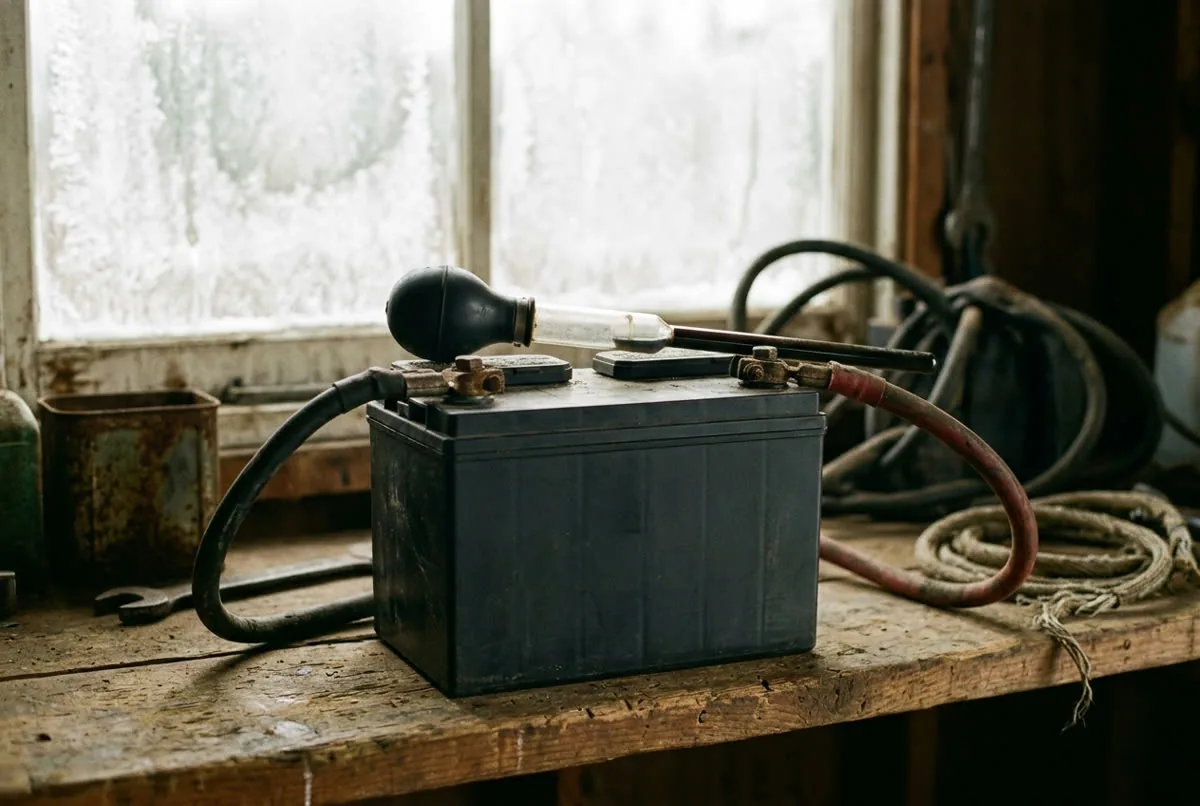
Open the battery box and look at the case itself. A bulging, swollen, or cracked case is a sign of damage; Trojan’s inspection guidelines start with looking for cracks in the container and say to repair or replace any damaged battery (Trojan Battery). In winter, one cause is frozen electrolyte: Battery University notes that a lead-acid battery freezes more readily at a low charge, and that freezing can crack the enclosure (Battery University). A bulging case isn’t something to monitor and revisit later; it means the battery gets pulled from the bank now, before it’s asked to work through a cold snap.
Sign 4: Heavy corrosion at the terminals
Corrosion at the terminals isn’t just cosmetic. Heavy buildup is a sign the battery and its connections need attention. Terminal inspection is also step one in Trojan’s maintenance routine: the posts and connections should be clean and free of corrosion, and because visual inspection alone isn’t sufficient, it’s followed by voltage and specific gravity checks (Trojan Battery). There’s no reason to wait until spring to run that same check; doing it before winter catches the battery that won’t make it through.
Sign 5: The bank drains faster than it used to
If the system is running down faster than it did a month ago on a similar load, and the panels haven’t changed, that’s often the combination of shorter days and a bank that’s already losing capacity. Cold makes this worse on its own: below freezing, a battery’s internal resistance rises and its usable capacity drops (Crown Battery, 2023-10-13), and at around -20°C (-4°F) most batteries are at about 50 percent of their performance level (Battery University), which raises the odds of a deep discharge that pushes a marginal battery over the edge. A bank that was already running close to its limits in September has very little margin left once temperatures drop.
How Cold Weather Hits Lead-Acid and Lithium Batteries Differently
It’s tempting to assume a battery that worked fine all summer will keep working fine once it gets cold. That’s not how either lead-acid or lithium chemistry behaves.
For lead-acid, the capacity loss described above is the core issue: the colder it gets, the less usable capacity is actually available. A bank sized correctly for summer loads can end up undersized for the same loads in a hard freeze, and the practical result is lower running times and a shorter battery life if the bank is not managed carefully (Crown Battery, 2023-10-13).
Lithium iron phosphate, or LiFePO4, is one of the lithium-ion types Battery University lists (Battery University), and Battery University’s temperature table shows lithium-ion cells discharging down to -20°C (-4°F) but accepting no charge below freezing (Battery University). Cold charging is the problem. Battery University warns that consumer-grade lithium-ion batteries cannot be charged below 0°C (32°F): the pack can appear to charge normally while metallic lithium plates onto the anode, permanently degrading performance and safety (Battery University). That’s why the usual fixes are a charger that blocks charging below freezing, which Battery University notes advanced chargers do, or bringing the cells up to a moderate temperature before charging. Check the battery’s own spec sheet for its low-temperature charge limit. A lithium bank that’s fine discharging on a freezing night can still be quietly damaged if it gets charged on that same freezing morning without temperature protection in place.
Both of these run against a common assumption. “If my batteries work fine in summer, they’ll be fine in winter” ignores how much capacity cold takes off a lead-acid bank, especially one that’s already sized close to its limits (Battery University). And “lithium batteries don’t care about cold” is only half true: LiFePO4 can still discharge in the cold, but charging it below freezing without temperature management can damage the cells for good (Battery University).
Should You Insulate or Heat Your Battery Bank Before Winter?
For a lead-acid bank, general manufacturer guidance leans toward keeping batteries fully charged going into cold weather and storing them somewhere cool but not exposed to freezing; Trojan notes that a high state of charge also prevents freezing, which does irreparable damage to plates and container (Trojan Battery). The details vary by manufacturer, so check the guidance that came with the specific batteries in the bank rather than assuming one rule fits every model.
Charging behavior matters as much as insulation. Battery University notes that charging lead-acid at cold and hot temperatures requires adjusting the voltage limit, and that adding temperature compensation to a lead-acid charger is said to prolong battery life by up to 15 percent (Battery University). Temperature-compensated charging means the charger adjusts its target voltage based on the battery’s actual temperature. If the current charge controller doesn’t have a temperature probe or compensation built in, that is worth addressing alongside any insulation.
For a LiFePO4 bank, the calculus shifts toward active heating rather than passive insulation, since the real risk is charging below freezing rather than storage temperature alone. A charger or controller that blocks charging below freezing, which Battery University notes advanced chargers do, or warming the cells before charging, addresses the actual failure mode directly in a way that wrapping the box in insulation on its own doesn’t (Battery University).
How to Load-Test Your Batteries Before the Cold Sets In
The signs above point to a specific sequence: inspect the case and terminals, measure resting voltage, and run a load test on anything that looks marginal. Trojan’s own routine starts the same way, with inspection followed by voltage checks, because visual inspection alone isn’t sufficient (Trojan Battery).
Start with a visual check of every battery in the bank: case shape, terminal corrosion, and any sign of leakage. Clean and tighten terminals as needed, then fully charge the bank and let it rest. Measure resting voltage on each battery individually rather than just the bank as a whole, since one weak battery can hide behind several healthy ones on a combined reading. Finally, apply a realistic load, whatever the system would actually draw on a normal evening, and watch how far the voltage drops and how fast it recovers. Trojan says to always wear protective clothing, gloves and goggles when handling batteries and electrolyte. This is all low-voltage DC work with a multimeter and a load tester at the battery terminals; it doesn’t involve any mains AC wiring, breakers, or household circuits, and nothing here should be treated as a substitute for a licensed electrician if the question ever turns to anything on the AC side of an inverter.
Any battery that fails to hold voltage under that load, or that recovers slower than the rest of the bank, is the one to replace before the cold arrives rather than the one to keep testing through January.
Can You Mix Old and New Batteries in an Off-Grid Bank?
Trojan Battery does not recommend partially replacing a flooded battery bank. Batteries behave differently over their lifespan, so a bank of same-age batteries responds more uniformly. With one new battery among older ones, the older batteries tend to need more charge than the newer one, which is then overcharged, and the older ones can end up undercharged because the overall voltage response is not a good representation of either group (Trojan Battery). If a load test turns up one clearly weak battery among several strong ones, Trojan’s guidance points toward replacing the whole matched set rather than dropping in a single new battery next to older ones.
None of this requires guessing. A battery bank going into winter with any of the five signs above, cold-reduced capacity on top of it, and no temperature-aware charging in place is a bank at real risk of leaving someone without power on the coldest night of the season. The reasonable next step is the same load-test sequence described above, run on every battery in the bank before the first hard freeze, with any battery that fails replaced rather than nursed through the cold. For a broader look at how off-grid backup power holds up once temperatures drop, the comparison of the Bluetti AC180 against an EcoFlow unit in a winter blackout and the honest look at how backyard wind turbines actually perform in winter are both worth reading alongside this checklist.
Frequently Asked Questions
- How does cold weather affect lead-acid battery capacity?
- Cold significantly reduces usable capacity in lead-acid batteries. Battery University notes that at around -20°C (-4°F) most batteries are at about 50 percent of their performance level, which raises the risk of deep discharge and failure in a marginally sized bank.
- Can I charge a lithium (LiFePO4) battery in freezing temperatures?
- Generally no, not without protection. Battery University warns that consumer-grade lithium-ion batteries cannot be charged below 0°C (32°F), because metallic lithium plates onto the anode and permanently degrades performance and safety. Common fixes are a charger that blocks charging below freezing, or warming the cells to a moderate temperature before charging. Check your battery's own spec sheet for its low-temperature charge limit.
- What's the fastest way to tell if an off-grid battery is failing?
- Inspect the case and terminals, then measure open-circuit voltage after a full charge and at least 6 hours of rest (Trojan Battery prefers 24). A reading that stays low after a full charge can mean the battery sat discharged too long or has a bad cell. A cracked or bulging case, heavy terminal corrosion, and a sharp voltage drop under load are other warning signs.
Sources & references
- Crown Battery, Winter Battery Performance: Tips for Cold Weather (opens in new tab)
- Battery University, BU-502: Discharging at High and Low Temperatures (opens in new tab)
- Battery University, BU-410: Charging at High and Low Temperatures (opens in new tab)
- Battery University, BU-205: Types of Lithium-ion (opens in new tab)
- Trojan Battery, Battery Maintenance (opens in new tab)
- Battery University, BU-802a: How does Rising Internal Resistance affect Performance? (opens in new tab)
Before you go
The Renter's Homestead Pack
Self-reliance projects for the yard you don't own — container yields, a raised bed built to move with you, balcony preservation basics, and the landlord questions to ask first.
Free guide
The Renter's Homestead Pack
Self-reliance projects for the yard you don't own — container yields, a raised bed built to move with you, balcony preservation basics, and the landlord questions to ask first.