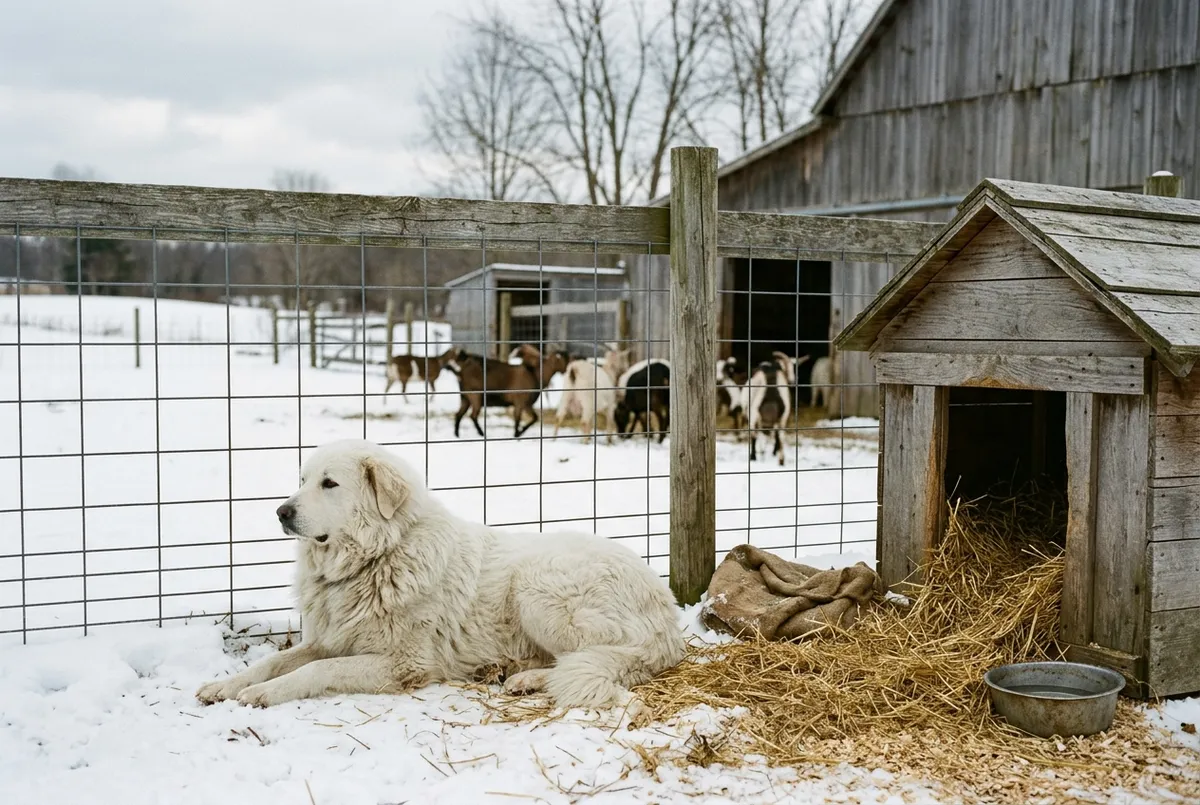
If your goat pen or sheep paddock sits exposed once the first hard frost hits, you have probably wondered whether a guardian dog can actually work outside all winter or whether it needs to come in at night like a house pet. The question comes up every fall for anyone adding a livestock guardian dog (LGD) to a small flock or herd: how cold is too cold, does the dog need its own shelter separate from the barn, and does its feed ration have to change once temperatures drop.
The short answer: A properly conditioned livestock guardian dog can work outside through winter without supplemental heat, relying on its double coat and body mass to stay warm. You generally do not need to build it a separate doghouse if it already shares a barn or run-in shed with your animals, but you should raise its feed ration as temperatures fall and watch smaller or younger dogs more closely once conditions turn extreme.
Why an LGD’s coat matters in winter
Livestock guardian breeds were bred to live outdoors year-round, and the coat is a big part of why that works. A technical guide distributed by Ontario Sheep explains that LGD breeds generally have a double coat: a long, flat, weather-resistant outer layer that sheds water, paired with a thick, downy undercoat for warmth, though it adds that body mass is what really determines a dog’s cold resistance (Ontario Sheep). That combination is doing two separate jobs: the outer coat sheds water, and the undercoat provides warmth.
How cold is too cold for a guardian dog
There is a real threshold where cold stops being background weather and starts costing the dog energy. The Ontario Sheep guide notes that around -32°C (about -26°F), medium-sized dogs under roughly 32 kg (about 70 lbs) begin visibly responding to cold through shivering and elevated metabolism (Ontario Sheep). Larger dogs, such as LGDs weighing around 45 kg (about 100 lb), tolerate even lower temperatures before showing that same response.
For much of the US, that -26°F threshold is an outlier cold snap rather than a typical January night, which is useful context. The dogs most likely to need extra attention are smaller-bodied individuals, puppies still growing their adult coat, older dogs, and any dog that is thin going into winter, since the guide says body mass is what really determines a dog’s cold resistance.
Shivering and a visibly elevated metabolism, meaning the dog is burning through calories faster and acting hungrier than usual, are the response the Ontario Sheep guide describes once a dog approaches its cold threshold (Ontario Sheep). The guide describes that response as the dog’s body acting against the cold, not as a diagnosis of trouble by itself. It becomes worth intervening when the dog cannot seem to get warm even with shelter and food available, when shivering continues after it has had time to dry off and settle, or when a normally alert dog seems sluggish and withdrawn during a cold stretch. Any of those, especially in combination, is a reason to bring the dog into a warmer space and involve a veterinarian rather than waiting it out.
Does a guardian dog need its own doghouse?
Most working LGDs do not require a separate doghouse. They typically share the same run-in shed or barn already used by the livestock they guard, and that shared shelter is usually sufficient (Ontario Sheep). The guide also notes that these hardy dogs may choose not to enter a doghouse or barn even in severe weather, preferring to sleep where they have a full view of their surroundings and the sheep.
If you want to offer a dedicated shelter anyway, keep expectations modest: Ontario producers surveyed for the same guide who supplied a doghouse reported that their dogs never used it and always slept outside (Ontario Sheep). If you keep other livestock through winter and have already worked through cold-weather housing for a different species, the underlying principles carry over directly; see our guide to cold-weather hog setups for how the same shelter-and-monitoring logic applies to pigs.
What a dedicated dog shelter should look like
If you decide to build or buy one anyway, start from county animal-care guidance for animals kept outdoors in cold weather (Sacramento County Animal Care):
- Dry and draft-free. Face the house away from the wind and cover the doorway with waterproof burlap or heavy plastic.
- Raised off the ground. Keep the floor a few inches up and covered with cedar shavings or straw.
- Sized to the dog, not oversized. Large enough to allow comfortable sitting, but small enough to hold in body heat.
How much more should you feed a guardian dog in winter
Cold work burns calories, and the Ontario Sheep guidance cites one dog food manufacturer’s rule of thumb: about 7.5% more feed for every 5.5°C (about 10°F) drop in temperature, once the temperature reaches the point where the dog is shivering or trying to avoid the cold (Ontario Sheep). Shepherds surveyed for the guide increased feed during extremely cold weather, and it makes sense to raise rations during extended cold snaps rather than waiting until the dog has visibly lost weight or condition, since by the time weight loss is obvious the dog has already been running a calorie deficit for a while.
In practice, that means treating a hard cold stretch the same way you would treat a period of unusually heavy predator pressure or extra work: as a reason to check the dog’s body condition by hand under the coat, feeling along the backbone and ribs, not just by looking at it (Ontario Sheep). A dog that is losing weight needs more feed or a higher-energy feed. The guide also notes that dogs under coyote pressure often lose some weight, so predator activity and cold both push in the same direction on appetite.
Water access matters just as much as the food increase, and it is easy to overlook. Outdoor animals need more food in winter and fresh, unfrozen water (Sacramento County Animal Care), and a water source that ices over overnight can undo a lot of the benefit of a heavier feed bucket. Checking and breaking ice is worth building into the same daily routine as the winter feeding check.
Acclimating a dog to outdoor winter life
Timing matters as much as the numbers do. A dog that lives outside continuously from the warmer months into winter has had time to build up its coat and body condition, which a dog moved outdoors suddenly once cold weather has already set in has not. A dog raised or kept indoors through fall and then put out in December with a thin, unconditioned coat is starting from a real disadvantage compared to one that has been outside building up undercoat since late summer.
This is worth planning around if you are bringing a new LGD onto your property. A dog that arrives in early fall or earlier has months to grow into its winter coat before it needs it. A dog that arrives in November is starting winter under-prepared, and that gap is exactly where the smaller-dog, thin-dog cautions above become most relevant.
Where LGD care fits into your broader winter flock plan
Texas A&M AgriLife Extension runs a Livestock Guardian Dog Program that uses guardian dogs in its own sheep and goat predator management and develops research and education with the small-ruminant ranching community (Texas A&M AgriLife Extension). That is a sign guardian dogs are an established tool for sheep and goat predator management.
An LGD’s main job, keeping predators away from your flock or herd, also connects to the security decisions you are probably already making for your coop or pen. If nighttime predator pressure is part of why you are considering a guardian dog in the first place, it is worth reading how that same pressure is handled on the coop side in our review of automatic coop doors for winter and predators, since a locked-down coop and an alert dog patrolling outside it solve overlapping problems from different directions.
None of this requires treating winter as an emergency. A guardian dog bred and conditioned for outdoor work, with access to a dry barn or shed, a slightly heavier feed bucket during cold snaps, and an owner who checks body condition by hand rather than by eye, is set up to get through a normal winter without drama. The exceptions worth watching for closely are the ones already flagged above: a small-bodied dog, a young dog still growing its coat, an older dog, or any dog that arrived on your property too close to the first frost to acclimate properly.
If you are setting up a guardian dog’s winter routine for the first time, start by walking your existing barn or shed with the dog in mind: does it offer a dry, wind-blocked spot the dog can reach on its own, and is there room to add a small wood shelter nearby if the dog seems to want one. From there, plan on checking body condition weekly through the coldest months and adjusting feed upward before you see ribs, not after.
Frequently Asked Questions
- Do livestock guardian dogs need their own doghouse in winter?
- Most working LGDs do not need a separate doghouse. They typically share the same run-in shed or barn already used by the livestock they guard, and that shared shelter is usually enough. If you add a doghouse anyway, don't count on it: Ontario producers surveyed for an Ontario Sheep guide who supplied one said their dogs never used it and always slept outside.
- How cold can a livestock guardian dog tolerate?
- Around -32°C (about -26°F), medium-sized dogs under roughly 32 kg begin visibly responding to cold through shivering and elevated metabolism. Larger dogs, such as LGDs weighing around 45 kg (about 100 lb), tolerate even lower temperatures before showing that same response.
- How much more should I feed a guardian dog in winter?
- One dog food manufacturer cited in an Ontario Sheep guide suggests about 7.5% more feed for every 5.5°C (about 10°F) drop in temperature once the dog is shivering or trying to avoid the cold. Shepherds surveyed for the guide increased feed during extremely cold weather, and it recommends checking body condition by hand, especially in harsh weather.
- What should a guardian dog's winter shelter look like if I add one?
- Sacramento County Animal Care's cold-weather guidance for outdoor pets calls for a dry, draft-free shelter that is large enough for comfortable sitting but small enough to hold in body heat, with the floor raised a few inches off the ground and covered with cedar shavings or straw.
Sources & references
Before you go
The Renter's Homestead Pack
Self-reliance projects for the yard you don't own — container yields, a raised bed built to move with you, balcony preservation basics, and the landlord questions to ask first.
Free guide
The Renter's Homestead Pack
Self-reliance projects for the yard you don't own — container yields, a raised bed built to move with you, balcony preservation basics, and the landlord questions to ask first.