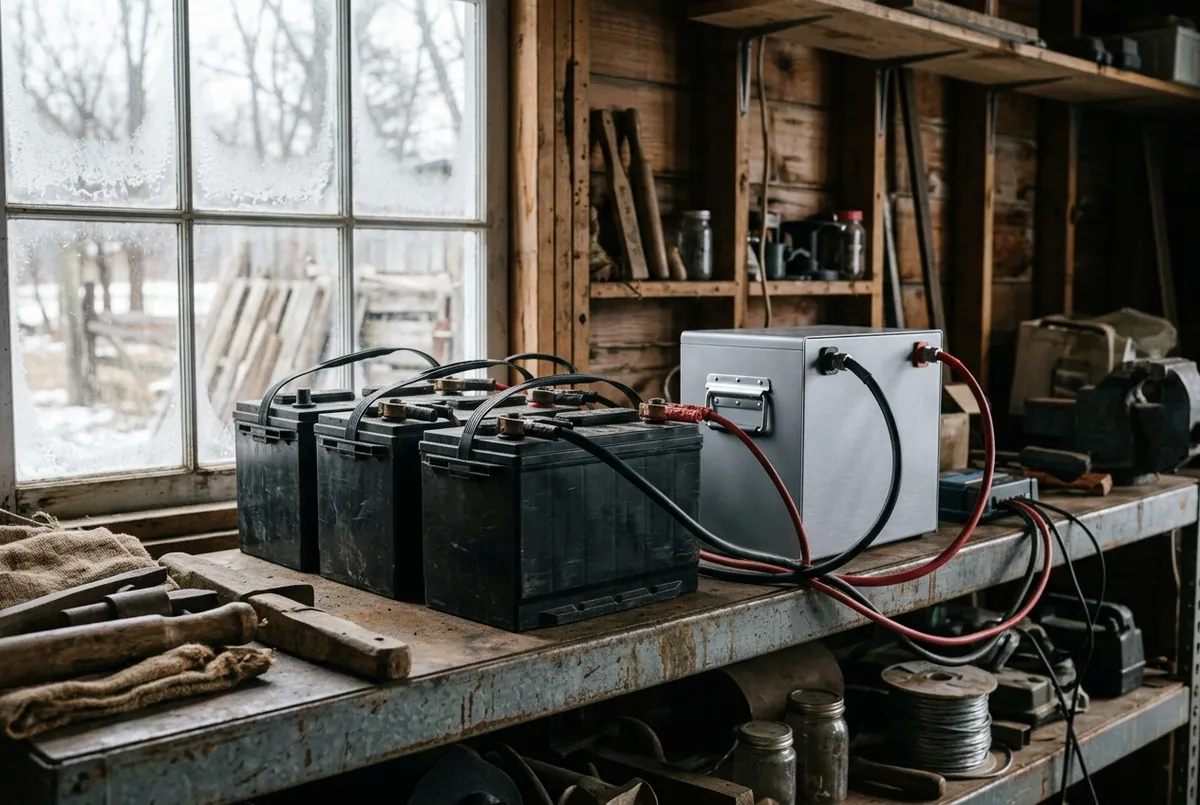
Picture the setup: a solar array feeding a battery bank in an unheated garage or shed, keeping string lights, a chest freezer, or a router running once the sun goes down. Now picture the forecast turning toward a real winter, with the garage sitting somewhere between freezing and a hard cold snap for weeks at a time. Whether that battery bank still works in January comes down to one decision made long before the cold arrives: LiFePO4 or lead-acid.
The short answer: Lead-acid tolerates a colder charging range than LiFePO4 and isn’t damaged by sitting in a cold garage, but a partially discharged lead-acid battery can physically freeze and crack its case in weather as mild as 5°F. LiFePO4 can sit cold without the freeze-and-crack risk, and general Li-ion self-discharge is slow in the cold, but charging it below freezing risks permanent capacity loss unless the battery has a built-in heater or gets moved somewhere warmer first.
Can You Charge a LiFePO4 Battery in a Cold Garage?
Not safely, not without help. Battery University’s charging guidance puts the fast-charge range for lithium-ion, the battery family LiFePO4 belongs to, at 5°C to 45°C (41-113°F), with reduced current below 5°C and no charging permitted at freezing temperatures (Battery University). Charge a cell below freezing and, because diffusion at the anode slows down in the cold, metallic lithium plates onto the anode instead, a permanent degradation in performance and safety.
The colder it gets, the worse the math. At -30°C (-22°F), the allowable charge rate for Li-ion collapses to just 0.02C, which stretches a full charge out past 50 hours (Battery University). That isn’t a battery that charges slowly overnight. That’s a battery that’s still charging two days later.
There’s a narrower workaround for some specialty cells: custom-made Li-ion cells that can charge down to -10°C (14°F) with a specialty charger that lowers the charge rate and the peak voltage (4.00V per cell instead of the customary 4.20V in Battery University’s example). Even then, usable capacity drops to roughly 80 percent and the charge can stretch to 12 hours or longer (Battery University). It’s a niche option for purpose-built cold-charging cells, not a universal fix, and it still means giving up capacity to get any charge into the battery at all.
Lead-acid doesn’t have this problem to nearly the same degree. Its charge-temperature range runs -20°C to 50°C (-4°F to 122°F), reaching well below the 0°C (32°F) floor for standard Li-ion charging (Battery University). The tradeoff is that the charge rate has to drop to 0.3C or less once temperatures fall below freezing, so it’s slower too, just not blocked outright the way an unheated LiFePO4 pack can be.
At What Temperature Does a Lead-Acid Battery Actually Freeze?
This is where the common wisdom about lead-acid being the “cold-hardy” chemistry gets more complicated, because the freeze point isn’t fixed. It depends entirely on how charged the battery is.
A lead-acid battery’s electrolyte is a mix of sulfuric acid and water, and the more charged the battery, the higher the acid concentration and the lower the freeze point. At a specific gravity of 1.15, which describes a partially discharged battery, the electrolyte can freeze at -15°C (5°F). A fully charged battery at 1.265 specific gravity won’t freeze until -55°C (-67°F) (Battery University).
That’s a 40°C swing in freeze point between a full and a partial charge, and it’s the real danger with lead-acid in a cold garage. A battery that’s been drawn down by a run of cloudy days or a few nights of heavy draw and then left sitting isn’t just weaker; it’s now vulnerable to freezing at temperatures that a healthy winter can deliver without much trouble. And a frozen lead-acid battery isn’t just dead until it thaws. Battery University notes that freezing causes permanent damage: flooded lead-acid batteries tend to crack the case and leak if frozen, and sealed lead-acid packs lose potency and deliver only a few more cycles (Battery University). Either way, a discharged battery can become a written-off one.
LiFePO4’s main cold-weather risk lies elsewhere, in charging, rather than in the freeze-and-crack failure Battery University describes for flooded lead-acid. The freeze-and-crack risk at 5°F is one Battery University ties to partially charged lead-acid.
Does Cold Weather Permanently Damage Lithium Batteries?
The honest answer is: it depends on whether the battery is charging or just sitting there, and a lot of people conflate the two.
Charging a LiFePO4 battery below freezing is the scenario that causes real, permanent damage, through the lithium-plating mechanism described above. That damage doesn’t reverse. Once metallic lithium has plated onto the anode, the degradation in performance and safety is permanent, and batteries with lithium plating are more vulnerable to failure under vibration or other stress (Battery University).
Sitting cold without charging is a different story. Li-ion self-discharge at 0°C (32°F) and 50 percent state of charge runs at about 2 percent per month, compared with up to 35 percent at 60°C (140°F) fully charged (Battery University). That is a general Li-ion figure; Battery University also notes that lithium iron phosphate has a higher self-discharge than other Li-ion types and that cold temperature reduces its performance (Battery University, BU-205). Still, the cold itself is not what causes the permanent damage: a bank that sits uncharged in a cold garage is not being plated, and heat is the harder storage environment for Li-ion.
This is where a common misconception trips people up: assuming that if a battery isn’t frozen solid, it’s fine to charge in the cold. A lithium pack charging in the cold gives no obvious physical warning sign. Battery University notes that although the pack appears to be charging normally, lithium plating still occurs during a sub-freezing charge. It’s a chemical failure, not a physical one, and it doesn’t announce itself the way a cracked battery case does.
The flip side is just as easy to get backward: assuming LiFePO4 simply “can’t handle cold” and lead-acid is automatically the safer garage battery. LiFePO4 struggles specifically with charging below freezing, not with existing in the cold. Lead-acid’s real cold-weather danger runs the other direction, through a partially charged battery physically freezing and cracking its case at temperatures as mild as 5°F, a failure mode tied to lead-acid’s water-based electrolyte.
Which Battery Type Is Better for Winter Solar/Backup Power Storage?
There isn’t a single winner here, because the two chemistries fail in different ways and reward different habits.
Lead-acid is more forgiving of an unheated space and can accept a charge in the cold as long as the charge rate is held to 0.3C or less below freezing (Battery University). Its failure mode is about state of charge: keep it topped up through the winter and the freeze risk stays low; let it sit partially discharged through a cold snap and the risk of a cracked case climbs fast.
LiFePO4 doesn’t carry the freeze-and-crack risk Battery University describes for lead-acid and, once it’s warm enough to charge, is credited with a long cycle life (Battery University, BU-205). Its failure mode is about temperature at the moment of charging, not state of charge. A LiFePO4 system in a cold garage needs either a battery with a built-in heater, a heated enclosure, or a routine of only charging it when the garage or the battery itself is above freezing.
For a garage or shed setup that isn’t insulated or heated, the deciding factor is usually less about the chemistry itself and more about which failure mode is easier to manage on a given property: keeping a lead-acid bank topped off through winter, or keeping a LiFePO4 bank’s charging window restricted to above-freezing conditions.
This same chemistry question shows up in whole power stations, not just standalone battery banks. Our comparison of the Bluetti AC180 against a competing EcoFlow unit runs into the same cold-weather tradeoffs on a system level, since many portable power stations on the market are built around LiFePO4 cells, which means the charging-temperature limits described above apply to them too.
Do LiFePO4 Batteries Need a Built-In Heater for Cold Climates?
Not always, but it’s one way to charge LiFePO4 in a genuinely cold garage rather than working around the temperature. A built-in heater keeps the cell core above freezing during charging, which sidesteps the lithium-plating problem at its source rather than accepting the capacity and speed penalty that comes with the reduced-voltage cold-charging approach.
Battery University’s data on specialty cells charging down to -10°C at 4.00V per cell shows that a workaround exists without a heater, but it comes at a real cost: roughly 80 percent usable capacity and a charge time north of 12 hours (Battery University). For a backup system that needs to reliably recharge in a single day of winter sun, that math often doesn’t work, which is why a built-in heater or a heated enclosure is worth considering.
Lead-acid doesn’t need this feature to charge below freezing since its charge-temperature floor already extends to -20°C. What it needs instead is discipline about state of charge, since that’s the variable that determines whether it survives a cold snap intact.
A Half-Charged Lead-Acid Bank in a Freezing Garage
Trojan Battery Company, in its maintenance guidance for lead-acid batteries, says the only way a flooded battery can freeze is if it is left in a state of partial or complete discharge (Trojan Battery Company). As the state of charge falls, the electrolyte becomes more like water, so the temperature at which it freezes rises.
The manufacturer’s figures for flooded batteries show how much charge level matters. In a fully charged battery, the electrolyte freezes at -92°F (-69°C). At a 40% state of charge, it will freeze if the temperature reaches approximately 16°F (-9°C). By those figures, a garage that reaches 16°F puts a flooded bank sitting at 40% at risk.
Trojan’s guidance is to avoid locations where freezing temperatures are expected and to keep the battery at a high state of charge, which also prevents freezing. It adds that freezing results in irreparable damage to a battery’s plates and container. For flooded batteries in storage, it says to monitor specific gravity or voltage every 4-6 weeks and to give a boost charge when they show a 70% charge or less.
Next Step
Before choosing a chemistry for a garage or shed battery bank, take an honest look at two things: how consistently the space stays below freezing through a normal winter, and how disciplined the setup can realistically be about keeping the battery topped off or charging it only in a warm window. A garage that swings above freezing most days and a routine of charging on sunny afternoons favors LiFePO4’s long cycle life. A space that stays hard-frozen for weeks and a battery that might sit partially discharged for stretches favors lead-acid’s wider charge-temperature range, as long as it’s kept as close to fully charged as possible through the cold months. Sizing the system correctly matters just as much as chemistry does; our breakdown of how much power a 300W versus a 1000W solar generator actually delivers is a useful next stop for matching battery capacity to the loads that need to keep running through a winter outage.
Frequently Asked Questions
- Can you charge a LiFePO4 battery in a cold garage?
- Not below freezing without help. Battery University gives the fast-charge range for Li-ion, the family LiFePO4 belongs to, as 5°C to 45°C (41-113°F), with no charging permitted at freezing temperatures; charging below 32°F risks permanent lithium plating and capacity loss.
- At what temperature does a lead-acid battery actually freeze?
- It depends on state of charge. A partially discharged battery (1.15 specific gravity) can freeze at -15°C (5°F), while a fully charged battery (1.265 specific gravity) won't freeze until -55°C (-67°F).
- Does cold weather permanently damage lithium batteries?
- The main permanent-damage risk is charging them below freezing, which causes lithium plating that doesn't reverse. Sitting cold without charging is much less of a concern: Li-ion self-discharge at 0°C and 50% charge is about 2% per month, though lithium iron phosphate is noted for higher self-discharge than other Li-ion types.
- Which battery type is better for winter solar or backup power storage?
- There's no single winner. Lead-acid tolerates a wider charge-temperature range but must be kept near full charge to avoid freezing and cracking. LiFePO4 can sit cold without freezing risk but needs a heater or a warm charging window.
- Do LiFePO4 batteries need a built-in heater for cold climates?
- Not always, but a heater is one fix for charging in genuinely cold conditions. Without one, some specialty cells can charge down to -10°C (14°F) at reduced voltage, but usable capacity drops to roughly 80% and charging takes 12+ hours.
Sources & references
- Battery University (Cadex Electronics) - BU-410: Charging at High and Low Temperatures (opens in new tab)
- Battery University - BU-808b: What Causes Li-ion to Die? (opens in new tab)
- Battery University - BU-205: Types of Lithium-ion (opens in new tab)
- Trojan Battery Company, Battery Maintenance (opens in new tab)
Before you go
The Renter's Homestead Pack
Self-reliance projects for the yard you don't own — container yields, a raised bed built to move with you, balcony preservation basics, and the landlord questions to ask first.
Free guide
The Renter's Homestead Pack
Self-reliance projects for the yard you don't own — container yields, a raised bed built to move with you, balcony preservation basics, and the landlord questions to ask first.