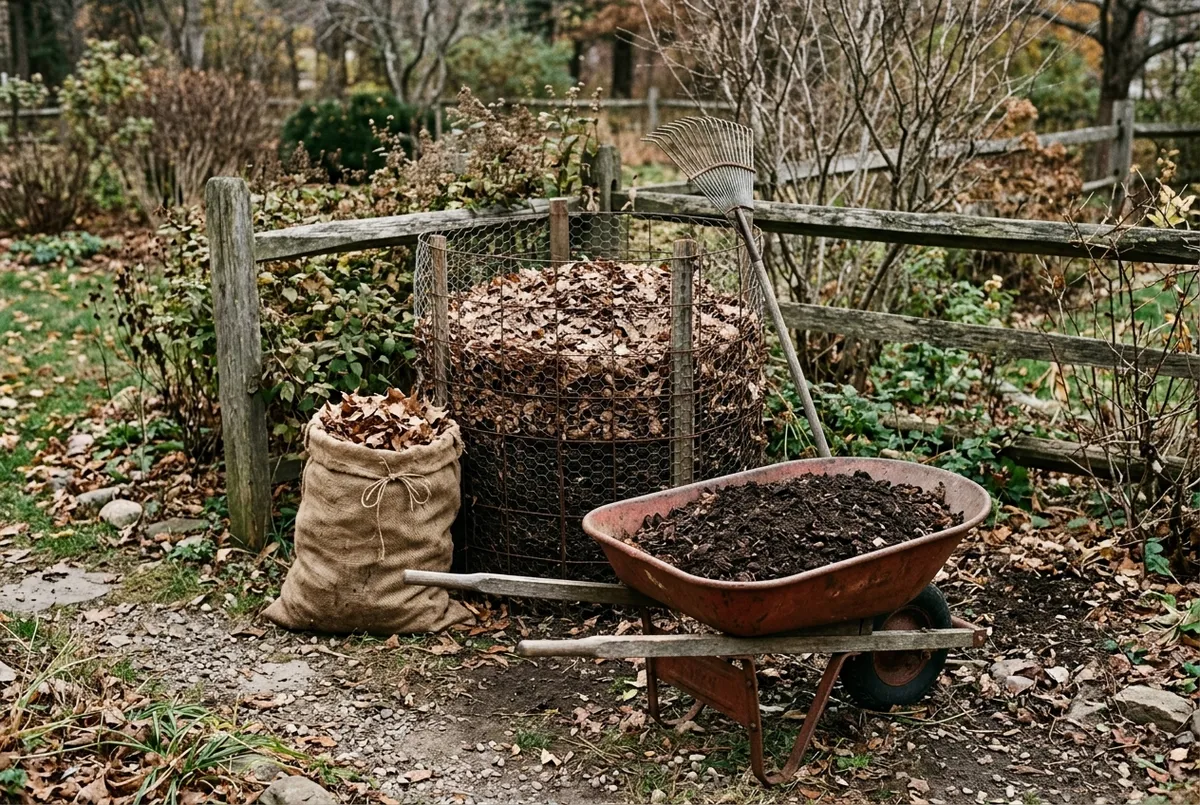
Your yard is buried in leaves again, and the pile you raked into the corner last October is still sitting there, barely broken down. You’ve heard leaf mold is supposed to be some kind of free soil amendment, but nobody explains how long it actually takes, why it’s not the same as compost, or what you’re supposed to do with a giant pile of leaves besides wait.
The short answer: Whole leaves left alone take about two years to turn into leaf mold (Penn State Extension, updated Jan. 22, 2025). Shred them, keep the pile moist, and turn it every couple of weeks, and you can have usable leaf mold much sooner, since shredded leaves decay much more quickly than whole ones.
Why Leaf Mold Isn’t the Same as Compost
The pile of grass clippings, kitchen scraps and leaves you toss into a compost bin heats up because bacteria are breaking it down fast. A pile of leaves alone does something different: it decomposes slowly, driven mostly by fungi rather than bacteria, and it never gets hot the way a working compost pile does (University of Georgia Extension, Paulding County, Jan. 18, 2022).
The reason comes down to chemistry. Bacteria that “hot compost” a pile need a carbon-to-nitrogen ratio of roughly 30:1 to work efficiently (Cornell Composting, “C/N Ratio”). Fallen tree leaves typically run around 60:1 carbon to nitrogen, which is too carbon-heavy for that fast bacterial process (University of Georgia Extension, Paulding County). That’s why a pile of leaves by itself just sits there instead of steaming on a cold morning the way a mixed compost pile does. It’s not a failed compost pile. It’s a different process with a different timeline and a different result.
That result matters, too. Leaf mold is mostly weed-free, and while it isn’t a significant source of nutrients the way finished compost is, it’s an excellent soil amendment that improves soil structure, increases water retention, and returns essential elements to the soil over time (Penn State Extension). Think of it less as fertilizer and more as a conditioner that makes whatever soil you already have hold water and drain better.
Two Assumptions That Stall a Leaf Mold Pile
Most people who try this once and give up are working from one of two wrong assumptions.
The first is treating leaf mold as just compost made from leaves. It isn’t. It’s a distinct, cool, fungal-driven process rather than the hot, bacterial one that breaks down a mixed compost pile, and it functions as a soil conditioner rather than a nutrient source, which changes what you should expect from it and how you should use the finished product (University of Georgia Extension, Paulding County, Jan. 18, 2022; Penn State Extension). If you’re checking a leaf pile for the heat and smell of an active compost bin, you’re checking for the wrong signs.
The second is expecting a pile of raked leaves to be ready by spring. Whole leaves typically need about two years (Penn State Extension), and only shredded, actively managed piles finish meaningfully faster. A pile that looks mostly like intact leaves in March isn’t behind schedule. It’s exactly where a leaf pile should be at that point, unless you shredded and turned it from the start.
How Long Does Leaf Mold Actually Take?
This is the part that trips people up, because the honest answer depends entirely on what you do with the leaves.
Left whole and untouched in a pile, leaves take about two years to fully break down into leaf mold (Penn State Extension, updated Jan. 22, 2025). That’s a long wait if you were hoping to use it next spring. But if you shred the leaves first, keep the pile moist, and turn it on a regular schedule, Penn State Extension puts the timeline at roughly 6 to 12 months (Penn State Extension).
The size of the material is the biggest lever you have. The smaller the pieces, the faster they decompose, which is the whole logic behind running a mower over a leaf pile before you stack it (Iowa State University Extension and Outreach, updated Sept. 27, 2024). If you’re the kind of gardener who wants leaf mold ready for next fall’s planting rather than the one after, shredding isn’t optional. It’s the step that makes the whole project realistic on a homestead timeline instead of a forestry timeline.
How to Build a Leaf Mold Pile That Actually Works
You don’t need anything elaborate for this. A leaf mold pile is closer to a slow-cooked side project than an active build, and the setup takes an afternoon at most.
Choose a Container
Penn State Extension describes a few workable options: a wood or wire bin roughly 3 to 6 feet in diameter and at least 3 feet tall, or a large plastic bag closed loosely to allow some airflow (Penn State Extension). A simple wire cage made from hardware cloth or chicken wire works fine and lets you see how the pile is settling without opening anything up. If you’d rather not build one from scratch, a purpose-built compost bin sized for this kind of pile saves you a Saturday.
Bagging It Instead of Building a Bin
If you’d rather not build anything, a large plastic bag with slits cut into the sides for airflow is a legitimate leaf mold container, not just a lazy shortcut (University of Georgia Extension, Paulding County). Fill it with shredded leaves, wet them down, cut a few slits so air and moisture can move through, and tuck it somewhere out of direct sun where it won’t get knocked over. It’s the option that makes sense for a small yard or a renter who doesn’t want to build a permanent bin. The tradeoff is that a bag is harder to turn than an open bin, so check it a little more often to make sure it hasn’t dried out in the middle.
Shred If You Can
Run a mulching mower over the leaves, bag them with a leaf vacuum, or pile them and go over them with a string trimmer. The goal is smaller pieces with more surface area exposed to moisture and fungi, which is what actually shortens the two-year timeline (Iowa State University Extension and Outreach, updated Sept. 27, 2024). Whole leaves aren’t wrong, they’re just slower, so skip this step only if you’ve genuinely got two years of patience.
Pack, Moisten and Turn
Pack the shredded or whole leaves into your bin, wetting them down as you go so the pile is damp but not soaked. From there, the routine is simple maintenance rather than active work: keep the pile moist through dry stretches, and turn it about once every two weeks (Iowa State University Extension and Outreach, updated Sept. 27, 2024). A pile that’s allowed to dry out will stall no matter how well you shredded it going in.
Know When It’s Ready
Finished leaf mold is dark brown with a pleasant earthy smell and a crumbly texture, rather than recognizable leaves (Penn State Extension). There’s no exact test date since it depends on how well you kept up with moisture and turning, but with shredded leaves and a pile kept damp and turned, Penn State’s 6 to 12 month range means you can start checking in late spring of the following year.
Can Leaf Mold Replace Regular Compost?
Not exactly, and this is worth being clear-eyed about before you commit a whole fall’s worth of leaves to one pile instead of your compost bin. Leaf mold and compost do different jobs. Compost from a mixed pile of kitchen scraps, grass clippings and leaves breaks down hot and fast, and it delivers meaningful nutrients back into your soil. Leaf mold, by contrast, is mostly weed-free and improves structure and water retention, but it isn’t a strong nutrient source (Penn State Extension).
The practical answer is that most yards benefit from both. If you’re weighing whether a hot compost system, a cold pile, or leaf mold makes more sense for your setup, the tradeoffs between hot and cold composting are worth understanding before you decide how to split your yard waste between the two (How to Build a Backyard Compost System: Hot vs. Cold Composting). Leaf mold is a supplement to that system, not a replacement for it.
That also applies if you’re deciding what equipment to add to your setup this season. A tumbler is built for the faster, hotter composting of kitchen scraps and grass clippings, while leaf mold is a slow, cold, fungi-driven process (University of Georgia Extension, Paulding County), so a tumbler isn’t the tool for it. If you’re trying to figure out which piece of gear actually earns its spot in a small yard, it helps to see how a tumbler and a worm bin compare on what they’re each good at (Compost Tumbler vs. Worm Factory: Which Makes Soil Faster?) before deciding where your leaf mold bin fits alongside them.
Using Leaf Mold in the Garden
Once it’s finished, leaf mold is straightforward to use. UGA Extension points to two basic applications: spread it as roughly a 2-inch mulch layer over garden beds, or till it directly into the soil in early spring before planting (University of Georgia Extension, Paulding County). Because it’s mostly weed-free, it’s a reasonable option for beds where you don’t want to introduce weed seed the way you might with a poorly managed compost pile.
If you’re already investing in raised beds or building up garden soil for fall planting, leaf mold is a low-cost way to improve what you’re working with without buying bagged soil amendments every season. For readers weighing whether a dedicated raised bed setup is worth the upfront cost, it’s worth reading a straight comparison before you spend (Is a Cedar Raised Bed Worth It for Fall Planting?) so the leaf mold you’re making has good soil to go into in the first place.
None of this requires precision. Spread it as mulch, or work it in lightly if you’re tilling, and let it do its slow work over the growing season. It’s a low-stakes way to put a fall chore back into your soil instead of hauling it to the curb.
Leaf Mold’s pH, Carbon-to-Nitrogen Ratio and Potassium
Oregon State University Extension puts numbers on what leaf mold brings to a garden bed (Oregon State University Extension Service, reviewed 2026). Leaf mulch, or leaf mold (partially decomposed leaves), has a near-neutral pH of 6 to 7.5.
The carbon-to-nitrogen ratio is about 50:1 in fresh leaves and falls below 20:1 when the leaves are fully composted. Most kinds of leaves are a good source of potassium: a 2-inch application supplies about 0.3 to 3 lb of potash (K2O) per 1,000 square feet.
There is one limit to keep in mind. Because leaves decompose rapidly, they are not as useful as one-time applications in increasing organic matter as yard trimmings compost. Oregon State’s suggestion for an annual vegetable or flower garden is a fall mulch of 1 to 2 inches of leaves, which adds organic matter, protects soil from raindrop impact and smothers winter annual weeds. In spring, the remaining leaf debris may be dug or rototilled into the soil.
Next Step
Rake or mow this fall’s leaves into a wire bin or slitted bag before the ground freezes, shred what you can on the way in, and commit to keeping the pile damp and turning it every couple of weeks through winter. That single habit is the difference between leaf mold ready much sooner and a slow-rotting pile you’re still waiting on two years from now.
Frequently Asked Questions
- How long does it actually take to make leaf mold?
- Whole, unshredded leaves piled and watered take about two years to break down into leaf mold (Penn State Extension, updated Jan. 22, 2025). Shredding them, keeping them moist, and turning the pile speeds that up, since shredded leaves decay much more quickly than whole ones.
- Can leaf mold replace regular compost in my garden?
- Not exactly. Leaf mold is mostly weed-free and improves soil structure and water retention, but unlike compost it isn't a significant nutrient source, so it works best as a supplement to compost rather than a replacement for it (Penn State Extension).
- Do I need to shred leaves first, or can I just pile them whole?
- Shredding isn't required, but it speeds decomposition because smaller pieces break down faster (Iowa State University Extension and Outreach, updated Sept. 27, 2024). Whole leaves work too, they just take longer, about two years.
- What's the difference between leaf mold and plain mulched leaves?
- Leaf mold forms through a slow, cool, fungal-driven decomposition process, distinct from the hot, bacteria-driven process of a mixed compost pile (University of Georgia Extension, Jan. 18, 2022). Freshly mulched leaves are just shredded leaves; leaf mold is what they become after months of moisture and decomposition.
- Can I make leaf mold in a trash bag instead of a bin?
- Yes. UGA Extension describes filling a large plastic yard waste bag with shredded leaves, tying it off, and cutting a few slits for airflow. Penn State Extension suggests a bag closed loosely to allow some airflow, or a wood or wire bin roughly 3 to 6 feet in diameter and at least 3 feet tall.
Sources & references
- Penn State Extension (opens in new tab)
- University of Georgia Extension (Paulding County) (opens in new tab)
- Cornell Composting (opens in new tab)
- Iowa State University Extension and Outreach (opens in new tab)
- Oregon State University Extension Service, Improving garden soils with organic matter (EC 1561) (opens in new tab)
Before you go
The Renter's Homestead Pack
Self-reliance projects for the yard you don't own — container yields, a raised bed built to move with you, balcony preservation basics, and the landlord questions to ask first.
Free guide
The Renter's Homestead Pack
Self-reliance projects for the yard you don't own — container yields, a raised bed built to move with you, balcony preservation basics, and the landlord questions to ask first.