What’s the short answer?
- ARBA's comfort range for rabbits is 55°F-70°F, but rabbits acclimated to the cold are quite hearty in extreme cold; heat above 85°F is the bigger risk per ARBA.
- UAF Extension housing guidance calls for a partly roofed, draft-free hutch out of rain and snow with enough ventilation to prevent ammonia buildup.
- During hard cold snaps: add extra straw or hay bedding, put a solid board over wire flooring (UAF Extension), increase feed, and check water daily so it doesn't freeze (ARBA).
Your rabbits are living in an open-air hutch, the budget has no room for wiring in supplemental heat, and the coldest stretch of the year is closing in. Search a few forums and you’ll find one camp insisting a heat lamp is non-negotiable, and another insisting rabbits are basically wild animals that need nothing from you at all. Here’s what the breed and extension organizations actually publish.
The short answer: A healthy adult rabbit that has been gradually acclimated to the cold does not need a heated hutch to survive winter outdoors; what it needs is a draft-free, partly roofed shelter, extra bedding during hard cold snaps, more feed to cover the extra energy it burns staying warm, and water checked at least once a day so it doesn’t freeze over.
How Cold Is Too Cold for a Backyard Rabbit?
The American Rabbit Breeders Association (ARBA) puts the ideal environmental range for rabbits at 55°F to 70°F (ARBA). That sounds narrow, but it describes comfort, not survival. The same guidance describes rabbits as “quite hearty in cases of extreme cold, provided they have been acclimated to such temperatures” (ARBA). The acclimation part matters as much as the cold-tolerance part, and it’s the piece most backyard advice skips.
Heat, not cold, is where ARBA draws its harder line: the organization warns that rabbits “do not do well when temperatures exceed 85°F” (ARBA). If you’ve been more worried about January than July, the guidance points the other way. A rabbit that has spent the fall living outside, with its coat thickening on its own schedule, is in a fundamentally different position than one moved from a heated garage into a hutch during the season’s first hard freeze.
Acclimation isn’t a switch you flip once; it’s the reason rabbits kept outdoors year-round tend to handle winter more easily than rabbits that spend summer indoors and only go out once the weather turns. If your setup has been mostly indoors and you’re moving toward year-round outdoor housing, making that move earlier in the fall, while nights are still mild, gives a rabbit’s coat and metabolism time to catch up before it actually needs to. That’s also the logic behind planning this kind of change well ahead of the coldest months rather than in the middle of them: the coldest stretch of winter is still ahead of a fall setup, not already on top of it, which is exactly when gradual acclimation has room to work.
Do You Really Need a Heat Lamp?
Not for a healthy, gradually acclimated adult. The persistent idea that a rabbit hutch needs supplemental heat to get through winter doesn’t hold up against ARBA’s own guidance, which says rabbits acclimated to cooler temperatures do quite well without heaters; the real risks it flags are lack of acclimation and exposure to wind, rain, and snow, not cold air by itself (ARBA). Watch behavior rather than a thermometer alone: a rabbit that’s not eating normally, seems reluctant to move, or is huddled rather than lounging is telling you something regardless of what the forecast says. Running through ARBA’s flagged risks, wind, wet, and unacclimated exposure, is the practical checklist worth working through before assuming a healthy adult needs supplemental heat.
If you decide you want supplemental heat or lighting anyway, treat the wiring as its own project. Running mains AC power to an outdoor hutch (new circuits, outdoor-rated sockets, breakers) is a job for a licensed electrician and your local code official, not a weekend DIY task. Low-voltage DC options, like a battery-powered light, sit outside that concern. The University of Alaska Fairbanks Cooperative Extension Service, writing for a climate considerably harder on rabbits than most of the Lower 48, recommends adding supplemental full-spectrum lighting in winter since natural daylight is limited (University of Alaska Fairbanks Cooperative Extension Service). Light, not heat, is the intervention it calls out.
What the Hutch Itself Needs to Handle Winter
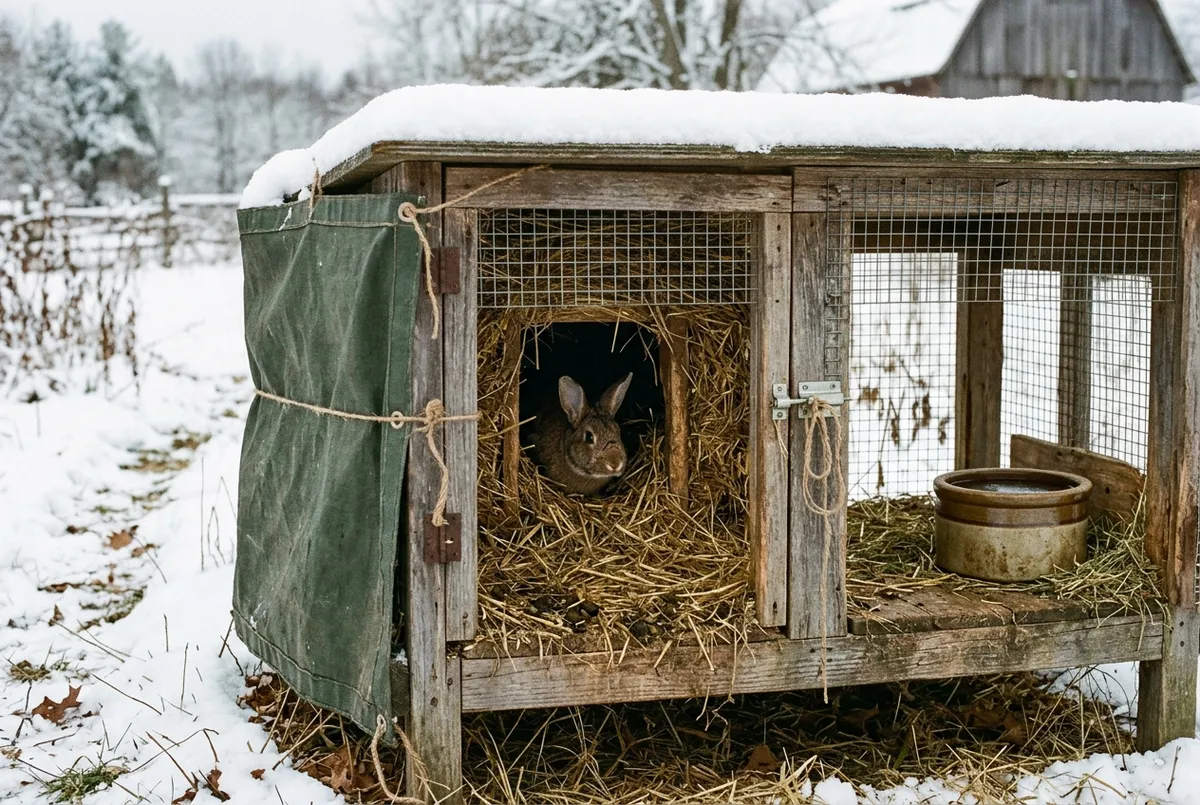
Extension housing guidance is more specific than “put it outside.” Cages should be at least partially roofed and positioned out of direct sunlight, drafts, rain, and snow, with ventilation adequate to prevent ammonia buildup (University of Alaska Fairbanks Cooperative Extension Service). Those last two requirements pull in opposite directions: sealed enough to block wind and wet, open enough that ammonia from waste doesn’t build up in the air your rabbit is breathing. Getting that balance right matters more in winter than any other season, because a closed-up hutch traps both moisture and ammonia at once.
If you’re already working through a fall prep list for other backyard animals, the shelter logic is the same one covered in 7 Fall Chores to Get Chickens and Bees Ready for Winter: block the wind and the wet, don’t block the air.
Positioning matters as much as construction. A hutch tucked against a wall or fence on the side prevailing winter wind comes from blocks more cold than extra material added to a structure left facing straight into it. Pair that placement with a roof overhang wide enough to keep rain and snow off the opening, and you’re covering the shelter from wind, rain, and snow that ARBA calls for (ARBA) without adding anything electrical.
Bedding and Flooring During Cold Snaps
Wire-bottom cages are standard for sanitation, but wire floors offer no insulation, and a rabbit sitting on bare wire in a cold snap is losing heat it can’t easily replace. ARBA recommends adding extra straw or hay bedding to wire-bottom cages for insulation during sudden extreme cold (ARBA). The University of Alaska Fairbanks Cooperative Extension Service goes a step further for its climate, recommending a solid board placed on the hutch floor during cold snaps so rabbits have somewhere to get off the wire entirely (University of Alaska Fairbanks Cooperative Extension Service).
A solid board doesn’t need to cover the whole floor to help. Laying it under where a rabbit typically rests, and pulling it back out once the cold snap passes, keeps the wire floor’s sanitation advantage intact for the rest of the season.
Watching for a Cold Snap, Not Just “Winter”
Both of these recommendations are tied to sudden extreme cold specifically, not the season as a whole. A rabbit that’s acclimated to a normal winter in your region can typically manage the everyday cold; it’s the sharp drop below what’s typical for your area and your rabbit’s coat that calls for the extra bedding and the solid board. It’s worth building a habit of checking a forecast a day or two out rather than reacting after the fact.
Keeping Water From Freezing Without a Heated Hutch
This is where an unheated setup takes the most daily effort. ARBA is direct about it: water must be checked daily, or more often in extreme cold, and watering nozzles checked daily to make sure water is actually flowing (ARBA), since a frozen bowl or nozzle leaves a rabbit without water. Without a heated hutch or an electric heated waterer, that means a manual routine: morning and evening checks during a hard freeze, a spare water container ready to swap in, and a habit of testing that a nozzle-style bottle hasn’t iced shut even when the bowl underneath looks fine.
If you keep a mixed flock and already rely on an electric solution for poultry, our Heated Chicken Waterer Review covers how well that approach handles the same freezing problem for chickens. That’s useful context for deciding where you’re comfortable running power outdoors and where you’d rather not.
Rotating two water containers, one in use and one thawing indoors, cuts down on how often you’re outside chipping ice, and it means a frozen container never leaves a rabbit without water while you deal with it.
Adjusting Feed for Winter Energy Needs
Rabbits burn more energy simply maintaining body temperature once it’s cold, and ARBA’s guidance notes they need more feed in winter as a result (ARBA). An unheated hutch makes this more relevant, not less: a rabbit that’s doing its own thermoregulation, rather than sitting in a climate-controlled space, has a higher baseline energy cost to cover. Watch body condition through the season rather than assuming a fixed increase works for every rabbit, since coat thickness, age, and how sheltered a particular hutch is all change how much extra a given animal actually needs. A rabbit that’s losing weight or leaving feed untouched during a cold stretch isn’t adjusting to the extra energy demand on its own, and that’s worth treating as a signal to check the hutch itself, not just the feed bowl, since a drafty or damp shelter can undercut even a properly increased ration.
Which Rabbits Still Belong Indoors
ARBA’s cold-hardiness guidance is conditional on acclimation, not a promise for every rabbit in every condition. Kits, seniors, and sick or recovering rabbits don’t have the same reserves, and moving them indoors during hard cold is the safer call even if your adult breeding stock is doing fine outside.
It’s also worth knowing that commercial-scale guidance doesn’t match this backyard picture, and that’s by design rather than contradiction. Penn State Extension’s rabbit-production guidance, aimed at larger operations, calls for an enclosed rabbitry building with heating and ventilation systems, stating plainly that “rabbits do not tolerate temperature extremes very well” (Penn State Extension). That standard exists for a different context (dense housing, production economics, animals bred and managed at scale) and isn’t a reason to distrust ARBA’s guidance for a handful of healthy adult rabbits in a well-built backyard hutch. If your own instinct is closer to Penn State’s caution than ARBA’s cold-hardiness claim, our piece on how cold is too cold for backyard chickens walks through the same acclimated-versus-vulnerable distinction for a different animal, if a second worked example helps it click.
Watching a young or newly acquired rabbit’s first cold snap closely tells you more than any general rule. If it’s eating, moving normally, and settling into its bedding the way an acclimated adult would, that’s a good sign; if it isn’t, indoors is the safer default until it catches up.
Getting Ready Before the Cold Actually Arrives
None of this works well if it starts the week of the first hard freeze. ARBA’s guidance leans on gradual acclimation, which means the hutch upgrades, the extra bedding on hand, and the winter feed adjustment are all things to sort out while the weather is still mild, not improvise once it isn’t. That’s especially true on a fall timeline like this one: the coldest months are still ahead rather than already here, which is exactly the point in the season when gradual acclimation has room to do its job. A backyard homesteading reference that covers rabbit care alongside the rest of a small property’s seasonal chores is a reasonable next stop if you’re setting this up for the first time and want the fuller picture before the first cold snap hits.
Frequently Asked Questions
- What temperature is too cold for rabbits outside?
- ARBA puts the ideal environmental range for rabbits at 55°F to 70°F, but that describes comfort, not the cold limit. The organization describes rabbits as quite hearty in cases of extreme cold, provided they have been acclimated to such temperatures. ARBA's harder line is actually on heat: it warns rabbits do not do well when temperatures exceed 85°F.
- Do I need a heat lamp for my rabbit hutch in winter?
- Not for a healthy, gradually acclimated adult, per ARBA's guidance, which says rabbits acclimated to cooler temperatures do quite well without heaters. The risks it flags are lack of acclimation and exposure to wind, rain, and snow, not cold air itself. If you do add supplemental heat, running mains AC power to an outdoor hutch is a job for a licensed electrician and your local code official; low-voltage DC options fall outside that concern.
- How do I keep my rabbit's water from freezing outdoors?
- ARBA recommends checking water daily, or more often in extreme cold, since a frozen bowl or nozzle leaves a rabbit without water. Without a heated hutch or electric waterer, that means a manual routine: regular checks during a hard freeze and a spare container ready to swap in.
- Can rabbits survive outdoors in freezing temperatures?
- Yes. ARBA describes rabbits that have been acclimated as quite hearty in cases of extreme cold. That guidance hinges on acclimation; young, senior, or sick rabbits are safer brought indoors during hard cold.
- How do I winterize a rabbit hutch without electricity?
- Per University of Alaska Fairbanks Cooperative Extension, keep the hutch at least partially roofed and out of direct sun, drafts, rain, and snow, with enough ventilation to prevent ammonia buildup. Per ARBA, add straw or hay bedding during sudden extreme cold, increase feed since rabbits burn more energy staying warm, and check water at least daily so it doesn't freeze over.
Sources & references
Before you go
The Renter's Homestead Pack
Self-reliance projects for the yard you don't own — container yields, a raised bed built to move with you, balcony preservation basics, and the landlord questions to ask first.
Free guide
The Renter's Homestead Pack
Self-reliance projects for the yard you don't own — container yields, a raised bed built to move with you, balcony preservation basics, and the landlord questions to ask first.