What’s the short answer?
- A 1,500W heater uses 1,500 watt-hours per hour; the 750W low setting uses about 750 Wh per hour.
- 1,500W draws about 12.5 amps on a 120V circuit, so plug it straight into a wall outlet, never an extension cord or power strip.
- A typical ~1,000Wh power station drains in well under an hour running a 1,500W heater once inverter losses are counted.
- Extreme cold cuts a lithium battery's discharge capacity, and it should not be charged below freezing without built-in self-heating.
- Space heaters cause about 29% of home heating fires but 77% of the related deaths, per NFPA (2019-2023).
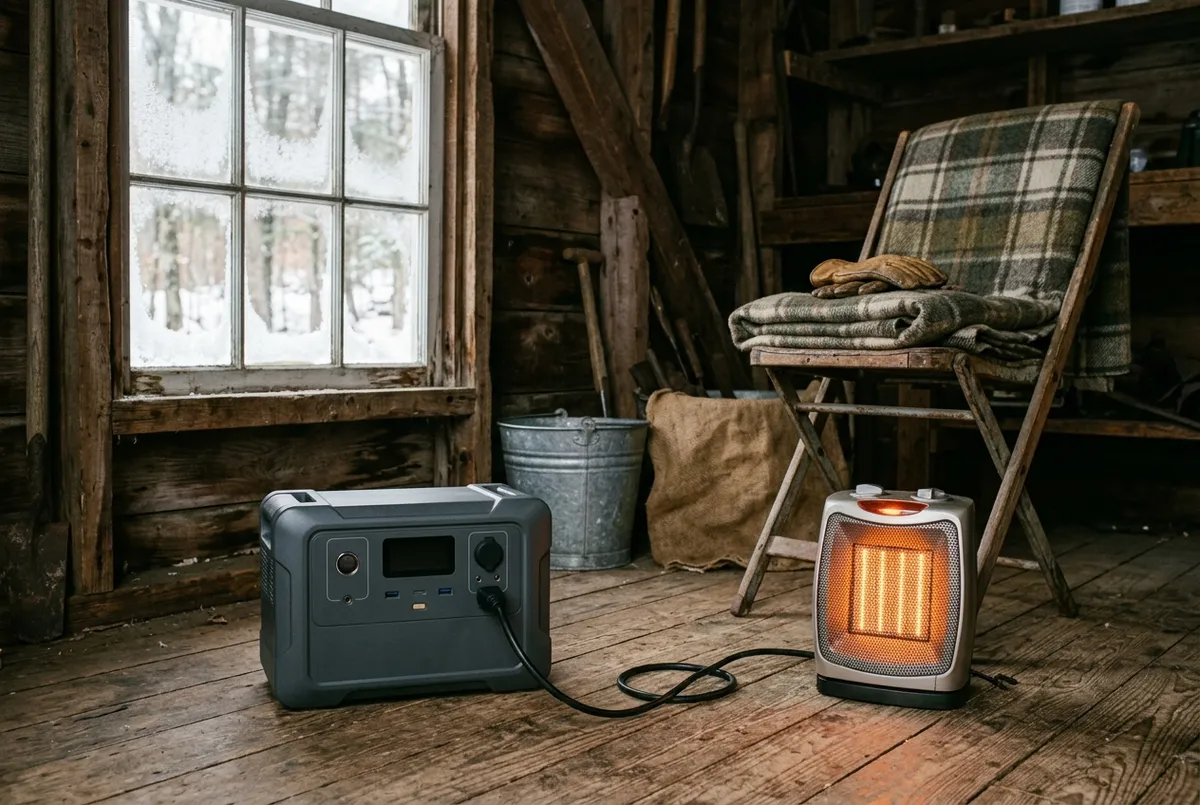
You’re staring at a folding space heater in the shed and a power station spec sheet listing a tidy watt-hour number, and reconciling those two numbers decides whether an outage stays comfortable or turns into a long, cold night. A heater’s rated wattage looks like one fixed fact, but how long it actually runs off a battery depends on which setting you use, how much of the battery’s rated capacity is really usable, and how cold the space around that battery is. It’s worth checking this math before any heater goes on a gear list, because the number on the box and the number you actually get are rarely the same story.
The short answer: A typical portable electric space heater draws 400-1,500 watts, and on its 1,500W high setting it burns through 1,500 watt-hours of battery capacity every hour it runs, enough to drain a common ~1,000Wh-class power station in well under sixty minutes. Realistic off-grid heat means either a much larger battery bank or running the heater on its lower setting for longer stretches.
How Many Watts Does a Portable Space Heater Actually Draw?
Portable electric space heaters typically draw 400 to 1,500 watts, with 1,500W as the standard maximum rating for a plug-in unit (Office of Congressional Workplace Rights). That 1,500W figure is the number printed on the box and the one most buying guides quote, but it’s a ceiling, not a constant draw.
Many units in this range have at least two settings: a low setting around 750W and a high setting around 1,500W. The heater does not pull its maximum wattage unless it’s set to high. Some models also cycle on a built-in thermostat, dropping to near zero between cycles once the space reaches the target temperature, but the honest way to plan battery capacity is to assume the heater runs continuously at whichever setting you’ve chosen. Planning around the cycling instead is how people end up short on power at hour three instead of hour one, when the thermostat happens to hold the heater on longer than expected.
This is also the root of one of the more persistent misconceptions in off-grid planning: treating a heater’s rated wattage as what it always draws. It’s what it draws at maximum. Watt-hour consumption scales with whichever setting is actually running, not with the number stamped on the housing.
The Watt-Hour Math: What One Hour of Heat Actually Costs
Watt-hours are just watts multiplied by hours, and that’s the entire calculation. Running a 1,500W heater for one hour consumes 1,500 watt-hours, or 1.5 kWh. Drop to the low 750W setting and you use about 750 Wh per hour, roughly half the draw for a roughly proportional amount of heat output on smaller units.
That single fact is why “a 1,500W heater is a normal off-grid backup option” doesn’t hold up once you run the numbers. A power station’s capacity rating and a heater’s hourly consumption are the same unit, watt-hours, which makes the comparison direct: divide the battery’s usable watt-hours by the heater’s wattage and you get a rough number of hours of runtime, before accounting for the inverter losses covered below.
A quick way to size it yourself
Take the power station’s rated capacity, subtract about 15% for inverter losses (Anker SOLIX), and divide by the heater’s wattage on the setting you’d actually run. A 1,000Wh unit running a 1,500W heater on high works out to roughly 850Wh of usable capacity divided by 1,500W, which is well under an hour. The same 1,000Wh unit on the 750W low setting gets you closer to an hour, still not the overnight stretch most people picture when they buy a power station for this purpose.
How Many Amps Does a 1,500-Watt Heater Draw, and Can It Run on a 15-Amp Circuit?
On a standard 120V household circuit, a 1,500W heater draws about 12.5 amps (1,500W ÷ 120V), a large share of a standard 15-amp circuit’s capacity. The safety guidance is to plug the heater directly into a grounded wall outlet, not an extension cord or a power strip (Office of Congressional Workplace Rights). Anything else sharing that circuit, a lamp, a phone charger, a second small appliance, pushes the combined draw closer to the breaker’s trip point.
This is where the math stops being about batteries and becomes a household wiring question, and that’s outside what this guide covers. If you’re not certain a given outlet or circuit is rated to carry a heater running for hours at a time, that’s a question for a licensed electrician or your local code official, not a guess made in the moment during an outage. Low-voltage DC setups, running an equivalent heat load through a battery and inverter rather than household wiring, are a different circuit entirely and the focus of the next section.
What Size Power Station Do You Need to Run a Space Heater Overnight?
Here’s where the watt-hour math meets the marketing copy on a power station’s box. A 1,500W heater run continuously will drain a typical ~1,000Wh-class portable power station in well under an hour once inverter losses, commonly modeled at about 15%, are factored in (Anker SOLIX). That’s the class of power station most commonly marketed for weekend camping trips and phone charging, and it simply isn’t sized for continuous space heating.
Getting through a single overnight outage, say eight hours, at 1,500W continuous would require roughly 12,000 watt-hours of capacity before inverter losses, and more once those losses are added back in. That’s a battery bank, not a portable unit you carry with one hand. If you’re shopping for a power station specifically to run a heater, the capacity comparison matters more than which brand’s case it’s in; see 300W vs 1000W Solar Generator: What You Actually Need for how those capacity numbers translate to real device runtimes, and Bluetti AC180 vs EcoFlow: Which Wins a Winter Blackout? for how two specific units compare on a winter outage workload.
Manufacturer guidance is consistent on this point: size the battery capacity to the load you actually intend to run, or drop to a much lower-wattage heat source if realistic off-grid runtime matters more than raw heat output (Anker SOLIX). Neither option is a shortcut around the arithmetic, one just changes which side of the equation you’re adjusting.
Is the 750W or 1,500W Setting More Realistic for Battery-Powered Backup Heat?
For anyone running heat off a battery rather than a wall outlet, the low setting is the more honest starting point. At 750W, a heater draws half the watt-hours per hour that it does on high, which roughly doubles the number of hours a given battery can support it. It also draws close to half the amps, which matters less on battery power than on a household circuit, but the watt-hour arithmetic holds either way: less draw per hour means more hours per charge.
That doesn’t turn a small power station into an overnight heating solution on its own. Halving the draw from an unworkable number still leaves a large number: a ~1,000Wh-class unit running a 750W heater still empties in roughly an hour once losses are included, not the full night most people are picturing when they buy one. The heater’s rated wattage is what it draws at maximum, not what it always draws, and that distinction only helps if you’re also honest about how much usable capacity remains even at the lower setting.
If the goal is stretching a fixed amount of stored power as far as possible, the low setting paired with closing off and heating the smallest space you can, rather than an entire room, does more for total runtime than any single piece of gear.
Cold Storage Cuts Into Your Battery’s Real Capacity
There’s a second variable that most runtime math skips entirely: temperature. Extreme cold reduces a lithium battery’s discharge capacity, and lithium batteries should not be charged below freezing, 32°F/0°C, unless they have built-in self-heating (BLUETTI). That matters directly for anyone planning to run a heater off a power station that’s been sitting in an unheated garage or shed during a winter outage, which is exactly the scenario where you’d want that heater working.
The practical fix is straightforward: bring the power station into the conditioned space you’re heating, or the space closest to it, rather than leaving it in the cold outbuilding where the heater lives. A battery rated for 1,000Wh at room temperature is not the same battery at 20°F, and the runtime numbers above already assume best-case conditions before that cold-weather penalty gets applied on top.
The Safety Math You Can’t Skip
The watt-hour and amperage numbers above are the planning math. This is the safety math, and it doesn’t get a lower setting.
Space heaters and heating stoves account for roughly 29% of home heating equipment fires but about 77% of the associated deaths and 71% of injuries, according to NFPA’s most recent analysis covering 2019-2023 (National Fire Protection Association, 2019-2023). A CPSC safety release also reported more than 5,000 emergency room visits in a single year for space heater injuries, more than two-thirds of them for burns, with about half of the injured being children under 5 (U.S. Consumer Product Safety Commission).
Everything else in this guide is technique; that rule is safety. Plug the heater directly into a wall outlet, give it the clearance the manufacturer specifies, turn it off when you leave the room or go to sleep (National Fire Protection Association), and keep it away from bedding, curtains, and anything else that burns. None of the watt-hour planning above changes those basics, and no amount of battery capacity makes a heater running too close to combustibles a reasonable risk.
If reducing the heat load itself is part of the plan, so the heater doesn’t have to run as hard or as long to keep a space livable, insulating that space does more for total watt-hour consumption than any battery upgrade; see DIY Storm Window Insulation Kit: Cut Heating Costs for one way to cut that load before the heater ever turns on.
What This Means for How You Plan Off-Grid Heat
Put the pieces together and the picture is consistent rather than contradictory. A space heater’s rated wattage tells you almost nothing about real-world runtime until you know which setting it’s on, what the battery’s usable capacity actually is after inverter losses, and how cold that battery has been sitting. A ~1,000Wh-class power station is built for phones, laptops, and small appliances, not for hours of continuous 750-1,500W heat, and no amount of optimistic rounding changes that math.
None of this means battery-powered backup heat is off the table, only that it needs to be sized honestly. That’s either a much larger battery bank than the entry-level camping unit on the shelf, a heat source with a genuinely lower wattage draw, or accepting that the power station’s job during an outage is short bursts of warmth rather than an all-night heating solution.
Run the numbers for your own setup before the outage, not during it: your heater’s actual wattage on the setting you’d realistically use, multiplied by the hours you need, against your power station’s real usable capacity after inverter losses and cold-weather derating. That comparison, done in daylight with a calculator, is what tells you whether the gear you already own can do the job or whether it’s time to size up.
Frequently Asked Questions
- How many watt-hours does a 1,500-watt space heater use per hour?
- Running continuously on high, a 1,500W heater consumes 1,500 watt-hours (1.5 kWh) every hour. On the 750W low setting it uses about 750 Wh per hour, roughly half the draw.
- How many amps does a 1,500W space heater draw, and can it run on a 15-amp circuit?
- About 12.5 amps on a standard 120V household circuit (1,500W divided by 120V), a large share of a 15-amp circuit's capacity. Safety guidance is to plug a space heater directly into a grounded wall outlet, not an extension cord or power strip.
- Will a compact ~1,000Wh power station run a 1,500W heater overnight?
- No. At 1,500W it will drain in well under an hour once inverter losses, commonly modeled at about 15%, are factored in. Overnight heat needs a much larger battery bank or a far lower-wattage heat source.
- Does cold weather affect a power station's runtime?
- Yes. Extreme cold reduces a lithium battery's discharge capacity, and lithium batteries should not be charged below freezing (32°F/0°C) unless they have built-in self-heating, which matters if the power station is stored in an unheated garage or shed during a winter outage.
- How dangerous are space heaters, statistically?
- NFPA data covering 2019-2023 shows space heaters and heating stoves cause about 29% of home heating equipment fires but 77% of the associated deaths and 71% of injuries. A CPSC safety release reported more than 5,000 space heater injury emergency room visits in a single year, more than two-thirds of them for burns.
Sources & references
- Office of Congressional Workplace Rights, Portable Space Heaters (opens in new tab)
- National Fire Protection Association, U.S. home heating fires peak during winter months (opens in new tab)
- U.S. Consumer Product Safety Commission, space heater safety warning (opens in new tab)
- Anker SOLIX, Portable Power Station for Heater (opens in new tab)
- BLUETTI, Battery-Powered Portable Heater (opens in new tab)
Before you go
The Renter's Homestead Pack
Self-reliance projects for the yard you don't own — container yields, a raised bed built to move with you, balcony preservation basics, and the landlord questions to ask first.
Free guide
The Renter's Homestead Pack
Self-reliance projects for the yard you don't own — container yields, a raised bed built to move with you, balcony preservation basics, and the landlord questions to ask first.