What’s the short answer?
- A stranded car with no heat running tends to drift toward the outside air temperature over time.
- Hypothermia can begin above 40°F if you're wet or chilled, not only in extreme cold (CDC).
- A snow-blocked tailpipe with closed windows can push carbon monoxide to lethal levels in about 2.5 minutes (BMC Emergency Medicine).
- Cracking a window only delays lethal CO levels by a few minutes; it does not remove the risk.
- Only clearing snow at least 12 inches around the tailpipe down to the ground eliminates detectable CO.
- At 0°F with a 15 mph wind, exposed skin can develop frostbite in as little as 30 minutes (NWS).
- AAA recommends running the engine only long enough to remove the chill and making sure the exhaust pipe isn't clogged.
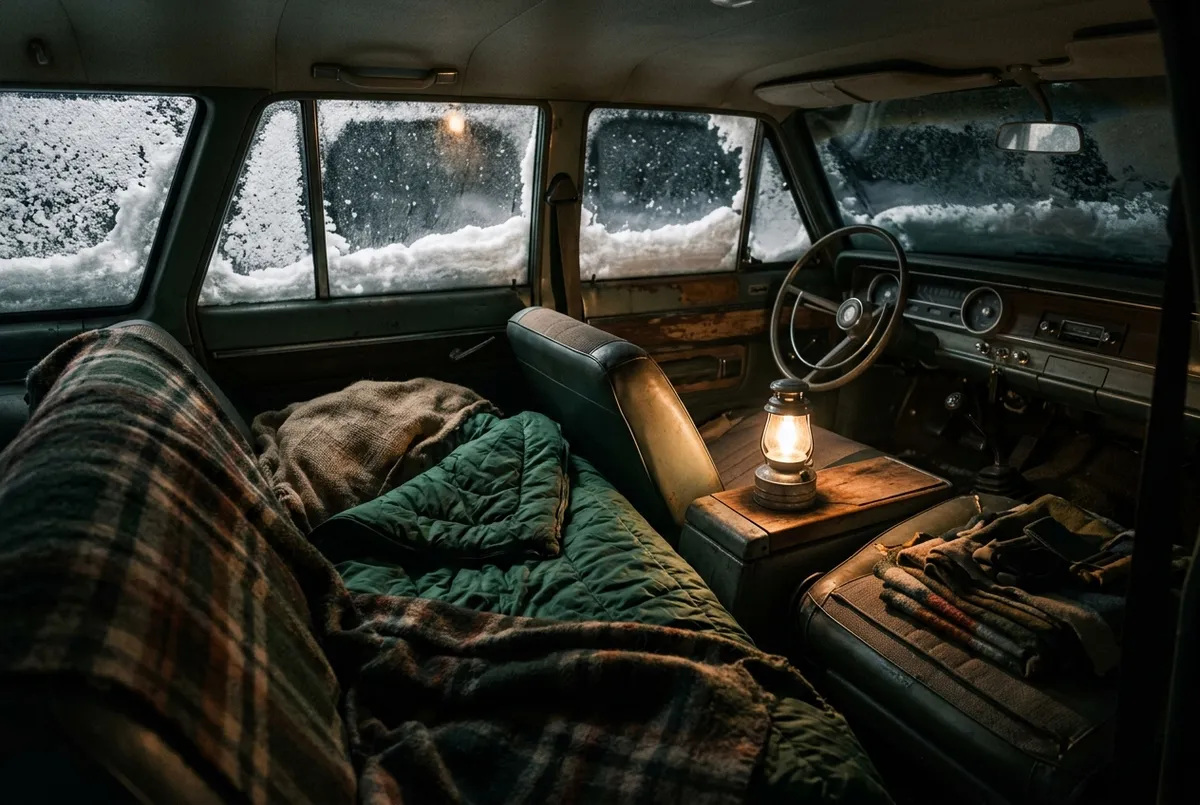
You’re on a rural road when the snow gets deep enough to stop you, or a ditch grabs a tire, and the engine goes quiet while the temperature keeps dropping outside. The dashboard read 28°F when you pulled over, and it’s still falling. The two questions that actually matter now are how cold it will get inside before help arrives, and whether running the engine to stay warm is safer than turning it off.
The short answer: A stranded car with no heat running loses warmth fast and tends to track close to the outside air temperature over time. The bigger danger usually isn’t the cold itself. Hypothermia can start above 40°F if you’re wet or chilled, and carbon monoxide can hit lethal levels in as little as 2.5 minutes if the tailpipe is packed with snow and the windows stay shut.
How Fast Does the Inside of a Car Actually Cool Down?
A parked car with the engine off has almost no insulation working in your favor. The metal shell, glass, and thin door panels shed heat quickly once the engine and cabin fan stop pushing warm air, and over time the interior air tends to converge with the temperature outside. Body heat and a closed cabin slow that drop somewhat, especially with two or more people sharing the space, but a single person alone in a stopped vehicle overnight should plan on the cabin eventually matching the outside air rather than staying meaningfully warmer than it.
Two people generate more shared body heat than one, and staying in the vehicle rather than walking away from it keeps you out of the wind, which matters more than most people expect once you factor in how much heat moving air pulls off exposed skin and thin window glass. Even so, a closed cabin with no heat source is not a warm room. It’s a windbreak, not an insulated shelter, and treating it as the second thing rather than the first is where a lot of the risk in this scenario actually comes from.
That’s why the next two questions matter more than the exact number on the thermometer: what that cold actually does to your body, and what running the engine to fight it can do to the air you’re breathing.
How Long Can You Actually Last Stranded in Freezing Temperatures?
There’s no single hour count that applies to every stranded driver, because survival time here depends on more than the raw air temperature alone: whether you’re wet or dry, whether you’re sheltered from wind, and whether you’re using the engine safely or exposing yourself to carbon monoxide while trying to stay warm. What the clinical staging in the next section makes clear is that the danger isn’t a cliff edge, it’s a slide. A dry, sheltered person who starts shivering (Stage 1) has meaningfully more time and more warning than a wet, wind-exposed person heading straight toward the impaired consciousness of Stage 2. The practical version of “how long can I last” is really “how long can I stay dry, out of the wind, and free of carbon monoxide,” and every section below is built around extending that window rather than promising a fixed number of hours.
When Does Cold Become Hypothermia?
The Centers for Disease Control and Prevention warns that hypothermia can develop even at temperatures above 40°F if a person becomes chilled from rain, sweat, or submersion in cold water, not only in extreme cold (CDC). That single fact changes how you should think about a stranded-car situation: damp boots, sweat from digging out a tire, or melted snow on your gloves can put you at risk well before the air temperature looks dangerous on its own.
Clinicians classify hypothermia in stages by core body temperature. Stage 1, mild hypothermia, runs about 89.6°F to 95°F, and the person is conscious and shivering. Stage 2, moderate hypothermia, runs below 89.6°F down to 82.4°F, with impaired consciousness, and the person may or may not still be shivering. Stage 3, severe hypothermia, is below 82.4°F, with the person unconscious but vital signs present, and Stage 4 is apparent death with no vital signs, classically below about 75°F (Paal P et al., “Accidental Hypothermia: 2021 Update,” International Journal of Environmental Research and Public Health via PMC, 2022). The CDC’s practical guidance follows that scale: anyone with a body temperature below 95°F needs immediate medical attention (CDC).
The shift from alert shivering toward drowsiness or confusion, both CDC warning signs, is the detail worth remembering. A shivering, alert passenger is still fighting the cold. A passenger who stops shivering and gets sleepy has crossed into a more dangerous stage, not a calmer one, and that’s when a stranded-car situation needs outside help rather than waiting it out.
Is It Safe to Run the Engine and Heat All Night?
This is where the real risk in a stranded car usually shows up, and it isn’t the cold. A peer-reviewed emergency-medicine study measured carbon monoxide inside a snow-obstructed vehicle’s passenger compartment and found that with the windows fully closed and the tailpipe blocked by snow, CO reached the test detector’s maximum reading, 999 ppm, a lethal range, in just 2.5 minutes (Griffin JA et al., BMC Emergency Medicine, Oct 2004).
Cracking a window doesn’t fix the problem the way most people assume. In the same study, cracking a window 1 inch delayed the lethal reading to 5 minutes, and cracking it 6 inches delayed it to 7.5 minutes (BMC Emergency Medicine, Oct 2004). Those are minutes, not hours, and a sleeping or exhausted person is in no position to notice the difference before it matters.
What Actually Stops Carbon Monoxide From Building Up
The same researchers tested what it takes to eliminate detectable CO rather than just delay it. Only fully clearing snow at least 12 inches wide around the tailpipe, down to the ground, eliminated detectable carbon monoxide entirely. Partially sweeping the area, or clearing just one cubic foot around the tailpipe, still let CO climb to 751 ppm and 299 ppm respectively within 7.5 to 10 minutes (BMC Emergency Medicine, Oct 2004).
The practical takeaway is specific: a quick kick at the snow near the exhaust is not the same as clearing a 12-inch-wide path down to bare ground. If you can’t confirm the tailpipe is fully clear, and staying clear as snow keeps falling or drifting, the engine and heater are a real carbon monoxide risk, not a theoretical one.
How Often Should You Run the Engine If You’re Stranded?
AAA’s guidance splits the difference between staying warm and burning fuel or risking exhaust buildup: run the engine and heater only long enough to remove the chill, rather than continuously, and make sure the exhaust pipe isn’t clogged with snow, ice, or mud (AAA Exchange, “Winter Driving Tips”). In practice, that means checking and clearing the tailpipe area every time before you turn the key, not just once when you first got stuck, since snow keeps drifting against a stationary vehicle.
Running the engine in short bursts also stretches your fuel supply, which matters if help is hours away rather than minutes. A car that’s been running continuously since it got stuck has a lot less reserve left for a second or third round of warming later in the night, and a dead battery from hours of idling accessories adds a second problem on top of the cold: no working phone charge, no working hazard lights, and no working heater at all when you eventually need one most.
A short-burst routine also gives you a natural checkpoint. Every time you’re about to restart the engine is a built-in reminder to step out, if it’s safe to do so, and physically confirm the tailpipe area again, rather than assuming the clearing you did an hour ago still holds while snow continues to fall or drift against the car.
What About Frostbite If You Have to Leave the Car?
If you need to walk for help, dig out the tailpipe, or set out a hazard warning triangle, exposed skin is on its own clock. The National Weather Service’s wind chill guidance shows that at an air temperature of 0°F with a 15 mph wind, a wind chill of -19°F, exposed skin can develop frostbite in as little as 30 minutes (National Weather Service, “Cold, Wind Chill, and You”). Wind, not just the thermometer reading, is doing most of the damage in that scenario, which is part of why a stopped car with the windows up is genuinely safer for your skin than standing next to it in open wind, even if the air inside isn’t much warmer.
Keep any outdoor task, clearing snow from the tailpipe included, as short as the job requires, and cover exposed skin before you step out, especially in wind. If you have anyone else in the vehicle who can trade off the tailpipe-clearing job, splitting that exposure between two people keeps any single person’s outdoor time shorter and further from the frostbite window the NWS chart describes.
Carbon Monoxide Symptoms Look a Lot Like the Flu
Carbon monoxide (CO) is an odorless, colorless gas, so you cannot smell or see it. The CDC lists the most common symptoms as headache, dizziness, weakness, upset stomach, vomiting, chest pain, and confusion, and notes that they are often described as flu-like (CDC, Jan 2026).
Sleep changes the picture. The CDC says people who are sleeping, drunk, or under the influence of other substances can die from CO poisoning before they have symptoms. Infants, the elderly, and people with chronic heart disease, anemia, or breathing problems are more likely to get sick from it.
CO is found in the fumes whenever fuel burns in a car or truck. The CDC adds that a small leak in the exhaust system can let CO build up inside the vehicle, and it advises having a mechanic check the exhaust system of a car or truck every year.
What to Actually Do If You’re Stranded Overnight
Put together, the facts above point to a specific order of priorities rather than a single rule. Deal with your body temperature situation first: dry off wet clothing and gloves where you can, since the CDC’s above-40°F hypothermia warning is about dampness as much as raw cold. Before you ever restart the engine, physically check that the tailpipe has a clear path 12 inches wide down to the ground, not just a visible gap, because the emergency-medicine data shows partial clearing still lets CO climb into a dangerous range within minutes. Run the engine and heater in short bursts rather than continuously, matching AAA’s advice, and recheck the tailpipe every single time before you turn the key again. If you have to step outside, budget for the NWS frostbite window at whatever the current wind chill is, then get back inside a properly ventilated, tailpipe-clear vehicle rather than staying out to finish a task.
None of this replaces getting help. A working phone, a general sense of your location, and staying with the vehicle so rescuers can find you all matter more than any single technique in this guide. A get-home bag packed before you ever leave the driveway is what gives you the dry layers, water, and light source this whole scenario assumes you already have on hand, and the same seasonal thinking that keeps a walkway safe applies to a stranded vehicle: our comparison of ice-melt and winter walkway prep covers the broader cold-weather prep that makes a stuck car less likely in the first place.
Next step: check what’s actually sitting in your vehicle’s winter kit right now, not what you remember packing last year, and treat the tailpipe-clearing step above as the one piece of this guide that has to happen correctly every single time, not just the first.
Frequently Asked Questions
- How cold does the inside of a car get overnight with no heat running?
- A parked car with the engine off has little insulation once the cabin fan stops, so the interior air tends to drift toward the outside temperature over time. Two or more people sharing the cabin slow that drop, but a single person should plan on the car eventually matching outside air rather than staying meaningfully warmer than it.
- Is it safe to sleep in a car with the engine and heat running?
- Only if the tailpipe is fully clear. A peer-reviewed emergency-medicine study found that with a snow-blocked tailpipe and closed windows, carbon monoxide inside the cabin reached a lethal reading in just 2.5 minutes. Only clearing snow at least 12 inches wide around the tailpipe down to the ground eliminated detectable CO.
- Should you crack a window if you're stuck in your car during a snowstorm?
- Cracking a window delays lethal carbon monoxide levels but does not eliminate the risk. In the same study, a 1-inch crack delayed the lethal reading from 2.5 to 5 minutes, and a 6-inch crack delayed it to 7.5 minutes. It is not a substitute for physically clearing the tailpipe.
- How often should you run the engine if stranded in winter?
- AAA recommends running the engine and heater only long enough to remove the chill, rather than continuously, and making sure the exhaust pipe isn't clogged with snow, ice, or mud.
- How long can you survive stranded in a car in freezing temperatures?
- There's no fixed number of hours; it depends on staying dry, staying out of the wind, and avoiding carbon monoxide. The CDC warns hypothermia can start above 40°F if you're wet or chilled, and clinical staging shows a conscious, shivering person (Stage 1) is in a less dangerous stage than someone whose consciousness is impaired (Stage 2), who may or may not still be shivering.
Sources & references
- CDC, Preventing winter weather injuries (opens in new tab)
- Paal P et al., Accidental Hypothermia: 2021 Update (PMC/NIH) (opens in new tab)
- BMC Emergency Medicine (via PMC/NIH) (opens in new tab)
- National Weather Service (opens in new tab)
- AAA Exchange (opens in new tab)
- CDC, Carbon Monoxide Poisoning Basics (opens in new tab)
Before you go
The Renter's Homestead Pack
Self-reliance projects for the yard you don't own — container yields, a raised bed built to move with you, balcony preservation basics, and the landlord questions to ask first.
Free guide
The Renter's Homestead Pack
Self-reliance projects for the yard you don't own — container yields, a raised bed built to move with you, balcony preservation basics, and the landlord questions to ask first.