What’s the short answer?
- Cornell Cooperative Extension recommends hardneck garlic for cold climates; softneck suits milder winters and typically stores longer.
- Garlic needs a genuine period of cold to bulb properly, which a hard winter provides naturally (University of Wisconsin-Madison Extension).
- Plant cloves pointy-side up, 3 inches deep, 6-10 inches apart, 3-4 weeks before the ground freezes (Cornell Cooperative Extension Warren County).
- A 4-6 inch mulch layer of hay, straw, or leaves is the main practical lever growers have over winter survival, buffering cloves against winter soil temperature swings.
- Commercial softneck garlic grown in mild-climate California underperforms and can turn unpleasantly hot in flavor when forced through a real cold winter (University of Minnesota Extension).
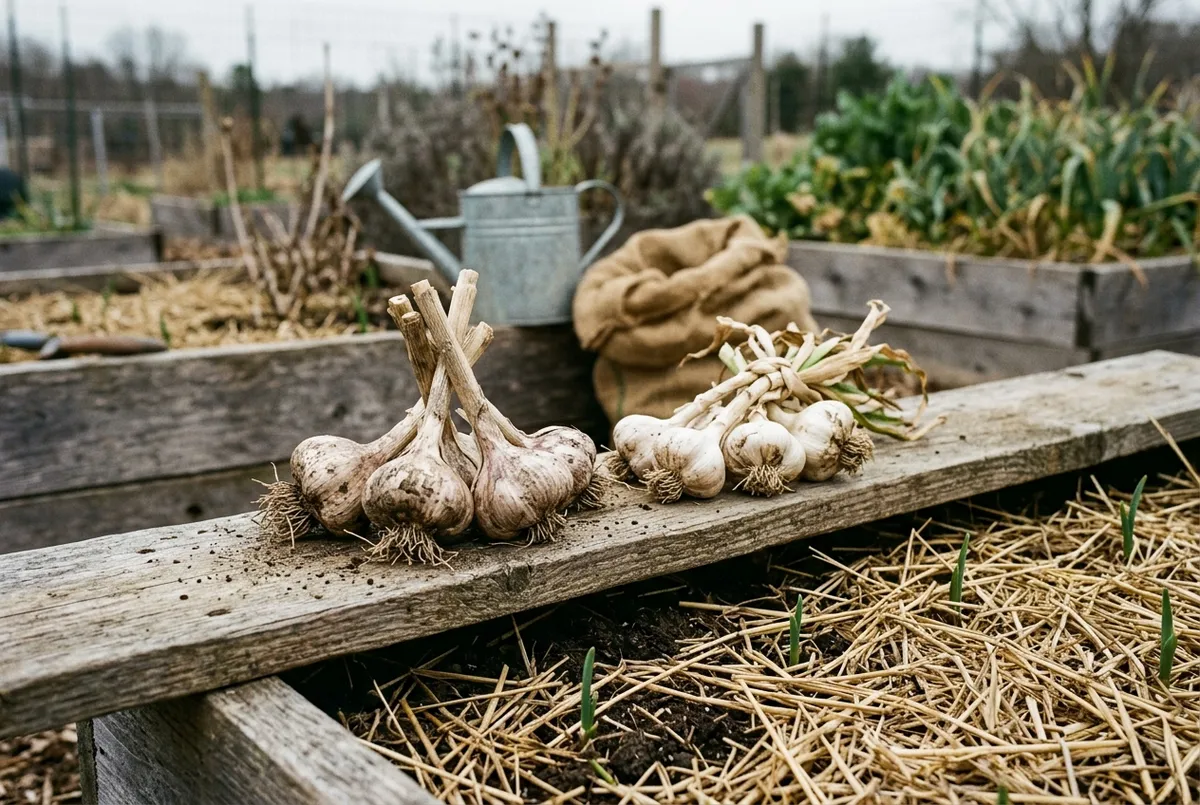
Your garlic order shows up in September, and you’re holding two kinds of seed stock: hardneck and softneck, with no clear signal for which one will actually make it through a hard winter in your yard. Seed catalogs sell both varieties the same way, but they don’t perform the same way once the ground freezes, and picking the wrong one for your climate wastes a full growing season before you find out.
The short answer: In USDA zones 3-6, hardneck garlic is the better choice for surviving a hard winter, because it needs a genuine cold period to develop properly and its genetics are built for that stress. Softneck can still be grown in colder zones, but it isn’t the first choice where winters are severe.
Why Hardneck Needs the Winter You’re Worried About
Hardneck garlic isn’t just cold-tolerant, it’s cold-dependent. To trigger proper bulbing, the cloves need a genuine period of cold (University of Wisconsin-Madison Extension), and hardneck types perform best where winters are long. That’s precisely the chilling a hard winter delivers in USDA zones 3-6. Skip that cold exposure, or blunt it with an unusually mild winter, and the plant struggles to form the distinct, well-separated cloves gardeners expect from a hardneck bulb.
This is the piece that trips up growers moving from a mild climate to a cold one: garlic isn’t a crop you can shelter through winter and transplant later once conditions improve. The cold isn’t a threat to manage around, it’s a required input the plant is counting on. Cornell Cooperative Extension’s Warren County program recommends hardneck garlic specifically for cold climates for this reason (Cornell Cooperative Extension Warren County), while pointing softneck growers toward milder regions instead.
What Softneck Trades Away for Milder Climates
Softneck garlic isn’t a lesser crop, it’s a different one, bred and selected for different conditions. University of Wisconsin-Madison Extension describes softneck types as better adapted to areas with long seasons and mild winters, often storing for 6 to 9 months, while hardneck types generally do not store well (University of Wisconsin-Madison Extension). If you’re gardening somewhere winter is more of an inconvenience than a threat, or your priority is a braid of garlic that lasts deep into next spring rather than a bulb with a bold, complex flavor, softneck is doing exactly what it was bred to do.
The tradeoff shows up when softneck is planted somewhere it wasn’t bred for. Most of the softneck garlic sold in grocery stores is grown commercially in the mild climate of northern California. According to University of Minnesota Extension, that commercially grown garlic doesn’t grow well in Minnesota and tends to develop an unpleasantly hot flavor when it’s forced through a real winter (University of Minnesota Extension). The extension’s recommendation is straightforward: gardeners in cold zones should choose varieties bred for their climate rather than plant store-bought commercial bulbs.
Cornell’s Planting Method for Cold-Climate Garlic
If you’re in a cold-winter zone and planting hardneck, Cornell Cooperative Extension’s planting guidance gives a specific method rather than a general one, and the details matter more for garlic than for most fall crops since there’s no spring do-over if the timing is off.
Depth, Spacing, and Orientation
Plant cloves pointy-side up, about 3 inches deep, spaced 6 to 10 inches apart (Cornell Cooperative Extension Warren County). Orientation matters here: pointy-side up is how the shoot finds the surface without wasting energy correcting itself underground first. Spacing that wide also gives each bulb room to size up without competing for the same square inch of soil, which matters more for hardneck since the plant is putting energy into a scape and a cluster of cloves rather than the single, tightly packed head a softneck bulb forms.
Timing Before the Ground Freezes
Cornell’s recommendation is to plant 3 to 4 weeks before the ground freezes, which works out to early October in upstate New York (Cornell Cooperative Extension Warren County). That window gives the clove enough time to put down roots before the ground locks up, without pushing so much top growth that a hard freeze damages young shoots. If your soil prep is still on the to-do list heading into fall, working the bed early matters more for garlic than for most other crops, since there’s no spring planting fallback the way there is with lettuce or beans. Build Fall Garden Soil with Coco Coir and a Broadfork covers loosening and amending a bed ahead of a fall planting like this one.
Mulch Is the Lever You Actually Control
Hardneck’s cold tolerance is baked into its genetics, but that doesn’t make winter survival automatic. The main practical lever growers have is mulch. Cornell Cooperative Extension recommends mulching with 4 to 6 inches of hay, straw, or leaves to protect the cloves (Cornell Cooperative Extension Warren County), and University of Wisconsin-Madison Extension notes that mulch helps minimize soil temperature fluctuations that can damage developing roots and shoots (University of Wisconsin-Madison Extension).
Temperature swings, not the cold itself, are a major threat to a shallow-planted clove; cloves planted too shallow are prone to injury during the winter and early spring. Repeated freeze-thaw cycles can physically push a clove up and partway out of the soil over the course of a winter, exposing it to temperature swings and drying wind it was never meant to face at 3 inches down. A consistent mulch layer buffers the soil surface against those swings, keeping the freeze-thaw cycle slower and shallower than it would be on bare ground. Put simply: hardneck’s genetics handle the cold, the mulch handles the swings, and skipping the second half of that equation is where otherwise well-chosen hardneck garlic still fails a hard winter.
If you’re weighing where to grow garlic in the first place, a raised bed can make maintaining that mulch layer more consistent than an in-ground row, since the contained soil in a raised bed tends to hold amendments and mulch in place better through wind and runoff than an open row does. Is a Cedar Raised Bed Worth It for Fall Planting? walks through that tradeoff for gardeners planning a fall planting like this one.
Can Softneck Survive a Hard Winter Anyway?
Yes, with a caveat. Softneck types are productive in a wide range of climates, but they are better adapted to mild winters (University of Wisconsin-Madison Extension), and Cornell recommends hardneck for colder climates (Cornell Cooperative Extension Warren County). If you already have softneck seed stock on hand and don’t want to switch varieties this fall, a consistent mulch layer matters even more. That said, growing softneck in a hard-winter zone means working against a mismatch between the variety and the climate, rather than with the plant’s natural strengths the way hardneck does under the same conditions.
For most gardeners in zones 3 through 6, the simpler path is choosing the variety already suited to the winter they’re going to get, rather than managing around a variety bred for somewhere else. It’s less mulch to haul, and less riding on getting the timing exactly right.
Don’t Confuse Store-Bought Garlic With Seed Garlic
One mistake is easy to make and costly to repeat a full year later: planting supermarket garlic instead of seed stock sold specifically for planting. Most commercial garlic in US grocery stores, softneck types included, is grown in the mild climate of northern California. University of Minnesota Extension is specific that this commercial garlic does not grow well in Minnesota and can develop an unpleasantly hot flavor when it’s forced through a real winter instead of the mild one it was bred for (University of Minnesota Extension). The extension’s advice applies whether you’re leaning hardneck or softneck: choose seed garlic bred for your climate, not whatever bulb happened to be on the produce shelf.
That distinction is also where curing and storage differences between the two types actually start to matter for your kitchen, not just your garden bed. Softneck’s longer shelf life is a genuine reason to grow it where the climate allows, since a braid of softneck can carry a household well past the point where a hardneck harvest has already started sprouting. But that storage advantage only shows up after the bulb survives the winter in the first place, which circles back to matching the variety to the zone before anything else.
How to Decide Which to Plant This Fall
If you garden in USDA zones 3 through 6 and winter reliably brings weeks of cold soil at a stretch, hardneck is the variety bred for exactly that stress, and it’s the one Cornell Cooperative Extension recommends for cold climates. If your winters are milder, or storage life matters more to you than a complex, spicy flavor, softneck is the better-suited choice, and it isn’t compensating for anything in that climate. Either way, the seed stock needs to come from a source selling it for planting, not a grocery store bin, and the mulch layer isn’t optional once the variety is in the ground.
None of this is a judgment call you need to make on faith. Both extension offices point to the same underlying logic: match the variety’s breeding to the winter it will actually face, and let the mulch do the rest of the work the plant’s own genetics can’t cover. A gardener in a milder pocket of a nominally cold zone, say a sheltered yard or a warmer microclimate near a building’s south wall, may find softneck performs better than the general zone guidance suggests. When in doubt, the extension recommendation for the region is the more reliable starting point than a guess based on how a neighboring county’s garden happens to perform.
Next Step
If you’re gardening in USDA zones 3 through 6, order hardneck seed garlic from a source that sells it for your climate, not a supermarket bulb, and get it in the ground 3 to 4 weeks before your ground typically freezes. Plant pointy-side up, 3 inches deep, 6 to 10 inches apart, and lay down 4 to 6 inches of hay, straw, or leaf mulch before the first hard freeze locks the bed in for the season. That mulch layer, more than the variety label on the bag, is what decides whether the cloves you plant this fall are still there come spring.
Frequently Asked Questions
- What is the main difference between hardneck and softneck garlic in cold climates?
- Cornell Cooperative Extension recommends hardneck garlic for colder climates, while University of Wisconsin-Madison Extension notes softneck types are better adapted to mild winters and often store for 6 to 9 months.
- How much cold does hardneck garlic need to bulb properly?
- A genuine period of winter cold. University of Wisconsin-Madison Extension notes that a period of cold is necessary for bulbing, which a hard winter provides naturally.
- When should garlic be planted before winter?
- Cornell Cooperative Extension recommends planting cloves 3 to 4 weeks before the ground freezes, which works out to early October in upstate New York.
- How deep and how far apart should garlic cloves be planted?
- Plant cloves pointy-side up about 3 inches deep and 6 to 10 inches apart, per Cornell Cooperative Extension Warren County's guidance.
- Can softneck garlic survive a hard winter?
- It can. Softneck types are productive in a wide range of climates, though they are better adapted to mild winters, and Cornell Cooperative Extension recommends hardneck where winters are cold.
Sources & references
Before you go
The Renter's Homestead Pack
Self-reliance projects for the yard you don't own — container yields, a raised bed built to move with you, balcony preservation basics, and the landlord questions to ask first.
Free guide
The Renter's Homestead Pack
Self-reliance projects for the yard you don't own — container yields, a raised bed built to move with you, balcony preservation basics, and the landlord questions to ask first.